Showing posts with label Q. Show all posts

Wednesday, October 10, 2012

Quantum of Solace Revisited

Cutting to the Chase
or
"Once More into the Cuisinart, Dear Friends"


When last we left James Bond, newly double-0'd agent On Her Majesty's Secret Service, he was nursing a broken heart and the betrayal by his lover, by the one way that he knew to ease the pain--shooting someone in the leg with an assault rifle.

After the success of
Casino Royale, the last complete James Bond novel not to be given an "official" film version, and the revival of the franchise with the casting of Daniel Craig, one had to wonder what the producers would do for an encore.


Or a sequel.
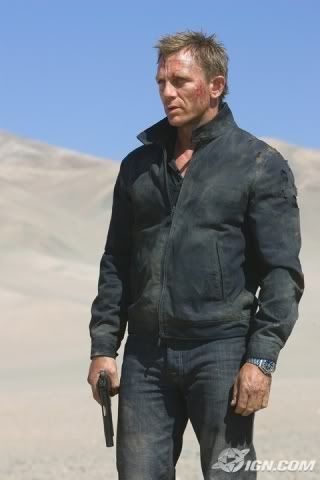
Quantum of Solace* takes place 30 minutes after the ending of Casino Royale, (in mid-car-chase) with Bond going "rogue" and seeking revenge.**
It's the first "true" sequel in the Bond series--all of them previously being stand-alone stories, where for budgetary or scheduling reasons, the secondary characters --like CIA agent Felix Leiter--would be played by different people from movie to movie.

Here, things are consistent: Jeffrey Wright again plays Leiter, Giancarlo Giannini returns as Rene Mathis as does Judi Dench as "M." And the mysterious Mr. White (Jesper Christensen), behind so much of Bond's troubles last film is in the rather bumpy custody of MI6, where he drops the news that there's a world-wide criminal organization that the Brits aren't even aware of, presumably the one financing the bombing of the Skyway jet, the funding of "freedom fighters," and high stakes poker games from the last film. Apparently these activities are so "under the radar" that the world's network of spies--and in this film even Bolivia has a Secret Service--hasn't noticed. But that is just a wild goose chase to Bond achieving that quantum of solace about the events of Casino Royale.

One could go on and on with the trivial aspects of QOS, but in broad strokes, one can answer the entreaties of those who couldn't wait for the next installment last time. No, it isn't as good as the last one;  Casino Royale was one of the best film in the series (this is No. 22 of the "official" Bond films), even after the perspective of a couple years.

Does Bond find out the answers to the questions he's seeking? Yeah, for all the good it does us. We spend 95% going down a blind alley--at 90 miles an hour, with a shaking camera pointed aimlessly and an average edit length of half a second. More on that in a moment.


Does Daniel Craig take off his shirt? Yes, all too briefly for some, I'm sure.

The dialog is crisp and also very, very brief. The acting is uniformly good, with particular mention of Craig,
Dench, and Giannini. Even the "Bond girls," traditionally where the Bond films fall down in the presentation category, can act: former model Olga Kurylenko is quite good, using a cat-walk scowl as the basis of her performance; and Gemma Arterton is pert, spunky...and sadly disposable. Mathieu Amalric--so good in The Diving Bell and the Butterfly--makes the most of his reptilian looks, as a sort of bug-eyed Roman Polanski.***


All well and good. The film feels like a less goofy version of the Roger Moore Bonds where outlandishness is the order of the day, but without the obvious winking. There are some lighter moments (and Craig makes the most of them) but most of it is played with deadly earnest. One expects to get lost in some details along the way by the orange light of the explosions. Indeed, two of the major players in this film are brought up and never mentioned again.****

But there is a major problem with Quantum... which dims the viewing experience, that being the slap-dash way that director Marc Forster and his second unit director Dan Bradley (who stunt coordinated the "Bourne" and last couple "Spiderman" movies) have staged and assembled the action sequences--and there are a lot of them--on land, sea, air, and fire, by foot and all manner of motorized vehicles. These sequences are nearly incomprehensible, with a rapid pace that does not allow the distinguishing of any participant or the context in which they're being done. A good action director allows the time to register surroundings and environment, and provides the context of relationship--who's doing what to whom and where. It's that information that provides suspense. Without that information, it's just fleeting images that don't add up—in other words, a trailer. What Forster and Bradley may be trying to do is put the audience in the same dizzying, disoriented position as Bond, but even then, there are times when there isn't enough context to inspire alarm. At one point, in one of the hand to hand fights it becomes apparent that, suddenly, one of the combatants has acquired an axe. There was just enough time for me to register that perhaps the film would be better if it were edited with that. The shame is that a lot of work went into these sequences--QOS is the most expensive Bond film while simultaneously being the shortest--and a couple of marvelous shots that literally tumble along with Bond merely disorient, rather than thrill, as you're not allowed to see the original position from where these shots start. At the end of it all, you're left with a battered Bond but absolutely no idea how he got that way.

This is a major mis-step. These are suspense films, after all. But in pushing the envelope of how fast to take these action sequences, post-Bourne, the film-makers have reached the point where they are no longer telling a story, no longer communicating with the audience, at which point they've failed in their own mission.

I'm not even sure what is to be gained by seeing Quantum of Solace in a theater, even in the back row. The best way to get anything out of the action is to watch it at a slower speed on DVD.


Hence, "Quantum of Solace" is a Rental.


Two of examples of the subliminal editing style of Quantum of Solace.


* The name is taken from a Fleming Bond short story in which Bond merely sits and listens to a tale of a marriage turned ruinous, and a "quantum of solace" is the smallest particle of comfort one can derive to keep it going. The only Bond titles left to be used are "Risico," "The Property of a Lady," "The Hildebrand Rarity," and "James Bond in New York," none of which is a "grabber" of a title, or would make a good song. But then, who thought you could do anything with Thunderball? Passing a reader-board for another theater en route to the Cinerama, it read simply "007."

** "What, he's gone 'rogue' again?" is what a friend said after seeing the trailer. Bond had already done something similar in the Timothy Dalton-starring Licence To Kill, which combined equal parts "Miami Vice," Yojimbo, and elements of the Fleming novel, "Live and Let Die."'


*** Director Marc Forster used directors Guillermo del Toro and Robert Rodriguez as voice-actors on this film, and the "director" connection applies to a henchman called "Elvis" who reminds one of Quentin Tarentino. What with the "colorful" names of the villains, ala Resevoir Dogs and the producers' history with QT--he famously announced that he wanted to make "Casino Royale" with Pierce Brosnan and griped about not getting the chance--it wouldn't be too far afield to think he was being tweaked.


**** I've since been told by one of the "Opening Night Regulars" I see the Bond's with, that a sequence resolving their stories (all one minute of it) was left on the cutting room floor, giving the producers a chance to start afresh next film, rather than continue with yet another sequel
.


Saturday, May 15, 2010

Missed It By That Much: Quo Vadis

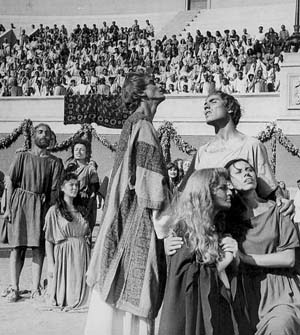
"Quo Vadis" (Mervyn LeRoy, 1950) This is M-G-M's first big biblical epic in the post-World War II environment, the one that spawned a genre that prospered in theaters for the next twenty years...and that has been revived for these times—you can't have enough bread and circuses for a recessed populace. The studio re-built the war-torn studios of Cinecittà, which would be home to Roman epics for the next two decades. The expansive sets would increasingly overtake the films created, until the out-sized production of "Cleopatra" nearly bankrupted 20th Century Fox.

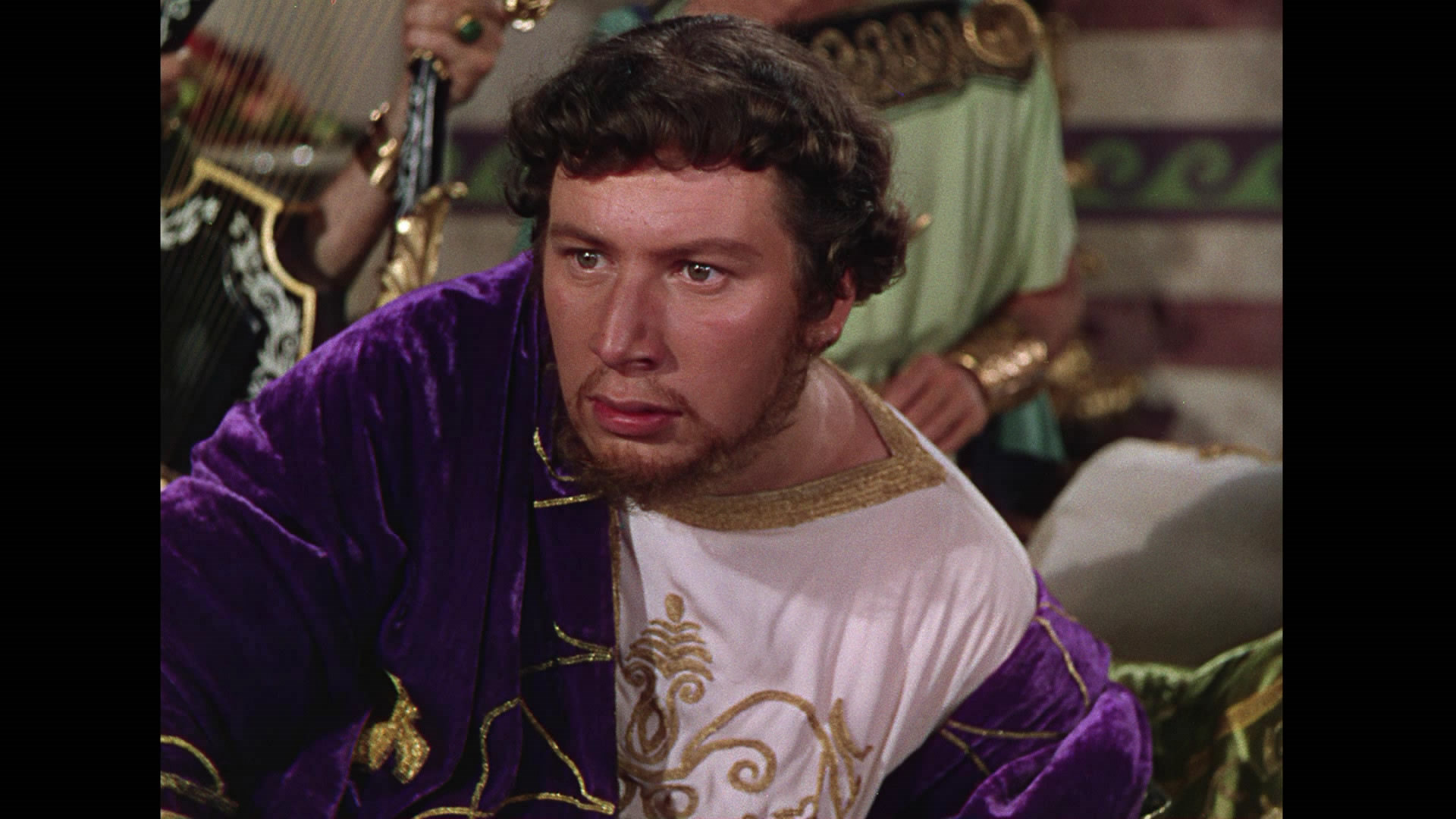
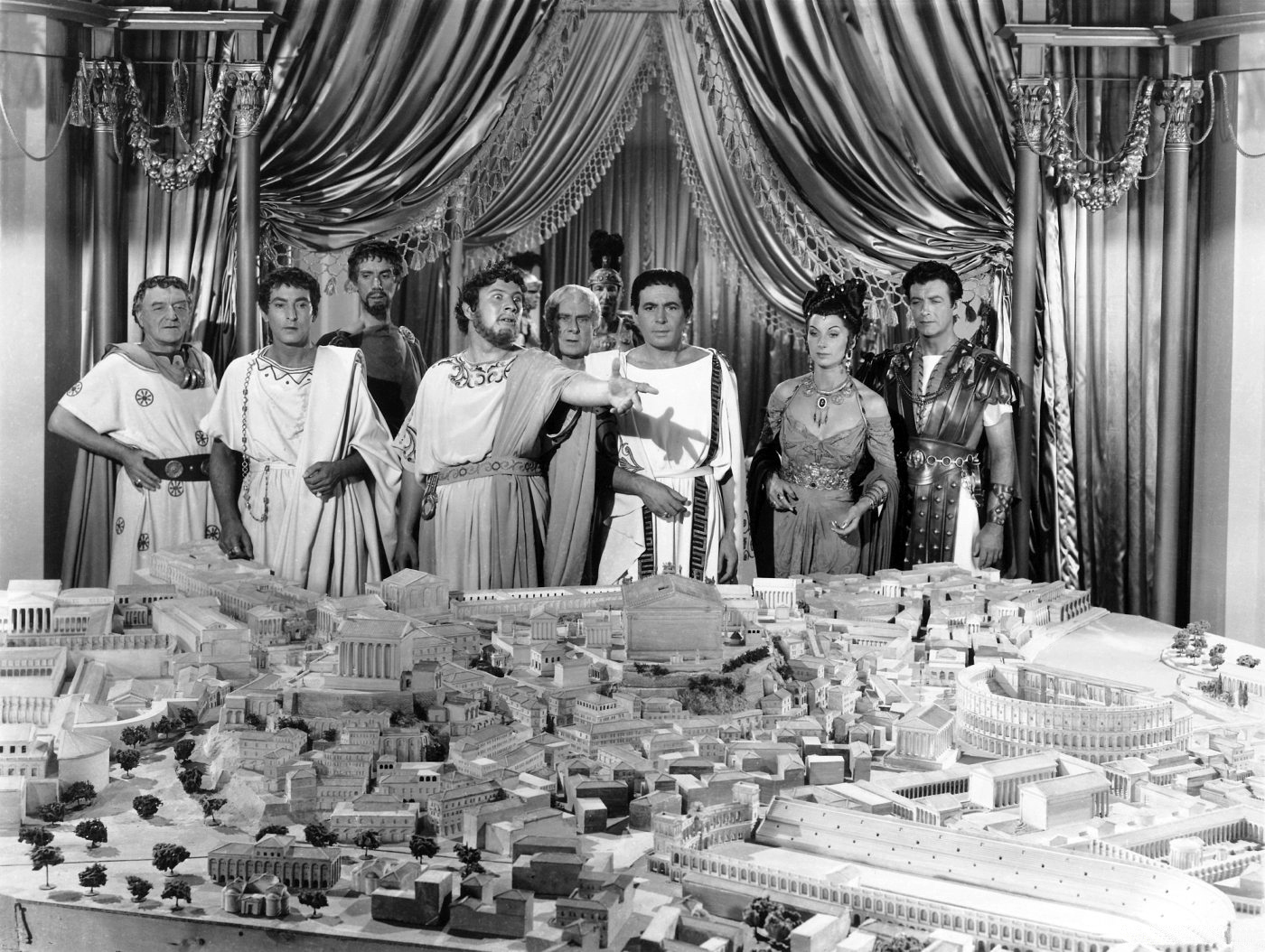
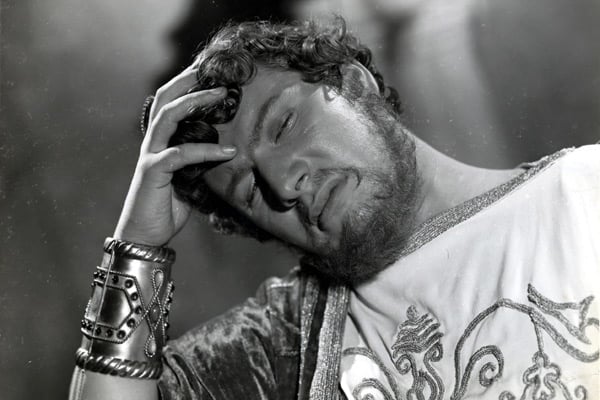
"Quo Vadis" tells two stories—of the Fall of Rome and the Rise of Christianity. Marcus Vinicus (Robert Taylor) returns from the wars to a very different Rome than the one he left; The Emperor Nero (Peter Ustinov) has declared himself a god, and the city is divided by his heinous act of murdering his wife and mother in order to marry the courtesan Poppaea (Patricia Laffan). Now, convinced of his own infallibility, the Emperor indulges his every whim and artistic pretension. That he's not very good at anything does not occur to him; anything a god can do must be significant.

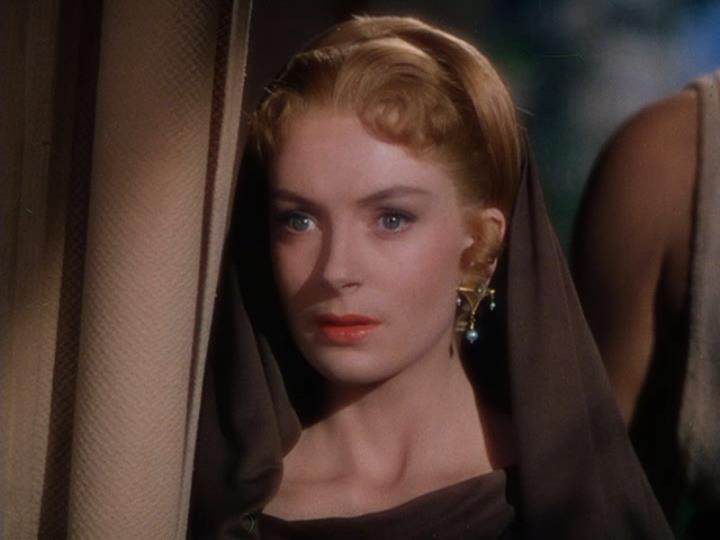
Vinicus, like the rest of Rome, indulges the Emperor—as long as what he does doesn't touch their lives, he can do anything he wants. For the returned tribune, what he wants is wine and wenching; Nero's wife is eyeing his lasciviously, but Vinicus sets his sights on the ward of the Senate, the captured princess of a Roman campaign, Lygia (Deborah Kerr). She is made a gift to him for his duty for Rome, but she initially spurns his advances. She's a follower of the teachings of the martyr Christ, as taught by his followers Paul (Abraham Sofaer) and Peter (Finlay Currie). This merely amuses Vinicus. But, when the Mad Nero decides he's going to design a new Rome in his own honor, and torches the old (without any evacuation plans), Vinicus sacrifices all to save Lygia.

It takes a lot of screen-time to get to that point in the story, and the film still has to have the persecution and throwing of Christians to the lions at Nero's behest, not to mention resolve all the story-tangles. So, the Christianity theme of "Quo Vadis" is given short shrift, despite the fact that the story hinges on it. As it ultimately leads to the establishment of The Church on the very spot where some of the events occurred, it undermines the religious under-pinning of the story.

The acting is a bit arch, as well. Leo Genn does a good turn as one of Nero's sycophants, but Kerr and Taylor are stuck in theatrical star mode, Taylor seems a bit out of place as a Roman Tribune, and doth protest too much when playing the Roman egotist. Peter Ustinov's Oscar-nominated turn as Nero is over-the-top and slobbering, a rare instance when the actor isn't doing precisely the right thing, even though the performance is an amusing one. All these elements lend a falseness to a story that has major significance to history and religion (however apocryphal it may be)

The Latin words "Quo Vadis?" translates to "whither thou goest?" or "where are you going?" It is what Simon Peter, fleeing Rome and its persecution of Christians, asks the passing vision of Jesus he encounters on the road. "Quo Vadis, Domine?" And the reply is "Eo Romam iterum crucifigi" (I am going to Rome to be crucified again), prompting Peter to return and sacrifice himself for his church. It's not a part of the "recognized" "approved" Bible—it is a section of the Apocrypha. And it is dramatised in the film with Christ speaking through the voice of a child. Peter goes back, and when confronted by his tormentors says "To die as Our Lord did is more than I deserve," to which the Roman guard replies in the tough-guy-henchman mode of the movie era, "We can change that." Another example of how this first modern Epic owes as much to LeRoy's gangster pictures as it does to the source material.*

It's always terrible to play the "what if?" game—the movie on the screen is the movie that was made. But in its early stages, it was being developed, and would have been directed, by...John Huston. Huston's historical films are always interesting for their attention to detail, and one ponders what he would have done with ancient Rome with a sad interest. His ironical eye would have been interesting, as well, when it came to Church matters. At that stage, before Huston's run-in's with Louis B. Mayer soured the deal (as reported in Lillian Ross's "Picture"), Marcus Vinicus was to be played by Gregory Peck and Lygia by Elizabeth Taylor, all of 19 years old. Now, Peck was not the most versatile of actors, but he could be counted on to deliver a prideful manliness with some depth, the kind that Taylor musters up as an oafish braggadocio. Taylor manages to pull off the scenes of Vinicus in distress, but Peck would have provided a younger, more believable protagonist. Elizabeth Taylor would have been able to pull off the vulnerability that Kerr has difficulty providing, while also giving Lygia the same spine of steel as Kerr's. What might have been... One looks at this "Quo Vadis" and wishes things could have been different.

"Whither thou goest?" At this point in the history of the Catholic Church—at this cross-roads it has reached—where it is caught in a choice between Unquestioned Authority and the culpability of its representatives, that question has never been more pertinent.

Quo Vadis? Indeed.


* Nero's last words in the film are the same as Johnny Rico's at the end of LeRoy's "Little
Caesar:" Is this the end of (me)?"

Saturday, November 15, 2008

Quantum of Solace

"Cutting to the Chase,"
or
"Once More into the Cuisinart, Dear Friends"


When last we left James Bond, newly double-0'd agent On Her Majesty's Secret Service, he was nursing a broken heart and the betrayal by his lover, by the one way that he knew to ease the pain--shooting someone in the leg with an assault rifle.

After the success of "
Casino Royale," the last complete James Bond novel not to be given an "official" film version, and the revival of the franchise with the casting of Daniel Craig, one had to wonder what the producers would do for an encore.
Or a sequel. "Quantum of Solace"* takes place 30 minutes after the ending of "Casino Royale," (in mid-car-chase) with Bond going "rogue" and seeking revenge.**
It's the first "true" sequel in the Bond series--all of them previously being stand-alone stories, where for budgetary or scheduling the secondary characters --like CIA agent Felix Leiter--would be played by different people from movie to movie.
Here, things are consistent: Jeffrey Wright again plays Leiter, Giancarlo Giannini returns as Rene Mathis as does Judi Dench as "M." And the mysterious Mr. White (Jesper Christensen), behind so much of Bond's troubles last film is in the rather bumpy custody of MI6, where he drops the news that there's a world-wide criminal organization that the Brits aren't even aware of, presumably the one financing the bombing of the Skyway jet, the funding of "freedom fighters," and high stakes poker games. Apparently these activities are so "under the radar" that the world's network of spies--and in this film even Bolivia has a Secret Service--hasn't noticed. But that is just a wild goose chase to Bond achieving that quantum of solace about the events of "Casino Royale."

One could go on and on with the trivial aspects of "QOS," but in broad strokes, one can answer the entreaties of those who couldn't wait for the next installment last time. No, it isn't as good as the last one; "Casino Royale" was one of the best film in the series (this is No. 22 of the "official" Bond films), even after the perspective of a couple years.

Does Bond find out the answers to the questions he's seeking? Yeah, for all the good it does us. We spend 95% going down a blind alley--at 90 miles an hour, with a shaking camera pointed aimlessly and an average edit length of half a second. More on that in a moment.
Does Daniel Craig take off his shirt? Yes, all too briefly for some, I'm sure.

The dialog is crisp and also brief. The acting is uniformly good, with particular mention of Craig,
Dench, and Giannini. Even the "Bond girls," traditionally where the Bond films fall down in the presentation category, can act: former model Olga Kurylenko is quite good, using a cat-walk scowl as the basis of her performance; and Gemma Arterton is pert, spunky...and sadly disposable. Mathieu Amalric--so good in "The Diving Bell and the Butterfly"--makes the most of his reptilian looks, as a sort of bug-eyed Roman Polanski.***

All well and good. The film feels like a less goofy version of the Roger Moore Bonds where outlandishness is the order of the day, but without the obvious winking. There are some lighter moments (and Craig makes the most of them) but most of it is played with deadly earnest. One expects to get lost in some details along the way by the orange light of the explosions. Indeed, two of the major players in this film are brought up and never mentioned again.****


But there is a major problem with "Quantum..." which dims the viewing experience, that being the slap-dash way that Marc Forster and his second unit director Dan Bradley (who stunt coordinated the "Bourne" and last couple "Spiderman" movies) have staged and assembled the action sequences--and there are a lot of them--on land, sea, air, and fire, by foot and all manner of motorized vehicles. These sequences are nearly incomprehensible, with a rapid pace that does not allow the distinguishing of any participant or the context in which they're being done. A good action director allows the time to register surroundings and environment, and provides the context of relationship--who's doing what to whom and where. It's that information that provides suspense. Without that information, it's just fleeting images that don't add up. What Forster and Bradley may be trying to do is put the audience in the same dizzying, disoriented position as Bond, but even then, there are times when there isn't enough context to inspire alarm. At one point, in one of the hand to hand fights it becomes apparent that, suddenly, one of the combatants has acquired an axe. There was just enough time for me to register that perhaps the film would be better if it were edited with that. The shame is that a lot of work went into these sequences--QOS is the most expensive Bond film while also being the shortest--and a couple of marvelous shots that literally tumble along with Bond merely disorient, rather than thrill, as you're not allowed to see the original position from where these shots start. At the end of it all, you're left with a battered Bond but absolutely no idea how he got that way.

This is a major mis-step. These are suspense films, after all. But in pushing the envelope of how fast to take these action sequences, post-Bourne, the film-makers have reached the point where they are no longer telling a story, no longer communicating with the audience, at which point they've failed in their own mission.

I'm not even sure what is to be gained by seeing "Quantum of Solace" in a theater, even in the back row. The best way to get anything out of the action is to watch it at a slower speed on DVD.


Hence, "Quantum of Solace" is a rental.
* The name is taken from a Fleming Bond short story in which Bond merely sits and listens to a tale of a marriage turned ruinous, and a "quantum of solace" is the smallest particle of comfort one can derive to keep it going. The only Bond titles left to be used are "Risico," "The Property of a Lady," "The Hildebrand Rarity," and "James Bond in New York," none of which is a "grabber" of a title, or would make a good song. But then, who thought you could do anything with "Thunderball?" Passing a reader-board for another theater en route to the Cinerama, it read simply "007."

** "What, he's gone 'rogue' again?" is what a friend said after seeing the trailer. Bond had already done something similar in the Timothy Dalton-starring "Licence To Kill," which combined equal parts "Miami Vice," "Yojimbo," and elements of the Fleming novel, "Live and Let Die."
*** Director Marc Forster used directors Guillermo del Toro and Robert Rodriguez as voice-actors on this film, and the "director" connection applies to a henchman called "Elvis" who reminds one of Quentin Tarentino. What with the "colorful" names of the villains, ala "Resevoir Dogs" and the producers' history with QT--he famously announced that he wanted to make "Casino Royale" with Pierce Brosnan and griped about not getting the chance--it wouldn't be too far afield to think he was being tweaked.
**** I've since been told by one of the "Opening Night Regulars" I see the Bond's with, that a sequence resolving their stories (all one minute of it) was left on the cutting room floor, giving the producers a chance to start afresh next film, rather than continue with yet another sequel
.


Monday, May 26, 2008

Quinceañera

Quinceañera (Glatzer & Westmoreland, 2005). By the directors' own admission, this is a reinvention of Tony Richardson's Taste of Honey: 6o's Manchester has been replaced by present-day Echo Park but though it does not lack realism, it has to be said that the 2005 story is a lot more optimistic and upbeat.

The film tells the story of Magdalena (Emily Rios) as she approaches her quinceañera, a coming of age ceremony. It is, like many such celebrations, a sources of both pride and pressure for those responsible as there are standards to be maintained and lived up to. The movie begins with the ceremony of Magdalena's cousin, Eileen (Alicia Sixtos) whose more prosperous parents are able to give her the ideal quinceañera. Magdalena's father, (Jesus Castanos-Chima), who runs a storefront church has neither the money nor the inclination to pay for what he sees as a decadent and immoral celebration. He is a deeply religious man who expects his family to live up to his exacting standards. Her mother tries to do her best to make up for her husband's unbending piousness but also to understand the desires of her daughter.

Thus, this is a community in transition in many ways; the prosperous cousins also have a rebellious child, Carlos (Jesse Garcia): a gang-banger of a son who disrupts his sister's ceremony and leaves home to live with his grandfather Tomas, (Chalo Gonzàlez). After she finds herself unexpectedly pregnant, Magdalena finds herself living there too Added to this, Tomas is living in a house that has been bought up by a pair of yuppies, part of the wave of Anglos who are gentrifying this area of Los Angeles with all the consequences there are for the existing population. The movie follows the fate of the three housemates as a microcosm of what is happening to the Latino population.

In the end, the movie has something of a happy ending and it is perhaps the uplifting nature of the ending that betrays the film's strengths in portraying the reality of the generational, cultural and moral clashes that drive the story.

Monday, January 14, 2008

The Queen

Sir Paul McCartney
And another Beatles quote might be appropriate here, as well. George Harrison's horrified appraisal of Beatlemania: "We gave them an excuse to go mad." Surely that's how the Royals must have felt seeing the outpouring of grief generated by the death of former Princess Diana over the week that this smart bitchy little film covers. The tone and volume of the crowds that surrounded Buckingham Palace, fueled by the predatory tabloids, approached hysteria and went well past the accepted levels of decorum practiced by its inhabitants. Flying the flag at half-mast for Diana? They hadn't even done it for the death of the King! The idea! There's a telling line QEII says in bewilderment: "But she isn't even an H.R.H.!"--a lovely combination of formality and informality within the Royal Family. But the film has its own opening quote, from Shakespeare--the one half-mocked by Jack Nicholson in "The Departed"--"Uneasy lies the head...etc, etc." But, in this day and age it can be asked, "Who wears the crown?"

Is it the Queen, cosseted in formal procedure and pomp, restricted in her powers and budgeted by the government (the first scene of the movie has an arch little discussion between her and a portrait artist regarding democracy and the in-coming Labor party of Tony Blair. "You might not be allowed to vote, ma'am,* but it is your government." "Yes...it is," she replies, smiling at the constancy)? Is it the fledgling Prime Minister Tony Blair who must bow and scrape to the Queen, but who uses whatever power he has to influence her actions? Is it Blair's eager-beaver, though cynical, staff, micro-managing and creating press-releases and agendas that sometimes frustrate, while bolstering the image of, the new PM? The Queen's consort, Prince Phillip, blusters about what is proper and how he'd do things (assuming he was in charge), and son Charles, dithering and defferential (there's a lovely moment as Charles enters a room where James Cromwell, playing Phillip--pointedly crosses his arms without even acknowledging that he knows his son is in the room), tries to sway the Queen emotionally and by proxies. Or is it the rabble with their devastated faces and the endless supply of flowers that becomes a memorial and a substitute for any public display from official sources?

Then there is the late Princess herself, seen only in vintage news footage, at times clowning, at times vulnerable...and at times, with a look like she's viewing the proceeding with a knowing satisfaction.

One wonders how the Royals themseleves would see this film**...no doubt, as an affront to be taken in stoic, stony silence. Yet, one can understand their actions, and even have some sympathy for their dilemma, while also wanting to shake some sense into them.

"The Queen" is a fine, gossipy movie, with a literate script***(whether any of the things depicted behind closed draw-bridges is anyone's guess) by Peter Morgan--he also wrote last year's "The Last King of Scotland.", top-of-the-line performances led by Helen Mirren (who has the canny knowledge to know she's playing two roles: Elizabeth and an eerie "Elizabeth-as-Monarch," and, yes, she'll win the Oscar for Best Actress) and a direction by Stephen Frears that's smart and canny. The last shot is the most telling. Frears leaves us with an image of the Queen walking in her immaculate formal garden--her unruly Pomeranian dogs jumping and bouncing and using the facilities while Elizabeth pays no mind to the chaos.

Long Live the Queen.

"The Queen" is a fine, blue-haired matinee movie.

* And make sure you pronounce that correctly. We're told that it is "Ma'am" as in "ham," not as in "harm." One of the conceits of the film is to show the "accepted" ways to present oneself to the Queen--always a prescribed way, no more and no less--surely a main reason for the atrophy the Windsors displayed in not responding to the public's reaction.

**I read somewhere in the Golden Globes coverage this morning that the Queen told Mirren "someone finally got (playing her) right."

***There's a funny scene where Blair, flush with his efforts to influence the situation starts to push for his own agenda. Elizabeth will have none of it, and warns her PM not to be too complacent for his crisis will come when he least expects it. It took every ounce of restraint to keep from yelling "Yo, Blair!" at the screen.


Post-script 02/07/07: Slate has quite an informative interview with director Stephen Frears