Showing posts with label Robert Taylor. Show all posts

Thursday, June 6, 2013

Above and Beyond

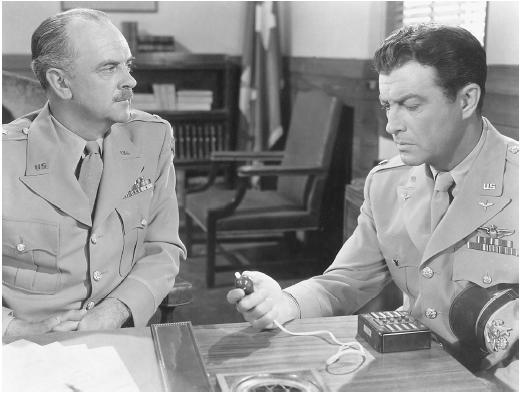
Above and Beyond (Melvin Frank and Norman Panama, 1952) The story of Lt. Col. Paul Tibbets who, during World War II, was charged with the task of training crews for the most secret bombing mission of the war—the dropping of the experimental atomic weapon that was concurrently being developed at Los Alamos.  The story is different in a couple different ways: one, made in 1952, it dares to tell the story of the mental strain that such a highly secretive mission can have on the psyche, especially considering the destructive consequences the new bombs would bring; two, probably to draw a female audience, it tells the story from Tibbets' wife's point-of-view, of the hardships that a war-time marriage must go through, especially in a situation where the details of the operation cannot be disclosed to anyone, even if the secrets and responsibilities threaten to tear the marriage apart.  The choices come down to nuclear war or nuclear family.  And both are extremely fissionable.

It's frustrating: Tibbets (Robert Taylor, far more nuanced than he usually is) working around the clock, must perfect the strategies for a potential suicide mission, while also consciously recognizing the horror his direct action will take—when offered an assignment, after readying the B-29 ("a flying death-trap," great commercial for Boeing) for high altitude combat missions, he's given a buzzer and told, "Now think—what would you do if that buzzer could end the war, but cause hundreds of thousands of Japanese lives." The idea rocks Tibbets back on his heels, considers all the options for forty seconds, then deliberately presses the buzzer.

Meanwhile, his wife (Eleanor Parker) must deal with long absences, no explanations, and the obvious stresses, the mission, which she knows nothing about, throws at them.  To make matters worse, she billeted, along with the other airmen's wives (who are only too quick to blame her and her husband for their own living situation), at Wendover air base in Utah, a hell-hole with sub-standard housing, raising two kids (with their own short fuses), virtually fatherless.  At first, it's suggested that she not come to Wendover, until the base's security officer (a tamped-down James Whitmore) opines that she being the only wife not on-base might arouse suspicions—the movie is full of such "damned is you do..." crossroads.

The scriptwriter-directors Frank and Panama, who were usually involved in lighter fare than this, do the character of Tibbets' wife no favors—she has difficulties, but domestically, not militarily, while a war rages on.  She's given some egregiously selfish moments, like telling her bomber-pilot husband how she feels bad for all the kids on the ground caught in the situation—absolutely, and an extremely valid sentiment, but are you really going to tell your bomber-pilot husband that, when he's got his own guilt he's dealing with?  At one point, remembering Tibbets' mother's name (which would eventually emblazon the Hiroshima bomber) she mopes "Enola—even the word backwards means 'alone.'"  Yeah, honey, the world's a powder-keg and it's all about you.  If you want something to worry about, how about your family turning to ash at ground zero?  And, not that she'd know it, her husband might get caught in the flash-point or his bomber might get buffeted by a shock-wave, the result of a man-made conflagration no atomic engineer could predict, and the world had never seen.  Tibbets as going through his own issues, but I'll bet his wife was faring better than her on-screen portrayal by Frank and Panama.  

Still pretty interesting to see a 1950's film sanctioned by the Air Force (and especially General Curtis LeMay—played in the film by Jim Backus) that contemplates the use of atomic weapons and—despite pressing the buzzer—takes that long pause to consider the options and the terrible weight such a decision might impose.


Saturday, May 15, 2010

Missed It By That Much: Quo Vadis

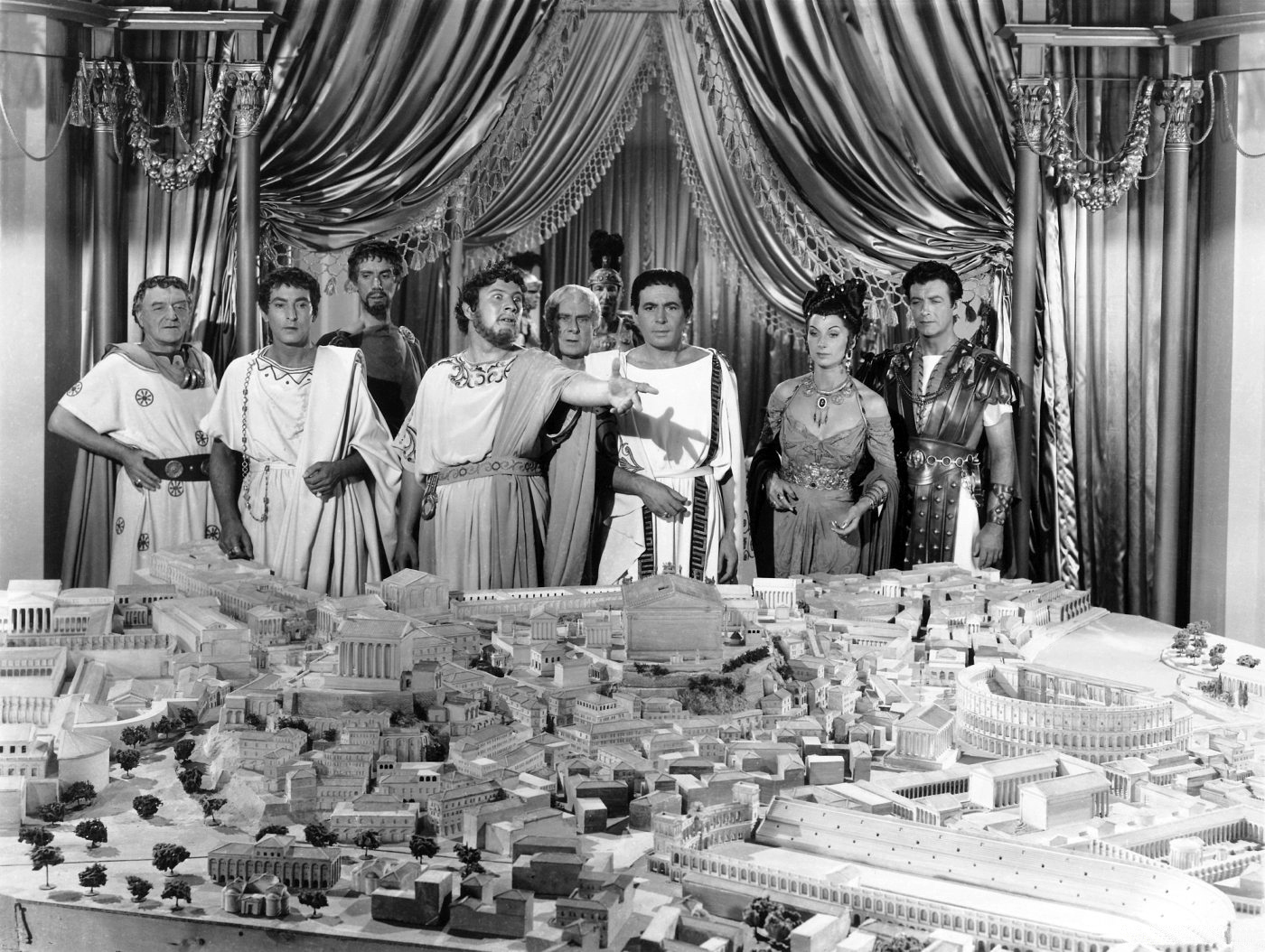
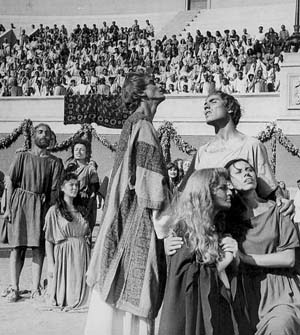
"Quo Vadis" (Mervyn LeRoy, 1950) This is M-G-M's first big biblical epic in the post-World War II environment, the one that spawned a genre that prospered in theaters for the next twenty years...and that has been revived for these times—you can't have enough bread and circuses for a recessed populace. The studio re-built the war-torn studios of Cinecittà, which would be home to Roman epics for the next two decades. The expansive sets would increasingly overtake the films created, until the out-sized production of "Cleopatra" nearly bankrupted 20th Century Fox.

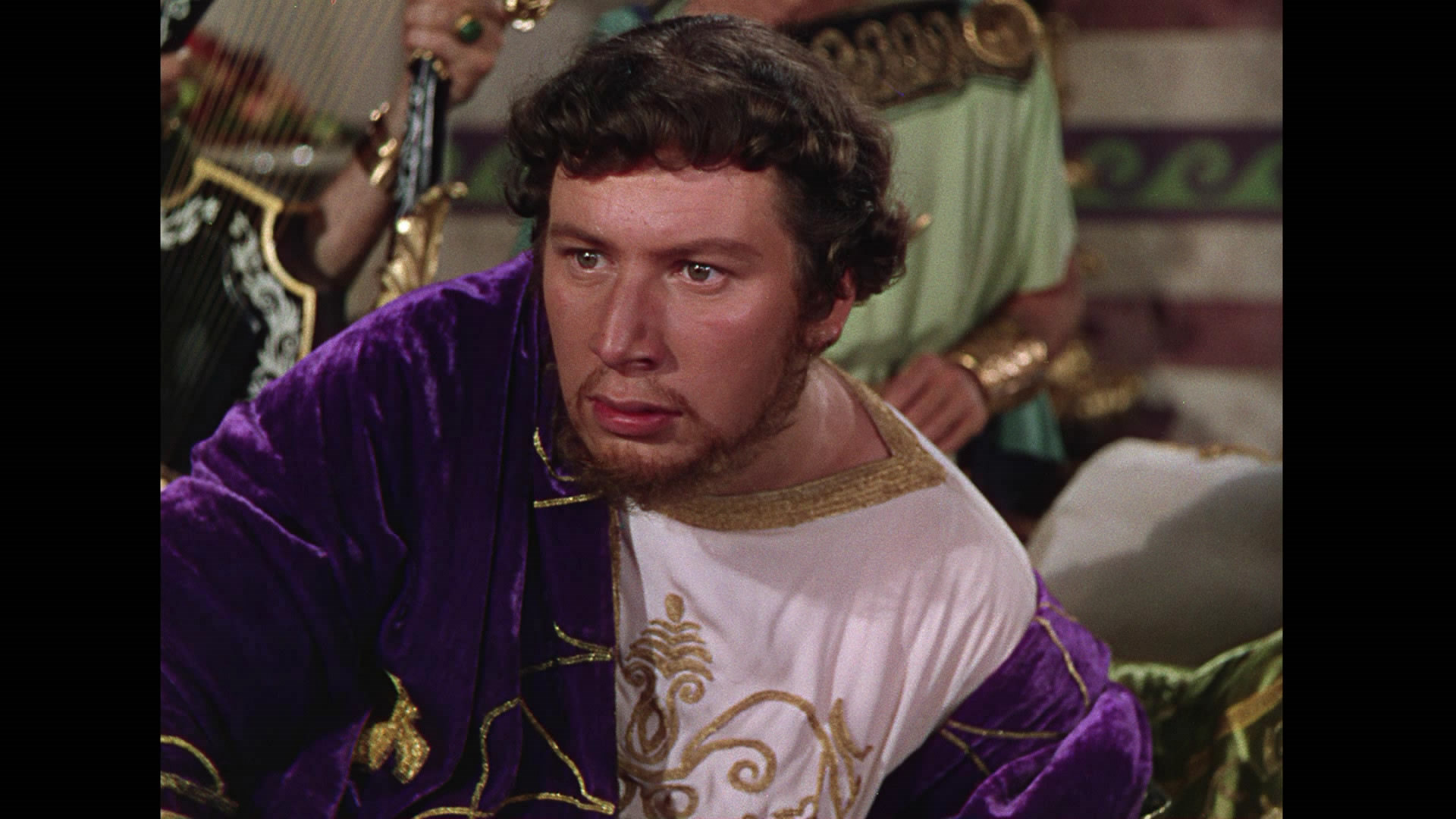
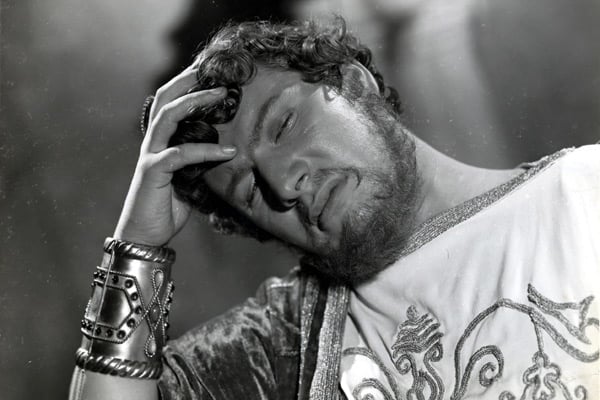
"Quo Vadis" tells two stories—of the Fall of Rome and the Rise of Christianity. Marcus Vinicus (Robert Taylor) returns from the wars to a very different Rome than the one he left; The Emperor Nero (Peter Ustinov) has declared himself a god, and the city is divided by his heinous act of murdering his wife and mother in order to marry the courtesan Poppaea (Patricia Laffan). Now, convinced of his own infallibility, the Emperor indulges his every whim and artistic pretension. That he's not very good at anything does not occur to him; anything a god can do must be significant.

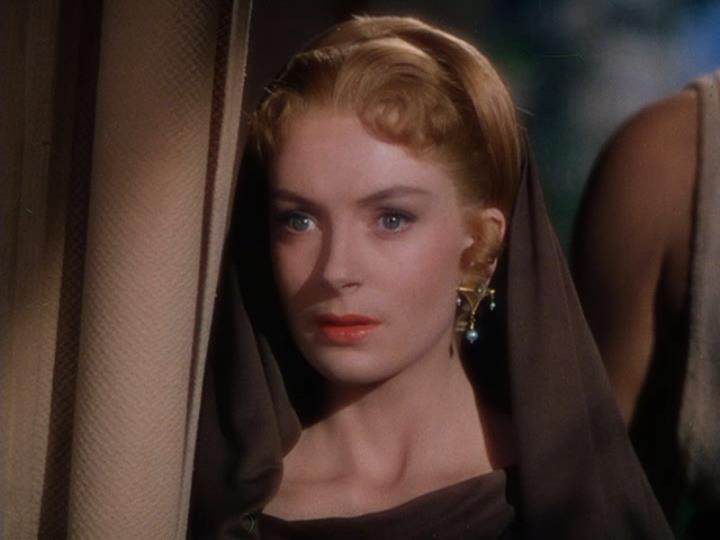
Vinicus, like the rest of Rome, indulges the Emperor—as long as what he does doesn't touch their lives, he can do anything he wants. For the returned tribune, what he wants is wine and wenching; Nero's wife is eyeing his lasciviously, but Vinicus sets his sights on the ward of the Senate, the captured princess of a Roman campaign, Lygia (Deborah Kerr). She is made a gift to him for his duty for Rome, but she initially spurns his advances. She's a follower of the teachings of the martyr Christ, as taught by his followers Paul (Abraham Sofaer) and Peter (Finlay Currie). This merely amuses Vinicus. But, when the Mad Nero decides he's going to design a new Rome in his own honor, and torches the old (without any evacuation plans), Vinicus sacrifices all to save Lygia.

It takes a lot of screen-time to get to that point in the story, and the film still has to have the persecution and throwing of Christians to the lions at Nero's behest, not to mention resolve all the story-tangles. So, the Christianity theme of "Quo Vadis" is given short shrift, despite the fact that the story hinges on it. As it ultimately leads to the establishment of The Church on the very spot where some of the events occurred, it undermines the religious under-pinning of the story.

The acting is a bit arch, as well. Leo Genn does a good turn as one of Nero's sycophants, but Kerr and Taylor are stuck in theatrical star mode, Taylor seems a bit out of place as a Roman Tribune, and doth protest too much when playing the Roman egotist. Peter Ustinov's Oscar-nominated turn as Nero is over-the-top and slobbering, a rare instance when the actor isn't doing precisely the right thing, even though the performance is an amusing one. All these elements lend a falseness to a story that has major significance to history and religion (however apocryphal it may be)

The Latin words "Quo Vadis?" translates to "whither thou goest?" or "where are you going?" It is what Simon Peter, fleeing Rome and its persecution of Christians, asks the passing vision of Jesus he encounters on the road. "Quo Vadis, Domine?" And the reply is "Eo Romam iterum crucifigi" (I am going to Rome to be crucified again), prompting Peter to return and sacrifice himself for his church. It's not a part of the "recognized" "approved" Bible—it is a section of the Apocrypha. And it is dramatised in the film with Christ speaking through the voice of a child. Peter goes back, and when confronted by his tormentors says "To die as Our Lord did is more than I deserve," to which the Roman guard replies in the tough-guy-henchman mode of the movie era, "We can change that." Another example of how this first modern Epic owes as much to LeRoy's gangster pictures as it does to the source material.*

It's always terrible to play the "what if?" game—the movie on the screen is the movie that was made. But in its early stages, it was being developed, and would have been directed, by...John Huston. Huston's historical films are always interesting for their attention to detail, and one ponders what he would have done with ancient Rome with a sad interest. His ironical eye would have been interesting, as well, when it came to Church matters. At that stage, before Huston's run-in's with Louis B. Mayer soured the deal (as reported in Lillian Ross's "Picture"), Marcus Vinicus was to be played by Gregory Peck and Lygia by Elizabeth Taylor, all of 19 years old. Now, Peck was not the most versatile of actors, but he could be counted on to deliver a prideful manliness with some depth, the kind that Taylor musters up as an oafish braggadocio. Taylor manages to pull off the scenes of Vinicus in distress, but Peck would have provided a younger, more believable protagonist. Elizabeth Taylor would have been able to pull off the vulnerability that Kerr has difficulty providing, while also giving Lygia the same spine of steel as Kerr's. What might have been... One looks at this "Quo Vadis" and wishes things could have been different.

"Whither thou goest?" At this point in the history of the Catholic Church—at this cross-roads it has reached—where it is caught in a choice between Unquestioned Authority and the culpability of its representatives, that question has never been more pertinent.

Quo Vadis? Indeed.


* Nero's last words in the film are the same as Johnny Rico's at the end of LeRoy's "Little
Caesar:" Is this the end of (me)?"