Cutting to the Chase
or
"Once More into the Cuisinart, Dear Friends"
When last we left James Bond, newly double-0'd agent On Her Majesty's Secret Service, he was nursing a broken heart and the betrayal by his lover, by the one way that he knew to ease the pain--shooting someone in the leg with an assault rifle.
After the success of Casino Royale, the last complete James Bond novel not to be given an "official" film version, and the revival of the franchise with the casting of Daniel Craig, one had to wonder what the producers would do for an encore.
Or a sequel. Quantum of Solace* takes place 30 minutes after the ending of Casino Royale, (in mid-car-chase) with Bond going "rogue" and seeking revenge.** It's the first "true" sequel in the Bond series--all of them previously being stand-alone stories, where for budgetary or scheduling reasons, the secondary characters --like CIA agent Felix Leiter--would be played by different people from movie to movie.
Here, things are consistent: Jeffrey Wright again plays Leiter, Giancarlo Giannini returns as Rene Mathis as does Judi Dench as "M." And the mysterious Mr. White (Jesper Christensen), behind so much of Bond's troubles last film is in the rather bumpy custody of MI6, where he drops the news that there's a world-wide criminal organization that the Brits aren't even aware of, presumably the one financing the bombing of the Skyway jet, the funding of "freedom fighters," and high stakes poker games from the last film. Apparently these activities are so "under the radar" that the world's network of spies--and in this film even Bolivia has a Secret Service--hasn't noticed. But that is just a wild goose chase to Bond achieving that quantum of solace about the events of Casino Royale.
One could go on and on with the trivial aspects of QOS, but in broad strokes, one can answer the entreaties of those who couldn't wait for the next installment last time. No, it isn't as good as the last one; Casino Royale was one of the best film in the series (this is No. 22 of the "official" Bond films), even after the perspective of a couple years.
Does Bond find out the answers to the questions he's seeking? Yeah, for all the good it does us. We spend 95% going down a blind alley--at 90 miles an hour, with a shaking camera pointed aimlessly and an average edit length of half a second. More on that in a moment.
Does Daniel Craig take off his shirt? Yes, all too briefly for some, I'm sure.
The dialog is crisp and also very, very brief. The acting is uniformly good, with particular mention of Craig, Dench, and Giannini. Even the "Bond girls," traditionally where the Bond films fall down in the presentation category, can act: former model Olga Kurylenko is quite good, using a cat-walk scowl as the basis of her performance; and Gemma Arterton is pert, spunky...and sadly disposable. Mathieu Amalric--so good in The Diving Bell and the Butterfly--makes the most of his reptilian looks, as a sort of bug-eyed Roman Polanski.***
All well and good. The film feels like a less goofy version of the Roger Moore Bonds where outlandishness is the order of the day, but without the obvious winking. There are some lighter moments (and Craig makes the most of them) but most of it is played with deadly earnest. One expects to get lost in some details along the way by the orange light of the explosions. Indeed, two of the major players in this film are brought up and never mentioned again.****
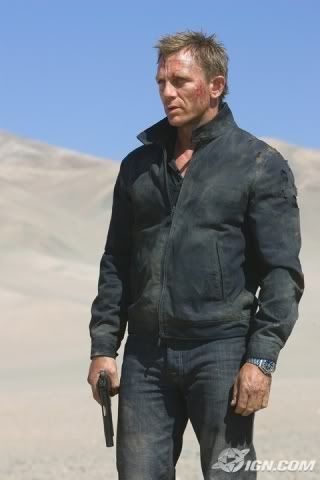
But there is a major problem with Quantum... which dims the viewing experience, that being the slap-dash way that director Marc Forster and his second unit director Dan Bradley (who stunt coordinated the "Bourne" and last couple "Spiderman" movies) have staged and assembled the action sequences--and there are a lot of them--on land, sea, air, and fire, by foot and all manner of motorized vehicles. These sequences are nearly incomprehensible, with a rapid pace that does not allow the distinguishing of any participant or the context in which they're being done. A good action director allows the time to register surroundings and environment, and provides the context of relationship--who's doing what to whom and where. It's that information that provides suspense. Without that information, it's just fleeting images that don't add up—in other words, a trailer. What Forster and Bradley may be trying to do is put the audience in the same dizzying, disoriented position as Bond, but even then, there are times when there isn't enough context to inspire alarm. At one point, in one of the hand to hand fights it becomes apparent that, suddenly, one of the combatants has acquired an axe. There was just enough time for me to register that perhaps the film would be better if it were edited with that. The shame is that a lot of work went into these sequences--QOS is the most expensive Bond film while simultaneously being the shortest--and a couple of marvelous shots that literally tumble along with Bond merely disorient, rather than thrill, as you're not allowed to see the original position from where these shots start. At the end of it all, you're left with a battered Bond but absolutely no idea how he got that way.
This is a major mis-step. These are suspense films, after all. But in pushing the envelope of how fast to take these action sequences, post-Bourne, the film-makers have reached the point where they are no longer telling a story, no longer communicating with the audience, at which point they've failed in their own mission.
I'm not even sure what is to be gained by seeing Quantum of Solace in a theater, even in the back row. The best way to get anything out of the action is to watch it at a slower speed on DVD.
Hence, "Quantum of Solace" is a Rental.
Two of examples of the subliminal editing style of Quantum of Solace.
* The name is taken from a Fleming Bond short story in which Bond merely sits and listens to a tale of a marriage turned ruinous, and a "quantum of solace" is the smallest particle of comfort one can derive to keep it going. The only Bond titles left to be used are "Risico," "The Property of a Lady," "The Hildebrand Rarity," and "James Bond in New York," none of which is a "grabber" of a title, or would make a good song. But then, who thought you could do anything with Thunderball? Passing a reader-board for another theater en route to the Cinerama, it read simply "007."
** "What, he's gone 'rogue' again?" is what a friend said after seeing the trailer. Bond had already done something similar in the Timothy Dalton-starring Licence To Kill, which combined equal parts "Miami Vice," Yojimbo, and elements of the Fleming novel, "Live and Let Die."'
*** Director Marc Forster used directors Guillermo del Toro and Robert Rodriguez as voice-actors on this film, and the "director" connection applies to a henchman called "Elvis" who reminds one of Quentin Tarentino. What with the "colorful" names of the villains, ala Resevoir Dogs and the producers' history with QT--he famously announced that he wanted to make "Casino Royale" with Pierce Brosnan and griped about not getting the chance--it wouldn't be too far afield to think he was being tweaked.
**** I've since been told by one of the "Opening Night Regulars" I see the Bond's with, that a sequence resolving their stories (all one minute of it) was left on the cutting room floor, giving the producers a chance to start afresh next film, rather than continue with yet another sequel.