Showing posts with label Dramedy. Show all posts

Tuesday, May 17, 2011

Being Julia

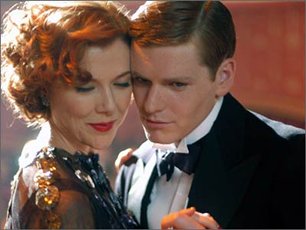
Being Julia (István Szabó, 2004) "My, this is getting complicated!" says Julia Lambert (Annette Bening) ad-libbing from the stage.  She should know; she lives for drama and theater.  But, it isn't enough.  Weeks into a production set up by her impresario husband Michael (Jeremy Irons) she is having a crisis of...something.  She's been playing the same part for what seems like ages.  She's bored, yet exhausted and desperately needs a holiday.

But a diva can never take a holiday from drama, or turn away from being the center of attention, and once the run of the play has been shortened she can turn her attention to other things.  Like an affair with a much younger American (Shaun Evans) besotted with her.  He shows up, the son of another theater investor and Michael, hoping for some input of the cash variety, encourages Julia to give him some attention.  Initially cool to the young man, Julia begins a passionate fling with the lad, falling deeply, passionately in love with him.  Anyway, it plays like love.  It's not like this hasn't happened before, as her deep friendship with Lord Charles (Bruce Greenwood) attests.  But, what's real for Julia has a tendency to blur between reality and the fantasy of the stage, something the spirit of her acting mentor Jimmy Langton (Michael Gambon) constantly pops in to remind her.  Then, just when things are going so well, her young Romeo takes up with a beginning actress (Lucy Punch) who wants to use his influence with Julia to get her a part in Julia's new play, written for her by a boozy playwright (the late, great Maury Chaykin).  Said actress is also cosying up to Michael (not that that really matters).  Whatever is Julia to do? 

Being Julia sounds like a "ladies'" picture, perfect for the LOL's attending their matinees after luncheon, but, written by Somerset Maugham (adapted here by Ron Harwood) it has more in common with a caper movie—we're constantly getting Julia's inner thoughts, as she is habitually throwing them out loud enough for the balcony to hear.  But, a great actress never reveals too many secrets—just enough to make her fascinating for her audience.  So, the final "heist" sequence has all the satisfaction of being a surprise and deliciously cathartic.

And it's fun to see Bening have fun with it in a performance in its high manner almost camp, were it not for the moments of reasonableness, which seem natural until you realize Julia's "acting." And Bening dives in, running the gamut from barely tolerant basilisk stare to "cry-me-a-river" deep diving.  Sure, she was nominated for an Oscar for this—who wouldn't be as it has the potential of being a one-woman show—but Bening brings such a savage nature to this creation, a moth who lives best in the glare of her own spotlight, that one wonders how the Academy escaped giving her this one.*  It is enjoyable, marred only by too many song interludes that provide period commentary that is completely unnecessary.


* Hilary Swank won that year for Million Dollar Baby.  Bening should meet Eastwood.

Friday, May 13, 2011

The Beaver

"Ignoring the 800 Pound Gorilla in the Room"
or
"Uh-uh, Honey.  Talk to the Hand"

Jodie Foster's new film, The Beaver, was always going to have an uphill battle finding an audience when it was released.  First, it's about mental illness, but atypically for Hollywood, it's not a comedy.  Second, it stars Mel Gibson (in a good...actually heroic...performance), so any review is going to feel obligated to slide in some mention of the "800 pound gorilla in the room."* Both detract from the film itself which has a difficult enough time staying focused on its issues, but at least has enough moxie to try and do something a little different—without tugging too hard on the obvious heart-strings.

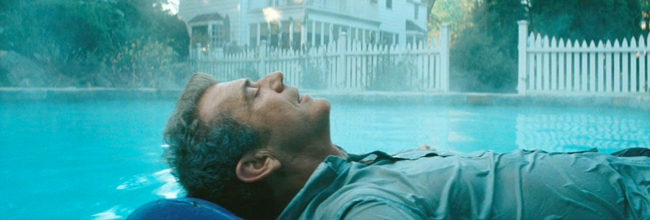
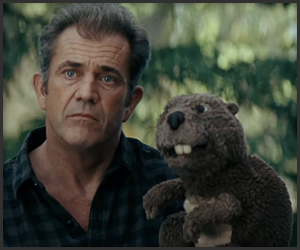
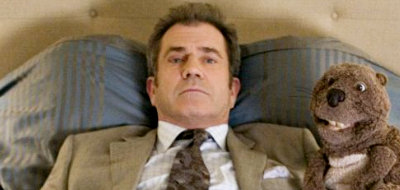
Gibson plays Walter Black, an executive of the Jerry Co. toy company, who, following The Peter Principle, was given the CEO position that he wasn't really qualified for, over a female executive (the always wonderful Cherry Jones).  He runs Jerry Co. into a few quarters of red-ink lethargy (although the brick-and-mortar doesn't come tumbling down) and has a complete mental breakdown...slowwwwly Not wanting to get out of bed in the morning, reduced to monosyllabic answers and avoiding any interaction, Walter is so clinically depressed that, finding a ragged beaver puppet in a dumpster, he starts using it as a surrogate to speak through and at.  Walter goes away.  And everybody has to address "The Beaver" (who talks in a gruff Cockney, sounding a bit like Gibson's co-star in Edge of Darkness, Ray Winstone).  The situation is explained to new recruits with an intro card:


"Hello, the person who handed you this card is under the care of a prescription puppet designed to help create a psychological distance between himself and the negative aspects of his personality. Please treat him as you normally would but address yourself to the puppet.
Thank you."

Thank YOU.  The thing is, "The Beaver's" not a better person than Walter, he's just chirpy and aggressive.  Walter can go away and "hide" in his limbowhile "The Beaver" does all the P.R. work, chortling and being cute, while Walter fails to commit.  Walter thinks that Beaver is a tourniquet on his arm, staunching the bleeding, but all he's applied is a band-aid...cover up the problem until it goes away.  "The Beaver" is the "manic" while Walter remains the "depressive" and the puppet is just another room where he can hide, pouring all his effort into the surrogate, while ignoring the real problem.

Sidebar:  Let's talk about depression.  Full disclosure—I have suffered from depression in the past, but, just like fools, I don't "suffer" it now.**  The instinct is to run away and hide and do nothing, lest you fail and make things worse.  But, action is the best cure for it—to ac-cent-u-ate the positive and e-li-mi-nate the negative.  It's "better than nothing," which is what depression inspires...a lonely, isolating cage of nothing.  It's always better "to be" than "not to be."

But, that's hard to convey in a movie (and be entertaining about it, anyway).  "The Beaver" has a brother-in-mind from movies-past, and that would be Harvey.  For all its twee charm, great lines and James Stewart whimsey, Harvey is a film about mental illness—Elwood P. Dowd has suffered a breakdown from the death of his wife and has replaced her companionship with a "pooka" taking the form of a six-foot-three-and-half-inch ('lets get the facts right") juicer of a rabbit.  The conceit of the play is to say that we're all crazy..."After this he'll be a perfectly normal human being. And you know what stinkers they are!"...and reassures us through stage-craft that we're just as nuts when we see doors opening and closing by themselves, indicating Harvey's presence.  The charm of it, played for comedy, disguises the pain at the heart and soul of the play; I once saw a performance of it at the Seattle Repertory Theater where Dowd (Elwood P.) was a melancholic, sad, mournful, and that version of the play has always stuck with me, despite the weird shift in tone.  

The Beaver (the film) has that same problem of tone.  There are moments of lightness...more irony than humor***...but, ultimately, it's a sad affair, however ludicrous and "wacky" it might seem in the overview.  And, Black's conflicts with his family, particularly his son (Anton Yelchin), who views his father's condition with contempt and fear...that he might go down the same path.  He's a student who charges a fee to write papers for less-gifted class-mates because he has a knack for writing "in other people's voices," and his efforts writing a valedictory speech for a school hottie (Jennifer Lawrence—she's terrific, and a tough little actor) makes up a parallel story to his father's struggles.  Foster plays Black's wife, and the best thing she brings to the role is a tentative panic behind the eyes in trying to keep her family together

Gibson's eyes, however, haunt.  They perfectly convey the radiating hurt (without overdoing it by going into mawkishness)...and the consuming deadness as he retreats.  This is some of his best work in years, especially considering he's having to play two characters at once, the puppet and the puppet-master, while simultaneously keeping it unclear which is which.  Foster, as director, maintains a discrete presence, but has one big pay-off by ommission; by filming Black and his symbiot constantly in two-shot, she maximizes the dread one feels when "The Beaver" is alone in the frame—quite the directorial coup, actually.  That conflict builds as the story goes along, cautioning that if you're going to have a surrogate speaking for you, choose one with less prominent teeth. 

This is good, disturbing stuff.  And an interesting approach by all concerned to a nicely buttoned-up screenplay that dots the "i's" (without putting little smiley faces on them) and double-crosses the tease, and dares to question the idea of "self" and losing it.  Some might find it depressing. 

But it made me smile.

The Beaver is a Matinee.


* If you wanna know about it (or if you've been living under a rock for the last few months), just "Google" Mel Gibson."  I'm sure you'll find out what's going on quickly.


** Yeah, yeah, I know. "TMI."  But, hey, I write, I analyze.  It's what I do.  It's why I'm here—on more than one occasion I've been told "Couldn't you just ENJOY the movie for what it is?"  Some other Yojimbo can do that.  It's not me.  I'm critical with movies as I'm critical with myself—I aspire to something more in what I do and I expect it of anybody who sticks their neck out onto the creative chopping block.  It's common among writers, actors...and, I am sure, puppeteers and ventriloquists, whom I've been fascinated with since I was a kid.  All take on other persona's in their craft—something the movie makes clear—and more than a little analysis—self- and otherwise—goes into that.  I wouldn't have it any other way.


*** I can only think, with horror, what this would have been like if, as was once the case, Jim Carrey or Steve Carell had played it, instead of Gibson, who looked the situation square in the eye and played it for truth, rather than laughs.

Wednesday, April 20, 2011

Win Win

"Do Whatever the F*@# You Have To..."
or
"If You Can Read This, You Are Pinned"

The only member of the Flaherty family, who doesn't greet the latest mini-tragedy with an "Oh, Shit" is the baby, and that's only because she's pre-verbal (It might even become her first word).

Michael Flaherty (Paul Giamatti) is a half-hearted New Jersey attorney whose practice isn't perfect by any stretch, and who's probably never set foot in a court-room, and has a clientele with one foot in the grave.  He also coaches the high school's losing wrestling team of mis-fitsHe's starting to have panic attacks any time someone mentions money, and he is so stressed out that he makes one compromise that will haunt him: he sign himself as the caretaker for one of his clients, then pockets the $1500 a month check so he won't lose his practice.  For that, he moves his lightly-demented client (Burt Young) into a care facility and lets the professionals do his job.

As if it was that easy.  The reason Leo needs a care-taker is his only relative, his daughter (Melanie Lynskey), is in rehab, trying to straighten out, and her son, Kyle (Alex Shaffer), set adrift, making his way to Jersey to check up on the only family he has. Kyle is a string-bean, a good wrestler, speaks in "that" teen monotone that every parent knows and can't duplicate, and has had to cope on his own for so long that he is pretty good at everything.  In order to keep his embezzling from Kyle, Michael takes him into his household, enrolling him in school, and getting him onto the wrestling team.

And everything changes.  Spurred on and inspired by Kyle, the team starts to win—the kid's "go-for-broke" attitude becoming contagious, forcing all in his path to be less cautious, or, at least willing to do "as little as possible," setting up a moral ambiguity about how can live with things going right for doing wrong.

Tom McCarthy wrote and directed Win Win, and like his previous films The Visitor and The Station Agent (he also wrote the story for Pixar's Up), this one is just as quirky and deeply delivered.  The whole thing has an awkward rhythm and comic timing that keeps one off-guard, while all the way rewarding with some genuine laugh-out-loud moments, and keeps one guessing what could possibly happen next.  Yet, the people in the frame feel recognizable in their routines and quiet desperations and McCarthy has judiciously cast it with not entirely attractive character actors who mine it all for what it is worth (which in considerable).  Giamatti is particularly relaxed in this, his brow furrowed, not with its regular actorly intensity, but with a low-level worried cogitation that underlines his every move.  It's one of those rare movies where everybody is note-perfect, including Young, who hasn't been this subtle in years, Jeffrey Tambor, Amy Ryan (playing a decent steadying influence for once—you love her), and Bobby Cannavale, as the guy who manages (innocently) to do the wrong things at the right time.  Even the kids, in their gawky, proto-human ways, "feel" right in their every move, artless, unstudied.  You like this community even when individual actions take you aback and surprise you.  It's one of those heartening spectacles where everybody, characters and artisans alike, are doing the best they can. 

Win Win is a Full-Price Ticket.

Thursday, December 23, 2010

How Do You Know


"Cynicism is Sanity"
or
"The Uncertainty Principles"

James L. Brooks finds salve in a cynical world.  That he is The Godfather of "The Simpsons" and is responsible for investing that rancid cartoon with so much heart and soul is testament to the fact.

But, that is Brooks' great charm as a writer-director—finding the grace in bad situations, and charting a course through it,  providing evidence that, even with no destination in sight, life is a process.  The journey is all, and you might as well enjoy it, every bump, every neglect, every inequity, every injury...or else you won't know  the good times to be (or not to be) if you tripped over them at night.  The light that emanates from the projector of his films is his own candle in the darkness.

How Do You Know presents two professionals in life-changing positions (something we are all too liable to identify with in the country's state of affairs).  Lisa (Reese Witherspoon) is a disciplined, principled professional softball player, who also manages to be the soul of her team.  When she gets cut from the roster, she's devastated—the game is all she knows, and she finds herself adrift...hell, not even in left-fieldAll of the life-strategy post-it notes on all the refrigerators in all the world can't help her through this. On the other side of the financial spectrum, George (Paul Rudd) is an investments broker, working for the firm of his Dad (Jack Nicholson), and everything is just fine, thank you, until the subpoena shows up, and he must go through the process of being disengaged from his company, fiancee, friends, apartment, belongings, essentially becoming a "non-person." As his father's lawyer informs him, "Accept the inevitable.  Accept that you will never again be the person you are."

And he's being nice.

George goes into a tail-spin.  Luckily, he gets a "hook-up" date with Lisa, but he's in no shape for it, unloading his angst in a vitriolic stream.  Appalled, she upbraids him:  "Jesus! Do you know I don't know you?"

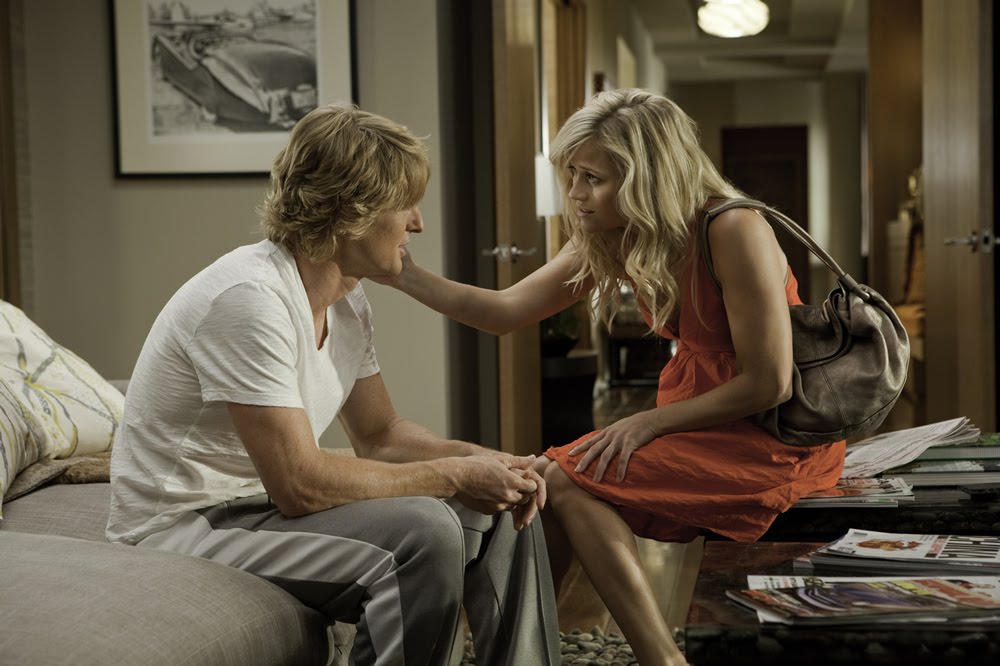
And that's how it starts:  George's stock is falling, and Lisa's struck out.  But in the great balancing act of the Universe, they might be lucky in love.  Maybe.  But, the course never goes smooth, as Lisa has started a relationship with a pro-ball player Matty (Owen Wilson), who's self-absorbed and a bit dim.  And with his troubles, George isn't exactly "a real chick-magnet," as Lisa sarcastically characterizes him.  Sounds like a typical romantic-comedy, the type in which Witherspoon has specialized the past few years.

But, at its heart, it's a bit more complicated than that, and thus, may not fill the rom-com comfort food quotient.  Lisa and George are two people with no prospects who have fallen off a cliff—additionally, falling in love may only serve to create more momentum to leave a bigger crater when they hit bottom.  There's a psychiatrist who says that the only people who think they control their Universe are psychotics...or bullies (temporarily, anyway)...or deluded.  Lisa and George are surrounded by them, no doubt wondering how such manage to survive.  Are they folks who can float on the tides of fate, or just an anchor.

Probably its all too much heaviness to attribute to this film, as slight as it is, never achieving the weight of Broadcast News, or the heart of Spanglish, but considering what has passed for romantic comedy the past few years, How Do You Know could pass for Noel Coward.  It, at least, tries to do something with the genre, placing the situation in a less sure framework—How Do You Know by its very title attempts to define the undefinable, and take this type of film out of the realm of the assured, even going so far as to remove the staple of the form: the clinch at fade-out.  Instead, we are left with a negative image that informs without giving much information, providing possibilities, but no definitive answers.

I like that. 

How Do You Know is a Matinee.  

Thursday, April 15, 2010

Adventureland

"Adventureland" (Greg Mottola, 2008) Nicely done coming-of-age comedy that has the same genial vibe of "Meatballs," or "Caddyshack," where, amidst a cast of eccentrics, the problems of the young leads are really, really serious (really...!).

New grad James Brennan (
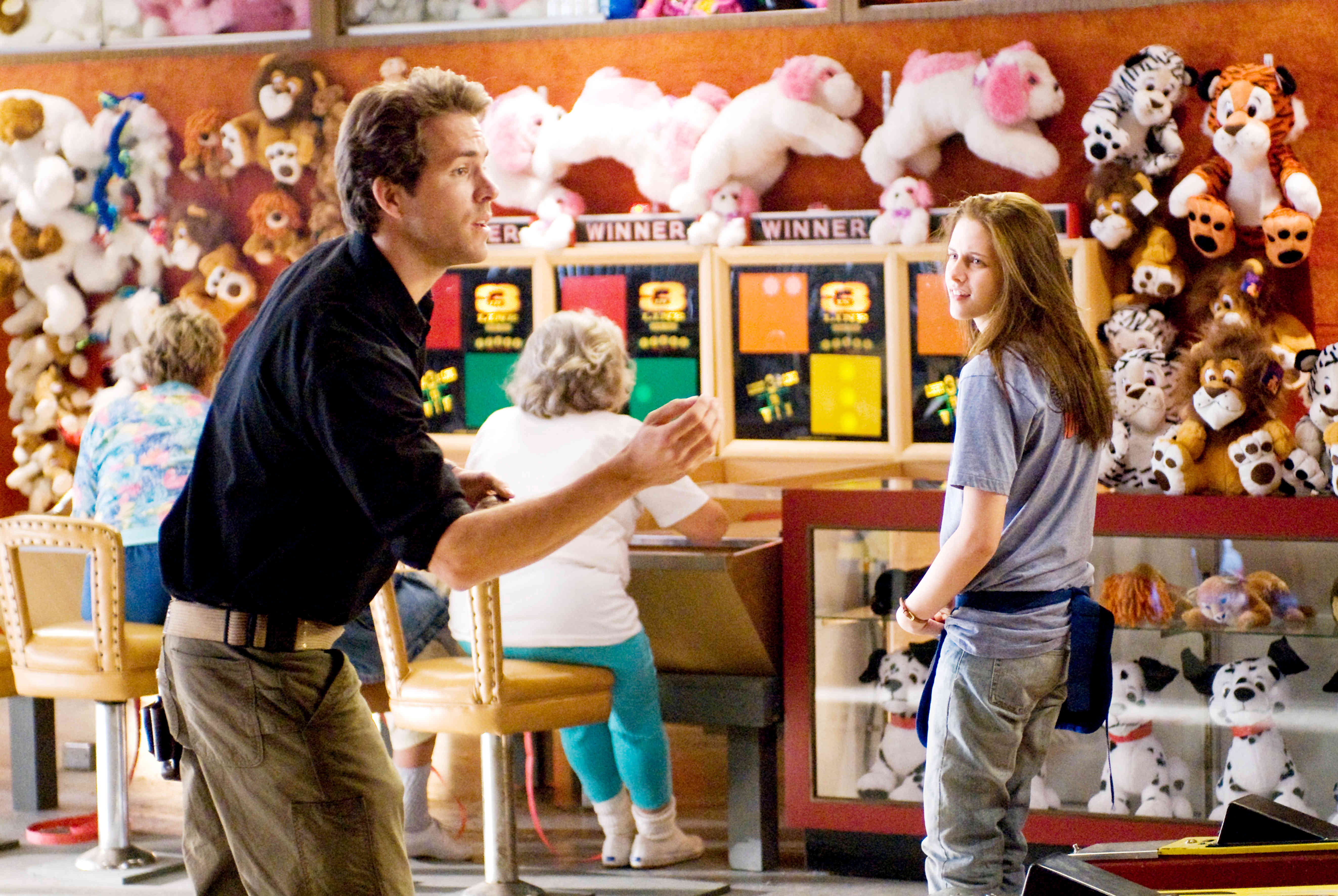
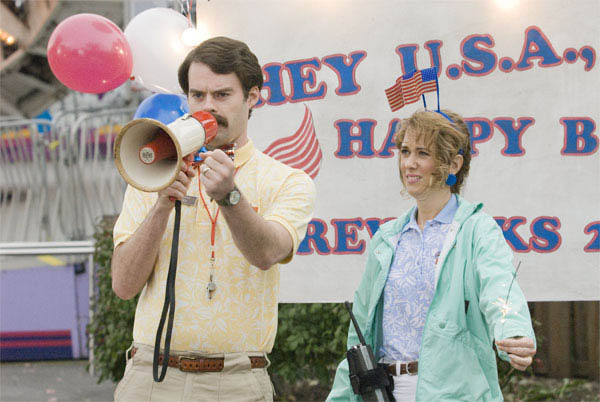
Jesse Eisenberg) had plans to travel Europe over the Summer before proceeding with his studies, but his family's economic situation means his little entitlement parachute had developed a leak. He has to find a job with no discernible work-skills and a major that doesn't really translate to employment ("unless you're restoring a fresco or something"), so he takes a crappy job—"doing the work of lazy, pathetic morons" says work-pal Joel (Martin Starr)—as a carny at a Pittsburgh amusement park, Adventureland, run by Bobby (Bill Hader) and Paulette (Kristen Wiig).

The park is crap-tastic, and so is the job and its meager paycheck. Plus, there are the kids, their duplicitous parents, the punks, the vomit from the rides, the usual breakdowns in equipment and communication and the intrigues that go on behind the scenes.

But the joys are the usual ones in work-settings—
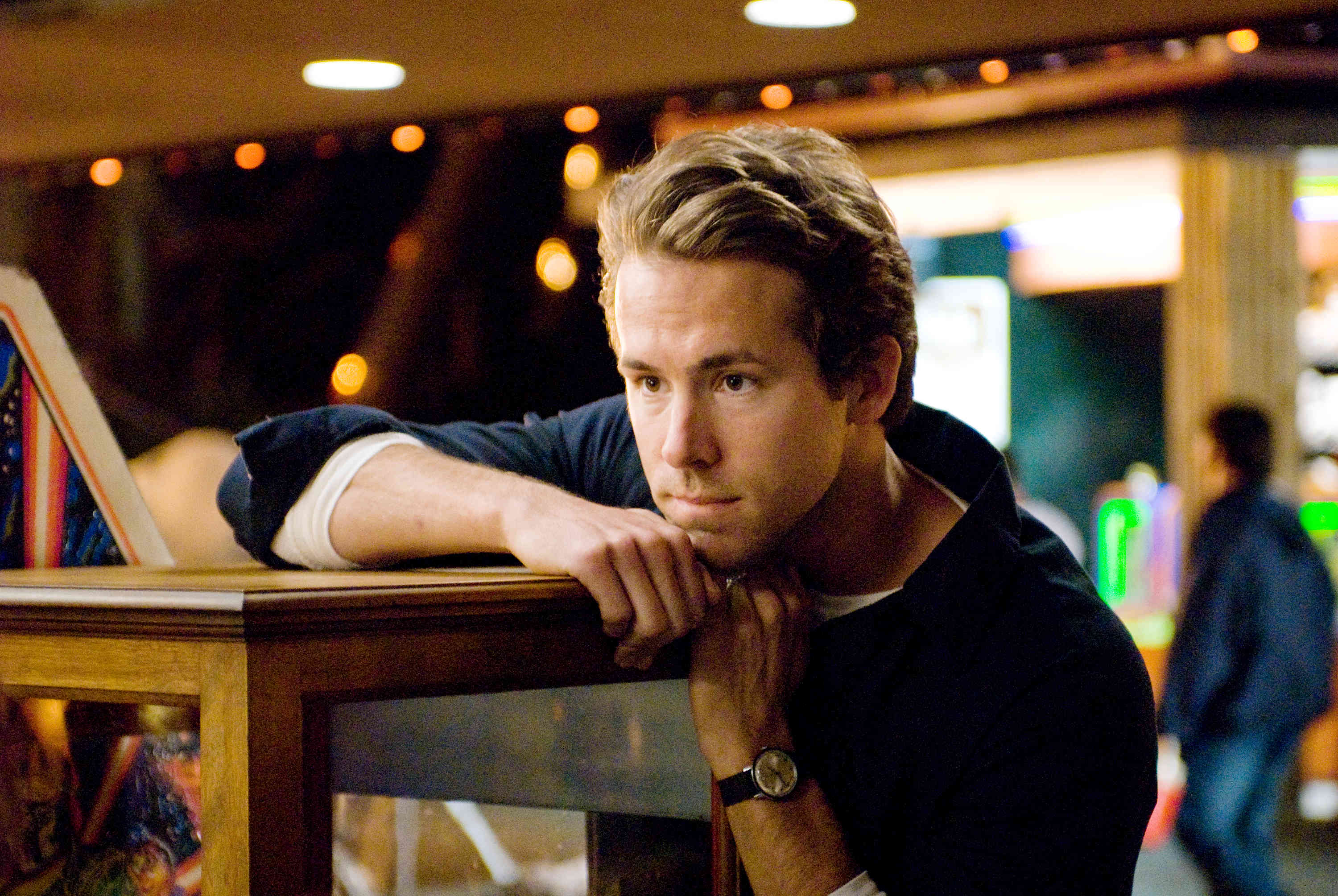
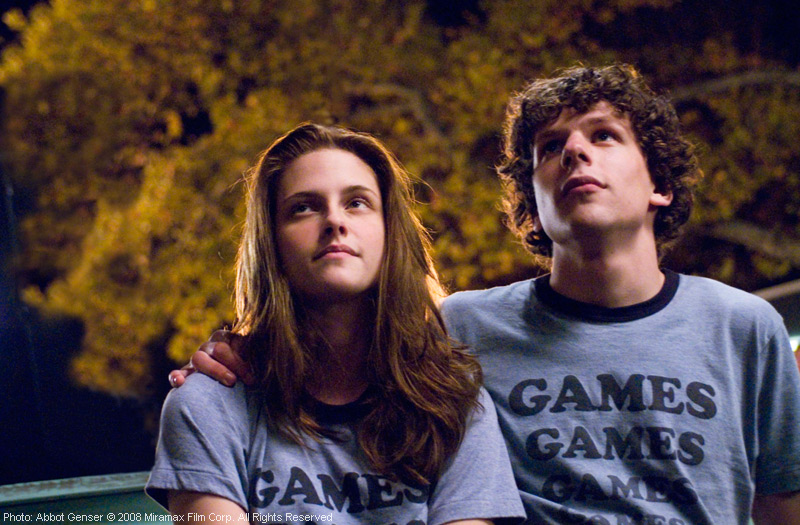
the people can be pretty interesting and take you out of your dull comfort zone and into another dull comfort zone that's initially pretty interesting. James is a geeky virgin (and yes, the main story plays like a more respectful version of those lame teen-deflowering comedies from the time-frame of this film, the 80's), but he has a summer's supply of good weed, he's smarter than your average carny, so he sticks out among the usual loser-drones milling about the place. Folks like Frigo (Matt Bush), James' arrested development neighbor,* Connell (Ryan Reynolds), the mechanic who hasn't quite matured yet, the afore-mentioned Joel—smart as a whip and dull as a doorknobLisa P (Margarita Levieva), the self-absorbed knock-out, and Em Lewin (Kristen Stewart), troubled slacker-chick. Brennan and Em start a spastically friendly courtship that spills over into one of those deadly earnest mis-matches that raging hormones have trouble steering clear of. But it's helped that Eisenberg and Stewart are two polar opposites acting: he is quick-silver fast, while maintaining a deadly funny dead-pan throughout; she's unfocused and just guarded enough to make her character interesting.

Because it's semi-autobiographical,
it's very male-centric, so that the guys are quirky and nuanced while the women are fascinating unfathomables, pedestaled and superficially drawn. But Mottola gets the work-place vibe right, especially in that first post-curfew touch of responsibility mixed with slacker-freedom that makes one think the pain of growing up might be behind you. It has that sense of "new crowd" work-place tribalism that feels like community until something better comes along. And it's sweetly raunchy without getting too deep in the muck, though it's probably not for the kids. And anything with Wiig and Hader in it is worth watching.

* Did I mention that Mottola directed a few episodes of the late, lamented "Arrested Development?" That helps explain the somewhat dead-pan tone of the thing.