
"Cynicism is Sanity"
or
"The Uncertainty Principles"
James L. Brooks finds salve in a cynical world. That he is The Godfather of "The Simpsons" and is responsible for investing that rancid cartoon with so much heart and soul is testament to the fact.
But, that is Brooks' great charm as a writer-director—finding the grace in bad situations, and charting a course through it, providing evidence that, even with no destination in sight, life is a process. The journey is all, and you might as well enjoy it, every bump, every neglect, every inequity, every injury...or else you won't know the good times to be (or not to be) if you tripped over them at night. The light that emanates from the projector of his films is his own candle in the darkness.
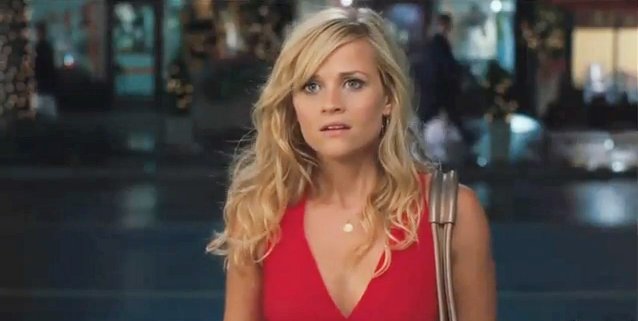
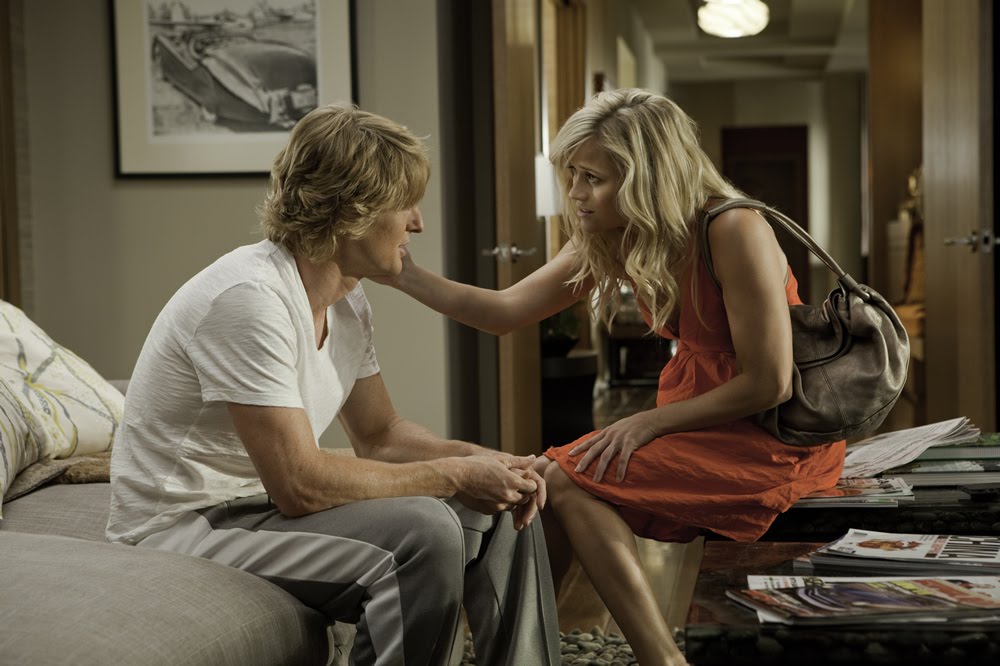
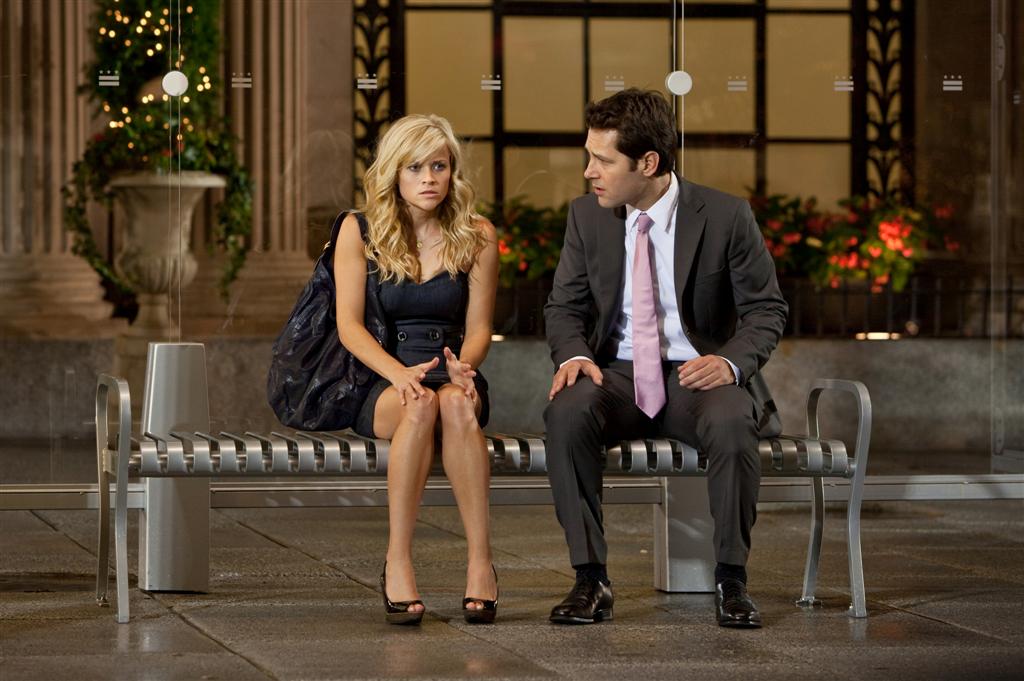
How Do You Know presents two professionals in life-changing positions (something we are all too liable to identify with in the country's state of affairs). Lisa (Reese Witherspoon) is a disciplined, principled professional softball player, who also manages to be the soul of her team. When she gets cut from the roster, she's devastated—the game is all she knows, and she finds herself adrift...hell, not even in left-field! All of the life-strategy post-it notes on all the refrigerators in all the world can't help her through this. On the other side of the financial spectrum, George (Paul Rudd) is an investments broker, working for the firm of his Dad (Jack Nicholson), and everything is just fine, thank you, until the subpoena shows up, and he must go through the process of being disengaged from his company, fiancee, friends, apartment, belongings, essentially becoming a "non-person." As his father's lawyer informs him, "Accept the inevitable. Accept that you will never again be the person you are."
And he's being nice.
George goes into a tail-spin. Luckily, he gets a "hook-up" date with Lisa, but he's in no shape for it, unloading his angst in a vitriolic stream. Appalled, she upbraids him: "Jesus! Do you know I don't know you?"
And that's how it starts: George's stock is falling, and Lisa's struck out. But in the great balancing act of the Universe, they might be lucky in love. Maybe. But, the course never goes smooth, as Lisa has started a relationship with a pro-ball player Matty (Owen Wilson), who's self-absorbed and a bit dim. And with his troubles, George isn't exactly "a real chick-magnet," as Lisa sarcastically characterizes him. Sounds like a typical romantic-comedy, the type in which Witherspoon has specialized the past few years.
But, at its heart, it's a bit more complicated than that, and thus, may not fill the rom-com comfort food quotient. Lisa and George are two people with no prospects who have fallen off a cliff—additionally, falling in love may only serve to create more momentum to leave a bigger crater when they hit bottom. There's a psychiatrist who says that the only people who think they control their Universe are psychotics...or bullies (temporarily, anyway)...or deluded. Lisa and George are surrounded by them, no doubt wondering how such manage to survive. Are they folks who can float on the tides of fate, or just an anchor.
Probably its all too much heaviness to attribute to this film, as slight as it is, never achieving the weight of Broadcast News, or the heart of Spanglish, but considering what has passed for romantic comedy the past few years, How Do You Know could pass for Noel Coward. It, at least, tries to do something with the genre, placing the situation in a less sure framework—How Do You Know by its very title attempts to define the undefinable, and take this type of film out of the realm of the assured, even going so far as to remove the staple of the form: the clinch at fade-out. Instead, we are left with a negative image that informs without giving much information, providing possibilities, but no definitive answers.
I like that.
How Do You Know is a Matinee.
Thursday, December 23, 2010
How Do You Know




Friday, December 17, 2010
Now I've Seen Everything Dept.: James L. Brooks

"Throw It in the Air and See Where It Lands"
James L. Brooks, the writer, pens things that James L. Brooks, the director, finds hard to bring to the screen. Brooks will tinker and hone, experiment and kibitz, noodge and futz, then re-think, re-edit, even re-shoot his movie to steer it more towards his original vision (which, in the process, probably changed, as well).
Polishing, always polishing.
Starting out in journalism, then moving to TV, where he helped to create "Mary Tyler Moore" (and its spin-offs, "Rhoda" and "Lou Grant") and "Taxi," Brooks garnered enough Emmy Awards to crack the sturdiest mantelpiece, then moved to films, first writing and co-producing Starting Over, then settling into the director's chair for a series of films that garnered critical acclaim and substantial box office. From his first film, he has garnered acclaim and awards, and if his films draw less attention than they have in the past, maybe it's because if you get too much quality...you might get bored with it after awhile.
Oh, yeah? Bring it on.
 Terms of Endearment (1983) This is the good version of Steel Magnolias. A movie about independent free-thinking daughters and the clinging mothers they drive crazy features some unpleasant people and a great deal about cancer and yet, it still defied being box-office poison and made zillions of dollars. It went on to win the Academy Awards for Best Picture, Best Supporting Actor (Jack Nicholson) and Best Actress (Shirley MacLaine, although if there was any latitude Debra Winger should have been a co-winner). Based loosely on Larry McMurtry's novel, Brooks added Nicholson's character, as an aging lothario-astronaut, who is brought temporarily to Earth by MacLaine's Aurora Greenway, still imagining herself a rose in full blossom. The script is tart, funny, and not afraid to challenge an audience's perceptions of how lead characters should act. It feels real...like life, only much better written.
 Broadcast News (1986) Brooks looks at the "new" TV journalism that started to tip into flash over substance and heat over illumination with this rom-dram-com about a triangle of news people with different styles. Everybody loves perky news producer Jane Craig (Holly Hunter), but who'll get her: Aaron (Albert Brooks) the smartly acerbic reporter with substance, or Tom (William Hurt), the dimly hunky anchor who skates on his looks? That Brooks ties the fates of Jane and The Truth together is risky but brilliant, and Broadcast News has both food for thought and the heart. It also catapulted Holly Hunter (in a brilliant performance)into the A-list after Raising Arizona, but everybody does a great job in this one—it certainly showcases how great Albert Brooks can be given proper material. Jack Nicholson has a cameo as a national news icon. The script is full of smart clever dialogue that is imminently quotable.*

And then, "The Simpsons" happened. Brooks hired Matt Groening to do interstitials for his "The Tracey Ullman Show" and the characters took off, spawning the longest-running animated show in television history. It created an empire for Fox, and a supervising responsibility for Brooks, who has shepherded the show throughout its run, directing the cast of talent for the inevitable The Simpsons Movie, which only came out in 2007.
 I'll Do Anything (1994) I'm sure someday we'll see a restored version of this film,** which started off as a musical (starring Nick Nolte??) at a time when folks hated musicals. Brooks always tinkers with his film obsessively, but after bad previews, he savaged this film, taking out all traces of musical numbers, and filming new segments to bridge the gaps. The story of a self-obsessed actor, who suddenly finds himself in charge of the life and (oooh, bitter irony!) burgeoning acting career of his pint-sized daughter,*** the film is full of wit and and wisdom, but feels a bit rarefied. And losing the connective tent-poles of the songs hurts. Try as Brooks did to stitch it together, the film feels anemic and "not very there."
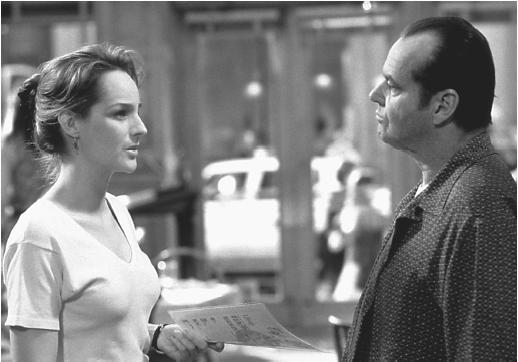
 As Good As It Gets (1997) Melvin Udall (Jack Nicholson) is the worst person in the world. A writer (of romance novels) he leads a self-imposed cloistered existence: he's obsessive-compulsive, an hysterical germaphobe, and a complete jerk. He has his routine down, and everything else—including relationships of any kind outside service-work—is too messy to be bothered with.****
Well, life is messy. The only waitress who'll wait on him (Helen Hunt) he becomes attached to, paying for her son's treatment of asthma. Then when his gay neighbor (Greg Kinnear) is seriously injured in an assault, Melvin has to take care of they guy's dog. As with his unwillingness to step on cracks in the sidewalk, Melvin starts to take baby-steps to accomplish his goals and enter the world of humanity again. Cracks start to form in his own shell, as he bonds with the dog (everything, it seems, is helped with bacon), and begins to think altruistically...sort of. It's an unsettling kind of heart-warming story (almost veering into heart-burn), and quite messy in itself, but the players are note-perfect (Nicholson and Hunt won Oscars for Best Lead Performances)
 Spanglish (2004) After avoiding this one for years due to its bad word-of-mouth, I finally saw it and fell in love with it. Shows ya what the experts know. Successful chef John Clasky (Adam Sandler, remarkably restrained and warm) is having panic attacks with a new restaurant he's opening, his wife (Téa Leoni, remarkably off-putting, a brave performance) is an neurotic control freak, and the only semblance of normalcy in their lives is the insertion of an immigrant housekeeper (the enchanting Paz Vega) and her precocious daughter who acts as interpreter. Again, Brooks takes a situation with high-end professionals and makes them down to Earth with foibles and flaws, but the emphasis here is on responsibility and dedication of duty to the important matters of life. There are the inevitable culture clashes and meldings that put strains on all relationships, but Brooks keeps it entertaining while not ignoring the grit that makes things...interesting. Love this movie.
Brooks' new film How Do You Know? opens today. Starring Reese Witherspoon, Paul Rudd, Owen Wilson and (of course) Jack Nicholson, it tells the story of two professional ballplayers, who must put away childish things and grow up to be adults...like Paul Rudd's investment banker under indictment. As with a lot of rom-com's the issue will be: will Reese choose Owen or Paul, and how will she know and when will she know it? My suspicion is the issue will be left up in the air.
* My favorite: After staff cut-backs at the network, an exec puts on his "bad news" face to ask if there's anything he can do for a laid-off employee. The old veteran newsie, box-in-hand, pauses and says: "Well...you could die soon."




 |
| Shhhh! Ba-da-dum-da-dumdum-dah-dumdum |
** Yeah, but then, that would depend on the idiosyncratic Prince, who wrote the songs, to give permission to allow that to happen. Brooks made a documentary about the making and unmaking of this film, but due to the same Prince-ly issue, it has never been released.
*** The situation was brilliantly but succinctly put in my real life by an actor-friend who commented on the life-transforming birth of his daughter: "I thought I was President of the United States. Now, I realize I'm just the Secret Service."
**** Of COURSE, he writes romance novels! He has no reality to dim the fantasy!
Tuesday, February 24, 2009
Spanglish
 "Spanglish" (James L. Brooks, 2004) I think it's a case of worrying too much. Brooks has had a history of vivisecting his movies in the editing room—for example, he made a musical "I'll Do Anything" and during the editing stage removed all the songs. Here, he took out two crucial lines: one, to shorten the journey of Flor Moreno (the adorable Paz Vega) and her daughter Christina (Victoria Luna, growing into the amazing Shelbie Bruce) into America—originally they flew in with a pilot whom Flora was attracted to, but made a silent vow to never again get involved with irresponsible men (That scene is crucial, but it's not in the version released to theaters); the other is a scene where it's quite apparent that although they have a lot in common, the two protagonists in that scene come from distinctly different emotional cultures, and that what they share comes down to empathy, rather than love and that's an important statement to make. Again, it was cut out, making the film a bit more undefined and quite a bit more "safe" from controversy.
"Spanglish" probably takes enough chances that it made its makers very nervous. Brooks does extensive research, drenching his films in the worlds they inhabit and making them seem unconventional when their stories are actually quite in line with conventional wisdom. Brooks takes worlds spinning out of control and contains them, returns them to the status quo, achieving the normal or what will pass for normal.
Here, it is a Latina single mom, with no English to speak of, assimilating into a well-to-do dysfunctional Hell.A. family. He's a five-star cook who'd settle for three (Adam Sandler, nicely played*), and she's a hopeless neurotic (Téa Leoni, taking scary chances)—so self-aware she's oblivious to the havoc she creates around her. Leoni's neurotic California wife is the biggest risk in the movie, because she's an intelligent woman who has made herself as dumb as a stump, stuck in a loveless relationship with herself and trapped in a never-ending downward spiral of self-improvement. She's irritating as hell, mostly because the actress does not cut her any slack (you want to give her an award, then slap her upside the head with it). You can feel her self-absorption suck the feel-good out of the movie, but without her, it would go nowhere, and, frankly, it wouldn't be a convincing portrait of Los Angeles.
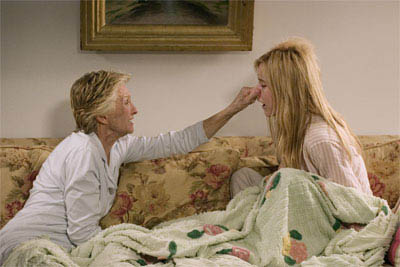
Rounding out the cast is Cloris Leachman, who reminds of why she's such a talent and can mine worth out of badly written parts, but especially out of good ones. Again, Brooks does amazing work with kid-actors, and each of the youngsters in "Spanglish" are unconventional and scary-good. But there is one scene between Sandler, Vega, and Bruce that is as deftly played as any I've seen as it's a conversation between Sandler and Vega with Bruce translating. It's good conversation, too, done at top-speed and lots of sub-text that all three actors excell at. It's a classic scene all around showcasing optimal writing, direction and acting. Brooks is that good. He just needs to trust himself and his material.
The film got a bit of a critical drubbing, probably for the superficial reasons that it starred Adam Sandler (never a hallmark of quality up to that point in his career) and the Leoni character is such a train-wreck (that's the point, I believe) But despite that reputation and its poor box-office, "Spanglish" is one of those movies that "got away"—a love story where "love" has the best of intentions and is more in line with the old bilblical term "Charity."
* Although it's certainly not something to hold out as indicative of the entire performance, check out Sandler's "blind" perfect beer pour. It's one of those character details that displays something would wouldn't associate with the actor/comedian—discipline.


Sunday, May 4, 2008
Don't Make a Scene: Broadcast News
 extraordinary adaptation of Larry McMurtry's "Terms of Endearment" and it was full to bursting with good ideas. A smart film about smart people, it showed how even those with their wits about them can settle for the comfortable, how idealism can be steam-rollered for emotion, and how objectivity is an illusion where self-interest is concerned. And these are the people delivering to us what we need to know to run a representative democracy. Gosh, what do you think the ramifications of that might be? (Bear in mind this came out during the Reagan administration) These were issues that couldn't be brought up on the "Mary Tyler Moore" show, but no doubt Brooks was thinking about them. But you couldn't compare Ted Baxter with The Devil--it'd kill the comedic momentum (Brooks said that the three leads of "Broadcast News" each came up to him during shooting and asked "Is Tom The Devil?"). It is also one of those superbly written scenes where research informs character, where character informs humor, and where humor reveals truth. It's people using intellectual arguments to defend and disguise emotion. Note also Brooks' 'non-directorial" directing. Simple scene. But look how it's framed with Brooks and Hunter occupying their own spaces in the screen. How the architecture of the room is used--two doors to two rooms suggesting choices to be made, and how Hunter is usually situated on the landing, so she's higher--on a pedestal?--than Brooks (also it's practical to keep the elfin Hunter in frame with the taller Brooks). This is one of my favorite scenes in all of cinema, and it was delivered with consummate skill by Albert Brooks, who was amazing throughout the entire movie. Even he hasn't written himself something this good to display his talents.

The Set-up: Aaron (Albert Brooks) and Jane (Holly Hunter) work for a DC news network--he as a reporter, she as a producer. They are young, driven, devoted, idealistic and neurotic as all hell. They are also the best of friends. Then Tom (William Hurt) is hired on a fast-track to an anchor position. Tom is practical, without much depth, preppy-handsome and shallowly earnest. Where Aaron and Jane use story to evoke emotion, Tom just uses emotion. Tom and Jane are attracted to each other, while Aaron thinks he's a big phony. Tonight is an important night for Jane. She and Tom are going on a Big Date, but she makes the mistake of visiting Aaron to console him after a disasterous try-out as a week-end anchor. When Aaron sees her dressed up for her date with Tom it is too much to take and he angrily kicks her out of his house. But as she reaches the door, he regrets it. Action!

 Jane(really upset): This is important to me!


 Jane(sits down on some magazines): What is this?

 Jane: What?!
 Aaron: Give me one minute, please. This is tough!


 Aaron: Aaaaah, Jane! Okay. Let's take the part that has nothing to do with me.
 Aaron: Let me just be your trusted friend now, the one that gets to say all the awful stuff, okay?


 Jane: I guess? Yes.
 Aaron: You can't end up with Tom. Because it totally goes against everything that you're about.
 Jane: Yeah. Being a basket case...
 Aaron: I know you care about him. I've never seen you this way with anybody, so don't get me wrong when I tell you that Tom...

...while being a very nice guy...
 ...is the devil.
 Jane: (She's had it. She gets up to leave) This isn't friendship. You're crazy, you know that?
Aaron: What do ya think the devil's gonna look like if he's around?
 Jane: God...
Aaron: Come on, no one's gonna be taken in by a guy in a long, red pointy tail.  Aaron: Come on, what's he going to sound like (Snarls and claws)

 Aaron: No. I'm semi-serious here.
 Jane: You're serious that--
Aaron: He will be attractive, he'll be nice and helpful.
 Aaron: He'll get a job where he influences a great, God-fearing nation.
 Aaron: He'll never do an evil thing, he'll never deliberately hurt a living thing. He'll just, bit by little bit, lower our standards where they're important.
 Aaron: Just a tiny bit. Just coax along flash over substance. Just a tiny little bit.
 Aaron: And he'll talk about all of us "really being salesmen."
 (She turns away)
 Aaron (sourly): And he'll get all the great women.
 Jane(at the door): Hey, Aaron? I think you're the devil!

Aaron: You know I'm not!
Jane (Gets in his face): How?!

Aaron: Because I think we have the kind of friendship where if I were the devil, you'd be the only one I'd tell!
 Jane: Well, you were awful quick to run after Tom's help when you--
 Aaron: All right! Fine! Yes!
 Aaron: And if things had gone well for me tonight then I probably wouldn't be saying any of this.
 Aaron: I grant you everything!
 Aaron: But give me this: He personifies everything that you've been fighting against.
 Aaron: And I'm in love with you. (Jane is taken aback)

 Aaron: How do you like that? I buried the lead.
 (He falls back on the couch exhausted)
 Aaron: I've got to not say that out loud.
 Aaron: It takes too much out of me.
 Aaron: I never fought for anyone before.
 Aaron: Does anyone win one of these things?
"Broadcast News"
Words by James L. Brooks
Pictures by Michael Ballhaus and James L. Brooks
"Broadcast News" is avaialble on DVD on Fox Home Video