Showing posts with label Guy Hamilton. Show all posts

Wednesday, May 13, 2009

Anytime Movies Reloaded: Goldfinger

It's Spring-Break for me. Times are busy. The Summer Movie Season is already begun (and I'll be writing about the new ones) and the Film Festivals are grinding away like creaky mills separating wheat from chaff. It's as good a time as any to re-boot a feature I started years ago, when it was suggested I do a "Top Ten" List.

I don't like those: they're rather arbitrary; they pit films against each other, and there's always one or two that should be on the list that aren't because something better shoved it down the trash-bin.

So, I came up with this: "Anytime" Movies.

Anytime Movies are the movies I can watch anytime, anywhere. If I see a second of it, I can identify it. If it shows up on television, my attention is focused on it until the conclusion. Sometimes it’s the direction, sometimes it’s the writing, sometimes it’s the acting, sometimes it’s just the idea behind it, but these are the movies I can watch again and again (and again!) and never tire of them. There are ten (kinda). They're not in any particular order, but the #1 movie IS the #1 movie.

I’m an unrepentant James Bond fan.

Yes, the movies are sexist and exploitive--frozen in the hardened amber of 60’s attitudes and prejudices.

They’re filled with mink-lined sadism, clueless Brit' snobbery and snarky humor only drunken Frat' boys laugh at.

I love it.  AndGoldfinger” (1964) is the epitome of it all.

Call it a “guilty pleasure” if you must and place it at the end of this list, but homage must be paid and credit given.

There may be better films in the series (that would be its predecessor, the slightly more sober “From Russia With Love”- and I have warm spots in my heart for OHMSS, the nasty/silly “Diamonds Are Forever,” and “The Living Daylights.”) Certainly there are more elaborate and flashy ones, where you walk out talking about the sets (and not much else).

But “Goldfinger” has it all, managing to take a middling Fleming thriller (even though Anthony Burgess listed it in his “99 Novels: The Best in English Since 1939 ” as representative of the Bond series) and improve on it—a rarity in the films. The screenplay (by series veteran Richard Maibaum and utility closer Paul Dehn) is an efficient series of traps and foreshadow-dropping gold nuggets of information that pay off later in the story: Bond’s improvised electrocution of an assailant in a seemingly-unrelated pre-titles sequence sets us up with information for another situation later, as does a casual conversation about discharging firearms in a pressurized airplane cabin (since disproved by the “Mythbusters”) Maibaum and Dehn toss out a group of characters early (and fittingly) to streamline the Big Set-Piece—Goldfinger’s raid on Ft. Knox—and go Fleming one better; instead of the unworkable book idea of physically stealing the gold, the screenwriters just devise a way to irradiate it, making it unexploitable, crashing the U.S. economy while increasing the worth of the villain’s holdings. Neat. They also update the book’s nasty “Perils of Pauline” sequence with a circular saw by strapping Bond to a slab of gold being bisected by the recently-developed laser beam.

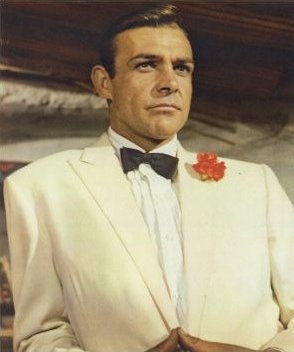
Maibaum excelled at plot and structure, but it was Dehn, a radicalized gay writer who had worked as a propaganda instructor at the OSS "Camp X" during WWII, who tossed in the more cheeky touches. There’s a cool re-appraisal of Bond as a hero in this film. He’s basically kicked between situations beyond his control, something which irked star Sean Connery who saw Bond as an active investigator. Connery was also miffed at some Bond set-ups—the seagull disguise at the very beginning of the film, although he did embrace Bond stripping off a wet-suit to reveal a white linen tuxedo jacket, which he wears to a seedy South-of-the-Border bar (The “cluelessly-overdressed Bond” joke would be done to death in the films until Timothy Dalton put an end to it --although Pierce Brosnan still had his Bond pathologically straighten his tie, even underwater).
His third time out, Connery is finally casual with Bond while tossing in odd little bits of business to suggest that Bond is inches away from being clobbered on a regular basis. The villains are memorable, and the women have defined personalities (for once) with Shirley Eaton’s “golden girl” displaying as much aggressive sexuality as Bond (Eaton, and Gert Frobe, as Goldfinger, had their vocal parts dubbed by other actors). Of course, there's also the gadgetry: the "homer," the lethal bowler hat, the hi-tech exoticism of the laser beam. And then, there’s the car.

John Barry’s score is the blaring frosting on the cake: repeating chimes announcing the presence of the villain or anything having to do with gold; sinuous strings, compounding like snakes, creep during the laser beam sequence and Goldfinger’s signature theme blats out in brass clusters. And although other artists’ Bond songs have topped the charts, no one’s topped its theme song (with lyrics by Leslie Bricusse and Anthony Newley) for brio and outrageousness. No one has ever “belted” a song like Shirley Bassey does this.

It also has my two favorite lines from any Bond film. The first, adapted from Fleming:
This is gold, Mr. Bond. All my life I’ve been in love with its color, its brilliance, its divine heaviness.

And from Maibaum and Dehn, a line so good, it’s amazing no thriller had used it yet:

Bond: Do you expect me to talk?
Goldfinger: No, Mr. Bond, I expect you to DIE!


They’ve just finished filming the latest James Bond film—which is based on Fleming’s first Bond novel “Casino Royale” but due to rights issues has been out of the grasp of the longtime Bond producers. The new Bond is an odd choice—Daniel Craig, who suggests (when he’s “on”) a British Steve McQueen. He has been bad in some films (“Lara Croft: Tomb Raider” and “Road to Perdition”) where he barely registers, but he CAN be the thing your eyes gravitate to, as in Spielberg’s “Munich” or the British TV version of “Copenhagen” (Craig played Heisenberg), or his signature film “Layer Cake.” He may be a bit different, but he can’t be THAT different. After all, every film has ended with “James Bond will Return.” It’s a bit like saying “Meet the new Bond. Same as the old Bond.”

2009 Update: "Casino Royale" managed that rare thing: besting its source—which is saying something because that first Bond novel is damned good. And Daniel Craig did a terrific turn as a Bond who is brutal and brutalized; for once the film continuity involved watching the healing of Bond's scars. The action may have been gritty, but the producers also tossed in a healthy dose of glamour, and revisited old haunts—the Aston Martin DB5, the Bahamas, Bond in a long-sleeved black polo shirt as well as a tailored three piece business suit, and an iconic "emerging-from-the-sea" shot, although this time performed by Craig. The script by Wade and Purvis (with a dialogue tune-up by Paul Haggis) was smart and snappy—and as convoluted as one can get for a script about a poker game. And the acting was several bars ahead of most of the films in the series. It's truly the best all-around Bond movie since "Goldfinger." Good show.

The next Craig Bond flick had less plot, more action and stumbled with the hiring of director Marc Forster who tried to make a more mature film while proving that he was incompetent at action sequences (Note to self: if you're going to "improve" things, first get the basics down).


Goldfinger
Bonus: Edge of Darkness


Thursday, August 21, 2008

Now I've Seen Everything Department: James Bond

In which the author, having seen everything there is to see on the subject makes a capsule* summary of each, looking for trends and contributing what he calls an Ouvre-view.**

Subject: The James Bond Series


"Casino Royale" (Brown, 1954): This one-hour adaptation for live-television's "Climax!" series starred Barry Nelson as "card-sharp" "Jimmy" Bond (American) taking on LeChiffre played by Peter Lorre. Primitive, a bit ill-timed in execution, it is a fairly faithful adaptation of Fleming's story although some liberties had to be taken (Bond's torture: tied up in a bathtub, his toes crushed by pliers (Ah, The Golden Age of Television), Bond never questions his assignment, Vesper lives). A not bad first attempt, but not great, either.00


"Dr. No" (Young, 1962): Sean Connery plays James Bond, Joseph Wiseman is Dr. No, Ursula Andress is...impressive. Armed with a $1 million budget, Bond comes to the big-screen with a heavy injection of humor, a lot more implied sexual activity than in the novel, and genuinely nasty streak in violence. Bernard Lee plays Bond boss "M" with a heavy layer of crust. Bond gets his Walther PPK and ends up in a boat with the girl at the end. Connery's rough around the edges with a soft purr to his voice. Director Terence Young has put a lot of grit into the movie, and Peter Hunt's slash-and-burn editing keeps things moving faster than your normal adventure flick. It's also a bit of a send-up of your normal adventure flick--Ken Adam's flamboyant sets being the most obvious evidence of so many tongues in cheeks. The music is laughable except for John Barry's arrangement of "The James Bond Theme" which is used so much it nearly out-wears its welcome. Introduces S.P.E.C.T.R.E., a world-wide terrorism outfit as a stand-in for the Soviet Union (the producers wanted to court them as a market). 0000000

"From Russia With Love" (Young, 1963): What is Fleming's best novel is given a couple extra surprises mostly in Soviet spies working as double-agents for SPECTRE-chief Blofeld (whose face is not revealed). Casting is top-notch: Lotte Lenya as spy-chief Rosa Klebb, Pedro Armedariz as Our Man in Instanbul, but best of all is Robert Shaw as Grant, assigned to assassinate Bond and discredit him. The Shaw/Connery scenes are genuinely tense culminating in a no-holds-barred fight in the close-quarters of a railroad car. Some spectacular stunt work--and a scene where Bond is pursued amidst hill-tops by a grenade-launching helicopter becomes iconic, which is a nod and a wink to Hitchcock. "Q" is introduced. Bond ends up with girl in boat. 0000000

"Goldfinger" (Hamilton, 1964): There are still thrills, but an extra coat of polish and humor is given this one, which also improves on Fleming, ditching his caper for one that's a bit more practical and scarier. Connery throws in more comic bits of business and plays it a bit more detached, probably because his Bond is a bit passive in the detecting department. Lots more gadgets. That car. That laser. Oddjob and his lethal derby. That little old lady with the machine-gun. Pussy Galore starts the trend towards eye-rolling names. Extended battle sequence at Fort Knox is the first extended battle sequence to climax the movie. 0000000


"Thunderball" (Young, 1965): Gadgets and locales start to crowd out Connery and for the first time, the movie seems like a let-down from Fleming. Starts with a jet-pack escape and ends with an underwater battle sequence that seems to go on forever--underwater ballet with spear-guns. So does the central atom-bomb hijacking that sets the plot...well, one is attempted to say "in motion" but it stops the movie cold. SPECTRE and the man with the cat is back. Connery appears iritated at times. But it is the all-time Bond box-office camp (adjusted for inflation). Bond ends up with girl in boat (until they're whisked away by air-sea rescue, see what I mean about the gadgets?) 00000


"Casino Royale" (Hughes, et al., 1967) Tiresome spoof with an all-star cast (David Niven, Peter Sellers, Orson Welles, Ursula Andress, Woody Allen...Woody Allen?) "Hellzapoppin'" Bond. If only it were funnier. Everyone ends up in Hell (deservedly, I thought) Audience only feels like it. 0


"You Only Live Twice" (Gilbert, 1967): Bond goes to Japan to stop hi-jacked space capsules. SPECTRE's secret HQ is in a big hollowed-out volcano that regularly launches rockets and helicopters. Right, no one'll notice. Finally see Blofeld and it's Donald Pleasance with one nasty scar and the voice of a braying chihuahua. Script logic and any resemblance to the Fleming story go down the ol' lava-tube. Connery hits his marks professionally, but that's about it. Big ninja attack in the volcano!! Goes...on...forever. Bond ends up with girl in a raft. 0000


"On Her Majesty's Secret Service" (Hunt, 1969): Connery's gone, but not for good. George Lazenby is Bond...only semi-good. He looks fine in stunts but so does a 2 x4 when used right. Editor Peter Hunt directs with an eye toward more color and a pell-mell style. Bond undercover to track down Blofeld who's now Telly Savalas. Bond falls in love with Diana Rigg who's groovy, baby. Lots of good skiing action. One bad love-montage with music. No gadgets to be seen. Nice crisp attack on mountain-top HQ, then a big wedding. Bond ends up with dead wife in his car. 000000


"Diamonds Are Forever" (Hamilton, 1971): Connery's back, jowlier and with a greyer toupee. Camp abounds. Effete Blofeld. Gay hoodlums. Big diamond laser thingy in sky. Played for laffs (what else can you do with Jill St. John as the Bond-girl), but some good jokey dialog still manages to surface. A none-too-impressive battle on an offshore oil rig. Bond ends up on ocean liner (another boat!) with girl. 0000


"Live and Let Die" (Hamilton, 1973): Roger Moore is Bond, and kinda mannequins his way through it. Racist little plot but a bit more hip than racist little book. Yaphet Kotto is not sure what movie he's in, can't maintain an attitude. Jane Seymour's not sure what movie she's in, feels she has to act. More chases, less material stringing movie together. Looking a little threadbare. Bond ends up with girl on train. 0000

"The Man with the Golden Gun" (Hamilton, 1974): Moore's back and is a little meaner which is hard to believe. Cristopher Lee would have been a terrific Scaramanga in another movie--here he's a bit cheery. Britt Ekland is the bottom of the barrel for Bond-girls. But is better than Herve Vellechaize as hench-thing. Exotic locales. Energy "crisis" plot (in 1975!) Highpoint is barrell-rolling car stunt across river. Still looks amazing. Bond ends up with girl in junk. Precisely! 000
"The Spy Who Loved Me" (Gilbert, 1977): Moore at his best, but Bond-by-formula. Lazy writing. Too-easy seductions. Bond has it too easy all the way. Jaws--"Nuff said." Chase after chase with a plot spray-painted from the "You Only Live Twice" stencil. Marvin Hamlisch score feels like "James Bond! The Musical!" Barbara Bach plastic-pretty. But that's a great stunt in the open. Good will of that can't sustain the movie. Bond ends up with girl in bath-o-sub-escape-thingee. 000"Moonraker" (Gilbert, 1979): Moore is less. Very lazy writing. Venice sequence with hover-craft gondola and double-taking pigeons. Space movie with ray-gun shoot-out. Jaws falls in love with Pippi Longstocking. Bond-girl's name is Holly Goodhead (and she's supposed to be taken seriously?). Bond ends up with girl in orbit. Shoulda stayed there. 00"For Your Eyes Only" (Glen, 1981): More plot. Less stunts. Moore's starting to show age. Great climbing sequence. Borrowed bit from Fleming's "Live and Let Die" works well. Major ick factor as under-age gymnast Lynn-Holly Johnson hits on grand-dad Moore. Topol makes a good ally though he chews a lot of scenery. Bond ends up with girl on boat. 0000 "Octopussy" (Glen, 1983): A lot of plot partly written by George MacDonald Fraser. Some good moments, especially those involving a radical Russian General (Steven Berkoff). Moore dressed as clown disarming nuclear bomb feels...natural. Maud Adams, a bit stiff. Louis Jordan, a bit ripe. Fight outside a plane in flight a bit preposterous. Bond ends up with girl on boat. 000


"Never Say Never Again" (Kershner, 1983): Connery back. Writer Lorenzo Semple (Batman television series) briefly uses the "age" thing but then returns to Bond as elder stuntsman. Great cast with Kim Basinger, Klaus Maria Brandauer (superb!), Max Von Sydow, Edward Fox and an over the top Barbara Carrera (never better). Borrowed "Thunderball" plot with some 80's relics (Bond and villain "duel" over a video game?) . Last third of the movie is slipshod and rushed. Time to say "Never Again." Bond ends up with girl in a therapeutic hot-tub. Good choice. 000

"A View to a Kill" (Glen, 1985): Speaking of not coming back. Roger Moore's last outing and its irritating. It's fun to have Christopher Walken (as the villain) and Patrick MacNee (as a disposable field operative), but not to have Grace Jones and Tanya Roberts (who's particularly grating). Oddly unexciting film about a plot to cause The Big California Earthquake. Villain's a genius who produces computer chips but doesn't realize he's trying to kill a sizable chunk of his customer base. Hmmm. Starts with a chase at the Eiffel Tower. Ends with a fight at the Golden Gate Bridge. After all that, Bond ends up with girl in a shower. Moore leaves all washed up. 00


"The Living Daylights" (Glen, 1987): Timothy Dalton is Bond and a good one, this 007 taking the job VERY seriously and not liking it much. Though Dalton is king of romantic mini-series, he tones it down here. Bit of a cad, in fact. And sometimes barely in control. Great pre-credit sequence on Gibraltar. Possibly best fight in series and Bond's not in it. Good cast with Jeroen Crabbe as The Villain, and Joe Don Baker as the literal heavy (subsisting on scenery, I think) Bond ends up with girl...backstage in dressing room. 000000 "Licence To Kill" (Glen, 1989): Borrowed bits from Fleming in a story about a drug king-pin who maims Felix Leiter, Bond's pal in the CIA. Bond quits MI6 and goes rogue for revenge. Feels like Fleming, but doesn't feel like Bond. Bond-girls are a bit token-tough. Villain has best lines. A very young Benecio DelToro shows up as villain's creepy, weasley assistant. Sub-plot of a televangelist as a drug marketer is mean-spirited/funny, but ruined by the casting of Wayne Newton. A guy gets exploded in a pressure chamber but Newton is ickier. Extended action sequence with 18-wheelers goes on far too long. Bond ends up with girl in a swimming pool. 00000


"Goldeneye" (Campbell, 1995): After a seven year hiatus where most of the old Bond-team die, Bond returns. Pierce Brosnan makes a dapper, very crisp Bond and his introduction in the pre-credits in terrific. Casting of unfamiliar names (except for Sean Bean and Famke Janssen as the villains) with fine acting chops helps push Brosnan to the forefront. Bond-girl can ACT!! And she's the one who saves the day! Dame Judi Dench is the female "M" (she's squinty-eyed/prickly), Allan Cumming is a Russian computer-nerd, Joe Don Baker is back as an ally, Michael Kitchen as M's Chief of Staff and Robbie Coltrane and Minnie Driver show up in cameos. Another too-long finale. Great CGI credit sequence. Horrible score by Eric Serra that electronically with sampled clanking between "oohs" and "aahs." Bond ends up with girl...in a military helicopter. 00000

 
"Tomorrow Never Dies" (Spottiswoode, 1997): Brosnan again, but a slightly devalued Bond. Plot's about a media mogul who makes his own conflict-headlines. A bit over-written in places. Too many worthless chases. Jonathan Pryce makes an ineffectual villain. Teri Hatcher shows up briefly and is killed. Michelle Yeoh kicks things up as Chinese agent. Odd little sequence with Vincent Schiavelli as assassination specialist Dr. Kaufmann. As soon as garage-chase ends, it all goes downhill. Final battle on "stealth-boat" in interminable. Bond ends up with girl...on pieces of a boat. 000 "The World is Not Enough" (Apted, 1999): Longest pre-credits sequence in Bond history makes a slight kerfluffle of the story, but Bond has to protect an oil heiress from an international terrorist who had previously kidnapped her. Robert Carlyle is largely wasted but Sophie Marceau makes the best of a confusedly-written part. Denise Richards is a nuclear physicist named "Christmas" (oh, the possibilities are endless) Old "Q" leaves, and new "Q" is John Cleese and hardly a "harrumph" is skipped. Dramatically a bit inert. Bond ends up with girl in Turkey... after exiting a too-long submarine sequence. Brosnan-Richards romance feels a bit icky. 0000"Die Another Day" (Tamahori, 2002): Starts out promisingly: Bond is captured by North Korea and held prisoner and tortured while 9-11 happens. Traded and discredited but escapes own services' captivity to start an investigation in Cuba. Then Halle Berry shows up and it all goes horribly...horribly wrong. Bond's Greatest Hits Done Poorly. Laser satellite. Car chase on ice. The thing is like a steroid-pumped video game (which probably was the idea). Snarky villain. Madonna title-song and..urk..cameo. Awful. Bond ends up with girl in Korean prayer temple. Protests ensue. Wanted to grab a sign and join them. 00


"Casino Royale" (Campbell, 2005): Brosnan out/Daniel Craig in. Great script. Great action. Out-Flemings Fleming. Somehow makes Bond work for post-9-11 world in the same way he worked for the Cold War. Terrific cast. Eva Green shines as love-interest. No gadgets. Bond ends up withOUT girl...on a boat. 0000000

"Quantum of Solace" (Forster, 2008): Settles into the same formula, though there are bright spots, great cast who all try to do their best with the material. However, the emotions are dictated in short-hand, the script scrimps on the dialogue, and the plot pin-balls from action sequence to action sequence, ala the tepid "Live and Let Die." While those action sequences are spectacularly conceived, they're filmed obliquely and edited horribly-almost incompetently, without a sense of context. Blink and you'll miss three shots. More Fleming, please, and less frenzy. Bond ends up...alone...and in a proper gun-barell! 0000

Ouvre-view: It only took forty years but somehow the producers and the audience have come together to bring Fleming's Bond to the silver-screen and see it succeed. "Dr. No" changed Fleming to increase the laughs and entertainment quotient and as long as the movies were in the Swingin' 60's it seemed to work. But once the '60's and the series' Rosetta Stone--Connery--passed, the movies and Fleming parted company to provide audiences with bread, circuses and gadgets-up-the-tailpipe jalopies. When attempts were made to take Bond back to his graying roots--with "OHMSS" and "Licence To Kill"--the poor box-office had the producers fleeing back to their bullet-proof tuxedoes. But, finally, with an official adaptation of the very first novel, everyone seems to be on the same page...and fortunately it's one written by Ian Fleming.

Monday, January 14, 2008

Goldfinger

I’m an unrepentant James Bond fan.

Yes, the movies are sexist and exploitive--frozen in the hardened amber of 60’s attitudes and prejudices.

They’re filled with mink-lined sadism, clueless Brit' snobbery and snarky humor only drunken Frat boys laugh at.

I love it. And “
Goldfinger” (1964) is the epitome of it all.

Call it a “guilty pleasure” if you must and place it at the end of this list, but homage must be paid and credit given.

There may be better films in the series (that would be its predecessor, the slightly more sober “
From Russia With Love”- and I have warm spots in my heart for OHMSS, the nasty/silly “Diamonds Are Forever,” and “The Living Daylights.”) Certainly there are more elaborate and flashy ones, where you walk out talking about the sets (and not much else).

But “Goldfinger” has it all, managing to take a
middling Fleming thriller (even though Anthony Burgess listed it in his “99 Novels: The Best in English Since 1939 ” as a representative of the Bond series) and improve on it—a rarity in the films. The screenplay (by series veteran Richard Maibaum and utility closer Paul Dehn) is an efficient series of traps and foreshadows-dropping gold nuggets of information that pay off later in the story: Bond’s improvised electrocution of an assailant in a seemingly-unrelated pre-titles sequence sets us up with information for another situation later, as does a casual conversation about discharging firearms in a pressurized airplane cabin (since disproved by the “Mythbusters”) Maibaum and Dehn toss out a group of characters early (and fittingly) to streamline the Big Set-Piece-Goldfinger’s raid on Ft. Knox, and go Fleming one better—instead of the unworkable book idea of physically stealing the gold, the screenwriters just devise a way to irradiate it, making it unexploitable, crashing the U.S. economy while increasing the worth of the villain’s holdings. Neat. They also update the book’s nasty “Perils of Pauline” sequence with a circular saw by strapping Bond to a slab of gold being bisected by the recently-developed laser beam.

Maibaum excelled at plot and structure, but it was Dehn, a radicalized gay writer who had worked as a propaganda instructor at the OSS "Camp X" during WWII, who tossed in the more cheeky touches. There’s a cool re-appraisal of Bond as a hero in this film. He’s basically kicked between situations out of his control, something which irked star
Sean Connery who saw Bond as an active investigator. Connery was also miffed at some Bond set-ups—the seagull disguise at the very beginning of the film, although he did embrace Bond stripping off a wet-suit to reveal a white linen tuxedo jacket, which he wears to a seedy South-of-the-Border bar (The “cluelessly-overdressed Bond” joke would be done to death in the films until Timothy Dalton put an end to it --although Pierce Brosnan still had his Bond pathologically straighten his tie, even underwater).

His third time out Connery is finally casual with Bond, while tossing in odd little bits of business to suggest that Bond is inches away from being clobbered on a regular basis. The villains are memorable, and the women have defined personalities (for once) with
Shirley Eaton’s “golden girl” displaying as much aggressive sexuality as Bond (Eaton, and Gert Frobe, as Goldfinger, had their vocal parts dubbed by other actors). Of course, there's also the "homer," the lethal bowler hat, the hi-tech exoticism of the laser beam. And then, there’s the car.

John Barry’s score is the blaring frosting on the cake: repeating chimes announcing the presence of the villain, or anything having to do with gold; sinuous strings compounding like snakes creep during the laser beam sequence and Goldfinger’s signature theme blats out in brass clusters. And although other artists’ Bond songs have topped the charts, no one’s topped its theme song (with lyrics by Leslie Bricusse and Anthony Newley) for brio and outrageousness. No one has ever “belted” a song like Shirley Bassey does this.

It also has my two favorite lines from any Bond film. The first, adapted from Fleming:

This is gold, Mr. Bond. All my life I’ve been in love with its color, its brilliance, its divine heaviness.

And from Maibaum and Dehn, a line so good, it’s amazing no thriller had used it yet:


Bond: Do you expect me to talk?


Goldfinger: No, Mr. Bond, I expect you to DIE!


They’ve just finished filming the latest James Bond film—which is based on Fleming’s first Bond novel “Casino Royale” but due to rights issues has been out of the grasp of the longtime Bond producers. The new Bond is an odd choice—Daniel Craig, who suggests (when he’s “on”) a British Steve McQueen. He has been bad in some films (“Lara Croft: Tomb Raider” and “Road to Perdition”) where he barely registers, but he CAN be the thing your eyes gravitate to, as in Spielberg’s “Munich” or the British TV version of “Copenhagen” (Craig played Heisenberg), or his signature film “Layer Cake.” He may be a bit different, but he can’t be THAT different. After all, every film has ended with “James Bond will Return.” It’s a bit like saying “Meet the new Bond. Same as the old Bond.”


"Anytime Movies" are movies I can watch anytime, anywhere. If I see a second of it, I can identify it. If it shows up on television, my attention is focused on it until the conclusion. Sometimes it’s the direction, sometimes it’s the writing, sometimes it’s the acting, sometimes it’s just the idea behind it, but these are the movies I can watch again and again and never tire of them. There are ten. This is Number 10.


V: The Searchers


X: Goldfinger