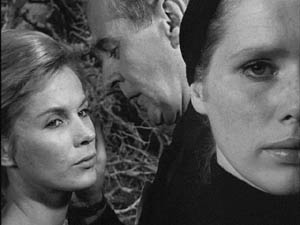
This was part of a series of reviews of the ASUW Film series back in the '70's. Except for some punctuation, I haven't changed anything from the way it was presented, giving the snarky, clueless kid I was back in the '70's a break. Any stray thoughts and updates I've included with the inevitable asterisked post-scripts.
"The Seventh Seal" aka "Det Sjunde inseglet" (Ingmar Bergman, 1957)
An odd combination of films await those in 130 Kane this Saturday night: Ingmar Bergman's "The Seventh Seal" and Ken Russell's "The Devils."
For those of you whose only experience with Ingmar Bergman is his wildly splintered and heavy film "Persona" from last quarter's ASUW series, "The Seventh Seal" will seem to be made by another man. At this time, Bergman wasn't so experimental, so strange. He was, as he is now, alive and vibrant with the charm of film-making and his '50's films ("The Magician," "Wild Strawberries," "Through a Glass Darkly") although dealing with "heavy" subjects of God and Death and self still possessed a lightness in the telling, a lightness that carried over from his beginnings in films and was lost in the dark broodings of his late '50's and '60's films. There was a time for comedy, and time for deep-think in the space of the best Ingmar Bergman films.
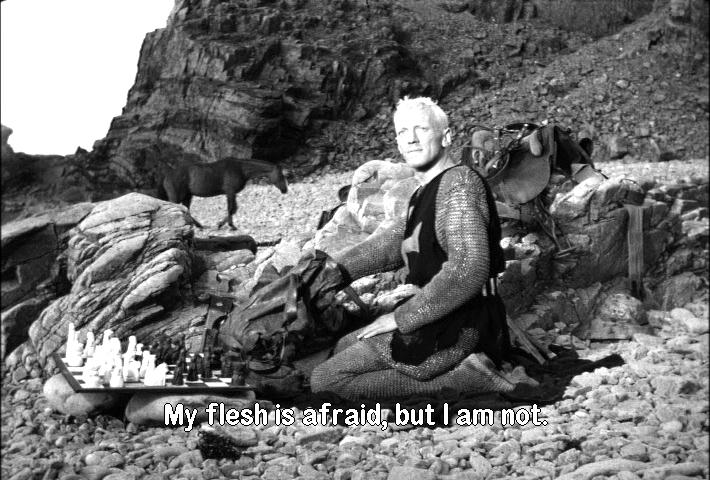
There are many characters in "The Seventh Seal," but at the film's hub are two. The most important is The Knight, who is played Max von Sydow, the supreme brooding actor. The Knight is home from the religious wars where the quest for God has been fruitless—where the point of the quest, after the year's ox-killing has been lost. But the quest for God continues. It has to. God can't be in the war, but can he be found outside amidst plague, witch-burnings and ignorance?
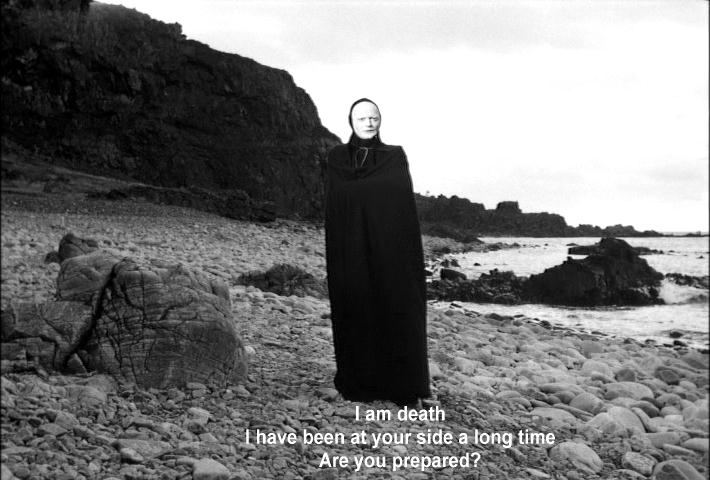
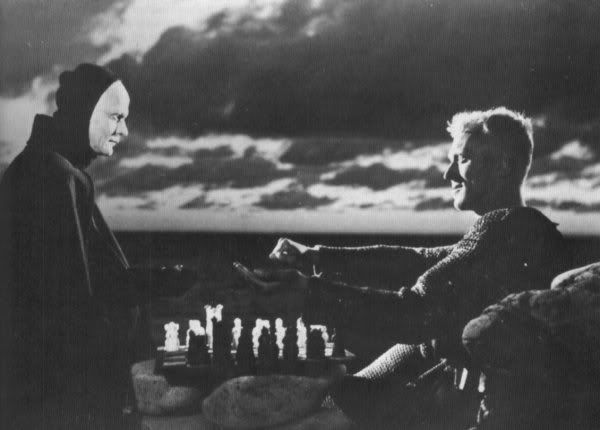
The answers are hard to come by, and even harder to come by while being pursued by another hold-over from the wars, the second most important character being Death. Death pursues the Knight and they engage in continuing battles of wits and of chess. The two opponents are only the hub of the story. There are others: the Knight's man-servant whose musings are concerned more with life that what is beyond; a troupe of actors; a wood-cutter and his adulterous wife. Bergman combines them all in a film that wheels between light and heavy in tone, but always excellent in quality.
Broadcast on KCMU-FM on January 8th, 1976 (thirty-three years ago today)
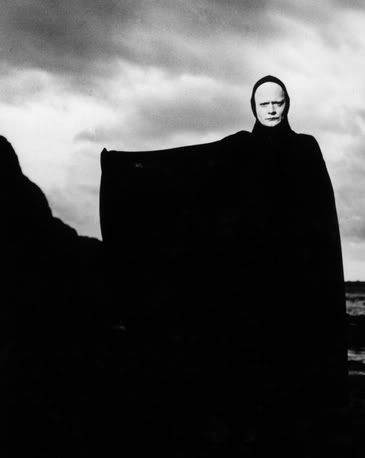
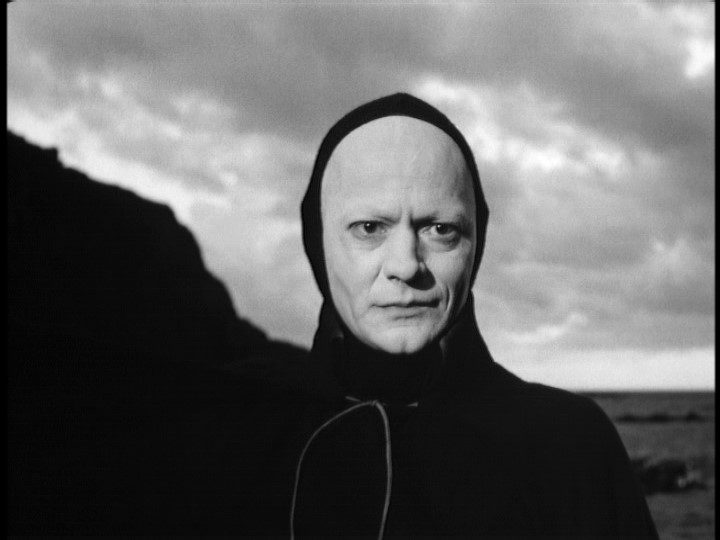
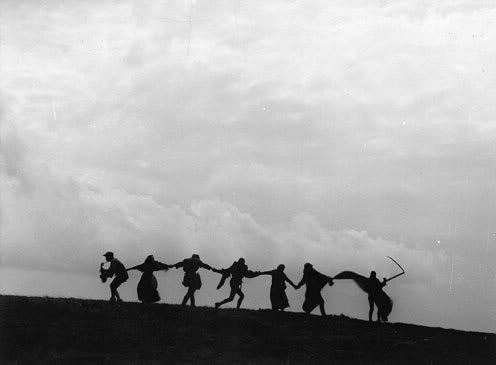
Sounds like I ran out of time there at the end--I usually only had two or three minutes per film to talk. So, I didn't even mention the stark black-and-white photography that has become so iconic, along with Bergman's simple personification of Death--an actor dressed entirely in a black cassock, with just his face appearing...in sharp contrast. And the image of The Knight playing chess with Death has been copied, parodied, purloined and done...well, to death. In "Bill and Ted's Bogus Journey," they played "Battleship."
It sounds bleak, and it is—it is the Plague-Years, after all. But the film ends with a touch of hope and sacrifice, that even after all the Knight has seen—and not seen in the form of God—he can still cling to ideals. Typing this out, it occurs to me that the film we're reviewing tomorrow has a lot in common with Bergman's masterpiece.
Thursday, January 8, 2009
Olde Review: The Seventh Seal



Thursday, July 31, 2008
Olde Review: Persona
This was part of a series of reviews of the ASUW Film series back in the '70's. Except for some punctuation, I haven't changed anything from the way it was presented, giving the kid I was back in the '70's a bit of a break. Any stray thoughts and updates I've included with the inevitable asterisked post-scripts.
This is a companion piece to "The Fires Within"
"Persona" (Ingmar Bergman, 1967) As opposed to the  approach Malle takes with "The Fires Within," Bergman takes a totally different tack--he lets you know right from the start that "Persona" is only a movie, not reality at all (and as an ex-projectionist, my sympathy to the fellow who has to show it Saturday night!). It is another Bergman film dealing with the supernatural. But for Bergman the supernatural does not come from beyond, it exists within us, within our personalities.
An actress (Liv Ullmann) is admitted to a hospital when she falls silent, unwilling to speak. A nurse (Bibi Anderssonn) is put in charge of the actress' care. For therapy, the two women live at a house on the seaside, and it is at this point that the supernatural forces of the soul take over.
The two women--the nurse, talkative and light; the actress, silent and brooding--begin to resemble each other, to merge psychically, take on each other's characteristics...and I find that I really can't go on with a synopsis of the story. For at this point, what one sees in the film is almost totally subjective. You have to explain what goes on to yourself. I can't do it for you, even if I were to try.*
Bergman can be a light and breezy film-maker as is evident in "The Magic Flute" and his '50's comedies. But at other times, his films can be claustrophobic and suffocating almost beyond endurance (and I think Bergman realized this in "Persona," for at one point he lets up, forgets the story just for a moment, and explodes the creen with fast, fleeting, and irrelevent images**--a filmic explosion to relieve this build-up in tension).
William Bayer in his book "The Great Movies"*** says this about "Persona" and its creator, Ingmar Bergman."It is not his obscurity that is so frightening about Bergman. It is his intensity. there is such tension in "Persona" that it comes at times to be an almost unberable experience. One senses a man revealing his anguish at the furthest extremes of cold fire, compelling attention by the blazing sting of total chill. In "Persona," the faces of Liv Ullmann and Bibi Anderssonn are incandescent with this intensity. Their interchange is so intimate that at times we want to avert our eyes." "The Great Movies" (p. 190)
It is all very heavy stuff. And I'm not sure the majority of UW students will be able to understand--be able to deal--with "The Fire Within" and "Persona."
But they are there...as a challenge.
Broadcast on KCMU-FM October 29, 1975
A little condescending there at the end, I think. Perhaps I should have said I HOPE the majority of UW students wouldn't be able to understand or deal with the movies. They're disturbing films, and they resonate more, the older one gets and the closer one gets to the Edge of the Abyss. Perhaps I should have said that. Who knew?
As for what happens in the film: is it an empathy, a Jungian merging of souls, a familial bond, a lesbian love, possession, a psychic experience? Is it like pet-owners resembling their dogs? Is it the two women influencing each other so much that it becomes impossible to tell where one begins and the other ends?
There's a line from the wonderful "Tucker: The Man and his Dream." I've always loved the dialog where Abe Karatz (Martin Landau), Tucker's financier semi-explains why he stays with the visionary auto-maker despite the financial risks: his mother, in her poor English, tried to communicate that you shouldn't get too close to people "or you'll catch their dreams. She meant germs. But she said 'you'll catch their dreams.'"
Maybe it's as simple as that.
*It sounds like a cop-out (in the language of that day), but it really isn't--"Persona" is such a personal film, that one's life-experiences, even one's fleeting subconscious thoughts, will influence what one sees in "Persona:" is it an empathy, a merging of souls, a familial bond, a lesbian love, a psychic experience? Quite literally, your guess is as good as mine. Bergman could have come out and said something preposterous like "this is based on the Norwegian folk-tale of the two sea-nymphs who become one with nature--of warring clans who find that they have more in common with what separates them, and when you attempt to care for a tyger, you become the tyger!," but what fun would that be? We all bring something unique to the table. Isn't that what a smorgasbord is all about?
** Irrelevent? I actually doubt that, now. Film is edited together for a reason.
*** Sadly out of print, and not to be confused with Roger Ebert's series of collected essays. I can't even find it mentioned at Amazon.com.