Showing posts with label The Beatles. Show all posts

Wednesday, November 17, 2010

Nowhere Boy


"Playing the Chords You're Dealt"
or
"Portrait of the Walrus as a Young Man"

"Half of What I Say is Meaningless/
But I Say it Just to Reach You/
Julia"
John Lennon, after Khalil Gibran

It's always going to be John Lennon who is the focus of dramas based on The Beatles; there have been a couple already (even two about his assassin) and PBS has Lennon Naked in the wings.  No biographies of McCartney (no drama, really), Harrison (no dharma, really), or Starkey (trying to think of the last movie about a drummer...).  It's always Lennon.  Partially because he's capital-F Fascinating, but also because he was so capital-F "F'd up."

All of The Beatles were born into a world in flux, all born during the second World War, and, in turn, they would change the world, as they themselves were changed by having that world screaming at their feet.  But, that's The Beatles story.

Lennon's story is as fractured as his snarky-twee published stories are.  Raised by his strict Auntie Mimi and his jocular Uncle George, he barely escaped the Strawberry Field Salvation Army orphanage—a place that he would ultimately turn into a personal childhood playground, given the choice—(Odd, that Lennon was forever looking at alternatives to his situation as an answer...even the bad ones—he was never satisfied, until the end).  His father, Alf, was a merchant marine and never home.  His mother, Julia, was a perpetual teen-mother, bi-polar, substance-abuser and sex-addict.  Mimi took John to keep him close to Julia (rather than with Alf), while simultaneously keeping them apart.  No wonder he was never comfortable.

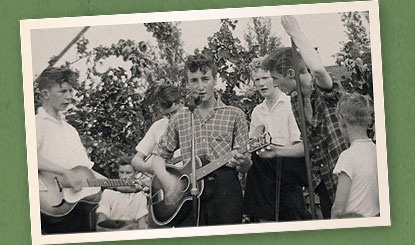
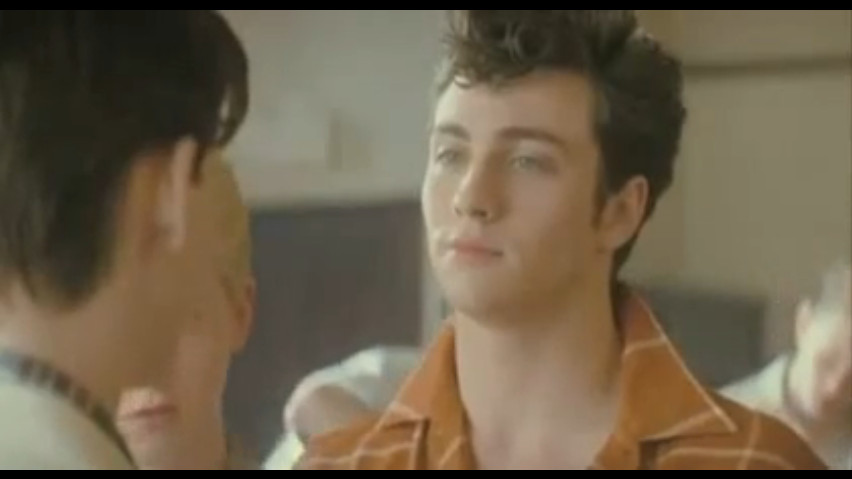
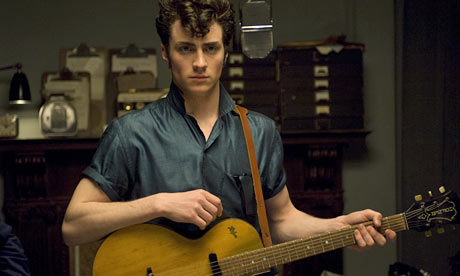
Sam Taylor-Wood's Lennon bio-pic Nowhere Boy (one of the few real references to Beatles songs in the thing) tells the story of Lennon's turbulent teen years—can you imagine being in charge of Lennon when he was going through puberty?—when he was flushing through some independence, experiencing second-hand death, sex, and music, all swirling through a loyalty-abandonment battle when he meets his long-lost Mother...and begins to understand the circumstances of his own almost Dickensian story.  That Julia also inspires his dedication to music, and the forming of his band The Quarreymen (the proto-Beatles), whose first concert starts to lock in the relationships that would inform the rest of his life, makes this movie a bit like being fortunate enough to watch a lightning strike.  It makes great drama,  and the screenwriter Matt Greenhalgh does a masterful job of making a familar story fresh, and putting in the comedic grout that informed Lennon's manner, while also capturing in smart, short-touches portraits of McCartney (Thomas Sangster) (their first meeting is wonderfully indicative) and Harrison (Sam Bell).

Kristin Scott Thomas does a great job of showing the brittle side of Aunt Mimi, while also quietly showing why she was such a good co-conspirator with her chargeAnne-Marie Duff's Julia is a girl-child, too immature to be a mother, as she always wants to be the girl-friend.  But the miracle is Aaron Johnson, who doesn't really look like Lennon (in the same way that Joaquin Phoenix never looked like Johnny Cash in Walk the Line), but has done such a fine job of looking at documentaries and studying the much filmed Lennon, that he has the manner down...so much so, that he begins to resemble him, mostly in motion, until you just accept the impersonation.  We've seen our share of bad Beatles imitations, but Johnson captures the illusion in all its facets of the diamond in the rough, and the Spaniard in the Works.

Nowhere Boy is a Matinee.


Saturday, August 21, 2010

Now I've Seen Everything Department: The Beatles

Last year, it was Michael Jackson's Summer, as everyone was listening to his music, realizing what we lost.  This year, for me, it's been The Beatles (John Lennon, Paul McCartney, George Harrison, "Ringo" Starr).  I've been listening to them intently, the old mixes and the re-masters of the British releases, the "ghosts" of the American releases on Capitol Records re-inserting themselves in my memory of their track orders.

And the music still amazes, and the lads who made them with their own individual talents coalescing into a musical unit.  That they were scruffy natural entertainers with an absurd sense of humor just made them more endearing to audiences (if not their parents, necessarily...), and after the doo-wop 50's, The Beatles were "Something New," even though they were raised on that music, copying, re-interpreting, improving those songs being produced in America.  A disc-jockey friend (who produces his own Beatles program locally) recently opined to me that they were "the perfect storm of talent and personality."

Just so.

And they were so popular—such a commodity—that they couldn't be confined in the music industry to merely being recording artists;  they were producing music videos (they didn't invent the form, but the current crop owes them a stylistic debt), and movies to extend their fame and satisfy the market and their own artistic visions.

And they produced a body of positive work from their early "Yeah, yeah, yeahs" to their last recorded utterance:  "And, in the end, the love you take is equal to the love you make" (and then one final joke-song).

Here's a brief overview of the major entries in their forays into all media...except, of course, mp3's...yet.


A Hard Day's Night, 1964 I went to the premiere of this in Seattle (thanks for buying the tickets, Dad), and it was a wild affair with screams from ardent fans at the craven images of The Beatles projected 40 feet across the screen. Below are the first ecstatic minutes of "A Hard Day's Night" (sans audience accompaniment, but still with plenty of screams), one of the initial attempts to expand the group's reach into all media. They couldn't have had a better start. Richard Lester had worked with Beatles faves, the Goons, and brought a fresh anarchic air to the film, which apart from the bit about Paul's larcenous, lecherous grandfather, sticks pretty close to life as the Beatles knew it--in perpetual transit.* Life for the Beatles must have seemed absolutely mad, with the hysteria from all sides focused on them like sunlight through a magnifying glass, while they were being shipped like freight from one performance to the next. On the clip, check out Lennon's clever bit with the Pepsi bottle.


Help!, 1966 Richard Lester again, with color film and a bigger budget, Lennon in his self-described "fat Elvis" period and a daft story full of good bits and gags, but dripping with paranoia. It's not just the fans out to get the boys this time, it's an Eastern cult trying to get a sacred sacrificial ring, sent to Ringo, by any mean necessary. Spoofs of Bond, Hammer-horror and adventure movies with the Beatles particularly loose--they were recently introduced to marijuana by Bob Dylan and higher than kites during filming. If the whole thing seems to hang together without a care to structure or plot (the resolution of the conflict, which, like "A Hard Day's Night," entails the group coming together to save Ringo, is thrown away-literally), that's why. After years of restoration work, "Help!" has a fine, cracking presentation on DVD that's a wonderful companion piece to Miramax's "Hard Days Night" box, only this one's released by the Beatles' own multi-media company, Apple. Well done. It's the first time that you can see David Watkins' stellar color cinematography (the first time he'd worked in color!) in all its beauty. The Features are nice, too, with Richard Lester contributing to a documentary.** His comments are invaluable. Here's my favorite part of the film-the weirdly anarchic and trippy end-credits with improvised Beatles overlay, finished by a hacking cough.


Yellow Submarine, 1968 An experimental cartoon built loosely around several Beatles songs in and around the Sgt. Pepper period. Not much Beatles content (although they appear at the end)--they didn't even provide the voices--but the techniques and the imagination behind it (directed by George Dunning, written by several folks including Erich "Love Story" Segal-egad!) are awe-inspiring. Yes, it's silly ("Frankenstein?!" "I used to date his sister, Phyllis.."), but this Peter Max influenced collage-fest is still a wonder to see.


Magical Mystery Tour, 1967 May you never suffer through this mess of a film, self-indulgently directed by The Beatles themselves. A holiday trip manufactured by the group is the thinnest of excuses to string song-videos. In "The Beatles Anthology," McCartney claims that they study it in film-schools (in a cautionary way, I'm sure) and that Spielberg thinks its brilliant! *Sigh* *** At least it has a performance of "I am the Walrus," which you can see here without watching the rest of the wretched thing.


Let it Be, 1970 My admiration for the Beatles knows little bounds, but this film nearly destroyed them in my eyes forever. It's a documentary with grandiose intentions: The Beatles rehearse in a studio, then perform a concert in some incredible location, but things don't turn out so well: Paul gets bossy; George turns diffident; Ringo sulks and John's strung out and passive-aggressive. You come out of this thing really liking Yoko (she's so damned patient)...and Billy Preston, whom George brings into the fold to keep everyone on their best behavior. Paul plays to the camera, and the rehearsals are dismal. Then, instead of some big foreign extravaganza, they just go up to the roof for an impromptu concert to get the damned thing over with...and they're brilliant (the filmmakers must have missed the parts where it all came together!), then the police come and say, "What's all this, then, eh?" Here's George presenting "I Me Mine" for group consideration (while John and Yoko and, of course, Henry the Horse, dances the waltz), George's "12-Bar Blues," and the boys (well...just Paul and John, ignoring the others) fooling around with one of their first rehearsal songs, "Besame Mucho."


The Beatles Anthology, 1995 The surviving Beatles, with pithy recordings from Lennon, tell the story of the Beatles--to a certain extent. When its best you get a sense of what it was like to be in the eye of the Beatlemania hurricane. At its worst its an opportunity for McCartney to spin-doctor--the project was his idea, after all. George and Ringo's interviews are in studio or their backyards, but Paul talks in the woods in the warm wrinkle-reducing glow of a fire or, most bizarrely, driving a tug-boat! No discussion of relationships--except for Yoko--but there is a lot of talk of how they worked so well against the world in the wild concert days and how they splintered in the studio. But, the best thing--the most brilliant thing--is the visual summing-up of The Beatles phenomenon in the perfect 20-seconds animation that began each episode: you can see it in the first moments here--a pull back from the Beatles performing "Help!" as they disappear from view and their music is overwhelmed by screams--and the individuals are dwarfed by "The Beatles" as a phenomenon far bigger than they are.


"I'm Down" from the first Shea Stadium concert, 1965 This is my favorite Beatles clip. Its a hot August night in New York and the four are performing their first concert in an outside sports stadium. During this song, John, feeling slightly uncomfortable with no guitar and playing organ, realizes that it doesn't matter what he does on stage. No one can hear him. No one cares, they're screaming their lungs out. They're little dots in the middle of the field, and their music is coming through the stadium PA. No one can hear them! And John goes just a little...crazy, then brings George into it, then Paul, and they're carried away by the absurdity of the situation. There's a joy here, a madness, that epitomized the Beatles, that overcame any scary situation. But it was the beginning of the end for the concert tours: they became pointless with all the screams; they couldn't play well with all the noise; their music was getting more complicated and harder to duplicate live. After a particularly scary world tour, The Beatles retreated to the studio and their individual efforts.


* When asked how he liked a particular country on a tour Lennon responded, "It was a limousine, a hotel room, a sandwich and another limousine ride" and on Beatlemania in general "It was like being in the eye of a hurricane. You'd wake up in a concert and think, Wow, how did I get here?"


** One nice "inside" bit is Elanor Bron revealing a nervous tic while filming--she would blink...a lot (Lester does a nice slow zoom on her during one of her eye-batting moments). And all of the Beatles take turns blinking excessively at her to throw her off. Combined with the already-established winking between her and Paul (and the consternation by George: "I'm getting winked at by ladies a lot these days--used to be you, Paul"), there's a lot of fluttering going on.

*** I throw a lot of sarcastic comments about Paul McCartney in this, but the man is some sort of genius, making his craft seem easy...maybe too easy.    And he was the guy who kept the group together as long as they were.  Ironically, his leaving the band is what caused it to break up.

Friday, May 28, 2010

My Favorite Musical: A Hard Day's Night

Here's a post requested by correspondent Andrew of the sweetly up-beat Encore Entertainment movie blog—a haven of civility in a slathering horde dominated by horror movie blogs. Sunday, he's hosting a blog-a-thon encompassing a great many writers cracking wise on one subject or theme: for this, he asked that we pick our favorite musical. That's a tough call as I count musicals I like on one and a half hands. But this one always makes me smile. And it's a great film, too.

"A Hard Day's Night" (Richard Lester, 1964) A jangling Fadd9-chord (with a George Martin multi-note slam on his Steinway) reverberates for a few solitary moments on the sound-track before the full-tilt tilt rock song churns ahead, accompanying—maybe for the first time in movies—an action scene; The Beatles (John Lennon, Ringo Starr and George Harrison, who stumbles in the opening shot, tripping Ringo, to Lennon's delight)are trying to catch a train, running from a mob of their screaming fans.

Just a typical day in the life of
The Beatles

A reporter once asked Lennon what he thought of a particular stop on a tour: "It was a train and a room, a car and a room and a room and a room." That's what scenarist
Alun Owen found when he stayed with the four mop-tops during a stretch of concert tours: The Beatles were prisoners of their fame. They were so successful that any chance of a normal life was out of the question. If all four of them were together there was a riot and they'd have to run for their lives, call out security, work out internecine routes. Their lives were led at a runner's pace, with no finish line in sight. It was utter insanity. And if they weren't so young and going through it together, they might succumb to the madness (and who's to say they didn't?)

And that's what "
A Hard Day's Night" is—a dramatic illustration of the life of the Beatles at the height of their success—managed, cajoled, used, stymied, interrogated, trying to be the calm in the center of their own hurricane.

That it's also a musical is without dispute. The story-line is interrupted every 15 minutes or so with a new Beatles song, and since the through-line of the story is to get The Beatles-collective to a broadcast-venue on time and in one piece, there's ample opportunity for practice and rehearsal. The songs do not necessarily spring out of the material of the story, but when has that ever been a requirement?

Critic Andrew Sarris, in his book "The American Cinema," off-handedly remarked that if
The Marx Brothers were an insane tonic to a sane if corrupt world, then The cinematic Beatles were the sane tonic to an insane world, and this is true of both "Help!" and "A Hard Day's Night." The worlds of both films seem to be doing everything in their considerable power to stifle joy, through ritual, constraint, and even finding ways to bottle it up and sell it. In "Hard Day's Night," specifically, The Beatles are bright and clever and anarchically up-beat while being herded from one venue to another, caught between strict rules and screaming hysteria. Each has their own episodes of dealing with the world: Paul, the cheerily shallow cute one is burdened with the responsibility of dealing with his lecherous grandfather (Wilfred Brambell-"He's very clean"), John, the prickly clown, toys with his fame and badgers the management ("You're a swine..."), played by Norman Rossington and John Junkin, as highly fictionalized versions of Brian Epstein and roadies Neil Aspinall and Mal Evans, while George, the stonily introspective one, finds himself confronted with the marketing and exploitation of Britain's youth culture. Ringo, the diminutive ugly duckling, possessed of and hiding behind "a large hooter," and shackled to a distancing drum-kit ("They loom large in his legend," remarks George) is depressed and yearns to break free on his own, a dream which is only encouraged by Paul's scheming grandfather.

The sub-text (as it is in "Help!") is that the world is conspiring to splinter The Beatles apart, and it is only their efforts as a group—both involving the rescuing of Ringo—that keeps them together and the world at bay. That's pretty ironic, as the four's own bickering is what led the group to self-destruct and go their own ways once they were no longer forced to go together in the same direction by their hectic tour schedule. The only real idyll they have in "A Hard Day's Night" is in the antic "Can't Buy Me Love" sequence, where, in a rare moment of freedom, they caper about a play-field, which Lester films in an eclectic helter-skelter array of techniques, formal and informal: sped-up, slowed down, from the air, and hand-held.** Even that ends with an admonition ("I suppose you know this is private property!").

It all turns out right in the end, with the concert accomplished, the boys back together and taking the safest route away from a crazy chaos—up, with a reprise of the opening song that ends with a jangling guitar arpeggio...that never ends, but just fades.

It is a tantalizing, if fictional, glimpse of Beatlemania, that hysterical era when, as Harrison stated in "The Beatles Anthology," the world seemed to be given permission "to go mad." And, in the best description of their situation, goes on to pointedly say that that madness made them rich and set them up for life, and, in exchange, "we gave them our nervous systems."


The declaritive beginning of "A Hard Day's Night," with that opening chord that passes for a fanfare or clarion call in a rock environment.
If you keep watching, at @ 05:10, Lennon makes a clever visual joke in reaction to being told to behave themselves—by taking a couple of snorts from a bottle of Coke.


* Where's Paul McCartney, you ask? Paul's not running in this scene. He's found his own way to avoid the mob, disguised with a moustache...and two "beards" of sorts, the other being his grandfather (played by "Steptoe and Son's" Wilfred Brambell). Since Brambell is accompanying McCartney on the train, you couldn't expect an elderly man to run in the opening. It should be noted that Mike Myers cribbed that joke (with no changes whatsoever) for "Austin Powers: International Man of Mystery."

** At one point, all rules are broken, and the sequence becomes even more over-the-top when Paul briefly snatches the camera from the director (There's your anarchy for ya, kids!)

Todd Haynes
, briefly, does his own tribute to this sequence in the Bob Dylan-house-of-mirrors bio-fiction "I'm Not There," as Dylan's meeting with the Beatles (where they were introduced to marijuana) is represented by a distant manic scampering, interrupted by chasing, screaming fans.