Showing posts with label Hilary Swank. Show all posts

Friday, November 12, 2010

Conviction

"I was Railroad!!!"

Tony Goldwyn was an actor for many years, before turning his focus to directing.  Starting with a couple of theater rom-coms, he turned to television where his work matured and focused, to the point where the camera-work disappeared and the story-teller emerged.  Conviction benefits from that hard-scrabble television work, where director moves out of the way and good decisions in casting and performance shine through.

The story is "basically" trueas true as Hollywood, given time-constraints and story-focus will allow: local roustabout Ken Waters (Sam Rockwell) is arrested for the brutal murder of a woman in Ayers, Massachusettes, and his devoted sister Betty Ann (Hilary Swank), convinced of his innocence but determined to free him any way she can, works her way through law school to accomplish the taskThat struggle compromises her life, her family—her dedication turns her, ironically, into the sort of part-time mother she swore she'd never be—and her resolve.  But, with the new circumstance of DNA testing, she finds a flaw in the prosecution's case and pursues original evidence for examination and the back-story of the officer (Melissa Leo), determined to send her brother to prison.  All very "Lifetime," except for its depiction of a hard-scrabble existence.

But, its the performances that grab your attention.  Lately, I've been smirking at movie-trailers emphasizing the presence of "Academy Award Winner..." and "Academy Award Nominee..." (and Conviction's are particularly guilty of this), but this one benefits from a carefully considered cast emphasizing talent over glamor.  Any movie with Rockwell in it is worth seeing, and Swank is always willing to dirty her fingernails for a role, but it is terrific to see smaller roles with great performances, for instance Leo's unflinching portrayal, and Minnie Driver (she played "Jane" to Goldwyn's "Tarzan" in the "Disney version"), as a key collaborator.  Driver's been in the background for movie roles for a bit, so it's heartening to remind oneself of what a particularly gifted actress she is, full of interesting choices that take you aback.  But, the standout performance is Juliette Lewis, in a small role as a former girlfriend of the brother's, whose testimony damns hims.  I've never been a fan of Lewis', her early teen work seeming distraught and hectoring.  But, this work, and her recent adult work, is disciplined, unsentimental, and tough.  Here, she's just a gnat's eyelash for Brando-ish grand-standing, but the choices are so clever and..."out-there," that one can't imagine anyone else being as good in the role (or would, frankly, want to), and makes one anticipate what work will be forthcoming from this singular actor.  It is probably too much to ask to see her name on the list of nominees for Best Supporting Actress, in a film that's full of ones that should be recognized.

Conviction is a Matinee.

The real Kenny Waters and the real Betty Ann, on the day of his release.

Saturday, November 7, 2009

Amelia

"Well...See Ya"

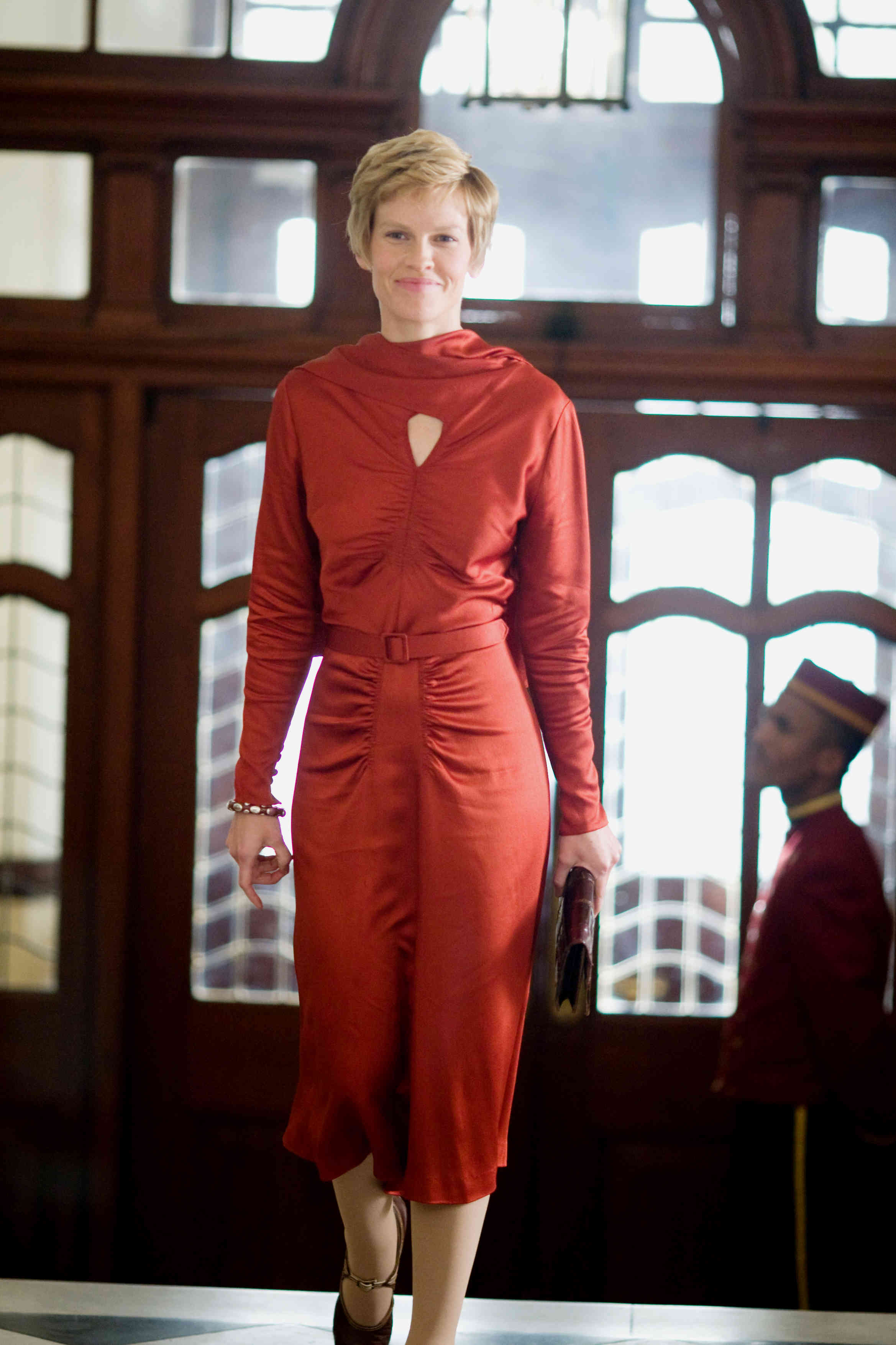
There have been enough bio-pics on Amelia Earhart that the only interest this one could hold would be in Mira Nair's presentation, or in any clarification of "The Mystery"—Earhart's disappearance during the last leg of her round-the-world flight. "Amelia" provides neither. It's is Nair's most conventional film, focussed on nailing the period details and the pictorial splendor of airborne sight-seeing. And as the particulars of the disappearance are so sketchy, the best the film can be do is merely suggestion (with a little obfuscation, but we'll get to that)*, "Amelia" comes off as a grandiose Lifetime movie—an "Aviatrix Flick"—that, while it occassionally gets off the ground, never really soars.

The problem is
Amelia, herself. After many records and accomplishments (which the movie ticks off studiously), her story ends in silence and perceived failure, which unfairly casts a pall over the woman's storied existence. And Amelia was a taciturn presence, not unlike Lindbergh, projecting confidence by competence, her super-ego revealed only in her goals. Hilary Swank is a perfect choice to play her—thin as a rail but seeming corn-fed, horse-toothed with a helmet of straw—and she obviously did her research on Amelia's voice. But Earhart's newsreel performances are merely performances and Swank's Amelia has the same air of phoniness that Cate Blanchett's Katherine Hepburn had in that other aviator movie. Richard Gere as publisher George Putnam (and "Mr. Earhart") has the same vocal problem, affecting an accent that wavers up and down the East Coast. Faring better is Ewan McGregor as Gene Vidal (father of Gore), with whom Earhart worked with the government to establish air-routes and create the first commercial airlines; that the movie makes more hay of a speculated affair between Vidal and Earhart than that accomplishment is part of the film's weakness.

The buffeting lift and drag on this film may be attributable to two strong scriptwriters building on each other's work:
Ronald Bass, who, if anything, tends to making his characters too likable, and Anna Hamilton Phelan, who doesn't (particularly in "Gorillas in the Mist: The Story of Dian Fossey"). The two seem to clash on who Earhart "is," a symbol or human being, devoted to flying or feminism, faithful or philandering. Such "takes" on her character fly afoul of the issue that the film should have focussed on and never strayed from: the "true path" of seeking freedom. It's the one through-line of Earhart's life, from childhood (which the movie skimps in detailing) on. It is only in Earhart's narration (taken from her writings, no doubt heavily influenced by publisher husband Putnam) that emphasize a still clean sky with borderless landscapes below, a world without limits on the ground or in the sky, whichever your sex. That her life on the ground is forever hemmed in, trying to secure funds for that freedom, could have made a dramatic metaphor if the film-makers had bothered to notice.

But some of it's there. Enough to inspire if one wants to look beyond the ghost of the most celebrated "Missing Person" of the last century, and see what she accomplished while she still walked the Earth and conquered the sky.

"Amelia" is a Rental.


* Quibble section: Beyond her standing in front of a Patton-esque American flag backdrop that if one were to calculate beyond the frame would indicate fifty stars, and the montage of filmed endorsements that would be created for a medium yet to be invented—and they don't explain why she came in third in the 1929 "Women's Air Derby"—the details of the disappearance are fudged a bit. Her navigator for the round-the-world flight, Fred Noonan, is depicted as drinking before the fateful flight, which, though it might have happened earlier in the trip did not re-occur preceding that most precarious of hops to the tiny Howland Island landing strip. A recent PBS documentary on a re-creation of the fateful trip (right down to the aircraft used) seemed to hint that Earhart might have ignored Noonan's inclinations to fly south of Howland, where the pilot could have sighted one of two islands that might have accomodated a touch-down, and instead flew north, decreasing their chances with a dwindling fuel supply. But that is just one more theory in the dozens that have been posited in the years to explain the failure to accomplish what was, essentially, a risky maneuver even under the best of conditions.


Tuesday, May 13, 2008

Boys Don't Cry

Boys Don't Cry, (Peirce, 1999) Teena Brandon is trouble in trouble and so is Brandon Teena. From what we can piece together about her life growing up as a girl with a sexual identity crisis and what we see on-screen of his brief time living out his dream to be accepted as a man, there are elements of character that cannot be escaped or maybe do not change, whichever gender we are. Boys Don't Cry is a tragedy.

Whether we know the real story or not, the farther you travel into the movie, the more certain you are that there is never going to be an escape. Brandon (Hilary Swank) cannot escape the prison of his body, Lana (Chloe Sevigny) cannot escape the confines of Falls City, the small mining town to which Brandon flees the 'big city' of Lincoln, Nebraska. John (Peter Saarsgard) cannot escape his sociopathic rage when his world is threatened by the arrival of Brandon.

Peirce often shows us the bare, flat Nebraskan landscape as cars race by, their headlights merging into a solid line of motion. Is it a contrast to the lives of these people who aren't going anywhere - even when they talk of Graceland and Memphis and Tennessee? Instead, they drink to get out of their heads as they lie to themselves trying to make their world a better place. Which it never is.

It's a sad and at times brutal movie that is moving without trying to be too profound about its subject matter. It is almost a love story. Almost.


Boys Don't Cry is available on DVD from 20th Century Fox.