 "Well...See Ya"
There have been enough bio-pics on Amelia Earhart that the only interest this one could hold would be in Mira Nair's presentation, or in any clarification of "The Mystery"—Earhart's disappearance during the last leg of her round-the-world flight. "Amelia" provides neither. It's is Nair's most conventional film, focussed on nailing the period details and the pictorial splendor of airborne sight-seeing. And as the particulars of the disappearance are so sketchy, the best the film can be do is merely suggestion (with a little obfuscation, but we'll get to that)*, "Amelia" comes off as a grandiose Lifetime movie—an "Aviatrix Flick"—that, while it occassionally gets off the ground, never really soars.
The problem is Amelia, herself. After many records and accomplishments (which the movie ticks off studiously), her story ends in silence and perceived failure, which unfairly casts a pall over the woman's storied existence. And Amelia was a taciturn presence, not unlike Lindbergh, projecting confidence by competence, her super-ego revealed only in her goals. Hilary Swank is a perfect choice to play her—thin as a rail but seeming corn-fed, horse-toothed with a helmet of straw—and she obviously did her research on Amelia's voice. But Earhart's newsreel performances are merely performances and Swank's Amelia has the same air of phoniness that Cate Blanchett's Katherine Hepburn had in that other aviator movie. Richard Gere as publisher George Putnam (and "Mr. Earhart") has the same vocal problem, affecting an accent that wavers up and down the East Coast. Faring better is Ewan McGregor as Gene Vidal (father of Gore), with whom Earhart worked with the government to establish air-routes and create the first commercial airlines; that the movie makes more hay of a speculated affair between Vidal and Earhart than that accomplishment is part of the film's weakness. The buffeting lift and drag on this film may be attributable to two strong scriptwriters building on each other's work: Ronald Bass, who, if anything, tends to making his characters too likable, and Anna Hamilton Phelan, who doesn't (particularly in "Gorillas in the Mist: The Story of Dian Fossey"). The two seem to clash on who Earhart "is," a symbol or human being, devoted to flying or feminism, faithful or philandering. Such "takes" on her character fly afoul of the issue that the film should have focussed on and never strayed from: the "true path" of seeking freedom. It's the one through-line of Earhart's life, from childhood (which the movie skimps in detailing) on. It is only in Earhart's narration (taken from her writings, no doubt heavily influenced by publisher husband Putnam) that emphasize a still clean sky with borderless landscapes below, a world without limits on the ground or in the sky, whichever your sex. That her life on the ground is forever hemmed in, trying to secure funds for that freedom, could have made a dramatic metaphor if the film-makers had bothered to notice.
But some of it's there. Enough to inspire if one wants to look beyond the ghost of the most celebrated "Missing Person" of the last century, and see what she accomplished while she still walked the Earth and conquered the sky.
"Amelia" is a Rental.
* Quibble section: Beyond her standing in front of a Patton-esque American flag backdrop that if one were to calculate beyond the frame would indicate fifty stars, and the montage of filmed endorsements that would be created for a medium yet to be invented—and they don't explain why she came in third in the 1929 "Women's Air Derby"—the details of the disappearance are fudged a bit. Her navigator for the round-the-world flight, Fred Noonan, is depicted as drinking before the fateful flight, which, though it might have happened earlier in the trip did not re-occur preceding that most precarious of hops to the tiny Howland Island landing strip. A recent PBS documentary on a re-creation of the fateful trip (right down to the aircraft used) seemed to hint that Earhart might have ignored Noonan's inclinations to fly south of Howland, where the pilot could have sighted one of two islands that might have accomodated a touch-down, and instead flew north, decreasing their chances with a dwindling fuel supply. But that is just one more theory in the dozens that have been posited in the years to explain the failure to accomplish what was, essentially, a risky maneuver even under the best of conditions.
Showing posts with label Mira Nair. Show all posts
Showing posts with label Mira Nair. Show all posts
Saturday, November 7, 2009
Amelia





Saturday, June 28, 2008
The Namesake
"The Namesake" (Mira Nair, 2007) Mira Nair's adaptation of Pulitzer Prize winner Jhumpa Lahiri's novel about the Ganguli family, leaving India to make a life in America, and how the two generations forgo, reject, accept, embrace and live within their Indian heritage in the Land of Opportunity. Nair's eye for telling detail and scriptwriter Sooni Taraporevala's choice of incident make this common tale, uncommon in its execution as Nair grabs random images of still lives that seem to remain while the humans in the drama change and change and change.
Particular attention is paid to the Ganguli son who is given the burdensome name Nikolai Gogol, after the writer (or just "Gogol," as he chooses to be called in childhood) and his dawning awareness of the many facets of meaning and legacy that that name has for him as it becomes associated with him in various stages of his life. He begins by seeing it as his identity; it sets him apart. Then, it sets him too apart, and he adapts it to his comfort, then as he digs into its origins, he revolts against it. The more he learns, the more he cherishes it.
Heritage and history co-mingle on life's chaotic journey; it informs and insinuates through the day-to-day business of making other plans, and shapes and colors the careers and marriages and deaths and life. The pull of the two countries ebb and flow and their primary influences on each individual change with incident.
The performances are low-key, but one becomes amazed at the subtle aging of the characters, and the familiarity of the lives led. It's a subtle, heart-warming movie that lingers in the mind, setting off little thrills of discovery.
 Mira Nair's adaptation of Pulitzer Prize winner Jhumpa Lahiri's novel about the Ganguli family, leaving India to make a life in America, and how the two generations forgo, reject, accept, embrace and live within their Indian heritage in the Land of Opportunity. Nair's eye for telling detail and scriptwriter Sooni Taraporevala's choice of incident make this common tale, uncommon in its execution as Nair grabs random images of still lives that seem to remain while the humans in the drama change and change and change.
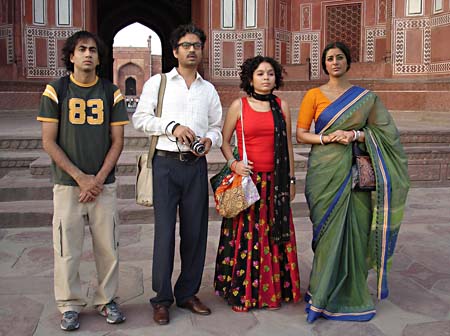

Particular attention is paid to the Ganguli son who is given the burdensome name Nikolai Gogol, after the writer (or just "Gogol," as he chooses to be called in childhood) and his dawning awareness of the many facets of meaning and legacy that that name has for him as it becomes associated with him in various stages of his life. He begins by seeing it as his identity; it sets him apart. Then, it sets him too apart, and he adapts it to his comfort, then as he digs into its origins, he revolts against it. The more he learns, the more he cherishes it.

Heritage and history co-mingle on life's chaotic journey; it informs and insinuates through the day-to-day business of making other plans, and shapes and colors the careers and marriages and deaths and life. The pull of the two countries ebb and flow and their primary influences on each individual change with incident.
The performances are low-key, but one becomes amazed at the subtle aging of the characters, and the familiarity of the lives led. It's a subtle, heart-warming movie that lingers in the mind, setting off little thrills of discovery.
Wednesday, April 23, 2008
Mississippi Masala

"Mississippi Masala" (Mira Nair, 1991)
There is so much that I liked about Mississsippi Masala that is seems churlish to be critical. It is the story of a family of Ugandan Asians expelled from their homeland by Idi Amin who fetch up in Greenwood Mississippi, living on the charity of relatives. Most of the movie takes place in 1990 and revolves around the Romeo and Juliet tale of Meena and Dimitri, a black carpet cleaner who first meet when she rear-ends his truck. Nair also shows us the circumstances of the family's expulsion from Uganda in order to introduce us to Okelo, the childhood friend of Meena's father, Jay. He is the person who persuades Jay that he must leave his homeland because 'Africa is for Africans now, Black Africans'. Yet, he is the one who rescues Jay from prison by bribing the police chief. This friendship is important because it reveals the tension that drives the movie, between what people feel about each other and what they feel about race and how these can conflict within the same person. The strength of this movie is that Nair manages to let all sides tell their own story and she refuses to be partial. We end up being as sympathetic to the Asian-Americans as to the African-Americans, to the immigrants as to the natives. The only group that comes out wholesale as less than sympathetic are the few White characters who appear. There are plenty of scenes that are well-observed such as when Meena first meets Dimitri's family at a backyard barbecue when she is interrogated by his family who are fascinated by her - the irony is that as they try to understand where she is from and what category she fits into, it is finally clear that she is the only one at the party who is truly African.
What doesn't work so well for me was first of all the episodic nature of the movie. Nair is concerned to give us a full context for the experiences of this Ugandan Asian family and so we have the sub-plot of her father's struggle to be compensated for all that he has left behind in Africa. It is rather heavy-handed as is some of the direction. There are times in the movie when the acting seems forced and awkward and you wish for a lighter hand on the tiller. However, it is a movie that is more than the sum of its parts.
Tuesday, January 22, 2008
Monsoon Wedding
" Monsoon Wedding" Mira Nair's multi-tiered middle affluent Indian wedding pic is delightful all the way around, but one is left with the nagging feeling afterwards--would a family patriarch really take the word of a niece over that of his white benefactor in the country of bride-burning? Really? Well, one is left with a hopeful picture, even if one has their doubts. Highly recommended.
 Monsoon Wedding" Mira Nair's multi-tiered middle affluent Indian wedding pic is delightful all the way around, but one is left with the nagging feeling afterwards--would a family patriarch really take the word of a niece over that of his white benefactor in the country of bride-burning? Really? Well, one is left with a hopeful picture, even if one has their doubts. Highly recommended.
Subscribe to:
Posts (Atom)