"The One with the Tiger..."
or
The Ocean in a Universe/The Universe in an Ocean
“The most terrifying thing about the universe is not that it is hostile but that it is indifferent; but if we can come to terms with this indifference and accept the challenges of life within the boundaries of death--however mutable man may be able to make them--our existence as a species can have genuine meaning and fulfillment. However vast the darkness, we must supply our own light.” -- Stanley Kubrick
"It's a story that will make you believe in God" --Pi Patel
Life of Pi, Ang Lee's new film is the best film I've seen all year, and it will take something very spectacular to displace it (which I doubt will happen). A children's film that children probably should not see, its themes are so adult—having to do with survivor's instinct (and that only reveals itself at the end)—and is presented with such a visionary sense of wonder that it is quite overwhelming. It's the most glorious, funny, amazing film that ever made me weep at the end.
Based on Yann Martel's Booker Prize winning novel, it tells of the story of young Piscine Patel, who grows up affluently in Pondicherry, India in a resort-zoo run by his family. Growing up inquisitively, surrounded by animals, he begins a personal search for God that links him with several religions and interpretations of God.
He'll need all of them on his journey.
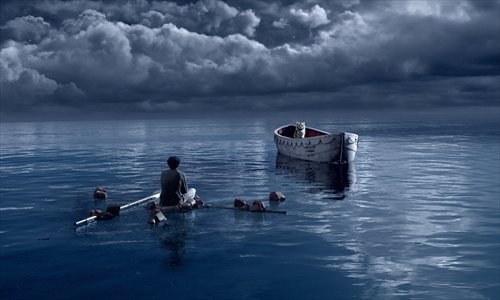
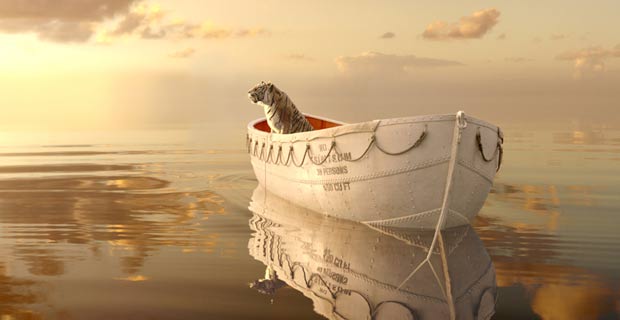
Political struggles in India leads the father to sell the zoo and embark for work in Canada, taking many of the animals with them on a Japanese freighter. The crossing becomes disastrous, the ship being capsized in a storm, leaving Pi, Ishmael-like, on a life-raft with a few stowaways that he rescues after the sinking. But, before long, it's just him and a Bengal tiger.
The journey then becomes a struggle for the two to survive, learning to cope with the hardships of surviving, stranded at sea, without killing each other.

Lee has done wonders with CGI before, but (like Cameron and Scorsese before him), he also manages to make the 3-D element become an integral and, (this is a surprise), necessary function of the film, weaving it into the narrative, like tapestry, and giving the film a sense of scope and scale across time and space that, frankly, I've never seen anyone try before.
Now, the film is controversial in some parts: the critic for "People" magazine has written they "just hate" the ending, and I've read a few other reviews that have praised the film to the heavens, with some hedging about the ending not fulfilling the promise of the rest of the movie. They're missing the point, and in their defense, the visuals have a way of seducing and comforting, but also distracting from what is important (like any good belief system). The ending is part and parcel of what the movie is about, which is finding the path to make peace with the world by any means necessary, even if it is by using a little imagination and the application of myth and story-telling—to see things a little differently and make sense of an indifferent Universe. Pi's search for God in his youth prepares him for the trials of surviving the ship-wreck, submerging his grief, and the movie's story of his 221 day journey—a speck in the vast ocean—is a fable reflecting the life-journey for all of us, adrift or under sail, whether charting our course by our stars, our God, or our selves.
Life of Pi is a Full-Price Ticket-see it in 3-D.




_-_Theatrical_Trailer_2_for_Life_of_Pi/300px-Life_of_Pi_(2012)_-_Theatrical_Trailer_2_for_Life_of_Pi.jpg)