Showing posts with label Tyrone Power. Show all posts

Saturday, April 14, 2012

The Rising of the Moon

When Orson Welles was asked what movies he studied before embarking on directing Citizen Kane he replied, "I studied the Old Masters, by which I mean John Ford, John Ford, and John Ford."  Over the last three days we've been looking at little-seen films from The Old Master, each different in tone, temperament and subject matter, but all unmistakably the work of America's storied film-maker, the irascible, painterly, domineering, sentimental puzzle that was John Ford, John Ford, and John Ford.

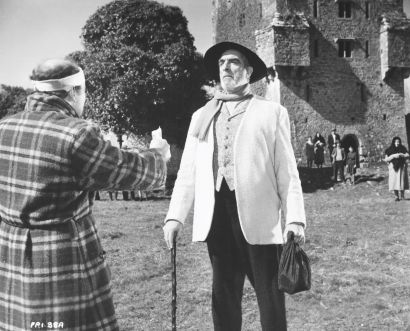
The Rising of the Moon (John Ford, 1957) Interesting, charming anthology film from Ford, featuring three short stories (of approximately thirty minutes each) from the Emerald Isle.

Ford was able to parlay his success with The Quiet Man—made on a shoe-string (and with a Western in the bargain for Republic Pictures) and reaping a pot of gold—to make this labor of love to promote the Irish film industry, with a cast of actors from the country's Abbey Theater (which figures prominently in the film's third sequence).  As a carrot for American audiences, Ford uses Tyrone Power as a presenter for each of the stories, each different in tone and style, but bearing Ford's ability to bring out the best in his cast, while also keeping a reign on several threads of character arc interlacing throughout each tale, to make a verdant pattern full of blarney.  Each one also has a distinct style of shooting, one landscaped, one close-quartered, one urban and chiaroscuro, that slyly reflect themes and moods of the story, even if the whimsy is a constant factor.

The three stories are thus: 

"The Majesty of the Law"—A police inspector (Cyril Cusack) ventures to the country-side, wind-blasted and rough-hewn to arrest a man for assault.  He attracts the interest of some locals, briefly toys with a rapscallion (Jack McGowran) who is trying to avoid him, then visits an old friend to shoot the breeze.  Things are not what they seem, and the segment ends on a complicated note.

"A Minute's Wait"—A busy, typical day at Dunfail station.  A brief stop-over opens the bar and the train empties of passengers.  Then things get complicated involving a match-making minister, a honeymooning British couple, young lovers, a goat, and a ghost story-in-passing.  Just when things get resolved, more complications ensue, and the train is delayed another "minute's wait."  The train empties again...and again...and again, as places change, stories get crossed, and get schedules get thrown out the window, while everyone gets increasingly drunk.  Man schedules, God laughs, and life gets in the way...and nothing is stationary.

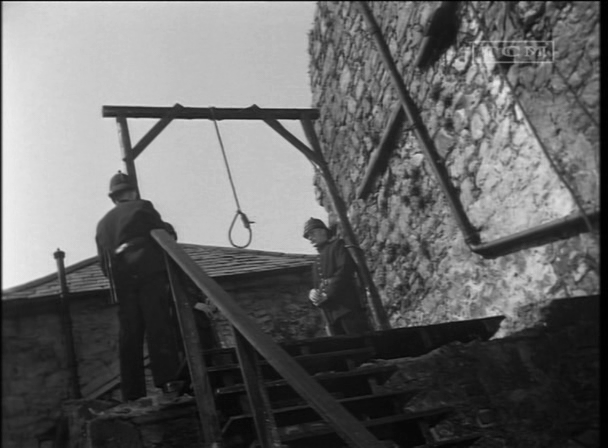
"1921"—The entire world seems to be a little off-kilter and threatening to fall into the abyss in this story set during the Black and Tan Wars, and the height of the British/Irish conflict.  Sean Curran (Donal Donnelly) is set to be hung for treason.  A snaking queue of townspeople parades in protest in front of the prison as the scaffold is prepared  ("That step is loose.  Fix it or he'll break his neck before he falls" says the Irish prison functionary in a display of gallows humor) Curran is set to hang and the Brit overseers are feeling the pressure keeping the lid on a situation that could quickly get out of hand.   A visitation by nuns, one of them Curran's sister inflames events and the intrigue moves to the streets as the Army presence builds up and loyalties are tested.  "There's a little treason in all of us," says a local bobby working for the Brits, summing up the situation and the tale.

It's great story-telling all the way through, with nothing familiar in the Ford crowd-pleasing arsenal: no John Wayne hook, no western fallback, no Ford stock company dependence, just the Old Master weaving his magic, with an artist's eye and a director's sense of pace, detail, and theatricality, each episode given its own look and feel, everything fresh, but rooted in the man's   presentation and gifts, unfamiliar, yet unmistakably Ford country.

Psycho is not my favorite Hitchcock film, but I revere it as a display of the director at the top of his story-telling gifts and mastery of the form.  In the same way, The Rising of the Moon shows Ford's abilities to play with the arts of tale and film, and is the purest example of the director's gifts..and his craft.   

Wednesday, August 31, 2011

The Razor's Edge (1946)

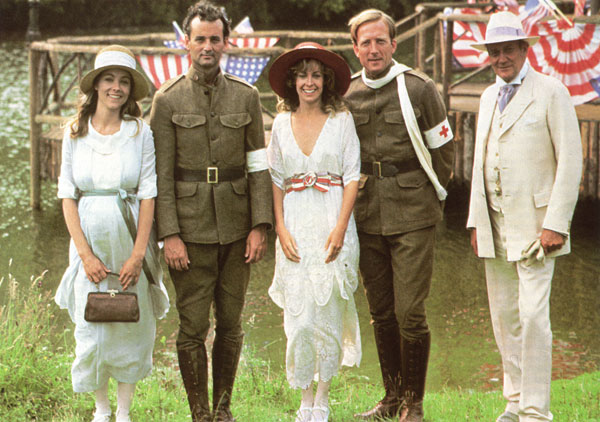
The Razor's Edge (Edmund Goulding, 1946) "The Razor's Edge" is a favorite book of mine, one I was inspired to read after a disappointing film adaptation, starring Bill Murray, who stood out from an otherwise respectful version like a howling sore thumb.  But, it had been filmed before, in 1946, under the tutelage of producer Darryl F. Zanuck and directed by Edmund Goulding, only two years after the novel's first publication.

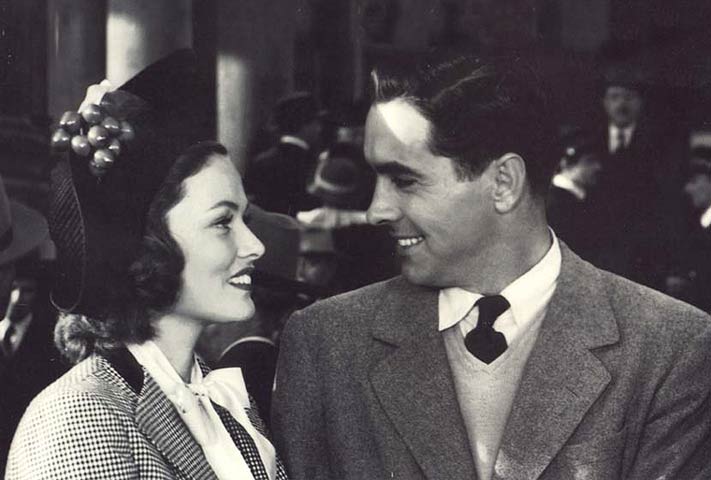
W. Somerset Maugham's book documents (in absentia) the travels of Larry Darrell (played in 1946 by Tyrone Power), who returns from pilot duties during World War I,* deeply affected by the death and devastation he's seen, and takes a period of time to "find himself"—a lot of time.  This seems odd to his high society friends, especially the family of his fiancee, Isabel (Gene Tierney), who can't seem to understand why Larry won't settle down, put his nose to the grindstone and make sure that she gets to live in the manner she's accustomed to.  Larry travels to Paris, ostensibly under the supervision of Isabel's prissy Uncle Elliott (Clifton Webb) (who does NOT approve), but Larry would rather live the life of a bohemian, working menial jobs.  After a year's separation, Isabel comes to visit and is appalled by Larry's simple living conditions.  She breaks off the engagement after taking one last attempt to seduce Larry back to her way of thinking, then returns to Chicago, where she marries Larry's millionaire friend.

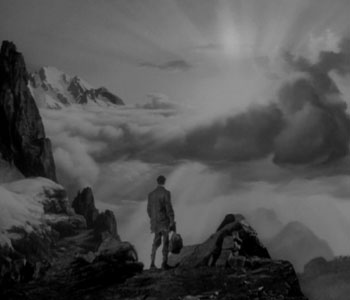
Larry continues his life in Paris, still searching for answers.  Eventually, he makes a pilgrimage to India,** where, after studying and living a monk's existence in the Himalayas, he achieves a measure of happiness, finds his answers and returns to Paris to find that Isabel and her husband have lost everything in the 1929 crash, and are now living off her Uncle's charity.  His old friends have all suffered various tragedies and are at a loss how to cope...and Isabel still loves him, complicating everyone's lives.

The Goulding version hews fairly close to the book, smoothing the rough edges that might have ruffled the feathers of the Hays Office, and implying what could not be said in Maugham's book—Uncle Elliott's gay, Isabel is a too-willing adulteress, and their mutual friend Sophie (Anne Baxter), who suffers her own tragedies, has turned to drink and prostitutionLarry would seem to be the answer to everyone's problems, but he knows that the problem lies in living in a material world and the cheapening of human life to get ahead.  And the 1946 version also includes one character that the '84 version excluded—the author (played by Herbert Marshall).  Maugham wrote "The Razor's Edge" as a roman a clef, an observance as he made his way between world wars through society as a successful author, settling in Paris and the Riviera.  The post-war version relies a bit too heavily on him, while the John Byrum version with Murray manages to make due without.  The author becomes a sounding board in the book and first film, revealing characters' innermost thoughts—a little too forthcoming, actually (one should never get too cozy with an author)—and revealing a little too much about what they're feeling.

Power is a good Larry, but not a great one (whereas Bill Murray could have been great, if his propensity for ad-libbing goofily hadn't gotten the better of him).  It's a little too hard to distinguish just what about him changes from "troubled" to "enlightened," other than a little too much intensity in the eyes.  Not the greatest of emoters, his war-weary Larry seems merely peeved and a shade brittle, but his post-pilgrimage Larry seems not so enlightened as slightly moony when reflective and somewhat superior and self-satisfied when things go his way.  Gene Tierney's Isabel seems far more shallow than the actress is capable of and when she turns vindictive, its done with a raising of the eyebrows and a haughty air—it's more a pose than a performance (as opposed to Catherine Hicks who wasn't afraid to make Isabel conspiratorial.  Clifton Webb has as much fun with Templeton as Denholm Elliott did (a role John Gielgud coveted), and Anne Baxter has some very good moments as Sophie, although her theatricality gets the better of her in the more demonstrative scenes (it did win her an Oscar, though), but she doesn't hold a candle to Theresa Russell's "fragility with a spine" Sophie.

One comes away with no definitive screen-version of "The Razor's Edge:" you'd like to take the supporting cast of the 80's version, find a new Larry and keep the later's travel footage as a replacement for the pristine (and wholly set-bound) ashram from the '46 version (were they trying to evoke Shangri-La from Lost Horizon?  Why does it look like a Hollywood hotel lobby designed by Frank Lloyd Wright?).  The dissatisfaction is high with both, with flaws impossible to overlook, but there is a great movie in there somewhere, and each film supplies some answers to what that might be like. 

The pilgrimage continues. 


* In the Murray version, he was an ambulance driver.


** In the the latter version, he goes to Tibet.


Thursday, June 16, 2011

Witness for the Prosecution (1957)

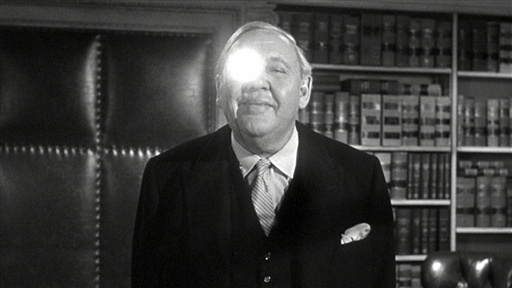
Witness for the Prosecution (Billy Wilder, 1957) Lady Justice is having some work done as we first approach "The Old Bailey," where the majority of the drama for Witness for the Prosecution takes place.  Good thing, too, although some attention should probably be paid to the legal loop-holes that keep cropping up inside the chambers.  This Agatha Christie-penned theater chestnut is given a nice presentation by Wilder, who has added much comic-relief in the form of giving brilliant barrister Sir Wilfrid Robarts, QC (Charles Laughton), a nurse after a debillitating heart-arttack (played by Laughton's wife, Elsa Lanchester).*

It was the third re-write of the story in as many adaptations, starting with Christie adding a justifiable coda to her original story for the theater adptation, and Wilder providing further complications in order to have Lanchester's presence, and giving Marlene Dietrich a song and a romantic scene with Tyrone Power in flashback (although both actors can't really pull off playing young at this point in their careers).

And that's an interesting point: the acting is what this one is all about.  This is Power's last completed film, and his anguished defendent is an interesting mix of distraught agitation and Big Studio Heart-throb mannerisms.  Laughton's performance is hilarious and dry as vermouth, while Lanchester fusses and kvetches

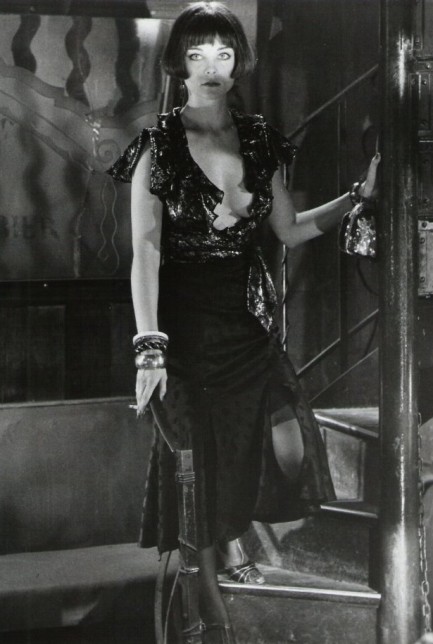
And Dietrich is as cool as can be.  Quite past her prime as a fascinating beauty, she is still fascinating, playing her Christine Vole as cold and aloof—Dietrich excelled at that, but with a simmering quality underneath the surface, especially in her work with Joseph von Sternberg, like an iceberg with a volcano at its heart.  She always was just on the edge of camp-sexiness,** but the heavy lidded smoldering eyes always had an air of superiority that were deadly serious.  And those eyes are still in play here, never revealing much, and keeping the characters and the audience off-guard...and then on, especially when she turns on the dramatic fire-works in the latter stages of the film.

Laughton and Lanchester were given Oscar nominations for their performances,*** but I'd make a case that Dietrich was robbed of a nomination—maybe because of the stunt-casting, the nature of the part, but also...maybe...because they didn't recognize how good she is.

* Er...she plays the nurse, not the heart attack...

** Her mannerisms were devastatingly lampooned by Madeleine Kahn in Blazing Saddles.

*** He lost to Alec Guinness for The Bridge on the River Kwai, and she to Miyoshi Umeki for Sayonara.  Can't argue with the first one.