 The Island of Lost Souls (Erle C. Kenton, 1932) You gotta be careful who you meet in your travels. As they say in Casablanca, there are vultures...vultures everywhere. Thing is, on The Island of Lost Souls (based on H.G. Wells' oft-filmed "The Island of Dr. Moreau"), they just might be vultures, literally.
Or, at least, some human-vulture hybrid.
Edward Parker (Richard Arlen), though, will take any port in a storm. Ship-wrecked, he's picked up by a freighter delivering supplies to a nearby island. After Parker causes some trouble after seeing the Captain attack one of the crewmen, he is thrown off the ship to the boat that meets it to pick up the supplies. It is manned by Montgomery (Arthur Hohl) and Dr. Moreau (Charles Laughton), and the doctor is only too happy to take the ship-wrecked Parker to his island.
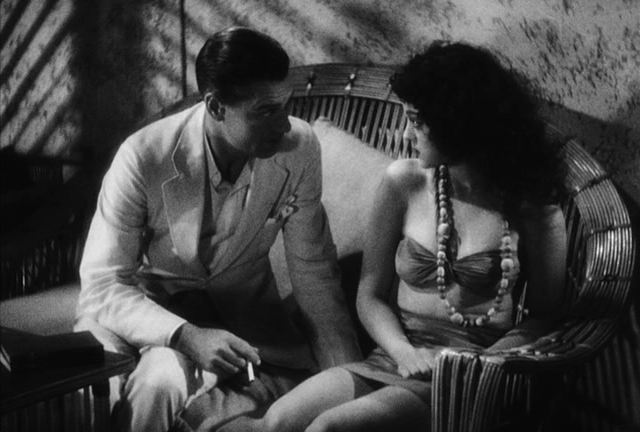
It's not a pretty sight. All jungle and dark and creepy, until Moreau introduces him to a young native named Lota (Kathleen Burke), who is entranced with Parker. While Parker tries carry on a conversation with her, screams are heard, which frighten them, but mostly Lota who enigmatically says that they come from "The House of Pain."
Parker investigates and finds Moreau and Montgomery performing surgery on a strange creature on an operating table. Alarmed that his host is a madman, Parker tries to leave the island but is stopped by a crowd of deformed brutes, until Moreau appears, cracks his whip and forces the creatures to obedience, making the Sayer of the Law (Bela Lugosi) recite the rules, which are echoed by the other creatures:
Not to eat meat, that is the law. Are we not men?
Are we not men?
Not to go on all fours, that is the law. Are we not men?
Are we not men?
Not to spill blood, that is the law. Are we not men?
Are we not men?
"Are we not men?" Not just a Devo lyric (remember this was 1932. slightly before "their time"), but a profound question of identity. Turns out Moreau is a mad-man with God aspirations, an anti-Frankenstein, the difference being the German doctor was trying to bring life back from death, whereas the doctor with the South Seas practice is altering life, trying to "do" Darwin generations faster by "un-natural selection"—surgically, chemically, any way he can think of, attempting to turn animals into homo sapiens.
And doing a bad job, by the looks of it. The pre-code movie Moreau presages Dr. Mengele's work for the Nazis by a few years, with vivisection as a specialty, and dictator as a hobby.* Having started with plants and moving on in his designs, his hybrids live as beasts and only the one subject that has yielded the best results—Lota, "the Panther Woman"—has met his standards. Sociopathic in his methods, Messianic in his goals, he sees throwing Lota at Parker as an experiment in biology. Nothing more. And Laughton plays the scene like an avid voyeur.
Subsequent films have been make-up experiments to see how realistically latex can be applied to actors to make the illusion playable. The Island of Lost Souls does a fine job of it, but is expressly concerned with making the hybrids monsters, and the situation nightmarish (as opposed to believable). Realism isn't the goal with this version, so much as driving home the point of the novel (although Wells thought the result was completely different. burying the novel's intentions in horror—he was spared having to see the other versions).
 |
| This movie inspired the phrase "The natives are restless." No. Really. |
* "Moreau" has been filmed a couple times (once with Burt Lancaster and most recently with a risible Marlon Brando as Moreau, that was frankly a bit incomprehensible), but those times the methods have been "magical" injections that can turn men to beasts and/or vice versa, more in tune with Dr. Jekyll than Dr. Moreau. Supposedly, there's a new one in the works from Leonardo DiCaprio's company.




_05.jpg)