Showing posts with label Guy Ritchie. Show all posts

Thursday, December 22, 2011

Sherlock Holmes: A Game of Shadows

Bullet-Time
or
"Forewarned is Fore-armed (and Don't Call Me 'Shirley')"

"'Well, well,' said he, at last. 'It seems a pity, but I have done what I could. I know every move of your game. You can do nothing before Monday. It has been a duel between you and me, Mr. Holmes. You hope to place me in the dock. I tell you that I will never stand in the dock. You hope to beat me. I tell you that you will never beat me. If you are clever enough to bring destruction upon me, rest assured that I shall do as much to you.'

"'You have paid me several compliments, Mr. Moriarty,' said I. 'Let me pay you one in return when I say that if I were assured of the former eventuality I would, in the interests of the public, cheerfully accept the latter.'

"The Final Problem" Sir Arthur Conan Doyle


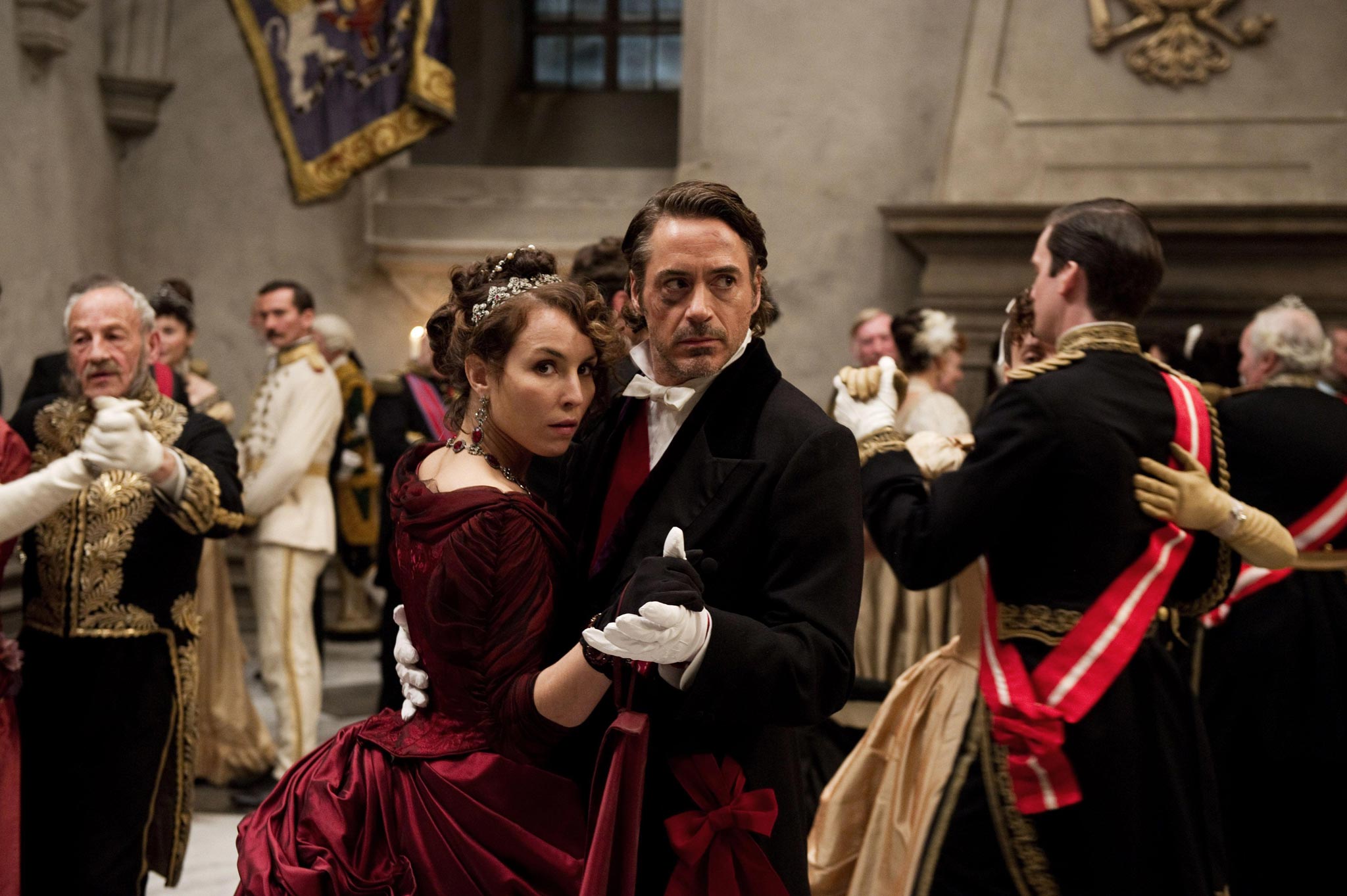
Sherlock Holmes: A Game of Shadows is the inevitable (and one should say quick-on-its-heels) follow-up to Guy Ritchie's Sherlock Holmes, and as an adaptation of Conan Doyle's "The Final Problem," It has as much source-relationship as the later Bond films have to Fleming—the bare-bones structure is there, but it's pumped, plumped, and trumped-up to fulfill the needs of action, humor and modern audience identification.  Really, "The Final Problem" is enough, we don't need the world-conquering machinations of Professor Moriarty (The Napoleon of Crime, the Scourge of London, and Holmes' best match) to make him a worthy adversary.  He merely needs to be omnipresent by means of his web of chicanery, rather than an omniscient history-maker.  In fact, Conan Doyle's Moriarty would rather his bad work went undetected, as opposed to this movie's version producing a shattering World War.  Here, in the words of Robert Downey Jr.'s Holmes, the plot is "so overt, it's covert," involving twins who aren't twins, TB, the Romany, anarchists, darts for various purposes, intricate explosive devices and not-so-intricate shell-firing ones, countries that can't be named ("although they speak French and German"), and the prospect of "war on an industrial scale."

20/20 hindsight always looks like genius when set in the past.

Actually, it's pretty clever how the doom-laden inevitability of "The Final Problem" is translated into the fore-shadowing of the war-torn 20th Century (the screen-writers are the wife-husband team Michele Mulroney and Kieran Mulroney*), and its focus on large artillery and semi-automatic "machine-pistols" has a nice hard edge as opposed to the original film's emphasis on the psuedo-occult.  But, director Ritchie seems to have lost of his somewhat, the fight-sequences (there are many) are nicely fore-shadowed with flash-cut Holmsian cognitive pre-functioning, but when the fisticuffs and baritsu moves start flying, the action is hard to follow, even when the action is slowed to a crawl—there is far too much ramp-editing and Matrix-y "bullet-time" FX in the film for no good purpose other than to slow down the practical and digital effects and give us the illusion of "wow, that was close." (Thanks, we assume that fire-fights and shellings are dangerous things).  However fast the editor can manipulate images, one still gets the impression of the film being a bit too "fussy" for its own good, delaying information or simply obfuscating it for a later time, giving one the impression that one is seeing a lot of the movie twice.  Efficient, it ain't, even if the titular character is supposed to be the heighth of it.

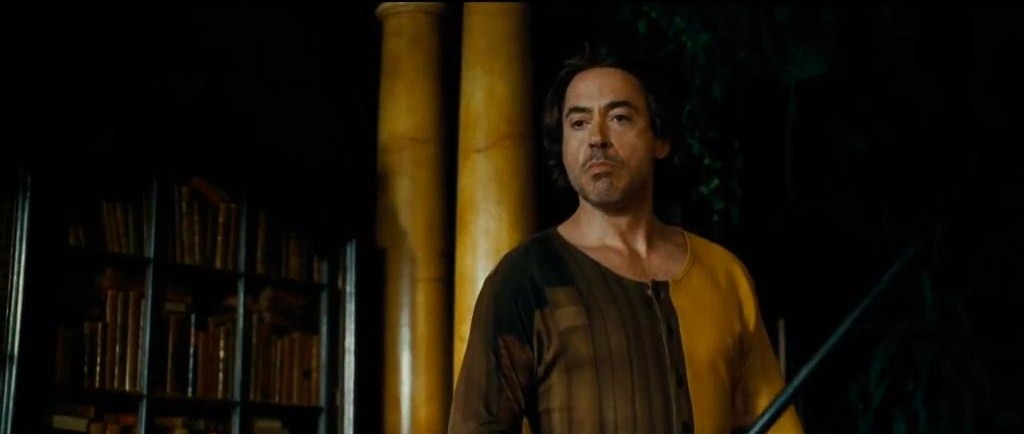
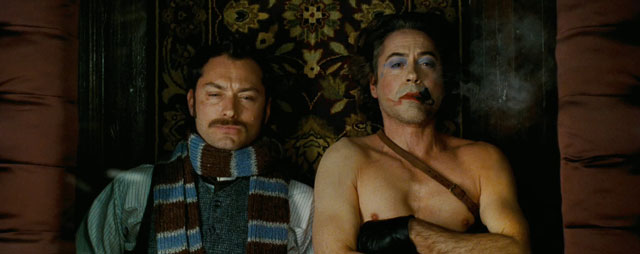
Also, although the first of Downey's adventurings could be seen as being a nicely nuanced (if scruffy) interpretation of The Great Detective, here the character is allowed to go a little more broad, dressing in comedic drag ("I admit, it's not my best disguise") and another, which is actually taken from The Pink Panther series (mind you, Steve Martin's "Pink Panther" series), the comedy is played up and not necessarily in character, and Holmes is seen to be practically infallibleeven his getting seriously hurt is all part of his plan.  

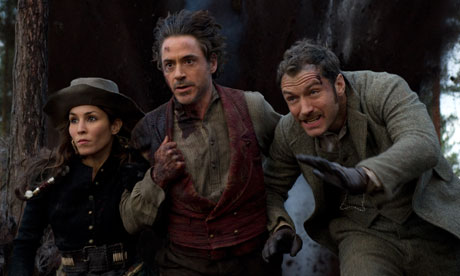
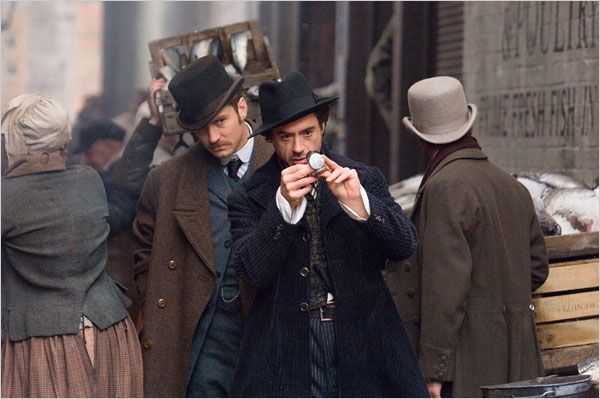
Downey, Jr. is great at playing this, even if it's a more absurd version of Holmes, and Jude Law again plays Dr. Watson (now with a severe limp and who is only now about to be married to Mary Morston, again played by Kelly Reilly) and it's one of Law's best performances, quick as Downey and capable of the slowest of "burns." Law's role is expanded somewhat and he makes the most of itThe two are joined (briefly) by Rachel McAdams, reprising her role as "the woman" Irene Adler, but is soon replaced by Noomi Rapace's gypsy princess Simsa.  Aiding and abetting is Stephen Fry, as Holmes' smarter, drier brother Mycroft (it might actually be considered type-casting), with Jared Harris as the coolest of Moriarty's (Brad Pitt was initially considered for the role), as well as being one of the youngest.

As fun as it is, one can't help but look at it as a step down—the filmmakers are getting further afield of the Holmes characterization, and it's only a matter of time before the Downey, Jr. version is locked into buffoonery and slapstick, and it comes perilously close to teetering off the edge here.  As it is, this plot is more reminiscent of the Basil Rathbone films set during WWII, entertaining if anachronistic fluff.

Sherlock Holmes: A Game of Shadows is a Matinee.


Paget's Strand Magazine illustration of the first of two Holmes-Moriarty encounters.

* Kieran is the brother of Dermot Mulroney, husband of Michele, and you may best remember him from "Seinfeld" as the fellow who gets bent out of shape at a funeral reception when he see George Costanza double-dipping a chip.

Wednesday, December 30, 2009

Sherlock Holmes

"The Lord, The Woman, the Ginger Midget and the Parisian Giant"
or
"The Peripatetic Plot of the Madonna's Husband"


The wife and I have been looking forward to the new "Sherlock Holmes" with anticipation and dread. We're both fans, though hardly "Baker Street Irregulars," and Robert Downey Jr. is always worth watching—even when he's not, able to suck nuance out of even claustrophobic camera set-ups and able to project a fiendish intelligence out of every role. Fans of the Great Victorian Detective, we've liked several incarnations—particularly Jeremy Brett's encyclopedic and eccentric interpretation, and suffered through the attempts to get another Holmes series started. Brett left a long shadow—one that not even a good choice like Rupert Everett could dispel.* And clues in the trailer led one to deduce that they would try and make Holmes more of an action figure than Conan Doyle might have intended—more like a Bourne-again Holmes than the amateur pugilist of the books.

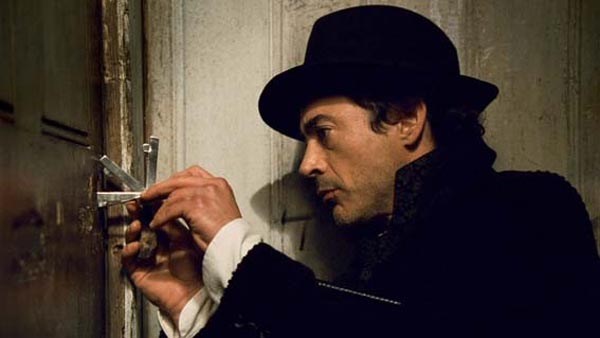
There are elements of that here, but done cunningly by writers Michael Robert Johnson, Anthony Peckham, and Simon Kinberg; Holmes, ever the synthesizer of information-bits diagnoses his battles first using his observations of his opponents, then carries them off with judicious speed, making note of their potential recovery time, both physical and psychological. Neat touch that, as is a nice summing up of Holmes' misanthropic characteristics—sitting at a restaurant table awaiting Watson (Jude Law,** as good as Law has ever been) and his intended, Mary Morstan (Kelly Reilly),*** Homes observes every argument, every petty theft, every peculiarity of his fellow diners—without his mind disciplined in pursuit, the vagaries of the world must drive him mad. Both Robert Stephens and Brett maintained that the difficulty in playing Holmes is that there is no center to him—a brain with no heart. Bur even an unbridled intellect must react to the world, and in Downey, jnr. there is quicksilver in those reactions.

The game that is afoot is one that will challenge Holmes to his core in a battle of facts and logic against magic and the dark forces.**** When we first see Holmes and Watson in action, they disrupt a ritual sacrifice by the fiendish Lord Blackwell (Mark Strong), who is already responsible for three murders before the fourth is disrupted. Sentenced to hang, Blackwell informs Holmes he will rise from the dead to usher in a new destiny for England. Holmes is skeptical, but intrigued, especially after Blackwell is hanged, declared dead (by Watson), then escapes his coffin. At a time in History, when engineering marvels such as London Bridge are being accomplished, it seems more imperative than ever for Holmes to dispel the superstitious.

Disrupting his concentration is a visit by
the one woman who has out-foxed Holmes, Irene Adler (Rachel McAdams, far too contemporary an actress for the part—one expects her to huff and say "whatever..." at any moment), in the story "A Scandal in Bohemia." Adler is an adventuress, to be sure, but she is almost a secret agent here, more in line with the fictional series of stories that been built up around her by Carole Nelson Douglas.

There is far less drawing-room discussion and far more darting about and cane-dashing than in previous incarnations.
The humor is amped up considerably, and the effects of injury down-played, but for all that it's a good representation of Holmes, adrenalized and puffed up as it is. Guy Ritchie shows that he has evolved from mumbling street-thug films to something with more than empty panache. His breathlessly paced opening half of the film stumbles somewhat with an extended fight with a Parisian giant, but manages to regain its footing with some genuinely well-done sequences that manages to clue the audience in to eke out its suspense. There has been some criticism of late that Ritchie doesn't have the depth or focus to pull off a big-budget film, although he's been angling for them for years. "Sherlock Holmes" is his defiant reply.

And not only are
Law and Ritchie showing their best games here—composer Hans Zimmer, long an adherent of the generically grinding over-the-top symphonic score (he supervised all three "Pirates of the Caribbean" scores, which, frankly, are hard to tell apart), his work for "Sherlock Holmes" is folk-song based, with clever rhythms and instrumentation—kudos to orchestrator Kevin Kaska—that keeps the period alive amidst the clutter of the art direction.

Fans of Sherlock Holmes can relax.

"Sherlock Holmes" is a Full-Price Ticket.


* Although I'd like to see Ralph Fiennes, or better, Daniel Day-Lewis, try.

** Law appeared in the Granada version of Doyle's "The Adventure of Shoscombe Old Place."

*** Although why Watson feels the need for Holmes to meet her in the first place is rather odd. She did, after all, hire him in "The Sign of Four."

**** Conan Doyle's stories focussed on matters that challenged the societal structures of Victorian England and elaborate plots of thievery, and rarely dealt with the occult, although some of the modern stories—like "Young Sherlock Holmes" (1985), which also featured an occult presence, as it was produced by Steven Spielberg, not long after "Indiana Jones and the Temple of Doom," have featured Holmes against more supernatural threats. There was always that element to Doyle—such as the monstrous "Hound of the Baskervilles"—but they were usually explained away in bursts of Holmesian fact-checking.