Showing posts with label 1954. Show all posts

Tuesday, November 26, 2013

The Adventures of Robinson Crusoe (1954)

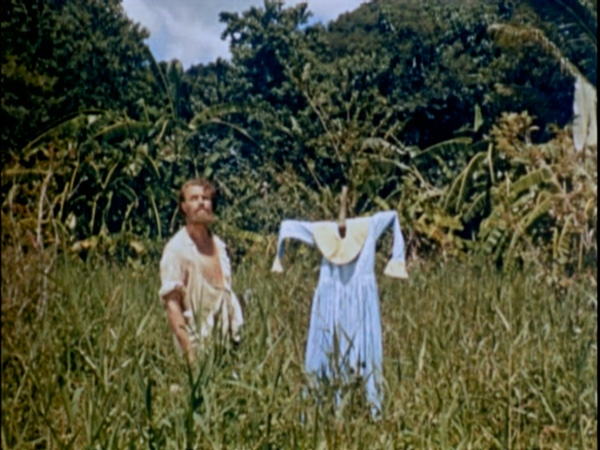
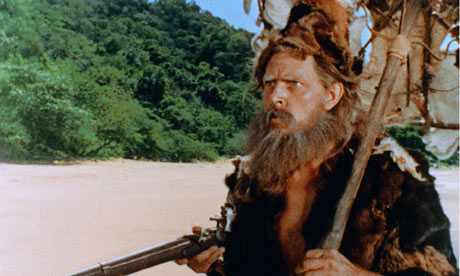
The Adventures of Robinson Crusoe (Luis Buñuel, 1954) This is another of those films that seems to be remade every few years (the attraction of the property being in the public domain is irresistible), but it would be tough from an overall perspective to improve on Bunuel's English language version (which was also made in the director's native Spanish) from 1954.

The story is familiar to everyone (it's been around since 1719)—of the British sailor who is stranded on an island after his ship is wrecked and must eke out an existence there without hope of rescue, despite his lack of experience taking care of himself.  Also, there is the man "Friday," who eventually becomes his companion on the island, leading to the "noble savage" mythology that is trucked around whenever somebody wants to point to relative "worth's" of races within the humanoid one.  

But, Buñuel, one of the peskiest of directors has nothing to do with all that, and the surrealist—and realist—in him, takes this Robinson Crusoe to some little-known parts of the island in this version of the adventure.  For example, Robinson Crusoe is on that ship as part of his work as a slave-trader, its wrecking serving as some kind of retribution for its business, and his exile a learning experience for what it is like for a man to have no choices in the world.  

Crusoe is able to swim back to the ship to get a good amount of supplies before it finally succumbs to the sea, and manages to rescue a cat, Sam, from the wreckage.  Once back on his island, with a raft so piled with supplies that it must have been in constant danger of sinking, he finds the Captain's dog, Rex, has also survived and made it to land.  With that troika of inhabitants comes the most interesting part of the film, where Crusoe explores the island, sets up fire-stations in case a ship should sail by, hunts game, starts to raise livestock from the wild goats that live on the island, builds a walled compound around a make-shift cave where he lives.  When he runs out of bread from the ship, he starts to raise his own wheat and grain and makes his own.  A rescued bible provides study, and he even takes up pottery.   He has a lot of time and quite a bit of resources.

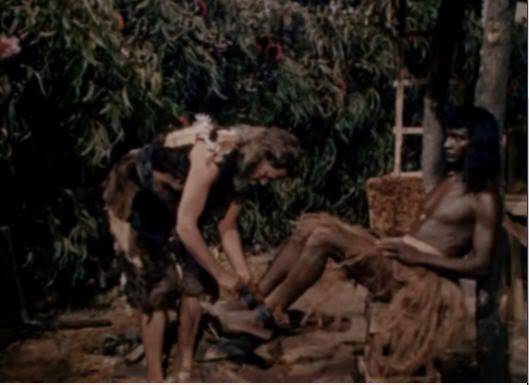
Years go by.  Rex dies of natural causes, and Crusoe keeps to his daily routine, living well if eccentric in his ways, until one day he notices that his island has been invaded by cannibals.  Being so industrious, you'd expect him to maybe start a small business, given the new source of traffic, but, instead he manages to rescue one of the intended victims and names him "Friday"* (Jaime Fernández) after the day of the week on which they met (Crusoe has an elaborate calendar).


Not sure of Friday's eating habits, Crusoe returns to his old ways and puts the native under metal restraints that he carried over with him from the slave ship.  Before long, he learns to trust the man, and one begins to wonder what the hierarchy between them is.  The native is "Friday." Crusoe is, disquietingly, "Master."  When Friday is barbering Crusoe's hair and the voice-over says it was a sublime time on the island, one is about to protest, when he gets up, the two exchange places and the former slaver cuts Friday's hair in reciprocity.  Buñuel, you crafty old Marxist. "We found that two working together could do much more than working separately."  We won't spoil the part where Crusoe and Friday debate the Bible.

And as far as surrealism, the closest Buñuel comes to it is in a Crusoe fever-dream, where he is warned by his father (also played by O'Herlihy) never to stray from his native land (Buñuel, a Spaniard was living in Mexico City at the time, after spending a few years in the United States) with the sequence intercut with shots of the father (or is it an elderly Crusoe) drowning.

O'Herlihy is mostly known for his later career of playing ancient, menacing autocrats, but here he is a revelation, and it is, frankly, amazing that the film had enough attention that he was nominated for a Best Actor Oscar, the same year as Bogart for The Caine Mutiny, Bing Crosby for The Country Girl (an amazing performance, that), James Mason in A Star is Born, and the winner, Marlon Brando for On the Waterfront.  Tough year.

It's interesting to note that Robinson Crusoe on Mars has a release in the Criterion Collection (not to quibble, I regard RCOM fondly), but this adult-oriented family film by one of the great directors of the 20th century is not.


*But, not T.G.I. Friday, because that would be something of a sick joke that nobody'd get until they invented shopping malls.

Thursday, March 1, 2012

Them!

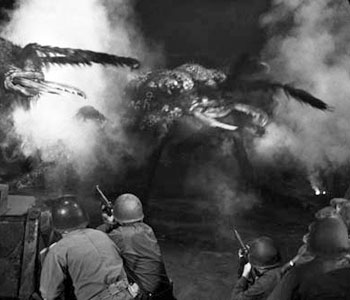
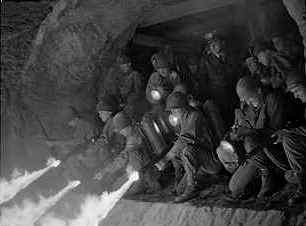
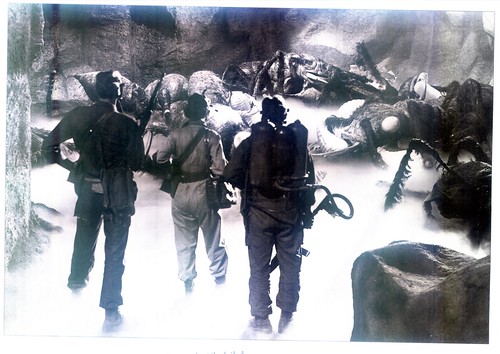
Them! (Gordon Douglas, 1954) "When Man entered the atomic age, he opened a door into a new world. What we'll eventually find in that new world, nobody can predict."  What no one could predict is that giant atomic-mutated ants would spoil The Big Picnic.  Somehow, one expected the splitting of the atom to have more profound effects.

But nature abhors a vaccuum or tampering with things on the atomic level, and, apparently, so did the world-wide movie industry, because, by 1953, two films that displayed horrific effects from atomic testing exploded on (appropriately, I guess) American and Japanese theater screens: The Beast from 20,000 Fathoms (Eugène Lourié) and Gojira (Ishirô Honda).  Neither film exactly bombed.

And as The Bomb (and a popular 1952 re-release of King Kong) begat The Beast..., so did that Warners film beget Them! (which became Warner Brothers' box-office champ in 1954)*, inspiring a subsequent fallout of atomic themed films featuring Incredible Shrinking and 50 ft. metamorphoses that have had a half-life of (going on) 60 years.  Them! may not be the glowingly cheesiest of them all—some of the writing's not bad, and despite the subject matter, some of the performances are surprisingly good—but, then, what can you expect with such an early entry in the genre, everybody was trying hard, and the writers managed to throw in some scientific fact mixed in with the hokum.  But, it does have an exclamation mark in the title, which immediately makes it suspect (although, next week, we will look at a movie with such punctuation that plays it absolutely straight).


And it has a good intro: a little girl (Sandy Descher) is found by police wandering in the desert, mute, in shock.  Tracing her back to the family trailer (!), they find it split open—but from the inside.  Hmmm.  Mystery abounds, and at one point Sherlock Holmes is invoked (appropriately, as he once had to do battle with The Giant Rat of Sumatra, "a story for which the world is not yet prepared").  But, you can't hide a gargantuan ant for very long, not even in the desert, and soon the local constabulary and the army (with the help of a couple of myrmecologists (you know, "ant-thropologists") take on the formidable formicidae with all manner of WWII surplus—flame-throwers, bazookas (that look really cool!), cyanide gas cannisters, and rocket-propelled grenades—one wishes for the huge Monty Python foot to appear, or a monstrous can of Raid...better yet, turn New Mexico into a giant ant-farm!  They is no trying to "negotiate" with the ants (it was the 1950's, after all, at least they weren't hauled up before the House Un-American Activities Committee), and even one of the scientists—the cute female one (Joan Weldon), after making her observations, documenting them, and taking her corroborative pictures,** turns to her companions with the flame-throwers and says, "Burn it.  Burn EVERYTHING!"  O-kay...


This one was directed by Gordon Douglas,*** who worked his way up from "Our Gang" comedies to Laurel and Hardy and became to go-to director for 20th Century Fox when they needed a fast turn-around on a sequel or a Frank Sinatra movie, and sports all sorts of good actors trying to take it all seriously: Edmund Gwenn, James Whitmore, James Arness, Fess Parker (in an odd role as a man driven lunatic by the sight of giant ants), and look for glimpses of Richard Deacon (reporter), William Schallert (doctor) and Leonard Nimoy (fleetingly) as a soldier with some interesting information, and with no less than four employments of the giddily hysterical "Wilhelm" scream (performed by Sheb Wooley) shrieking throughout.  "The Wilhelm" was recorded for the 1952 film Distant Drums and became part of the Warner Brothers stock sound effects library under the title "man being eaten by alligator." 

And giant ants.  Lots of giant ants.  Zillions of them.  Although, for budgetary reasons, we only see three at a time.

"The Wilhelm," however, probably wouldn't be classified as one of those "profound effects" previously mentioned.


* Interestingly, though, no Academy Award nominations....

** Dialogue that came to mind: "I need to get one of you officers close to one, so I can get some perspective.  Would you...?"  "Lady!  You nuts??!!

*** And, you can tell that it was SUPPOSED to be shot in 3-D, with some shots hurtling at you...and evidently in color (only the title is), but someone in Warners accounting wisely decided not to "spluge" on a giant ant movie.

**** (Ya know, there are days writing this blog when I feel like a character on "The Big Bang Theory" only the dialog isn't as good)

Saturday, October 17, 2009

Elephant Walk

"Elephant Walk" (William Dieterle, 1954) There are days...and movies...where you just want to say "this is just really bad," and be done with it. On to the next show with hope and a fresh perspective and a renewed realization of just how good cinema can be by seeing it...in its failings.

"
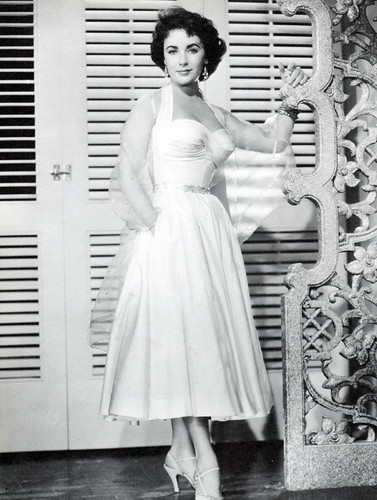
Elephant Walk" was a "programmer." A fiction property with clamored-for stars and an exotic location (Ceylon, now Sri Lanka) that probably made it to the top of a double-bill (when so many classic films were always relegated to the red-headed step-child "second feature"). Translating it to cinema, though, takes whatever might have been of value in the details, and splays out its derivative nature 100 feet across. This one's basically "Rebecca" crossed with "Moby-Dick"--an ingenue, Ruth (the glowing Elizabeth Taylor, newly mature) marries a rich businessman and travels with him to his estate (Manderley in "Rebecca," "Elephant Walk," here) where the new locale and the strange customs and a mysterious past make her an outsider when she should be at her happiest. And the Maxim DeWinter of this story is a cad; John Wiley (Peter Finch, who sounds eerily Burton-esque on occasion) runs an imperial tea facility, and the estate sits smack-dab in the middle of an elephant trail to a migratory watering hole. The elephants are pissed about it, of course and, led by a particularly aggressive bull, make regular attempts to cross through the property, always pushed away by the Ceylonese servants keeping "Elephant Walk" running. John is Ahab here, his obsession with the bull tearing away the veneer of civility that Ruth fell in love with. And "Elephant Walk" has all the spacious sterility of a James Bond villain's lair.

To cement the "
Rebecca" ties, there is a vaguely threatening servant (Abraham Sofaer) who objects to the new mistress butting into things, and there's a locked room that she is not allowed to enter. Ruth, however, is more of a spit-fire than "Rebecca's" shrinking violet, and soon there are purple-tinged daggers flying from her eyes.

Oh, and toss in a little of "
The Painted Veil," as well. One of Wiley's workers, Dick Carver (Dana Andrews) is attracted to the new Mrs. Wiley, to the point where she seeks him out as an alternative to her cold husband. As if that isn't enough conflict with the stampeding elephants and the stampeding hormones, there's a cholera epidemic and a crop-threatening delay in the monsoon season, leaving everyone high and dry.

There's plenty of photographic evidence that Finch and Andrews made the trip to Ceylon, but it's evident that
Taylor never set foot outside of Los Angeles, fully a third of her performance being performed by doubles for the long shots and the stunts*—the latter comes to the fore with the inevitable laying waste of "Elephant Walk"...by elephants. The sequences of Taylor's double being chased around the sets, and shoved around on ornate staircases, by trained pachyderms has a high camp zeal that dissolves all the drama in fits of delirious giggles.** Maybe it was the cholera speaking.

* One should always research the history of a film before writing about it, but for a sorry strip of celluloid like this, research might evoke a bile-blocking sympathy not unlike the elephant-walls surrounding John Wylie's nature-defying manor. My bad. Here's the story: The reason Taylor is never seen in Ceylon is that Vivien Leigh was playing the role. Although it was shaped and initially cast for Taylor, a pregnancy forced her out of of the role, and Leigh started the filming in Ceylon, but bowed out due to her bi-polar disorder (and that's her in some of the long shots) as well as a rumored affair-gone-badly with Finch. That might have been avoided if the original casting had kicked in: Laurence Olivier as Wylie ("Rebecca" again...Olivier played Maxim DeWinter in Hitchcock's film) who was still attached to the film when Leigh was cast—a natural for the married thespians—but Olivier dropped out due to a scheduling conflict.

** According to the Wikipedia article on it, Leonard Maltin makes one of his rare slams of a movie reviewing "Elephant Walk:" "Pachyderm stampede climax comes none too soon."

Wednesday, September 23, 2009

The Country Girl

"The Country Girl" (George Seaton, 1954) I'm not a fan of Clifford Odets' writing, feeling it unnatural and stagy—a view of the world only from Odets' smart-ass head—good ideas gussied up with painful patter of the eye-rolling variety, everybody on their last nerve. The best approach to Odets is with an editor's pen and skilled actors and George Seaton used both in his acclaimed adaptation of "The Country Girl."

The story of a Broadway director (William Holden) trying to revive the career of an alcoholic—and worse, stage-shy—actor for his show, has a canny, even inspired look at human psychology behind it, but a little too much of the passive-aggressive "I'm insulting you with honeyed words" gambit that the playwright brought to his later works. Seaton cuts almost half the dialogue, and by employing Bing Crosby spackles the holes with Harold Arlen-Ira Gershwin tunes for the crooner to sing. A slight alteration of director Bernie Dodd's play to be more of an "Oklahoma!"-style production, and Seaton glides over the dramatic gullies with a musical bridge. It pays off gang-busters, as well, as one particular tune haunts Crosby's Frank Elgin, effectively replacing the negative demons in his head with song.

Grace Kelly got the Oscar for her performance (taking the statue away from Judy Garland for "A Star Is Born" prompting Groucho Marx to wire Garland the consoling cable: "It's the biggest robbery since Brinks!"), but it's not her best performance (They rarely are). Kelly's natural Philadelphia blue-blood bearing still shines through, no matter how much they down-key the make-up, or how drab the wardrobe, and her first big confrontation scene with Holden feels like amateur night. She gets progressively better and is at her best with no dialogue at all.

Holden, on the other hand, has just enough acid bile in his stomach to regurgitate Odets and make it seem like he thought it up himself—Holden could make "pretentious" sing like gospel, and Odets must have seemed like a skip in the park for him.

But the revelation is Bing Crosby and his portrait of a self-loathing, weak man who isn't happy until the rest of the world agrees with what a louse he is. Crosby has enough corn in his dossier that he knows how to sell musical fluff, but here he digs deep and the displays of emotion over his face are tough to watch. Crosby, used to playing the relaxed reed in the breeze, shows a dark side that undercuts all the self-assurance he peddled over his long career. It's amazing and painful to watch, and shows the gifts contained in Bing Crosby on both sides of the entertainment spectrum, where he not only could sing the blues, but also show what's left when the music stops.

Friday, July 17, 2009

The Far Country

"The Far Country" (Anthony Mann, 1954) During the 1950's, James Stewart had two close director collaborations: one with Alfred Hitchcock (producing "Rope," "Rear Window,""The Man Who Knew Too Much," and "Vertigo") and Anthony Mann, with whom he made four westerns ("Winchester '73," "Bend of the River," "The Naked Spur," and "The Man from Laramie") that explored Stewart's range as an actor as he approached middle age, bringing a psychological depth to a genre that usually had the depth of a layer of dirt. Stewart's characters became practical men of dubious moral strength who would have their sense of loyalty and justice tested by circumstances, their balance frequently upturned by a burning desire for revenge.

When we meet Jeff Webster (Stewart), he's just finished bringing a herd of cattle to Seattle for his partners Ben Tatum (
Walter Brennan, without his teeth this time) and perpetual souse Rube Griffin (Jay C. Flippen). They're booking passage to Skagway, Alaska to deliver beef to the prospectors looking for gold. There's just this little problem of Webster having killed two of his wranglers over the course of the trip, which has the interest of the Seattle police who want to detain him for questioning. Some physical hi-jinks and the intervention of fellow passenger Rhonda Castle (Ruth Roman) and partners and cargo are heading up the passge.

But once in Skagway, they run afoul of the local constabulary in the form of Sheriff-Judge Gannon (
John McIntire, showing just how great he could be given a meaty part), who maintains an absolute authority over the territory—nothing gets done without his say-so, and that's just the sort of thing that can make Webster angry and defiant, two things not tolerated in Gannon's jurisdiction. You just know people are gonna get hurt, and there's only so much a Stewart character can take "before a man's gotta do what a man's gotta do."

Anthony Mann was a director who filled his screen, whether he was making intricately-shadowed film noirs, or here, where the mountains and glaciers fill the screen, providing a dramatic backdrop for the power-plays being carried out in mid-close-up. His westerns with Stewart featured a dangerous West, where the rules were whatever someone with power determined them to be.*** And Stewart's characters were loners who played by their own rules, the conflicts with the power-brokers escalating into a frightening violence when the stakes got too high. Mann and Stewart were pioneering a new frontier in exploring the psychology of coming to grips with the new territories and their struggles for civilization in which the spaces and emotions were untamed.

"The Far Country" also benefits from early appearances by Harry Morgan, Royal Dano and Jack Elam, all distinctive character actors able to play good or bad.

Sunday, February 3, 2008

The High and the Mighty

"The High and the Mighty" (William Wellman, 1954) One of the few John Wayne pictures that he produced himself, and one of his best-known and respected films outside of his Westerns, I had never sat through "The High and the Mighty." Oh, I could whistle the vague Dimitri Tiomkin theme, but I'd never seen it. William Wellman was a no-nonsense director and flyer, who no doubt seized the opportunity to do a dramatic film about the then-tony luxury of flying transcontinentally, and turned it into one of the first "disaster" films involving flying (Hello, "Airport!"). Wayne's character was meant for an older Spencer Tracy, but after Tracy left the project, Wayne stepped in to take the role of the haunted co-pilot, who has to fight his past and the demons of his pilot (Robert Stack) to "get this baby on the ground." With an international cast of passengers, all with stories to tell, it's a bit like "Grand Hotel" in the sky with its engines on fire (or "Stagecoach"). The emphasis is on character as there's only so much rollickin' Wayne can do in a plane cabin, though there is an over-the top scene where Wayne decks his pilot to keep him from ditching the plane in the drink...with his hands on the controls! It's also a bit dated in the need to explain every little detail about "plane travel," but not at all in how, at that early stage before rolling luggage, airline personnel were still griping about the passengers.

La Strada

"La Srada" (Frederico Fellini, 1954) Before his imagination took surrealistic flight, Fellini was still grounded in the Italian neo-realist school, and his "La Strada" takes place in the still existent ruins from the second World War--the villages and hovels where roving bands of merchants and entertainers try to eke out a living on the road. Strongman Zampano (Anthony Quinn), who breaks chains for a living returns to the family where his first assistant (now deceased) was acquired. Next in line is dim, but sweet Gelsomina (played by Mrs. Fellini, Giulietta Masina), and she hops on board Zampano's makeshift motorcycle/carnival tent/camper-trailer ("It's American!") and learns the tricks of the trade, which she takes to quickly. Eventually, they hook up with a larger circus, where they meet The Fool (Richard Basehart), who is sweet to her, but pushes all of Zampano's buttons, making the frustrated performer ever more enraged. Quinn is terrific, a bull with steam constantly coming out of his nose, Basehart shows his lighter irresponsible side rather than the stalwart authority figure he became used to playing, and Masina's performance is one of such force of personality that you can only call it "Chaplinesque," so much of it is tied to wordless expression and acting with the face. It's a melancholy circus Fellini liked to paint, supported by Nino Rota's ebullient/lyrical score but in the end shows how some chains can never be broken. Like any good fable or morality play, it saddens but doesn't disappoint.

(A week after watching "La Strada," Nino Rota's score still capers in my head.)