Wednesday, August 22, 2012
Life With Father
"I am the character of my household!" booms Clarence Shephard Day, as he's choosing the latest in a long line of maids, which he has chased out of his employ int he last few months, many of them in tears and some in hysterics. Truer words were never spoken. He is the titular patriarch of Life with Father, from the hit Broadway play,* based on the remembrances of Clarence Day, Jr. of turn-of-the-century living with a father-figure who paces slowly in his own grooved path. William Powell plays the role, one he actively petitioned for.
It's a charming film, full of easy irony about the mores and prejudices of the time, where male pomposity poses as dignity, and more separates people than unites them—easy excuses for keeping things nice and orderly on the surface, while underneath, they are broiling with chaos that is easily ignored and denied. Clarence Gray, Sr. denies at the top of his lungs, and his monologues—against politics, taxes, unnecessary expenses, and organized religion (organized against him, it seems)—built individually in intensity and volume, are performances for an audience of one—himself. His barely suffering wife (played by Irene Dunne as if she were singing the entire role) has more influence over him than he is willing to admit, or recognize...or even remember. And his kid's are "mini-me's" of him, all boys, all carrot-tops, and as they age they morph further into miniature versions of The Old Man, down to his expletives and bluster.
Michael Curtiz directs formally and breezily, with his actors performing at top gear, and the director altering pace in editing and filling the frame with as much set decoration as it can hold.
The material doesn't need much else. It's strongly forced, comically subtle and has an undercurrent of mature content, that you just don't see in movies nowadays. Life with Father is from a far subtler era in which sub-texts flew over kid's heads, while the adults exchanged knowing glances and suppressed chuckles (that way you don't have to explain it to the youngsters with a simple "you'll understand some day").
And the sub-text is sex. Clarence, Jr. is growing up, voice changed (but his violin playing still has noticeable cracks) and he's noticing girls—and when it's Elizabeth Taylor as a visiting friend's daughter, one can't help noticing. At the time of the film, it was still early in Taylor's career and her performance is breathy, needy and comes from the same type of ingenue training that produced Marilyn Monroe's early performances. Clarence wants to impress Taylor's Mary, but he can't do so in Dad's ill-fitting hand-me-down suits. The excuse is they're practical, but, as he says, "I can't do anything in Dad's clothes." But, the truth is he gets...uncomfortable...in Taylor's presence. It's not bluntly said, it's danced around, implied, suggested, but never spelled out (as would be the norm today). It's hilarious, charming, and pays off in some ironically comic laugh-lines throughout the film.
Yeah, they "don't make 'em like this anymore." More's the pity. Life with Father deserves its classic status—for some reason, it's not in the National Film Registry—because it's smart, pointed...and hilarious.
GAD!
* It still holds the record for the longest run of a non-musical stage-play.
Thursday, March 1, 2012
Them!
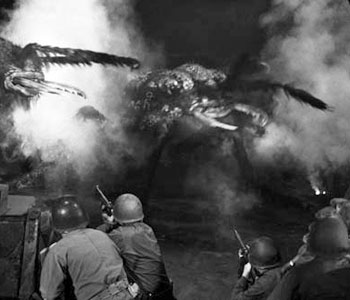
Them! (Gordon Douglas, 1954) "When Man entered the atomic age, he opened a door into a new world. What we'll eventually find in that new world, nobody can predict." What no one could predict is that giant atomic-mutated ants would spoil The Big Picnic. Somehow, one expected the splitting of the atom to have more profound effects.
But nature abhors a vaccuum or tampering with things on the atomic level, and, apparently, so did the world-wide movie industry, because, by 1953, two films that displayed horrific effects from atomic testing exploded on (appropriately, I guess) American and Japanese theater screens: The Beast from 20,000 Fathoms (Eugène Lourié) and Gojira (Ishirô Honda). Neither film exactly bombed.
And as The Bomb (and a popular 1952 re-release of King Kong) begat The Beast..., so did that Warners film beget Them! (which became Warner Brothers' box-office champ in 1954)*, inspiring a subsequent fallout of atomic themed films featuring Incredible Shrinking and 50 ft. metamorphoses that have had a half-life of (going on) 60 years. Them! may not be the glowingly cheesiest of them all—some of the writing's not bad, and despite the subject matter, some of the performances are surprisingly good—but, then, what can you expect with such an early entry in the genre, everybody was trying hard, and the writers managed to throw in some scientific fact mixed in with the hokum. But, it does have an exclamation mark in the title, which immediately makes it suspect (although, next week, we will look at a movie with such punctuation that plays it absolutely straight).
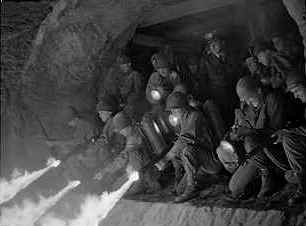
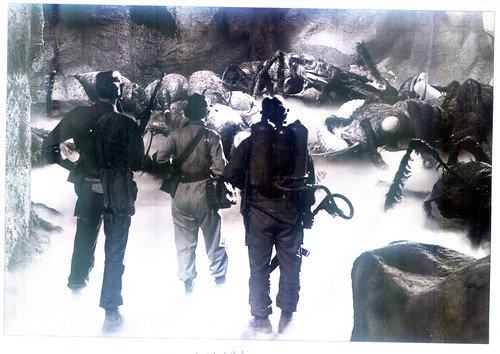
And it has a good intro: a little girl (Sandy Descher) is found by police wandering in the desert, mute, in shock. Tracing her back to the family trailer (!), they find it split open—but from the inside. Hmmm. Mystery abounds, and at one point Sherlock Holmes is invoked (appropriately, as he once had to do battle with The Giant Rat of Sumatra, "a story for which the world is not yet prepared"). But, you can't hide a gargantuan ant for very long, not even in the desert, and soon the local constabulary and the army (with the help of a couple of myrmecologists (you know, "ant-thropologists") take on the formidable formicidae with all manner of WWII surplus—flame-throwers, bazookas (that look really cool!), cyanide gas cannisters, and rocket-propelled grenades—one wishes for the huge Monty Python foot to appear, or a monstrous can of Raid...better yet, turn New Mexico into a giant ant-farm! They is no trying to "negotiate" with the ants (it was the 1950's, after all, at least they weren't hauled up before the House Un-American Activities Committee), and even one of the scientists—the cute female one (Joan Weldon), after making her observations, documenting them, and taking her corroborative pictures,** turns to her companions with the flame-throwers and says, "Burn it. Burn EVERYTHING!" O-kay...
This one was directed by Gordon Douglas,*** who worked his way up from "Our Gang" comedies to Laurel and Hardy and became to go-to director for 20th Century Fox when they needed a fast turn-around on a sequel or a Frank Sinatra movie, and sports all sorts of good actors trying to take it all seriously: Edmund Gwenn, James Whitmore, James Arness, Fess Parker (in an odd role as a man driven lunatic by the sight of giant ants), and look for glimpses of Richard Deacon (reporter), William Schallert (doctor) and Leonard Nimoy (fleetingly) as a soldier with some interesting information, and with no less than four employments of the giddily hysterical "Wilhelm" scream (performed by Sheb Wooley) shrieking throughout. "The Wilhelm" was recorded for the 1952 film Distant Drums and became part of the Warner Brothers stock sound effects library under the title "man being eaten by alligator."
And giant ants. Lots of giant ants. Zillions of them. Although, for budgetary reasons, we only see three at a time.
"The Wilhelm," however, probably wouldn't be classified as one of those "profound effects" previously mentioned.
* Interestingly, though, no Academy Award nominations....
** Dialogue that came to mind: "I need to get one of you officers close to one, so I can get some perspective. Would you...?" "Lady! You nuts??!!
*** And, you can tell that it was SUPPOSED to be shot in 3-D, with some shots hurtling at you...and evidently in color (only the title is), but someone in Warners accounting wisely decided not to "spluge" on a giant ant movie.
**** (Ya know, there are days writing this blog when I feel like a character on "The Big Bang Theory" only the dialog isn't as good)