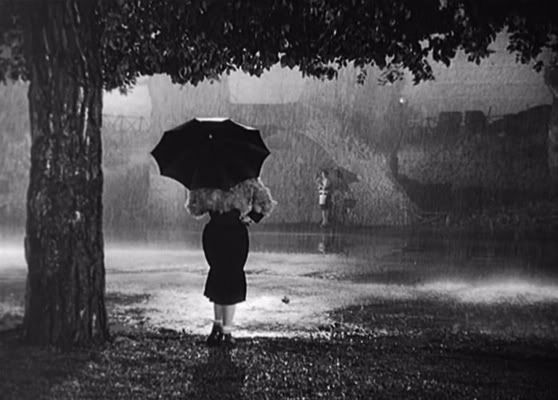
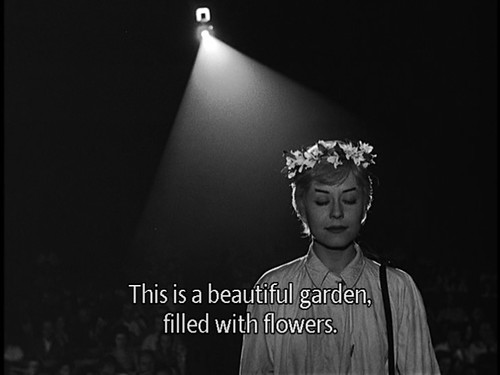
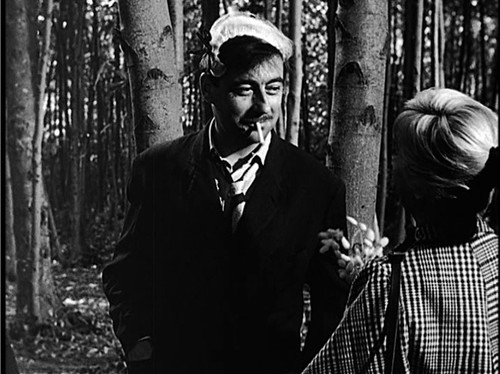
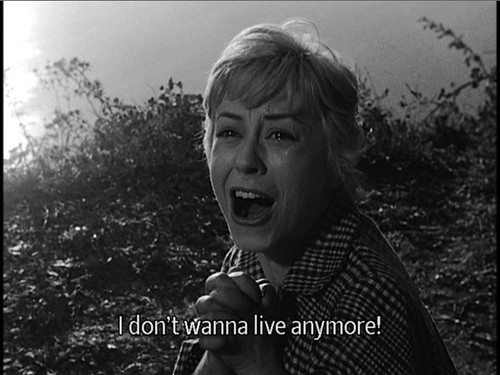
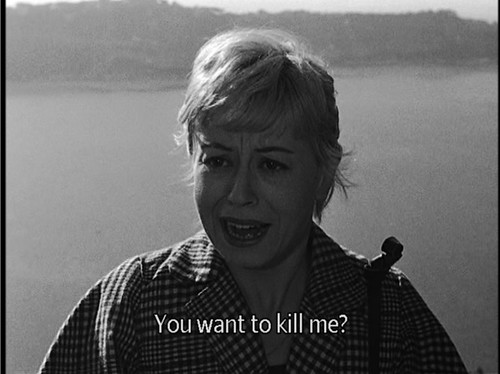
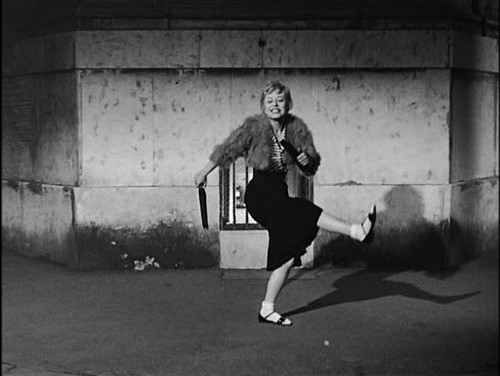
This was part of a series of reviews of the ASUW Film series back in the '70's. Except for some punctuation, I haven't changed anything from the way it was presented, giving the kid I was back in the '70's a break. Any stray thoughts and updates I've included with the inevitable asterisked post-scripts."The Nights of Cabiria" (Frederico Fellini, 1956) Both times that I previously saw "The Nights of Cabiria" I was in the projection room showing it, and that is not the best place to try and appreciate any movie, believe me. But even filtered between dirty glass, and the change-overs,* and the re-windings, it was easy to see that it was an exceptionally fine film.
Cabiria, when we first see her, is in the process of being robbed and shoved into the river by her lover of one month, and after going down for the third time and being fished out by some nearby kids, she is pronounced "dead" (albeit by one of the kids) and then revived and indignantly stalks back to her house. "She's got nine lives, like a cat," one of Fellini's nosey neighbors says as she disappears down the road.
That first scene is symbolically representative of the entire film, for it has an episodic structure in which Cabiria, "a well-known night-bird," is continually finding herself putting herself into situations that, for a while, make her think she might improve her current state as a street-walker, only to be "shoved" and "drowned" by having those hopes dashed. She is usually rescued by something else which also provides hope and also explodes in her face, providing more humiliation, Not coincidentally, most of these hopes entail people: an actor who momentarily uses Cabiria, is momentarily charmed by her, and in a moment, drops her; a hypnotist who exposes her fantasies to a cruelly amused audience. By the end of the film, Cabiria has come full circle--she is miles away from her home, which was her only previous certainty of retreat and recovery, she is without money for she has been robbed and betrayed by her fiancee, who only out of sheer cowardice refrained from pushing her off a cliff. When we last see her, she is presumably walking home in the dark, when a group of young people, revelling and celebrating, catch up with her and gradually her spirits are lifted by them. She begins to nod and smile at the revellers, and then, finally she nods at us, as if to say, "Yeah...well, it's alright" and she continues to move on.
I can just hear the feminists in the audience hiss this film** because Cabiria is prey, just asking to be taken advantage of. She smirks and sneers on the outside, but inside, she is quite susceptible to being suckered into anything. How could she constantly take such abuse? Why does she allow herself into such situations? I'm not sure I can put what I feel on that into this review, but I can safely say that that final few feet of film, when she turns to the audience and nods with a slight, battered smile--that final few feet of film is charged with a life-renewing energy, and I see it as a personal challenge, just as surely as I see "The Nights of Cabiria" as Fellini's finest film.
One note: "Nights of Cabiria" is subtitled, so you might want to get in line early, since it's tough to read them from the top row of 130 Kane.
Broadcast on KCMU-FM , Oct. 7th and 8th, 1976
Nothing to add, really. I still love "The Nights of Cabiria," and although Fellini went many marvelous and torturous routes during his film-career, I still think it's his finest film (Although I also have a deep love for "Toby Dammit: Or, Never Bet the Devil Your Head"--which has just been restored, I've heard. Reason to celebrate. And I neglected to mention the performance of Giulietta Masina, putting her in the category of Chaplin as one of the great screen-faces and personas) Tomorrow: the second half of the double-bill (remember those?): "Diary of a Mad Housewife"
*In college (when this was written), I was a film projectionist showing movies all around the UW campus. There were no DVD's back then, just massive reels of celluloid encased in metal, each feature made up of a few reels. The projectionist's job was to switch from reel to reel (and projector to projector) without missing a beat, and certainly without distracting the viewer's attention. Two film-blips, ten seconds apart at the end of reels was the signal to "switch-over" from one reel to the next. Then the projectionist would rewind the previous reel (for the next projectionist), and set up the next one, and wait for the blips. A nice job, that. And you got to see a lot of movies.
** Yeah, that's a little harsh, but I can certainly see the argument. Cabiria is a victim, led astray by her hope for something better. If that was all she was, if she was accepting of this victim-hood, and gave in to it, she might be warranting some bad attitude. But she's also a fighter, who keeps picking herself up, throwing off self-pity, and accepting the joy that life has to offer. I really love this character. I want her to "make" it.
Who wouldn't?
 Fellini adaptation of the obscure Edgar Allen Poe story of a rake whose egotism gets the better of him has been making the rounds this year at the film festival circuit and receiving the attention and the acclaim it is due. Made as part of a European Poe omnibus (and released in the U.S. by AIP--who'd been producing their own Poe adaptations). under the title "Spirits of the Dead" aka "Histoires Extraordinaires" or "Tre Passi Nel Delirio." The other adaptations were Roger Vadim's heavy-breathing "Metzengerstein" starring Jane and Peter Fonda as incestuous cousines, and Louis Malle's dull S & M piece "William Wilson," despite starring Brigitte Bardot and Alain Delon. As the Fellini was the Grand Finale, I wouldn't be surprised if folks walked out of it before the Fellini segment. They missed a chilling masterpiece.