Showing posts with label Jennifer Connelly. Show all posts

Saturday, January 22, 2011

The Dilemma

"Mouth Wide Shut"

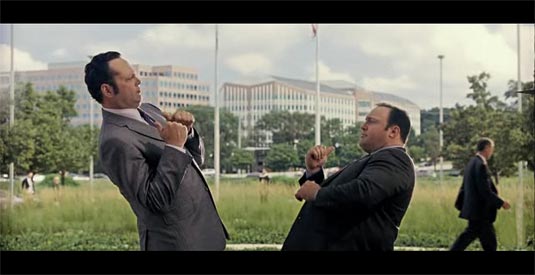
I put up a snarky comment on the LNTAM Facebook page that nothing strikes fear into my heart so much as the words "A Comedy by Ron Howard."  A little facetious, perhaps.  I like Splash a lot and Parenthood may be my favorite of Howard's films.  But the director of so many thunderously ponderous dramas does not have the necessary light touch,* at least these days, when it comes to directing comedy.  Instead, he's dependent on the flip style of his stars (like Tom Hanks and Steve Martin) to rise above his heavy hand, and The Dilemma** has no such talent in evidence.

Not that Vince Vaughn and Kevin James don't try, but they're caught in a script so painful in its ramifications that you feel more sympathy for them than any mocking superiority, that might allow some amusement.  It's a "Comedy-of-Errors" story, an "Incredible-Mess" scenario, and wants (wants, mind you) to say something about "the futility of good intentions" as well as "the value of honesty."  But, then goes out of its way to show that one should just avert your eyes and walk away.  The results, and the messages, are mixed.

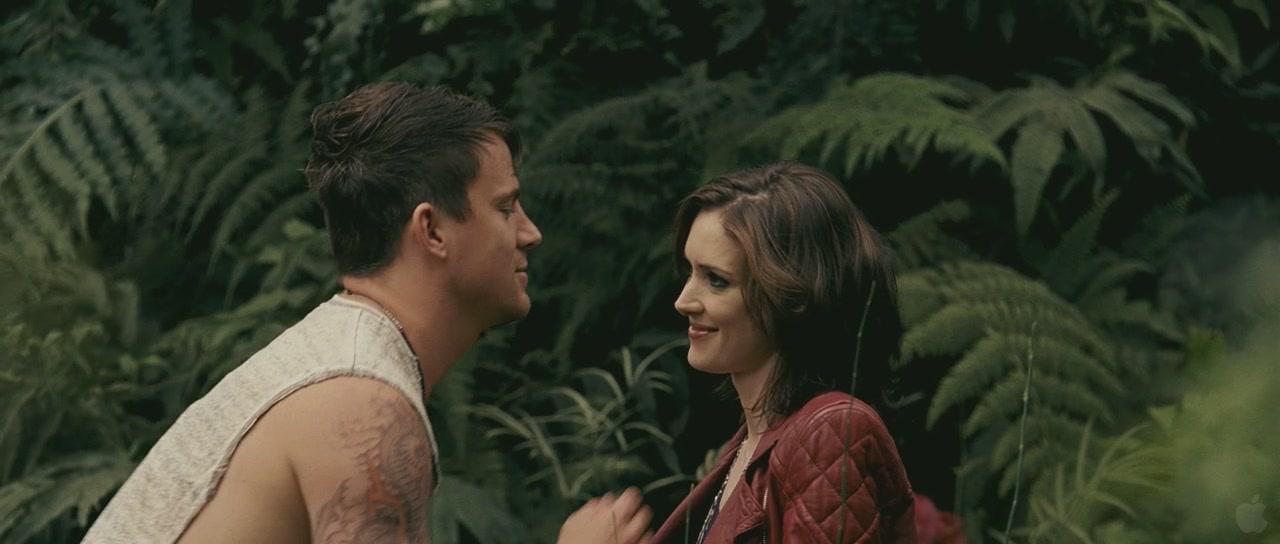
Ronny Valentine (Vaughn) is a gambling addict in denial.  His struggles with the problem have previously derailed a relationship with Beth (Jennifer Connelly), and they're coping with honesty and trust issues, because its easier for Ronny to bull-shit over embarrassing situations with elaborate fictions rather than just stating the truth.  Its a helpful business strategy for him in his business with Nick Brannen (James) in automobile development—their current scheme is to give electric cars the same vibrating muscle power as a gas-guzzler.  But, lately, he's been thinking up elaborate ways to pop the question to Beth.  During one of his scouting forays to an ultimate proposal sight, he is appalled to find Nick's wife, Geneva (Winona Ryder, welcome back), canoodling with a young dude (Channing Tatum), something that a) affects both his personal and business relationship with his college buddy and b) strikes at the core of his fear of entering into marriage with Beth.  Not to add stress to Nick's life, he chooses to add stress to his own by NOT saying anything (except to the duplicitous Geneva, who is ready to make life VERY uncomfortable for Ronny).  This leads to a series of mis-understandings and down-right lies that makes everyone in Ronny's life think that he's back to his old tricks of hiding the truth to cover his gambling habits...and, indeed, by taking the dilemma by the horns, he is gambling with his life and relationships and losing...badly.

Hilarity is supposed to ensue, but nothing approaching a smile cracked my face.  Ronny's habit of lying, fudging and obfuscating makes him an easy mark for any sort of suspicion and the situation he finds himself in is somewhat Kafkaesque.  The former gambler can't win for losing, and the thought that kept pin-balling through my mind was "since the creative Hail-Mary's of over-promising to his potential clients is so integral to his success, how can he effectively keep his salesmanship from entering osmotically his personal life?" (Honestly, that's what I was thinking).  I found it tragic more than comic, and wondered how any person with an addiction can hope to live out a normal life...even after overcoming it.

Pretty depressing thoughts to arise from a comedy.

Maybe such thoughts wouldn't have popped up if I'd laughed more.

Or...at all. 

The Dilemma is a Cable-Watcher.


* I'm omitting, of course, the bright spot of Ron Howard's recent comedy output, his shepherding of the TV-series "Arrested Development," whose crazed blunderbusting of the immaturity of the entitlement class was one of the better comedies of recent years.

** The most interesting aspect of The Dilemma is the spelling of its title.  I'd always learned that it was spelled "D-I-L-E-M-N-A," and would frequently make a joke of too literally pronouncing it "dilem-na."  But, these days spell-checks and my own (previously trusted) Random House Dictionary spells it with the double "m." However you spell it, it's a quandary. 

Wednesday, June 16, 2010

The Rocketeer

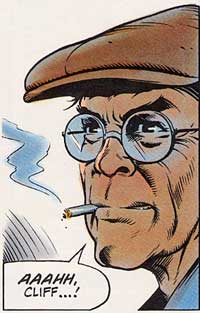
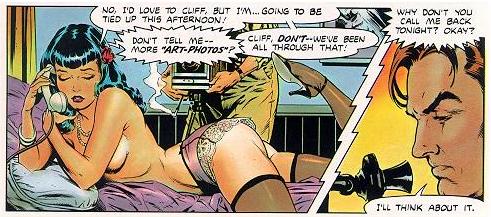
"The Rocketeer" (Joe Johnston, 1991) Graphic artist Dave Stevens was handed an assignment for a new comic book*—he'd get to create an eight-page second feature of his own devising and do anything he wanted with it. For Stevens, that meant it had to have a pulp-fiction atmosphere, a late 1930's Los Angeles locale, an art-deco look, and characters with which he was familiar enough to draw. He based the hero on himself, his mechanical engineer Peavey on Doug Wildey (who'd created "Jonny Quest") and for the hero's girlfriend, a forgotten pin-up girl of the 40's and 50's, "Bettie" Page.**

That second feature, "The Rocketeer," quickly eclipsed the comic's title character, and moved to its own publication that, due to Stevens' fastidious attention to artistic detail, came out only infrequently. But the elements were there to attract Disney, looking for a comic-book hero that could economically catch the wave of the recent burgeoning comic-book movie and match the box office returns of the "Batman" series.
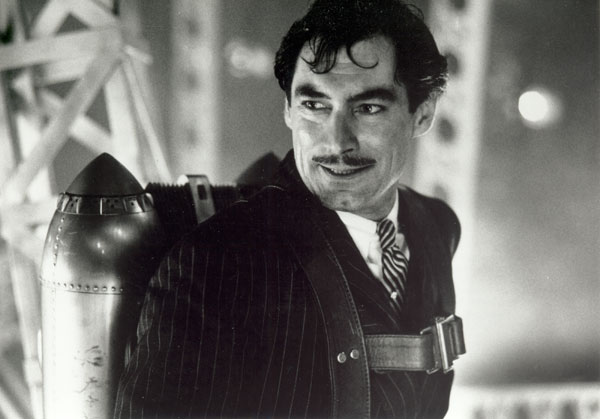
Even though "The Rocketeer" didn't have the Caped Crusader's cache of cultural iconicism (That's Adam West-speak for recognition by the general public), the cult-status of the comic and the script's deep-dish banquet of 30's flotsam (Rocket-packs, Flying Gee-Bee's, Nazi's, gangsters, ugly goons, Howard Hughes, zeppelins, Erroll Flynn swinishness, and the Griffith observatory) looked like it was going to be 1991's "sure thing" at the box-office.  So confident that it would soar on plumes of flame into the stratosphere that Disney honcho's put out a "memo" saying that this was "the way" they were going to make movies: good properties, well-cast with cheap stars--put all the money up there in the screen.

Good plan if only "The Rocketeer" hadn't flamed out and fallen to Earth.  "The Rocketeer" under-performed badly at the time of its release.

It became popular on the rental circuit, but the damage was done.  No sequels (a trilogy was planned), the other studios chortled about Disney's memo hubris, and went back to paying stars (and their agents) $20 million for a movie.

Too bad.  "The Rocketeer" is not that great of a movie, but if it had inspired similar "value" films, it would have been worth it.  The thing is, its heart is in the right place, it's sweet and affectionate about the period it's in, the romance is chaste and makes no concessions to modern audiences, the players adept—Billy Campbell was born to play "The Rocketeer," he looks just like Dave Stevens and any movie with Alan Arkin and Paul Sorvino, AND Terry O'Quinn, it goes without saying...plus, Tim Dalton got to bust up his Bond image a bit. 

The movie only takes off, logically enough, when the rocket-pack fires, then things zip, zoom, loop-de-loop and go slightly out-of-control in a giddy display pyrotechnics.  The rest of the time the film stays firmly rooted to Earth, refusing to soar.  Oh, Dalton has fun with his role—he was always better suited playing bad-guys, anyway—And Jennifer Connelly adds some brief spark to her role as "Jennie," Cliff's naive actress girl-friend. 

That's the problem.  Sweet as it is, "The Rocketeer" could use some spice, which Disney was just too timid to provide.  "Jennie" was "Bettie" in the comics, specifically "Bettie" Page, who was far more world-wise and ambitious than the screen incarnation could capture.  There was a bit of the real Page's persona in the original character, all too aware that she was the type of girl "men like," and all too willing to exploit her looks to be exploited.  That was way too hot for Disney, who gussied Connelly up from head to toe, effectively neutering her ambitions.  That the real "Bettie" Page was still alive at the time, and fully capable of contacting lawyers, probably influenced Disney's decision, as well.

And that's too bad.  "The Rocketeer" takes chances, but still feels "safe," something the comic was having too good a time to worry about. 

Dave Stevens, died after a long fight with leukemia, at the too-young age of 52.

Splash page ad from the original "Rocketeer" story, which promised more pulp sensibility than it delivered (at least it had a guest appearance by an unnamed "Doc" Savage character) but still contained the necessary "Bettie" Page figure.

* Mike Grell's "Starslayer" #2 was the first appearance of "The Rocketeer"

** She wouldn't stay forgotten for long.  "The Rocketeer" re-generated interest in her long career as a photographer's model, and "nudie" dancer, and she was able to see some money from the marketting of her image.  "The Notorious Bettie Page" is based on her life.  She didn't like it much, reportedly.