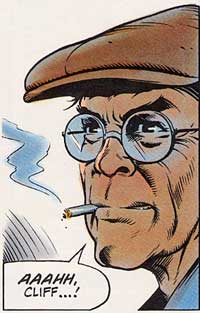
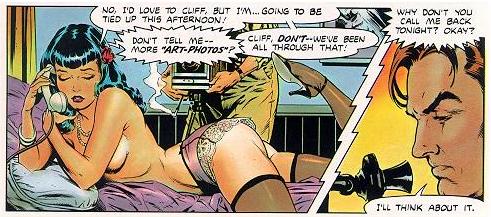
 "The Rocketeer" (Joe Johnston, 1991) Graphic artist Dave Stevens was handed an assignment for a new comic book*—he'd get to create an eight-page second feature of his own devising and do anything he wanted with it. For Stevens, that meant it had to have a pulp-fiction atmosphere, a late 1930's Los Angeles locale, an art-deco look, and characters with which he was familiar enough to draw. He based the hero on himself, his mechanical engineer Peavey on Doug Wildey (who'd created "Jonny Quest") and for the hero's girlfriend, a forgotten pin-up girl of the 40's and 50's, "Bettie" Page.**
That second feature, "The Rocketeer," quickly eclipsed the comic's title character, and moved to its own publication that, due to Stevens' fastidious attention to artistic detail, came out only infrequently. But the elements were there to attract Disney, looking for a comic-book hero that could economically catch the wave of the recent burgeoning comic-book movie and match the box office returns of the "Batman" series.
Even though "The Rocketeer" didn't have the Caped Crusader's cache of cultural iconicism (That's Adam West-speak for recognition by the general public), the cult-status of the comic and the script's deep-dish banquet of 30's flotsam (Rocket-packs, Flying Gee-Bee's, Nazi's, gangsters, ugly goons, Howard Hughes, zeppelins, Erroll Flynn swinishness, and the Griffith observatory) looked like it was going to be 1991's "sure thing" at the box-office. So confident that it would soar on plumes of flame into the stratosphere that Disney honcho's put out a "memo" saying that this was "the way" they were going to make movies: good properties, well-cast with cheap stars--put all the money up there in the screen.
Good plan if only "The Rocketeer" hadn't flamed out and fallen to Earth. "The Rocketeer" under-performed badly at the time of its release.
It became popular on the rental circuit, but the damage was done. No sequels (a trilogy was planned), the other studios chortled about Disney's memo hubris, and went back to paying stars (and their agents) $20 million for a movie.
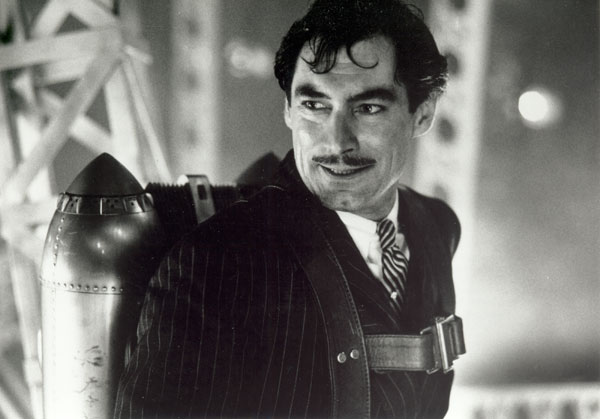
Too bad. "The Rocketeer" is not that great of a movie, but if it had inspired similar "value" films, it would have been worth it. The thing is, its heart is in the right place, it's sweet and affectionate about the period it's in, the romance is chaste and makes no concessions to modern audiences, the players adept—Billy Campbell was born to play "The Rocketeer," he looks just like Dave Stevens and any movie with Alan Arkin and Paul Sorvino, AND Terry O'Quinn, it goes without saying...plus, Tim Dalton got to bust up his Bond image a bit.
The movie only takes off, logically enough, when the rocket-pack fires, then things zip, zoom, loop-de-loop and go slightly out-of-control in a giddy display pyrotechnics. The rest of the time the film stays firmly rooted to Earth, refusing to soar. Oh, Dalton has fun with his role—he was always better suited playing bad-guys, anyway—And Jennifer Connelly adds some brief spark to her role as "Jennie," Cliff's naive actress girl-friend.
That's the problem. Sweet as it is, "The Rocketeer" could use some spice, which Disney was just too timid to provide. "Jennie" was "Bettie" in the comics, specifically "Bettie" Page, who was far more world-wise and ambitious than the screen incarnation could capture. There was a bit of the real Page's persona in the original character, all too aware that she was the type of girl "men like," and all too willing to exploit her looks to be exploited. That was way too hot for Disney, who gussied Connelly up from head to toe, effectively neutering her ambitions. That the real "Bettie" Page was still alive at the time, and fully capable of contacting lawyers, probably influenced Disney's decision, as well.
And that's too bad. "The Rocketeer" takes chances, but still feels "safe," something the comic was having too good a time to worry about.
Dave Stevens, died after a long fight with leukemia, at the too-young age of 52.
 Splash page ad from the original "Rocketeer" story, which promised more pulp sensibility than it delivered (at least it had a guest appearance by an unnamed "Doc" Savage character) but still contained the necessary "Bettie" Page figure.
* Mike Grell's "Starslayer" #2 was the first appearance of "The Rocketeer"
** She wouldn't stay forgotten for long. "The Rocketeer" re-generated interest in her long career as a photographer's model, and "nudie" dancer, and she was able to see some money from the marketting of her image. "The Notorious Bettie Page" is based on her life. She didn't like it much, reportedly.
Showing posts with label Joe Johnston. Show all posts
Showing posts with label Joe Johnston. Show all posts
Wednesday, June 16, 2010
The Rocketeer








Wednesday, February 17, 2010
The Wolfman (2010)
 "Clap-Trap for The Wolfman"
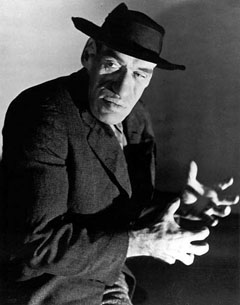
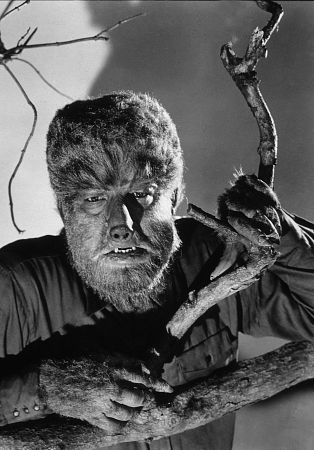
 Benicio Del Toro's dream project of a modern...er, make that period remake of "The Wolf Man" (1941) has had more tranformations than a month with two full moons! There have been two directors, settling on Joe Johnston, a litter of writers and re-writers, two scores—one by Danny Elfman, the other by Paul Haslinger, then reverting back to the Elfman score—a pack of editors, including the legendary Walter Murch, all trying to beat this one into shape. Whether this is studio interference or the "creative differences" that emerges when the star is The Big Dog is not known, but there've been a lot of changes on "The Wolfman," some of them quite hairy.*


But, you can tighten up the editing, change the score, even bleed the color out of the thing, but if the script is mangey, no amount of post-production wizardry can save it. I'd say something about "lipstick on a pig" but that would be the wrong genus, and I'd probably get a nasty tweet from Alaska for it (but, I digress). Movie-making, as in lycanthropy, requires an engaging source from which a fiendish entertainment can spring.

Let's start with the curse. I've always loved the doggerel poem ** (written by 1941's scripter Curt Siodmak) that describes the werewolf mark. It contains the essence of Horror-tragedy. Yes, we like to see the fur flying and the blood spatters on the wall, but it's all just gristle for the grinder unless it evokes empathy, inspires sympathy and not merely psychopathy. I'm not saying that every villager who has his heart (and one noticeable liver) stolen by the werewolf should have a back-story, but we could at least set up a situation where their hasty plans to hide goes for naught, which would inspire a cruel comedy, which is tragedy's keister-kicking cousin. Nope, the film-makers are too busy with the stop-watch trying to elevate the body-count per minute than to think about The Wolfman's victims.
And that includes the beast, himself.

Because at the beating, pulsing heart of that curse lies the secret. Any man (or woman, for all of that ***) who is pure of heart...can become a wolf. And that's the tragedy, and the horror, of this particular story. And Benicio Del Toro's Lawrence Talbot, famous American touring actor (eh?), has little going for him to evoke sympathy...in the script, or Del Toro's performance. The actor (the real one, not the film one) may love the story, and the movie may have been constructed around him, but the performance is so internal as to be inscrutable—a surprise, as Del Toro is one actor you can count on to do something interesting...even audience-challenging...in his roles. Sure, he grunts and groans and strains and bugs his eyes suitably in the transformations, but as Larry Talbot—actor—all he does is hang around, looking miserable, and some of his line readings are merely flat. Yes, he's sad—he is, after all, in mourning for his brother, killed in a vicious wolf attack—but Del Toro doesn't do anything with it, and it's a plum opportunity to, at least, emote—as in, Talbot's an actor, he's supposed to be grieving, and some actors might seize on that for material, research...something?

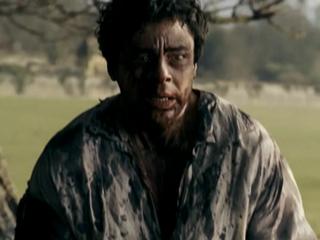


But, that's not the aim of the scripters (Andrew Kevin Walker and David Self). Here, they go back to their Freud texts, and the curse becomes a familial one. Dear old dad (Anthony Hopkins, gleefully playing a sadist) is the cause of all of Larry's problems and "the sins of the father, blah, blah, blah." For this Larry Talbot, his fate is not so much a Curse as a Destiny.**** And you know how things go with Destiny—the Ending is telegraphed a mile away. Things go as planned. The End.


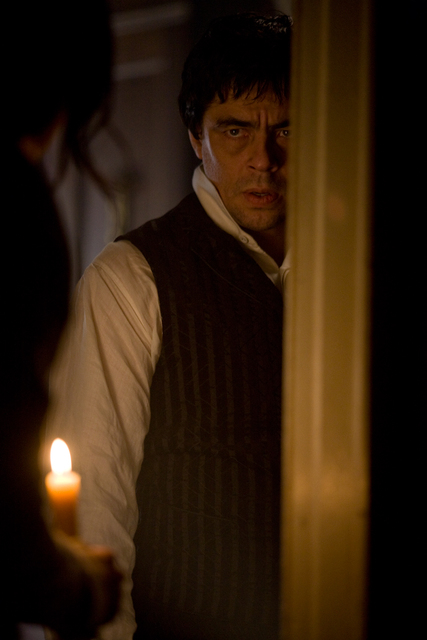
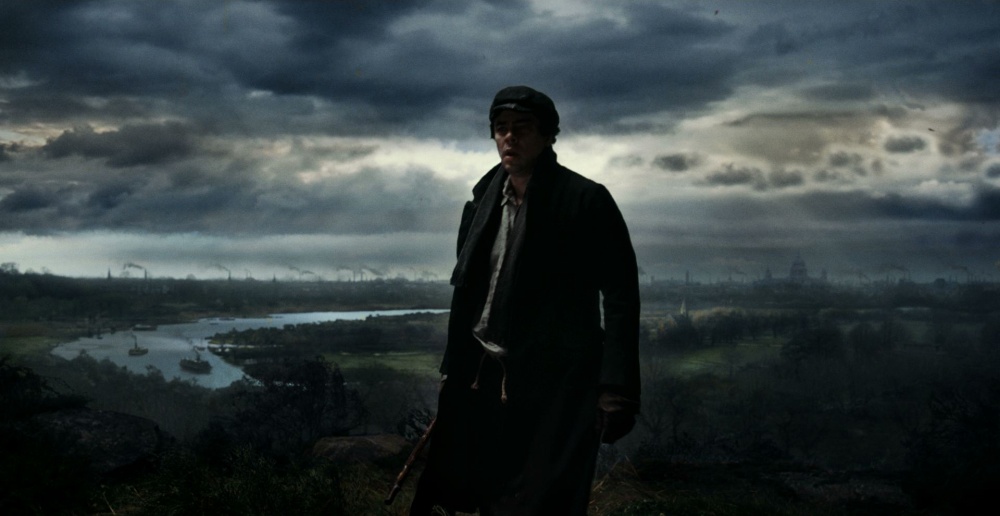

Destiny is the Curse of the modern Movie-goer, not just the cost of the ticket (or 3-D head-aches).
So, as a movie, this dog don't hunt. Oh, the sets are nicely gloomy, with carefully applied whisps of cob-webs in corners and all the floor-boards creak ominously (I mean, ALL the floor-boards creak, and the stuffed animal-heads growl—editor Murch started out as the One True Sound Designer, but this is sonically gilding the lily). The effects are bloody-good, the wolf-turnings snap, crackle and pop, and the village square has the cozy compactness, familiar of the Universal back-lot. Emily Blunt is appropriately tremulous, Hopkins tries desperately to make his evil part fun—he calls son Larry "pup" at one point—but the film was pre-ordained to be uninvolving. That was its curse by taking the tragedy out of the horror and the melodrama out of the actor.


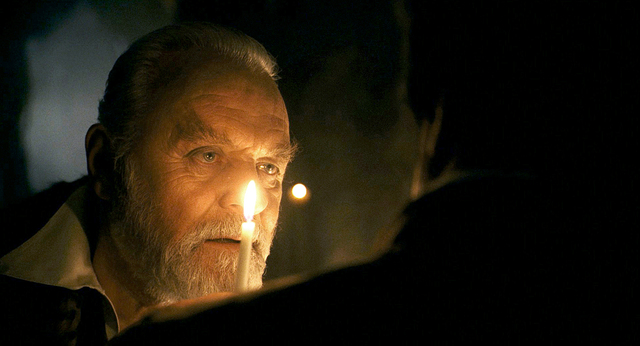
Those howls you hear in the night are from the Hollywood Hills.
"The Wolfman" is a Cable-Watcher. A-woooooo!
* Rick Baker, the make-up genius who's worked on so many great projects over the years, did the 2010 Wolfman design, basing it on Jack Pierce's legendary work for the 1941 film, and joked "You don't have to do much to turn Benicio into a Wolfman."


** "Even a man who is pure in heart,

And says his prayers by night
May become a Wolf when the Wolfbane blooms
And the autumn Moon is bright"
*** Alan Moore, the writer of "Watchmen" and "V for Vendetta," bless his tilted little mind, also wrote a werewolf story when he was exploring the roots of the horror genre while writing "Swamp Thing." In it, a woman became a marauding werewolf not on the monthly lunar cycle, but on her once-a-month menstrual cycle. Moore's title for it? "The Curse."
**** Modern script-writers are so hung up with pre-ordained Fates the argument by the Religious Right that Hollywood is anti-God goes up in a puff of Intelligent Design. You can't have a Destiny without some Omniscient Travel Agent planning the itinerary.
Subscribe to:
Posts (Atom)