84 Charing Cross Road (David Hugh Jones, 1987) You never know where something delightful might come in, like a parcel of unexpected mail that can lighten one's mood, or found money in a not-recently worn garment, or the spurious act of kindness. The "nice" surprise. 84 Charing Cross is one of those, one of the films I've known about, mostly for its score by George Fenton, and that's about it, save that it starred Anne Bancroft and Anthony Hopkins, both of whom were in a popularity valley, Hopkins doing TV movies at that time (four years away from The Silence of the Lambs), she doing one movie a year, often at the behest of her producer-director husband, Mel Brooks (who produced this one).
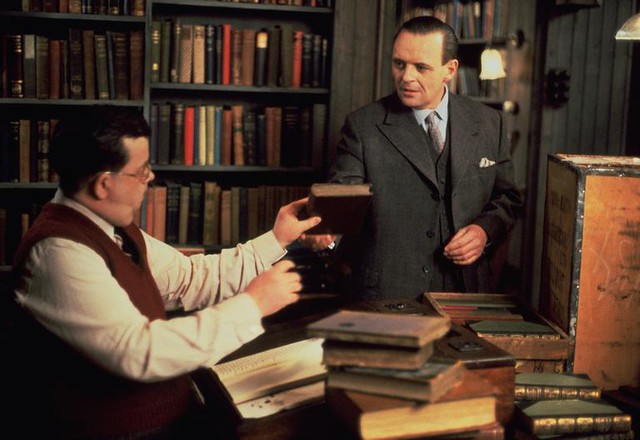
Good property, too. Brooks tended to bankroll movies from stage-plays (or based on stage-plays), and 84 Charing Cross made it to the boards after being published in book form by author Helene Hanff, documenting her decades long relationship with a London book store. This was in the day before the Internet, before Amazon, even before Barnes & Noble or Tower Books or the massive retailers who would buy books by the case-load to over-populate bargain bins. These were Mom & Pop operations, or even older, in dark rooms that smelled of dust and yellowing paper, where books had cloth or leather bindings, and even opening one of them was an adventure. I could spend an entire day in one of these hovels, marveling at what one could find waiting on the heavy oaken shelves. Before they actually became warehouses, it was the closest thing to a warehouse of information and just following a line across the Dewey Decimal System could lead you to an amazing surprise.
 |
| The Marks and Cohen Secondhand Bookseller at 84 Charing Cross Road |
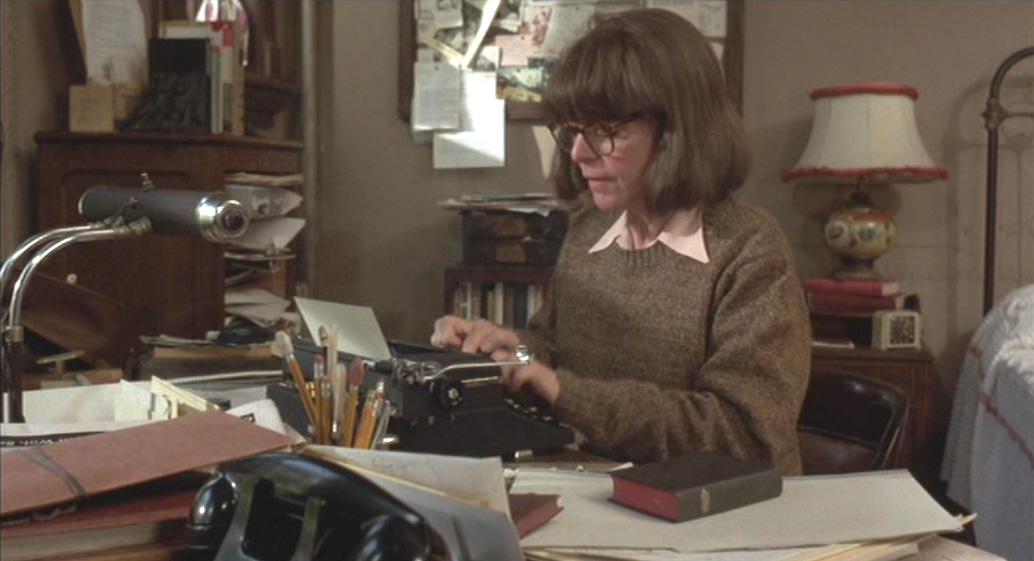
The story begins in New York, 1949. Hanff, an editor by trade a playwright by desire, is looking for specific books around the city and coming up with bupkis. A stray ad in the Saturday Review of Books mentions the bookseller in London, Marks & Co, at the 84, Charing Cross Road address and she writes to the place looking for her treasures. She is answered by Fred Doel, buyer, who sends her what he has, mentions the price and the two work out a pounds to dollars conversion with some sloppage in change here and there, with a relationship of immediate trust established, and an expertise that Hanff comes to rely on and marvel at.
Before long, her hearing of food shortages in Britain inspires her to send food-stuffs to the store, which are distributed amongst the employees and generally making their life increasingly special. Before long, everyone is on a first name basis in correspondence and the letters and orders from Hanff become a special treat for the business. It becomes a long distance love story of mutual kindnesses and respect.
 |
| Hanff (Anne Bancroft) leaves a long ash watching Brief Encounter (in a theater, kids!) |
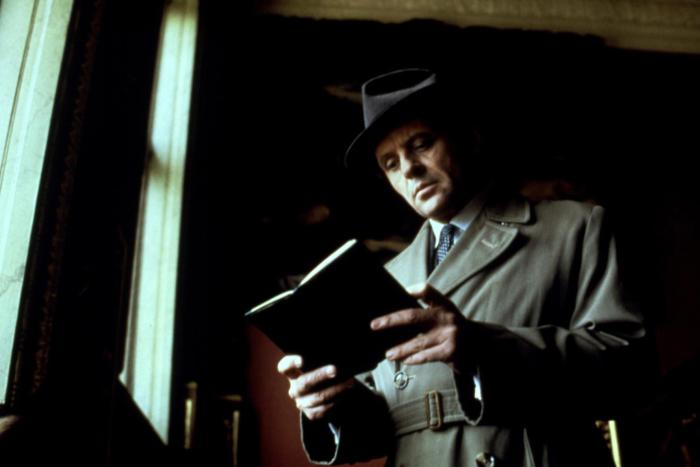
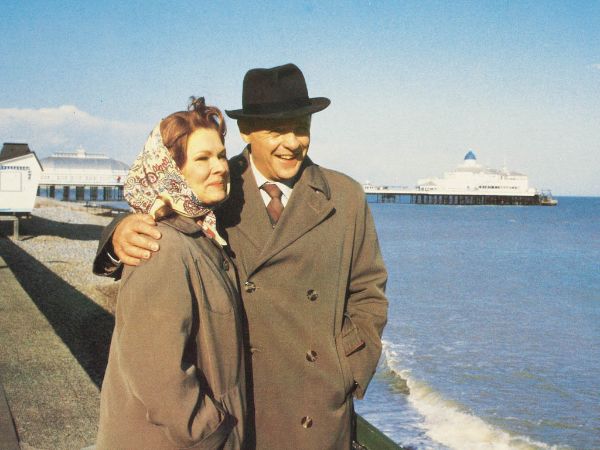
Lovely story, and certainly something that anyone who has a favorite place of business or customer for whom business is never usual can relate to. And it's one of those movies that would particularly appeal to the blue-haired old ladies in matinees for whom the shocks should not be roller-coasterish or beyond community standards. The performances are comfortable—Bancroft's verbose and brazen, Hopkins, donnish and in that automaton-ically restrained emotionally manner he'd perfect in Remains of the Day, Judi Dench has very little to do as his wife, other than dignified fretting, but does it like with an immediacy and a good-natured bantering with Hopkins that feels right.
If there is one complaint, it is that, after awhile, the director gets weary with the cutting back and forth and gets a little cutesy with the transitions, at one point Hanff addresses the camera which is jarring, and then there is a sequence where both characters are talking to the camera with no pretext of papyrus, writing or reading interpolated as voice-over. They appear (God help us) to be on Skype, and by that time the illusion and some of the magic disappears. They're not talking to each other anymore, as we've gotten used to. Instead the fourth wall is broken and they're talking to us, right at us, and, frankly, treating the audience as an unnecessary go-between is rather a step-down from our previous role as omniscient viewer. I didn't appreciate it much.
But other than that little spoiler, it's fun, nicely unique, and quite refreshing.


Helene Hanff The Doel family, Frank to the right