Tuesday, October 16, 2012
End of Watch
or
"...More Capers in One Deployment Than Most Cops Will See Their Entire Career."
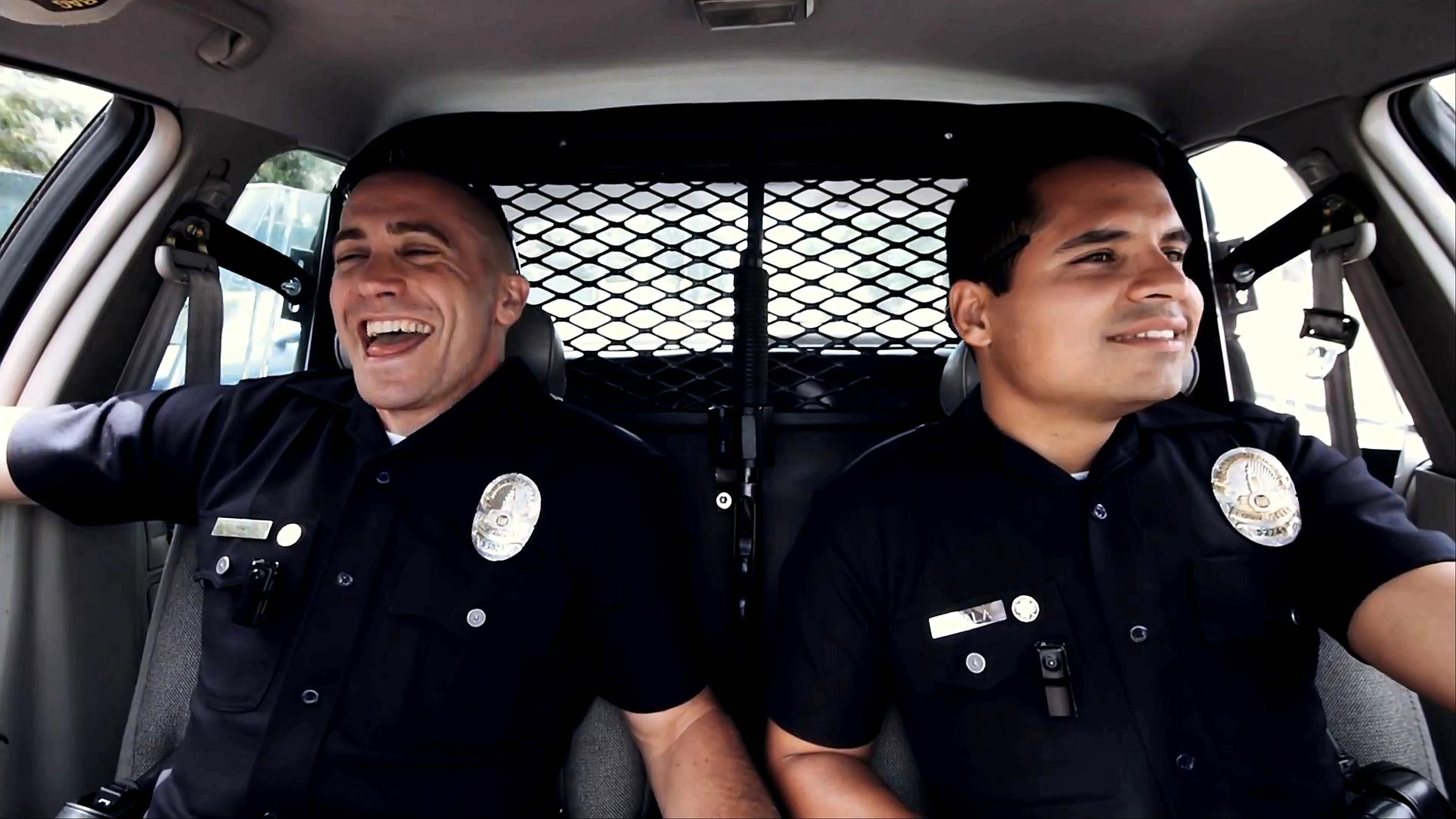
It's a war out there "once upon a time in South Central." And Officer Brian Taylor (Jake Gyllenhaal) is the front-line reporter documenting the whole thing "for a project." He's carrying a camera—not that he really needs it, the dashboard cam will pick up everything needed for an investigation. But that camera can only look forward—it's myopic. It can't see around you, it can't check the perimeter. And it can't look into your soul. It can look at your back, but it can't have it.
It starts with one of those dash-cam chases, so familiar to "reality" chase shows. No overlayed sound, save for Gyllenhall's narration, said in a monotone as if he was giving you your Miranda.
I am the police and I am here to arrest you. You have broken the law. I did not write the law. I may even disagree with the law. But I will enforce it. No matter how you plead, cajole, beg or attempt to stir my sympathy, nothing you do will stop me from putting you in a steel cage with gray bars. If you run away, I will chase you. If you fight me, I will fight back. If you shoot at me, I will shoot back. By law I am unable to walk away. I am a consequence. I am the unpaid bill. I am fate with a badge and a gun. Behind my badge is a heart like yours. I bleed, I think, I love, and yes, I can be killed. And although I am but one man, I have thousands of brothers and sisters who would die for me and I for them. We stand watch together. The thin-blue-line, protecting the prey from the predators, the good from the bad. We are the police.
And with that, the law of the film is layed down. The dash-cam goes away and the camera goes into cinema verité, the camera pointing from inside Taylor's locker as he goes through basic introductions—himself, his partner Mike Zavalla (Michael Peña, never better), his equipment (and a conversation from Rio Bravo pops into one's head: "That all you got?" "That's what I got."), and the beginning of the look inside—the harsh joshing, the tensions, the coolness and coldness and camaraderie of the corps. Joseph Wambaugh had an apt phrase for them in his book (and subsequent film), "The New Centurions." But Rome was never like this.
The turf in South Central is tough and hard-scrabble. Poverty is on display on every street corner, and behind the boarded-up windows of the houses in various states of disrepute are secrets for the outside world not to know, but will see the light of day once the front door is kicked in. The war is in the streets, but inside cook the warning signs that something is about to explode, the stakes rising, the limits of human degradation dropping, the calibers of the weapons increasing, the risks increasing and the only good side of it being that they're not increasing exponentially.
It's a tough film, directed and written by the guy who wrote Training Day and the original The Fast and the Furious, David Ayer, who has a knack for keeping things on the down-trodden path no matter who's behind the camera or what the subject matter is. It's not a film for continuity buffs, who will be driven crazy if they think "Okay, who's taking that shot?" with every change of perspective. Very quickly, the strictures of the snatch-and-grabbed shot are forgotten to gain perspective. The film would have been a pretentious (and claustrophobic) confusion if the conceit was maintained throughout, (I can see the review headline now: "The Blair Watch Project"), but as it is, breathes enough air into it while maintaining a feeling of impromptu recording—keeping the spirit of the law, rather than the letter of it. That, along with the ad-libbed spark of the dialogue gives it an edgy immediacy that, again, "seems" right, while never fully escaping the feeling of planned manipulation (not that it ever could). Game try, though. And manages to show the life—long stretches of tedium punctuated by moments of terror—that one imagines the life to be, even though blown up with steroids to fulfill the needs for melodrama and tension.
End of Watch is a Matinee.
Tuesday, April 5, 2011
Source Code

"This Train is Bound for Glory, This Train"
or
"Getting to Heaven By Way of Hell"
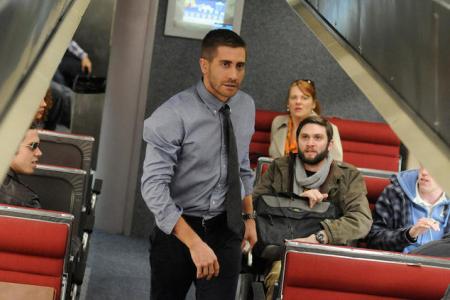
Captain Colter Stevens (Jake Gyllenhaal) wakes up, disoriented on a train. He was on a mission in Afghanistan just a moment ago...now he's on a train heading for Chicago, and the pretty girl (Michelle Monaghan) sitting across from him is calling him "Sean."
What the..?
The world is rushing by, full of commuter-sounds and commuter-problems, but all he knows is that he's not where he should be, and that the face staring back at him from a bathroom mirror isn't his.
"Don't worry," says the pretty girl, Christina. "Everything is going to be alright."
And then, the train explodes.
Famous last words.
Duncan Jones' (a clever enough director after two films that we can stop saying he's David Bowie's kid) last film was the under-performing Moon, featuring a tour de force performance by Sam Rockwell, and a sensibility that borrowed its uneasy creepiness from other sci-fi pics like 2001: A Space Odyssey. What was nice about Moon was that it was science fiction for adults, touching on themes and concepts that point out what role exactly man will play in Space, whether its comfortable or not. In Source Code, Jones and his clever scriptwriter Ben Ripley explore the same issues in the guise of a science-fiction time-travel movie that has, at its core—its owen source code, if you will—the guarantee that the train is going to blow up every few minutes...like a movie serial gone very, very wrong. And it is Stevens' mission, as he is military, to keep catching that train for the critical eight minutes before the explosion to try and find the bomb, stop it (low priority), but, more importantly, find out who did it—for that terrorist attack is merely a distraction for emergency crews to turn their attention away from a much bigger threat. Stevens must survey the passengers on the train to determine how the bomb was detonated...and who did it.
Each eight minutes gives him more clues, narrowing his focus and his mission, but at the same time, he's starting to have feelings for the girl sitting across from him. He wants to save her, and maybe the other strangers on the train.
But, like any broken-hearted suitor, he's living in the past. They're already dead. And time is running out for Chicago. His mission specialists (Vera Farmiga—doing a lot of subtle work with so little—and Jeffrey Wright—doing too much, as he is wont to do when searching for a character) are tasked to keep him on point: "Out here, the clocks only move in one direction."
"Out here?" Where is he?
"Star Trek: The Next Generation" had an ingenious episode "Cause and Effect" (directed by Jonathan Frakes), where the U.S.S. Enterprise-D was caught in a time-loop, but its crew didn't know it. We'd watch them go through a series of events, there'd be an emergency and the ship blew up. Cut to commercial. Back to the story, everything would reset, we'd watch the crew go through the same scenario, but with an increasing sense of deja-vu. The ship would blow up. Back to commercial. We'd run through the same incidents over and over, until Picard and co. realize that..."oh, we're caught in a time-loop, and we're doing the same things over and over, how do we stop?" It takes a few Enterpri blowing to smithereens before they figure out how to keep it from happening again. It was 60 minutes of Boom, Rinse and Repeat.
As I said, clever.* Like Groundhog Day with one hell of a punch-line. But here, the stakes are higher. Stevens doesn't know anyone on that train, but in his plunging again and again into that future-Hell, he gets to know them, as they go from suspects to victims, while managing to piss off each and every one of them along the way. The deeper he goes, the more he empathizes with their plight and wants to change a History already set in smoke and flame. Even if in a small way.
Source Code manages to be many genres in its perpetual loop of pieces of time: Science-fiction, disaster, action, detective, love story, and finally, inspirational, in showing how we, mere meat and electricity, can escape any trap that science, however well-intentioned, springs on us.
The best of science-fiction, despite the abilities of its clockwork mechanisms and theories to explain How Things Work, take those trappings of the soon-to-be, and tests the mettle of the beings caught in the gears. The most inspiring of science fiction always throws in the element of humanity that rises above by taking a leap of faith in nothing that approximates theory. Inspiration makes science. Wishing makes it so. Humanity makes both. And there's no formula, no theorem, no artificial intelligence to replace that one organic spark, the living breathing pilot light in the testing furnace of technology.
And the belief that everything is going to be alright.
Source Code is a terrific Matinee.
![]() |
| The official poster for Source Code just sucks (and even the one I used above doesn't do the job). But Olly Moss designed one (for the SXSW double bill with Jones' Moon) and it's quite timely. |
Saturday, December 11, 2010
Love and Other Drugs

"An Hour or Two of Relief From Being You"
or
"Life is Pain, Princess. Anyone Telling you Different is Selling You Something"
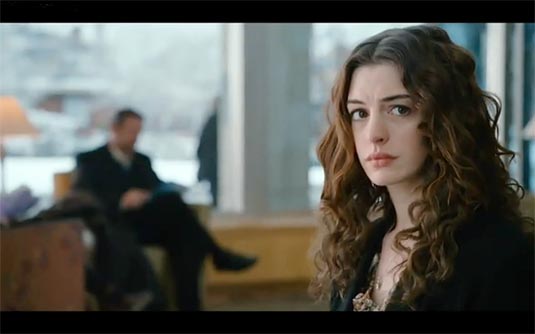
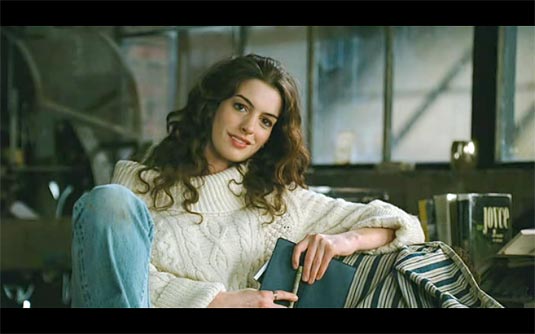
Edward Zwick and Marshall Herskovitz—the boys who brought "thirtysomething" to television many dances-by-the-light-of-the-moon ago—have put together (along with co-scenarist Charles Randolph) this adaptation of Jamie Reidy's book from tell-all to rom-com with a bit of a twist: taking Mary Poppins' advice that "a spoonful of sugar helps the medicine go down," Herskowitz and Zwick use the opportunity to educate a bit about the selling and hooking practices of pharmaceutical companies under the guise of watching Jake Gyllenhaal and Anne Hathaway cavort semi-nakedly through a noncomittal sexual relationship. At the same time, they try to inject a message about the pervasiveness of an over-the-top over-the-table drug culture, while also adding to the cocktail by venturing into rom-com territory about commitment and weightier problems than merely Twittering properly, or not being so damned selfish (well, actually, there's a lot of that) that it might actually fool you into thinking it's an adult romance. Symptomatic of too many script-doctors in the room, Love and Other Drugs is one over-prescribed movie, with far too many complications to be healthy.
Author Reidy's composite character is Jamie Russell (Gyllenhall), a privileged, entitled son of a well-to-do upper-class family of doctors (headed by George Segal and Jill Clayburgh—her second-to-last role). Russell was going through medical school, but dropped out, because he was bored (he was diagnosed early with ADD—a Ritalin child) and he didn't want to live up to parental expectations. He transitions from being a randy electronics salesman (he is...not the electronics) to a randy pharmaceutical salesman for Pfizer, a natural fit as the seduction of doctors begins as foreplay with the receptionists and nurses. He's a rep for zoloft, which Pfizer is hoping with cut into the considerable market-share of that penny-candy of anti-depressants, prozac. While sweet-talking a Doc (Hank Azaria) on his rounds "posing" as an internist, he sits in on an appointment with Maggie Murdock (Hathaway), a self-described "drug-slut" not without reason—she's 26 and in the first stages of Parkinson's. Rom-com's have a way of "meeting cute" and here it's that Maggie has a mark on her breast that she wants examined, only to discover that the internist in the examining room is doing too much examining. She clobbers him with her bag out in the parking lot when she finds out.
Somehow this turns into a relationship, heavy on the sex, and light on the commitment—she's just out of relationship with a married pharmaceutical rep (quite the coincidence) who just happens to be Russell's chief competitor (QUITE the coincidence!), while he's concentrating on fast-tracking his career. All well and good, but what starts out clinical and cynical, soon turns sorrowful and needy. Then, just when you think the movie has settled down to puzzle out the relationship, the game changes again with the introduction of Viagra to Pfizer's list of drug-pushing material. As it was in the pharmaceutical trade, it's a game changer for Love and Other Drugs.
Russell's not the only one with ADD, this movie is showing symptoms (that is, if it would stay consistent for 15 minutes!).
In its attempt to be a cure-all for all movie-goers (remain faithful to the book, but inject a romance:* hit the book's highlights, but try to maintain a storyline), it soon turns into one of those situations where the movie tries to cure its own side effects, rather than what's wrong at the source. It's competent in every way, and Gyllenhaal does yeoman's work trying to keep his character likable while being predatory, venal, and wildly inconsistent in behavior, while Hathaway, she of the big doe-eyes—seemingly always caught in the headlights**—gains sympathy even when she's flaunting the victim card in a variety of diverse and contradictory ways.
The film tries so hard to entertain everybody, but it's more a placebo effect than the real thing, that you might even be able to fool yourself into thing that, at the end, you feel all warm and gooey inside.
But, there's probably a pill for that, too. Consult your physician. Especially if it lasts more than four hours.
Love and Other Drugs is a Rental.
* Yeah, it's sexist, but Hollywood is the epitome of sexism--there has to be a romance in the movie to "attract the ladies." My favorite story on the subject was contained in a book about the making of John Huston's film of Moby Dick. In it, one of Ray Bradbury's stipulations to writing the script is that there be no requests for a "romantic sub-plot." , At a late stage in the scripting, Huston, being an irrepressible prankster, asked Bradbury to write a part for a producer's girlfriend.
** She's this generation's Liza Minnelli (that's not necessarily a compliment!).
Friday, June 4, 2010
Prince of Persia: The Sands of Time
"Iran Up the Wall; Iraq Your World"
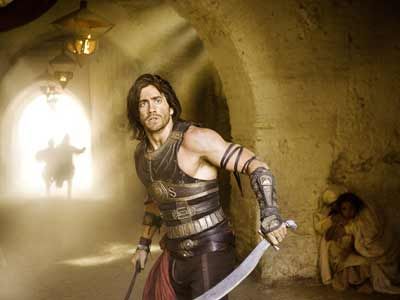
Jake Gyllenhaal's buffed-up appearance reflects the hefty expansion of the "Prince of Persia" video game from a simple 2-D grid game one level ahead of "Donkey Kong"(see below) to a full-blooded adventure story reminiscent of Hollywood's back-lot recreations of Arabian Night stories, from Doug Fairbanks to Ray Harryhausen. There are no sabre- and bone-rattling skeletons or out-sized shellfish scuttling across the screen in "Prince of Persia: The Sands of Time," the menaces are purely human and reflect intrigue amidst a royal family with absolute authority over a territory extending, as we're informed, "from the steppes of China to the shores of the Mediterranean."
Why, it's almost as big as the Ponderosa.
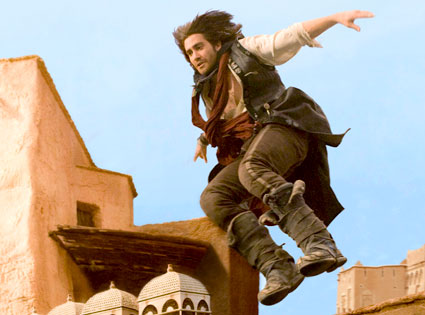
To carry the frivolus "Bonanza" analogy further,* King Sharaman (Ronald Pickup) rules with equanimity with the help of his brother Nizam (Ben Kingsley), his regent, and his three sons—two by birth. First in line to be King is Tus (Richard Coyle), then Garsiv (Toby Kebbell). Last up is Dastan (Gyllenhaal), a "street-rat" adopted by the King after witnessing the boy's bravery and selflessness—a sequence that borrows heavily from the "One Jump Ahead" sequence from Disney's "Alladin."** Dastan's prowess video-game leaping from roof-top to roof-top across the alley-ways of the city are demonstrated—and there is a representative slo-mo level shift in every action sequence with eye-rolling regularity—but the new addition proves beneficial, despite being the black sheik of the family.
Time is the key to "Prince of Persia," for once the old king advances in age, it falls on his two and half men-sons to expand his kingdom and keep the CGI populace of the vast CGI cities under control. When we transition to the story-proper, the three are quibbling over who should lead the attack invading the Holy City of Alamut, where it is suspected that a cache of weapons is being created for a suspected attack on the Royal City of Nasaf. That there are weapons is as sure as yellow-cake, but Dastan is suspicious that the the invasion is unnecessary and pointless.
I'd screech to a halt at this point, but you can't screech on sand. Buried deep in the shifting plot-line there are some allusions to recent events in the same region, especially once it's discovered there aren't any "secret weapons caches" anywhere in the city. Why attack it, then? There's something important there, and somebody wants it...in the worst way.
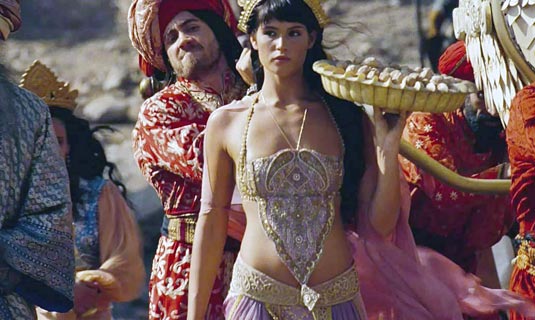
It gets complicated. Before we're done brother is pitted against brother, and Dastan falls under suspicion for war-crimes. He becomes a fugitive, with the reluctant help of the feisty, yet nubile Princess Tamina (Gemma Arterton, I'm sure the writers resisted calling her "Homina, Homina") and some rogues along the way—Sheik Amar (Alfred Molina) and the mysterious fighter Seso (Steve Toussaint), the kinds of entertaining second bananas required of this type of tale. Familiar? Yes, but the scenarists and director Mike Newell (Enchanted April, Donnie Brasco, Four Weddings and a Funeral, Harry Potter and the Goblet of Fire—no slouch, he!) manage to satisfy the gamer-need for frenzy and the genre's need for romanticism, while keeping enough fresh ideas to make it all entertaining.
Despite that opening "Alladin" sequence, everything happens a bit differently: the seige of Alamut is staged with an initial assault that is swash-bucklingly aggressive, while also showing ample opportunities why it could go hilariously wrong. Yes, it has the standard big glowing action set-piece at the end, but there are enough dire consequences of it that one actually begins to suspect that the film-makers want to mess with the audience's expectations.
Not to worry. "Prince of Persia" is a big, old-fashioned popcorn adventure movie, done with the love of past desert epics glinting in its sand-encrusted eye. Quibble all you want, it is the best of the video-game movie-adaptations—several levels above, one is tempted to say—determined to entertain the kiddies in all of us.
Be sure and get a large pop-corn. And a large drink—they don't make anything of it, but it gets thirsty out there in the desert.
"Prince of Persia: The Sands of Time" is a Saturday Matinee.
* But not as far as one could with, say, "Legends of the Fall."
** As Disney is releasing "Prince of Persia," I'm sure any intellectual property problems will be solved by memo.
Monday, June 9, 2008
Rendition
Rendition (2007, Gavin Hood)
"Politics is personal".
Rendition by Gavin Hood is a story based around one of the most criticized tactics used by the Bush administration in their 'war on terror' - the removal of those suspected of terrorist activities to a location outside of the United States in order to avoid any of the remaining legal safeguards against extended detention and unlawful methods of interrogation. By setting this as a fictionalized account, we are meant to see the human face of those who are affected by this policy as well as those who employ it. The plot revolves around the detention of Anwar El-Ibrahimi (Omar Metwally) and the attempts of his wife (Reese Witherspoon) to find out what has happened to her husband when he fails to return from a trip to South Africa. She tries to enlist the aid of an old boyfriend (played by Peter Sarsgaard), who is now an aide to Senator Hawkins (Alan Arkin), who attempts to intervene on her behalf with the head of US Intelligence, Corinne Whitman (Meryl Streep) until it becomes politically inopportune to do so. Whitman represents those that believe that what they do is worth the price that others pay for it:
Corrine Whitman: Honey, this is nasty business. There are upwards of 7,000 people in central London alive tonight, because of information that we elicited just this way. So maybe you can put your head on your pillow and feel proud for saving one man while 7,000 perish, but I got grandkids in London, so I'm glad I'm doing this job... and you're not.
Ibrahimi has been removed to an unnamed Maghreb country where he is to be interrogated by the local head of police, Abasi Fawal (
Yigal Naor), supervised by a CIA intelligence officer, Douglas Freeman (Jake Gyllenhaall). To add another twist to the plot, Fawal's daughter, Fatima (Zineb Oukach) is having a relationship with a young jihadist, Khalid (Moa Khouas) who is planning an assassination attempt on her father's life.Freeman, played with almost a complete lack of emotion by Gyllenhaal, has had no experience with the interrogation of prisoners but is less than impressed with the results of Fawal's methods.
Douglas Freeman: In all the years you've been doing this, how often can you say that we've produced truly legitimate intelligence? Once? Twice? Ten times? Give me a statistic; give me a number. Give me a pie chart, I love pie charts. Anything, anything that outweighs the fact that if you torture one person you create ten, a hundred, a thousand new enemies.
Hood gets good performances out of his actors and for two-thirds of the movie, we are engrossed in a thriller but then it seems that the Hollywood suits stepped in and asked for some kind of resolution that would leave us suitably outraged but not too complicit in the use of torture. Though it is probably true that there have been many prisoners quietly released from detention, it is hard to see it happening in the way that is shown here. Which is a shame after what has come before in the movie.
Tuesday, January 22, 2008
The Day After Tomorrow
top about global warming (sorry, make that "climate change") as it can be about asteroids and volcanoes. Dennis Quaid plays a climatologist whose alarm-level is always at a pinched 85% (Quaid, a conservative, carries a slight air of disbelief in the performance), and it does contain a "peril" sequence that just made me hoot--Jake Gyllenhaal and buddies trying to out-run a deadly ice-freeze taking over the New York Public Library. It's got something for everbody, including, as Thelma Ritter so famously said in "All About Eve" "the bloodhounds snapping at (your) rear end." Impressive visual effects, though, backed up by some pretty impressive imaginations of the U.S. in a deep-freeze. My favorite part was the heated discussions (in a freezing room) of what books they were going to burn to stay warm. Kids, for practical reasons I'd start with the Encyclopedia's, but on the other hand given their current track record, maybe you should start with the Farmer's Almanacs!
Monday, January 14, 2008
Zodiac
"You're doing it again! That thing I don't like that starts with an 'L'"David Fincher's "Zodiac" is the most disciplined and least-flashy movie in his career. A 2 hour, 45 minute overview of California's "Zodiac" serial-killer case from almost the start to the finish--a nearly thirty year tale that is less about the crimes, specifically, but more about obsession: the obsessions that sparked the crimes and the obsessions, in turn, sparked by them. Over time as personalities change, careers and fortunes rise and fall, as the city morphs and hem-lines and side-burns flare and recede, the obsession burns and inflicts its own damage. It's a movie about that damage and the shockwaves that killers inflict beyond the immediate victims.
This is not to say that "Zodiac" is not violent--it is, at least for the first half-hour or so, but it is the cold-blooded casualness of the violence that stuns (at one point "Zodiac" is seen pummelling a woman and you realize to your horror that she is being stabbed--these are the least "theatrical" killings I've seen on-screen), and those expecting a gore-fest will be let down by the lack of screen-time devoted to the actual murders, but Fincher maintains a looming (that "L" word mentioned above) unease that infects later scenes with dread.
Stay to the end of the credits and you'll be presented will three big-screen pages of technical consultants (many of whom are the real-life characters portrayed in the film) and a long list of thanks to communities who figured in the convoluted path of the tale. Meticulously researched and painstakingly recreated (I've seen glowing comment threads from San Franciscans amazed at the scruplulousness of the production), the same care is also taken with the many performances from a non-stellar, but reliable cast of character-actors all doing subtle, nuanced work. From Robert Downey Jr.'s fussy turn as a scruffy San Francisco Chronicle reporter, to Anthony Edwards and Mark Rufalo as the two lead SFPD detectives investigating (you can imagine Rufalo's Detective Toschi serving as a model for both Steve McQueen's "Bullitt" and Eastwood's "Dirty Harry" even though his performance is far-afield of those star-turns), and Jake Gyllenhaal as the character involved longest with the case...except for the killer.
Fincher harkens back to the paranoid thrillers of the 70's, even going so far as to use the Paramount and Warners Studio logos from the era, and reviving the career of composer David Shire whose sombre, oppressive scores provided the low rumblings of such films as "The Conversation" and "All the President's Men."
But despite the intricacies of plot, the labyrinth of clues and puzzles, the shadowy corridors, darkened streets and blind alleys, the film is never allowed to lose focus or drag. One is never aware of the length of the film, only the passage of time in the film. And that's an amazing accomplishment, but not the last one.
Because for all the time-lapse CGI tricks Fincher employs (and some of the essential clues that are focussed on), there is an acknowledgement made of the most lethal serial killer: in the end, time gets all of us. Our life-histories catch up, and right or wrong, no one goes away unpunished.
"Zodiac" is a full-price ticket