Showing posts with label Video Game. Show all posts

Saturday, December 1, 2012

Wreck-It Ralph

Who Framed Wreck-It Ralph?
or 
Being Two-Bit in an 8-Bit World

It's not that I didn't "like" Wreck-it Ralph.  I did.  I just wasn't moved by it, nor did I care one bit about any of it—not the movie, not the characters—any of it.

Oh, there's a lot to admire: the animation is amazing, albeit to a limited world inside a video game (it can't be too complicated in its design as it's supposed to reflect the limited world-view of a flat 8-bit world refracted in 3-dimensions); the expansions and contractions of those worlds are quite cleverly done—the expansions of those environments being of the commingling of those worlds before the lights turn on in the video arcade, the characters commuting in a Grand Central Station hub to their various scenarios, and the contractions being in the limited animation movements of some of the characters.  The voice-acting is fine, headed by John C. Reilly, Sarah Silverman, Jane Lynch, Alan Tudyk, and Jack McBrayer (of "30Rock").  The cameos by various amusement game characters are amusing—the Pac-man ghosts, Sonic, Qbertwhich gives the whole thing a tinge of Who Framed Roger Rabbit,* Disney Animation has done a great job of it under the tutelage of Pixar's Jon Lasseter.

But, as great as it is, it's hardly inspired, the central conceit being all those video game characters have lives and concerns when no one's looking, which is the idea behind the "Toy Story" franchise.  But, instead of that series forming a concept of the toys banding together to get along in The Big Toy-Box, the issues of the segregated video game characters are decidedly trivial and territorial.  They inhabit an 8-bit world, but their concerns are decidedly two-bit, as in the story's central story-line.  "Wreck-it Ralph" is the villain of the game "Fix-it Felix"—inspired by "Donkey Kong" but not (Mario, remember?) and he's dissatisfied with his life as a villain.  He wants to be a hero, but is never given a chance and his intended role keeps him ostracized in the "Felix" community.  He's shunned, gets no respect, and isn't even invited to parties.  His "villain support group" provides no comfort.  So, Ralph decides to expand his horizons (if video games have horizons) and starts visiting other games, like a WOW game with a butch commander in curvy leather (Lynch, of course), then navigates to another game "Sugar Rush" (no doubt coming to a Game Stop near you) where perky princesses race in a candyland world (and one of the racers is voiced by Silverman, not of course).  


There are some wonderful things that could be done here as far as the migration of traditional characters in non-traditional environments, but what's here doesn't have a lot of imagination as far as plot, the complications or the resolution.  Ultimately, it's a bright, pretty snooze-fest (I felt the need to feed myself quarters to keep from nodding off).  But ultimately I just wanted to move on, feeling like I was losing a life—the only one I have!—just waiting for the blessed relief of "Game Over."


Wreck-It Ralph is a Cable-Watcher.


The game-screen of "Fix-It-Felix" and its inspiration "Donkey Kong"©


* ...although you wonder where some other characters are, like Prince of Persia, Mario, Halo, and then you remember "Oh, yeah, they have their own movie franchises" (mostly inactive) and their places are "suggested" by other characters.

Friday, June 4, 2010

Prince of Persia: The Sands of Time

"Iran Up the Wall; Iraq Your World"

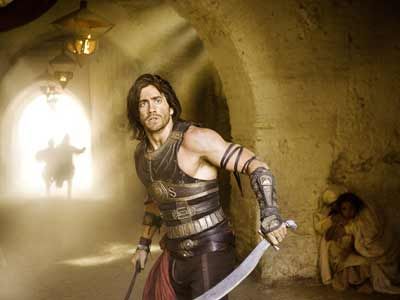
Jake Gyllenhaal's buffed-up appearance reflects the hefty expansion of the "Prince of Persia" video game from a simple 2-D grid game one level ahead of "Donkey Kong"(see below) to a full-blooded adventure story reminiscent of Hollywood's back-lot recreations of Arabian Night stories, from Doug Fairbanks to Ray Harryhausen. There are no sabre- and bone-rattling skeletons or out-sized shellfish scuttling across the screen in "Prince of Persia: The Sands of Time," the menaces are purely human and reflect intrigue amidst a royal family with absolute authority over a territory extending, as we're informed, "from the steppes of China to the shores of the Mediterranean."

Why, it's almost as big as
the Ponderosa.

To carry the frivolus "
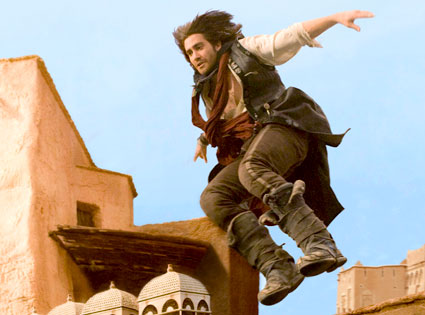
Bonanza" analogy further,* King Sharaman (Ronald Pickup) rules with equanimity with the help of his brother Nizam (Ben Kingsley), his regent, and his three sons—two by birth. First in line to be King is Tus (Richard Coyle), then Garsiv (Toby Kebbell). Last up is Dastan (Gyllenhaal), a "street-rat" adopted by the King after witnessing the boy's bravery and selflessness—a sequence that borrows heavily from the "One Jump Ahead" sequence from Disney's "Alladin."** Dastan's prowess video-game leaping from roof-top to roof-top across the alley-ways of the city are demonstrated—and there is a representative slo-mo level shift in every action sequence with eye-rolling regularity—but the new addition proves beneficial, despite being the black sheik of the family.

Time is the key to "
Prince of Persia," for once the old king advances in age, it falls on his two and half men-sons to expand his kingdom and keep the CGI populace of the vast CGI cities under control. When we transition to the story-proper, the three are quibbling over who should lead the attack invading the Holy City of Alamut, where it is suspected that a cache of weapons is being created for a suspected attack on the Royal City of Nasaf. That there are weapons is as sure as yellow-cake, but Dastan is suspicious that the the invasion is unnecessary and pointless.

I'd screech to a halt at this point, but you can't screech on sand. Buried deep in the shifting plot-line there are some allusions to recent events in the same region, especially once it's discovered there aren't any "secret weapons caches" anywhere in the city. Why attack it, then? There's something important there, and somebody wants it...in the worst way.

It gets complicated. Before we're done brother is pitted against brother, and
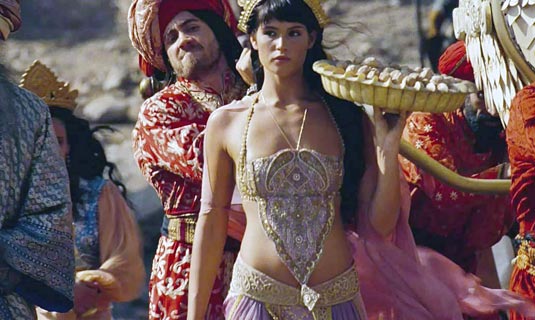
Dastan falls under suspicion for war-crimes. He becomes a fugitive, with the reluctant help of the feisty, yet nubile Princess Tamina (Gemma Arterton, I'm sure the writers resisted calling her "Homina, Homina") and some rogues along the way—Sheik Amar (Alfred Molina) and the mysterious fighter Seso (Steve Toussaint), the kinds of entertaining second bananas required of this type of tale. Familiar? Yes, but the scenarists and director Mike Newell (Enchanted April, Donnie Brasco, Four Weddings and a Funeral, Harry Potter and the Goblet of Fire—no slouch, he!) manage to satisfy the gamer-need for frenzy and the genre's need for romanticism, while keeping enough fresh ideas to make it all entertaining.

Despite that opening "Alladin" sequence, everything happens a bit differently: the seige of Alamut is staged with an initial assault that is swash-bucklingly aggressive, while also showing ample opportunities why it could go hilariously wrong. Yes, it has
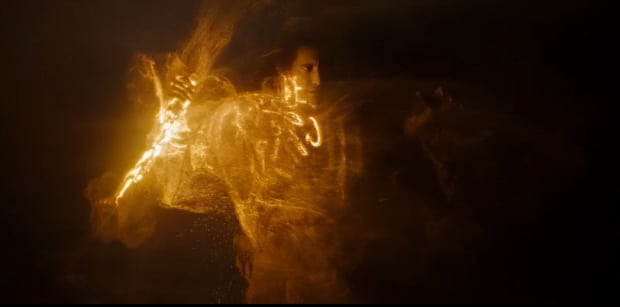
the standard big glowing action set-piece at the end, but there are enough dire consequences of it that one actually begins to suspect that the film-makers want to mess with the audience's expectations.

Not to worry. "Prince of Persia" is
a big, old-fashioned popcorn adventure movie, done with the love of past desert epics glinting in its sand-encrusted eye. Quibble all you want, it is the best of the video-game movie-adaptations—several levels above, one is tempted to say—determined to entertain the kiddies in all of us.

Be sure and get a large pop-corn. And a large drink—they don't make anything of it, but it gets thirsty out there in the desert.

"Prince of Persia: The Sands of Time" is a Saturday Matinee.

* But not as far as one could with, say, "Legends of the Fall."

** As Disney is releasing "Prince of Persia," I'm sure any intellectual property problems will be solved by memo.