"Raising Caine" or "Eyesight to the Blind"
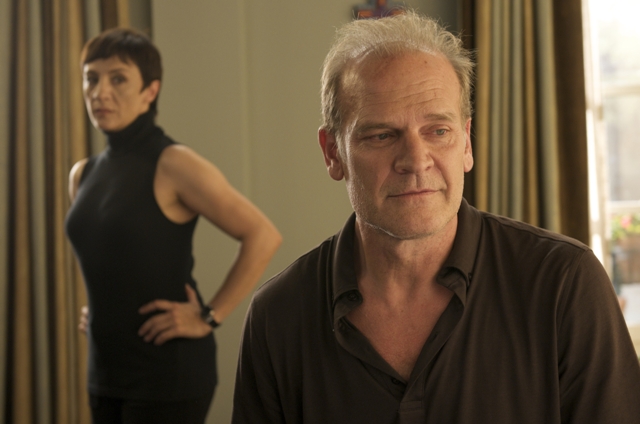
Harry Caine (Lluís Homar) is a writer of screenplays in Madrid, semi-content to take on the occasional assignment his former production assistant Judit (Blanca Portillo) gives him and to pick up the occasional stranger who helps him across the street. Harry happens to be blind, and that he writes for a visual medium is just one of the ambiguities that inform "Broken Embraces" (or "Los Abrazos Rotos"), the latest film of Pedro Almodóvar that, like Quentin Tarantino's "Inglourious Basterds," is a valentine to the movies.
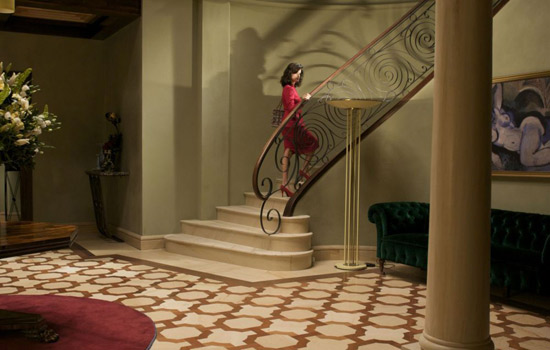
Maybe it's more like a box of dark chocolates. Multi-layered, with movies within movies and a story told mostly in flashbacks and first-person narration, it's a film noir in candy-colors (like the Andy Warhol prints of firearms in the heavy's house), and interlocking human triangles that make up the chain of the movie.* Running throughout are the Almodovar themes of dual identity, parental issues and role-playing (but no sexual ambiguity here, he keeps this story fairly hard-boiled), but it comes back to the art of seeing, and illusion, and seeing and creating illusion.
And Penelope Cruz. But, let's back-track.
On the day when a wealthy industrialist, Ernesto Martel (José Luis Gómez) dies, Harry gets an appointment with a film-maker (he claims to have made a documentary fourteen years ago) named Ray X (Rubén Ochandiano), who wants Harry to collaborate on a screenplay. Given the scenario, Harry refuses and X is tossed out by Diego (Tamar Novas), Harry's assistant and typist (and Judit's son). An accident to Diego while his mother is away, puts the two men together in a mutually care-giving relationship, and Diego asks him about Mateo Blanco.
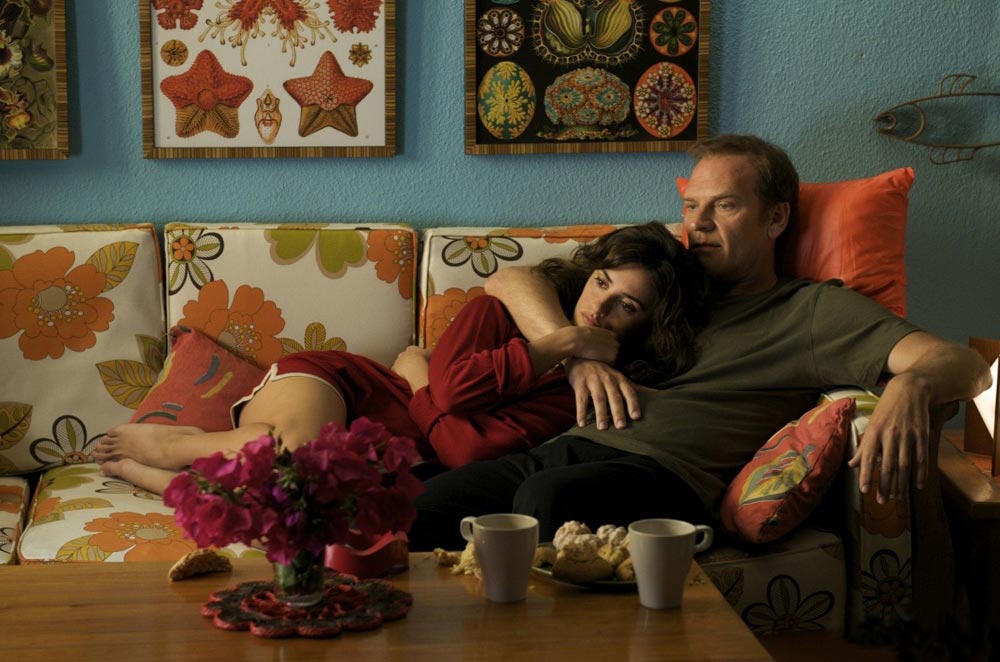
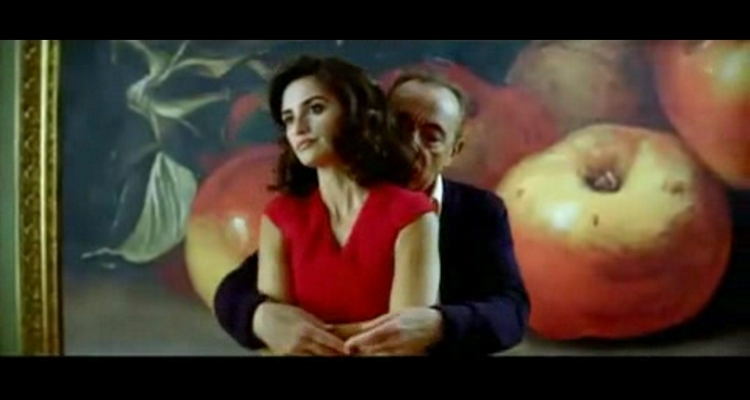
Mateo Blanco, you see, was another life. "Harry Caine" is a pseudonym that Blanco lives and writes under now. And over the course of the film, "Harry" tells Diego about the complicated story that led up to the day that Blanco lost his sight, his life and his love. It involves Magdalena Rivas (Penélope Cruz), secretary to Martel, and in a past life, a call-girl. A family crisis puts "Lena" in Martel's debt and she becomes his mistress, and he provides her anything money can buy...except freedom. Lena desires to be an actress, and one day she auditons for Mateo, who becomes enchanted with her.
There's a lot more to tell, but you can probably guess a lot of it, if you've seen a few movies out of the past. Almodovar isn't breaking any new ground this time, but he is tilling rich story-telling soil, the kind that binds screenwriters to Fate, for Good or Ill, and produced the films that made him fall in love with The Movies.
And movie-making. The film that the film's Mateo is fussing over is highly reminiscent of one of Almodovar's own films (right down to the...uh...cast), and his perverse humor knows there's not much difference between a controlling lover and a controlling director. Lena is a pawn in both men's game, and when being pulled in two directions something's gotta give...or be taken.
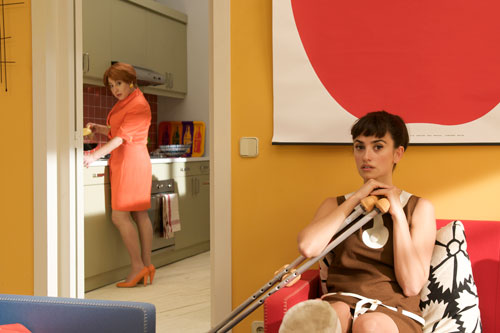
It's familiar stuff, but one more opportunity for Almodovar to have fun with the house of mirrors that is cinema. And one more opportunity to work and reflect a different aspect of his current Muse, Penelope Cruz. In his last film, "Volver," Cruz was an earthy Sophia Loren. Here, she's Audrey Hepburn...well, that's how Mateo molds her for the film (in a scene highly reminiscent of this blog-post by Almodovar about the film's prep). There's another more tragic icon that's touched on. One that the public embraced, and who loved the attention it brought her. And who learned too late that to be embraced also means to be held, constricted and restricted. Things cost.

Cruz and Almodovar show how it's done.
* At one point, Penelope Cruz is festooned with the most elaborate gold jewelry that almost looks like an elaborate horse harness. Makes one consider whether any jewelry is a form of "tack."