Showing posts with label Walter Matthau. Show all posts

Saturday, June 15, 2013

Gangster Story

Gangster Story (Walter Matthau, 1959) An odd one, this.  And not a very good one, but still an oddity.  A capital "B" B-movie, directed by Walter Matthau, and the only movie he ever directed (someday I want to see the one Cagney directed, too), done very early in his career.  At the time, Matthau was a stage actor, but since 1950 he'd been doing small parts in TV series, and didn't make his first film until 1955's The Kentuckian (starring Burt Lancaster and, as we're on a theme here, directed by him, as well) and would start becoming a fixture in films with Elia Kazan's A Face in the Crowd.   

It's not known whether it was done on a dare, or out of desperation. The script wasn't much, but Matthau took the job, starring in and directing, because he had gambling debts.  His co-star was his wife, Carol Grace, and instead of New York, it was filmed in sunny Los Angeles, mostly during the day, unusual for a supposed film-noir, and where the most shadows are seen in, of all places, a library.


Matthau is fine, his performance, at least, is professional, but loose and schlumpy, and plays well, even in scenes that are patently absurd...like the one where his con character Jack Martin stages a bank-vault robbery by posing as a movie director rehearsing a scene—distracting the guards to "stay in character" and convincing the bank president to open the vault. (Really?  It's that easy?  Everyone is that dumb and star-struck, not even asking for a filming permit and with no cameras, no crew, nothing?), while most of the other performers range from merely amateurish to a painfully charitable "at least they remembered their lines."  Wouldn't have mattered if they didn't.  The entire movie is post-dubbed, the dialogue replaced in the studio after the fact—whether because they had no sound recordist during filming (it was a five-man crew...and edited by future porn director Radley Metzger) or background sounds are so pervasive.  It does create a rather unnerving sequence, late in the movie (when nobody was paying attention?) where dialogue is punctuated a few times by the sound of the timing "beep" that alerts the actor when to talk—no one bothered to take them out...it wasn't in the critical first or last reels, and maybe it was just overlooked. 


Professionalism aside, what this movie most resembles is the 1973 film Matthau made with director Don Siegel, Charley Varrick, about "the last of the independents" (criminal division).  Both Martin and Varrick are bank-robbers, who get caught up in a situation they're not accustomed to: not only avoiding the police, but also the organized crime lord attached to the last institution Matthau's perp robbed.  Both involve a good amount of time on the lam and hiding out, although Martin capitulates and, to settle differences, joins the organized bad guys to save his neck.  The quirky, nastily-funny Siegel film is full of invention and colorful characters; everything about Gangster Story is pure black-and-white, and is really worth watching only for the curiosity factor.  Matthau moved on, and when this vampire of a movie rose from the dead in conversation he'd crack wise in interviews saying the film "premiered at Loew's in Newark and never crossed the Hudson."  He never was tempted to direct again.


Thursday, August 14, 2008

The Taking of Pelham One Two Three (1974)

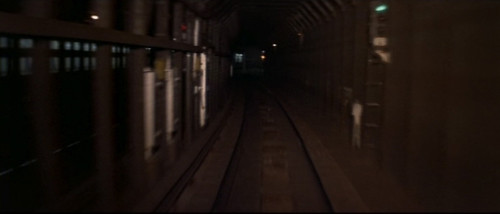
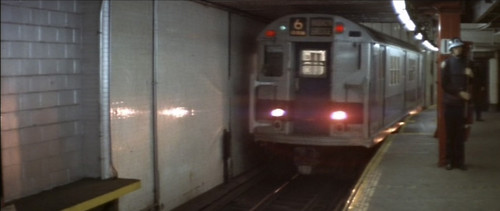
"The Taking of Pelham One Two Three" (Joseph Sargent, 1974) Taut, no-frills caper thriller about the hi-jacking of a New York subway train by a group of color-named conspirators. Veteran director Joseph Sargent and cinematographer Owen Roizman create a gritty landscape of dark passages and harsh fluorescent lighting while the Transit police try to negotiate with the hi-jackers, and the hi-jackers deal with their internal squabbles and a subway car of jumpy New Yorkers. It's like anything: Nothing's easy.

This was the first of more adaptations than necessary (
a TV version was broadcast in 1999 with Edward James Olmos and Vincent D'Onofrio, and Tony Scott is making a new one with Denzel Washington and John Travolta) of John Godey's novel, but is the best of the bunch, having the advantage of a witty script penned by Peter Stone, screenwriter of "Charade" and the musical "1776." Stone realized the bare-bones plot of the novel wouldn't sustain a movie, and fleshed out the characters with a jokey, schlumpfy "attitude" that keeps the slow parts entertaining, especially when played by two character actors like Walter Matthau and Jerry Stiller. Matthau gets the advantage of playing a fairly straight character with a muffled humor, while Stiller makes the sarcasm of his dispatcher as dry as Brooklyn dust. By contrast, the hi-jackers (Hector Elizando, Martin Balsam, Earl Hindman, led by Robert Shaw) are twitchy no-nonsense cyphers cloaked in anonymity. It's the cops who are the interesting ones, as they race against time to secure a million dollars in ransom and deliver it before hostages begin being killed.

The direction and lighting take their cues from the documentary style of "The French Connection,"* as does the funky score by David Shire, but Stone's script is the factor that nudges the film beyond its thriller origins and give it a cynical style.

In fact, it is so well done, that one questions the need to do another version.


*Owen Roizman was the DP for that film, as well.