Here's a re-post of my Chuck Jones appreciation.
 Chuck Jones is a big hero of mine, because I grew up watching cartoons. My favorites were always the Looney Tunes and Merrie Melodies—the products of Termite Terrace, the animated unit at Warner Bros. And of the anarchic geniuses to sync a spitting lisp onto a character,* Charles M. Jones was my favorite. His cartoons had a bit more artistry, a better sense of design. That’s not why I liked them when I first encountered them, sitting on the floor in my ‘jammies, the television looming above me. I liked them because they were meaner.
What I didn’t know at the time was they had a sense of gentleness and tragedy and of doomed inevitability that just tickled me pink--that combination of sweet and sour with a cruel cynicism that delighted me.
I didn’t know how powerful Jones’ influence on me was until I was in college, majoring in communications. In a rather useless assignment for some theory class or other, they were showing one of Jones’ Oscar-winning cartoons “The Dot and the Line,” with the sound off, the challenge for the students being to determine what the cartoon was “communicating.” Easy, right? Except for the fact that the cast for “The Dot and the Line” consisted of…a dot…and…a line. No faces or expressions were painted on either character. They were your basic black India ink dot and line. The film had a narration, but the class was not privy to it. Despite all of that, I was able to suss out exactly what was going on throughout (even though I had never seen it before), and even interpret what emotions the…”dot” and the…”line” were going through. I was the only one in the class to do so.
Now, this had nothing to do with me, but everything to do with Jones’ story-telling style being consistent from cartoon to cartoon. This is the guy who made a cartoon featuring musical notes, for sufferin’ succotash. So, when the dot in a moment of sadness sighed, Jones had a way of animating that…even for just a dot…that was distinctive, and for me, identifiable.
Charles M. Jones Esq. is also the only hero I’ve ever met and had a sit-down discussion with. When I worked at KIRO Newsradio, Jones was selling animation cells and was appearing at a gallery (I believe, at the time, owned by his daughter) downtown, and he’d agreed to appear on the Jim French program. He was in his early 70’s at the time, and my impression of him was that he was just like his cartoons—a short, sweet-looking little man, who was as crusty as all get-out. I had him sign an ad for the video of the Jones compilation movie “The Bugs-Bunny-Road-Runner Movie” (“Where the hell’d you find THAT!?” he rasped.) We had a nice, casual conversation before he went into the studio, and, for some reason, we got into the origins of Marvin the Martian. “Well,” he said, “I based it on Mars, the Roman God of War. I figured with the helmet and the armored toga, I could get away with showing what an angry little guy he was with a minimum of work—so I based it on that.” “So….” I said. “What about the sneakers?” There was a Jonesian pause (approximately 48 frames) while he squinted at me like I was an idiot. “I LIKE sneakers!!” he yelled. I howled, and he chuckled. He was called in to do the interview and that was that. There were a couple of other times I had planned to see him, but at one I was booked to work, and the other—a talk and a showing of his adaptation of his buddy, Dr. Seuss’ “How the Grinch Stole Christmas” at the King Cinema, he was too sick to attend. His brilliant background artist, Maurice Noble, came instead.
He died on February 22, 2002, at the age of 89.
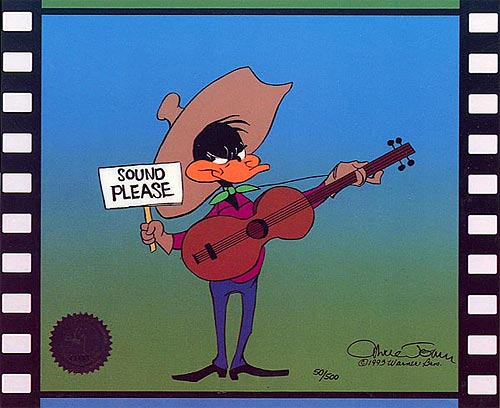
I have an animation cell of his that has Daffy Duck (from “Duck Amuck”) holding up a sign that says “Sound, Please!” that I treasure.
Acme Poem Company
Nature’s Cruel. Chuck Jones is crueler.
Time stops for the revelatory pause.
The realization, the brief reaction.
Hesitations of inviolable laws
The cosmic clockwork has seized its gears
to present your moment of doom.
Then, once you’ve noticed, it’s on with the show.
Now, wait for it...............
...................................boom!
There are quite a few Chuck Jones cartoons hovering around the web (but they disappear like zephyrs once the Warner Brothers get wind of it). My favorite for sheer inventiveness in toying with the cartoon-form and all of its possibilities is "Duck Amuck," one of the simplest ideas for a cartoon in concept, but is dizzying in its timing and the ability to build on and vary what is essentially a "one joke" concept. It's also a nifty little meta-commentary on the realtionship of animator with animatee.*
I can also present, for the time being (as it's been snatched from my clutches before!) "One Froggy Evening." If you’ve never seen it, frankly, I’m amazed—but you’re in for a treat. And, another plus—except for a few songs, it tells its story with no dialog—only visually. Steven Spielberg calls it "The Citizen Kane of cartoons." It, like “Duck Amuck” and Jones’ Wagner parody with Bugs Bunny and Elmer Fudd, “What’s Opera, Doc?,” are part of the National Film Registry, for being "among the most culturally, historically and aesthetically significant films of our time."
* The lisp was a secret dig at the animator’s boss, Leon Schlesinger, who had a prominent lisp and was loathed by all his employees, and who seemed blissfully unaware of the jokes at his expense.
** The other thing I love about it is that I just know Michael Maltese and Chuck Jones were trying to come up with a concept, and Maltese started with "Daffy comes out and..." and stopped, and they looked at each other blankly, and when they had wracked their brains enough, they just threw out all the rules and went "free-form" with the thing. Desperation and deadlines make you bold as well as crazy.
Chuck Jones’ Official Web Page
The Chuck Jones Center for Creativity
Chuck Jones on Toonopedia
A Chuck Jones Fan Site
Chuck Jones at IMDB
Chuck Jones’ Wikipedia entry
Roger Ebert on Chuck Jones
Chuck Jones section of the “Academy of Achievement”
PBS’ Great Performances: “Chuck Jones-Extremes and In-Betweens”
A comprehensive List of Jones’ cartoons
An essay on Jones from “Senses of Cinema”
The Chuck Jones Center for Creativity
Chuck Jones on Toonopedia
A Chuck Jones Fan Site
Chuck Jones at IMDB
Chuck Jones’ Wikipedia entry
Roger Ebert on Chuck Jones
Chuck Jones section of the “Academy of Achievement”
PBS’ Great Performances: “Chuck Jones-Extremes and In-Betweens”
A comprehensive List of Jones’ cartoons
An essay on Jones from “Senses of Cinema”


 Bugs Bunny: [echoing] Ehhh...what's up, doc?
 Elmer Fudd: I'm hunting wabbits. It's wabbit season!
 Bugs: Rabbit season, huh? Havin' any luck?
 Elmer: Well, no, as a matter of fact, I haven't seen...
 Elmer: ...a wabbit yet!
 Daffy Duck: [spitting, fuming] Thith ith prepostherous-sth-sth!
 Daffy: Sthay, what's the matter with you, anyway?
 Daffy: Don't you know a rabbit when you sthee one? Hmm?


 Bugs: It's true, Doc; I'm a rabbit alright. Would you like to shoot me now or wait 'til you get home?
 Daffy: Shoot him now! Shoot him now!
 Bugs: You keep outta this! He doesn't have to shoot you now!
 Daffy: He does stho have to shoot me now!
 Daffy: [to Elmer] I demand that you shoot me now!
 Daffy: Nyeah!
 [Elmer looks at the camera, unsure if Daffy knows what he's talking about. As Daffy sticks his tongue out at Bugs, he is shot.]

 [Daffy puts his beak in its place and pushes the tongue back in and walks back over to Bugs, gun smoke pouring out of his nostrils.]
 Daffy:[to Bugs] Let'sth run through that again.
 Bugs: Okay!
 Bugs:[deadpan] Would you like to shoot me now or wait till you get home.
 Daffy:[similarly] Shoot him now; shoot him now.
 Bugs:[as before] You keep outta this, he doesn't have to shoot you now.
 Daffy:[re-animated] Hah! That’sth it! Hold it right there!
 Daffy: [to audience] Pronoun trouble.
 Daffy: [to Bugs] It'sth not "He doesn't have to shoot you now";
 Daffy: ...it's "He doesn't have to shoot me now!"
 Daffy: [angrily] Well, I sthay he does have to shoot me now!!
 Daffy: [to Elmer] Stho shoot me now!
 [Elmer obliges and lets him have it. Daffy puts his beak back to normal and rushes to Bugs in a pose with him pointing a finger at him with his mouth open.]


 Bugs: Ye-es?
 [Daffy looks at the camera and forcibly pulls his arm back and closes his beak.]


 Daffy: [shakes his head] Oh no you don't. [shakes head again]
 Daffy: Not again, sorry.
 [Daffy walks over to Elmer.]
 Daffy: Look, you're a hunter, right?
 Bugs: [interrupting, pointing at Daffy] And if he was a rabbit what would you do?
 Daffy: Yeah, if you're stho sthmart, if I was a rabbit what would you do?
 Elmer: Well, I'd... [Points gun at Daffy]
 Daffy: [Looks at the camera in horror] Not again! [gets shot]
 [Daffy puts his beak back and walks over to Bugs with a deadpan expression.]


 Daffy: [re-animated] Ha-ha-ha, very funny, ha-ha-ha! [resumes deadpan expression]