Showing posts with label Michael Haneke. Show all posts

Wednesday, March 17, 2010

The White Ribbon

"Das Dorf der Verdammten"

In memory, a tailor recalls 15 extraordinary months when the village of Eichwald, Germany was beset by tragedies that divided the populace, as small as it was. The town is a self-sufficient cell, run by a Baron, who is a somewhat benevolent provider and moral leader in the Protestant community, the town's schedule built around the growing seasons and the natural order of things. All is calm in the Lynchian manner of normal.

But, the tenant-farmer's wife is killed in an industrial accident when she falls through a rotten floor-board into the gears of machinery, the doctor cannot save her, and
the family is thrown into despair—some seeing it as an unfortunate accident, others blame the Baron for the negligence of the floor's up-keep. It becomes either The Way Things Are, or a conspiracy and a schism occurs amongst the reverent.

Soon, other "accidents" occur: the doctor suffers an injuring fall when his horse is fallen by a trip-wire.
The Baron's cabbages are scythed into pulp, and his son is found hog-tied and beaten. The Baron's wife is horrified and takes her son to a retreat in Italy. Relationships implode and families are torn asunder, and no one can figure out why. The incidents escalate, and no one does anything.

Parallel to this story the teacher (who will age to become the Narrator)
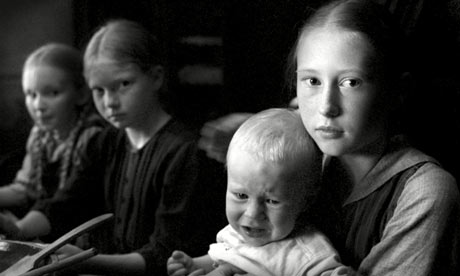
begins a chaste romance with the Baron's nanny, and notices a change in his students—they're becoming more rebellious, less prone to obedience, something noticed also by the Minister, who, in an attempt to impress his brood, ties a white ribbon in his eldest daughter's hair and a white sash around his first son's arm to remind them of their "innocence and purity" when they were younger. But, what was once a declaration of love and pride in their early years is now a punishment.

This is another of what we can now call director
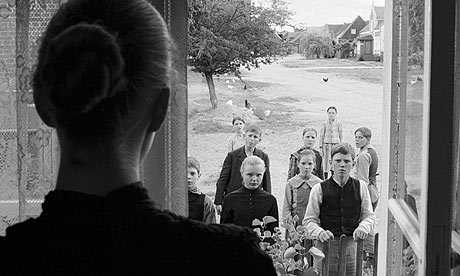
Michael Haneke's "Fables"—small stories of incident with lessons that reflect a larger truth about mankind and history. Shot in color, but processed in a distancing and denatured black and white, the shadows of the interiors of the houses are sometimes impenetrably dark and some individuals are made out only at the bare margin of perceptibility. Perception is important in "The White Ribbon," as it reflects what we see when we want to see it and how we interpret it. That parts of the escalating problems plaguing Eichwald in "The White Ribbon" are due to hubris and denial.

The film and incidents end at the assassination of the Arch-duke Ferdinand, where, of course, everything starts to go down-hill, but even at the start of the slide, implies Haneke, the seeds of the Holocaust were sewn in the fields of a blind aristocracy. And
Fascism begins at home.

"The White Ribbon" is a Full-Price Ticket.


"Tomorrow Belongs To Me..." ♫


Tuesday, March 16, 2010

Caché

"Caché" (Michael Haneke, 2005) Pronounce it with the accent, please, because it doesn't refer to a hiding place. The french is an attribute, as in "hidden," "secret," or "covert." "Caché" is all of that, and more taking a small situation and blowing it up in the background until it becomes an indictment of a secret sin, not only of an individual but an entire country.

I forget which of the early astronauts said it, but when asked to describe space-flight he drawled: "It's hours of boredom punctuated by moments of blind terror." He could have been talking about life, as well. And so, too, is "
Caché," sly enough to take what might be boring for a viewer and turning it into a subtle trick, like the dinner guest depicted in the film who tells a long and involved story only to have it explode in the punch-line. That risk of boredom is the key, for Haneke employs long unbroken takes, sometimes not even moving the camera, but employing a stock-image—a staging area—through which the world and his characters move. The longer it takes, the more anticipation is built up in an audience; one begins to question why one is looking at something for so long, and then to look for the importance of that image and one's senses go on alert: what is that in the corner of the frame?; is it a still image, or is something moving?; one hears the doppler of a car-engine and anticipates its entering the frame. Why are we here, and why are we looking at this, are the questions.*

The answer is a joke and also a key to the suspense of the story. A
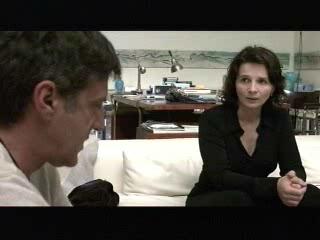
well-to-do nuclear family—he (Daniel Auteuil) is a televised literary critic and she (Juliette Binoche) is a book publisher, their son, a diffident middle-schooler—begin receiving mysterious video cassettes wrapped in violent child's drawings. Viewing the cassettes, the couple realize they're being targeted and monitored, but they don't have a clue as to why or by whom. The answer must be some secret one or the other is hiding, and soon the couple are quibbling and quarrelling...and keeping their own secrets from each other.

Haneke is an austere film-maker with a trickster's heart—his most controversial film is the sadistic "Funny Games" which he made in both
European (1997) and U.S. (2007) versions—and here, it's basically the same gambit but without the smirking meta-smugness. Here, its about story-telling (and audience puppeteering), his camera moves are controlled, liking riding on a secret rail, formal and distancing, not so much mindful of Hitchcock, as Brian De Palma's magically smooth and impersonal camera-glides, just an extension of those monitoring tapes, coolly surveying.

But the film is punctuated by
the rare burst of upsetting violence that occurs quickly (so quickly it takes a moment to register..."Did they just...?") and is usually the end-point of a strategy (real or imagined) by the players. One is left contemplating responsibility as the characters in the play do, with no end (or conclusion) in sight. It's frustrating, but not false, and gives the film the grit of reality...while also keeping an audience on the edge of their chairs waiting for the next shock.

Mon Dieu, où est Waldo?

* One of my favorite shots in
Bryan Singer's film-career (there aren't many) occurs in "The Usual Suspects," when at one point in the movie there is a short sequence where, once the movie is over, we realize "that was a shot of nothing." No importance, whatsoever, except as a red herring thrown to the audience to play on their suspicions and ability to anticipate plot-points.

Tomorrow: Haneke's latest—"The White Ribbon"