Tuesday, November 29, 2011

The Descendants

"Finding Grace in Paradise"
or
"Keeping the Kidneys and Other Vital Organs Working and Hoping for the Best"

There's a lot of water in Hawaii.  It's an island, after all, a string of volcanic mountains surrounded by water on all sides.  Plus, there are the myriad rivers that course through, invading the land, falling off the mountains combined with the torrential rains that sometimes beat down with such ferocity that they turn highways into flood corridors, making negotiating trails on the islands difficult.  All that water does have an advantage—it turns the volcanic soil green with lush verdant beauty.

And it also hides the tears.

Alexander Payne's adaptation of Kaui Hart Hemmings' novel The Descendants is something of a miracle, a nearly perfect adaptation, much like James L. Brooks' transformation of Larry McMurtry's Terms of Endearment (and if there's any justice...or taste...in Hollywood this awards season, Payne's film will be awarded as much gold as Brooks').  It retains Payne's way of nailing a particular culture, as he has with right-wing religion, high school politics, retirement wanderlust, and the pretentious pseudo-culture of Napa Valley.  In The Descendants, it's the extreme casualness of the privileged Howlies, who have invaded the island culture, overcoming it like a tsunami.

But, there's a difference here.  All of Payne's films have been a trifle dodgy, askew or off-kilter.  Not The Descendants. It is a fine distillation of the book, taking the best of the dialogue, a perfect cast of vets and unknowns and bringing it together with polish, exquisite comic timing and poignancy.

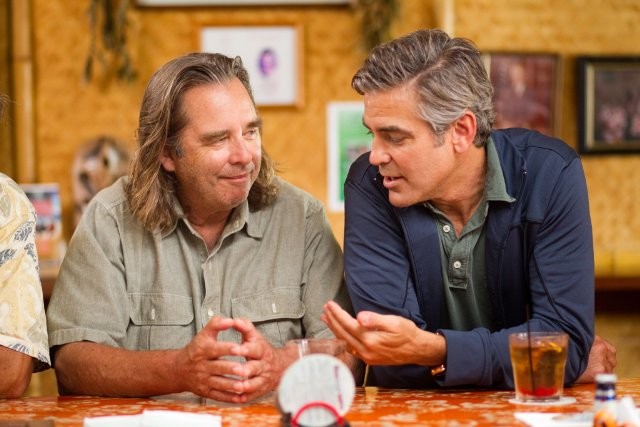
Attorney Matt King (George Clooney) is the last in a long line of Kings of Hawaii, who trace their roots back to King Kamehameha, a family history that has held in trust 25,000 acres of undeveloped, still natural Kauai'i coastline which will be out of trust in seven years.  Matt is the sole trustee, but is in negotiations with his family on how to deal with the land.  A decision is to be made soon.

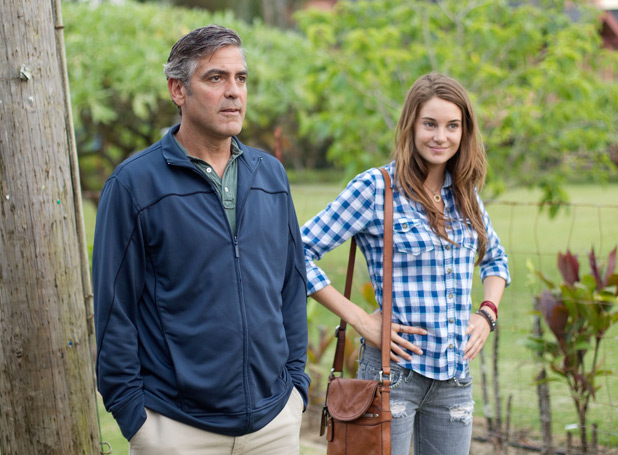
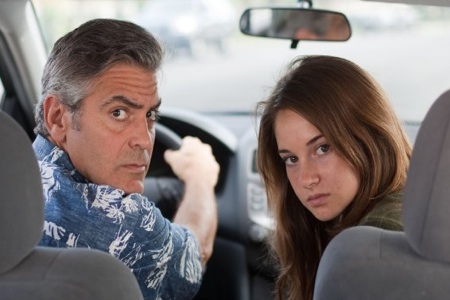
But, that's the least of Matt's concerns.  His wife, Elizabeth, has been put in a coma from a boating accident.  He is left with her medical decisions and the caretaking of their two daughters—Scottie, 10 (Amara Miller), and Alexandra "Alex," 17 (Shailene Woodley, I hesitate to mention he performance as a standout, because everyone is great)—a difficult task as the aloof and professional Matt is, for all intents and purposes, "the back-up parent."  Scottie is starting to react to her mother's hospitalization in odd, destructive ways...and Alex?  She's already been shipped to another island to a strict boarding school for dabbling in drugs and older boyfriends.  "What is it with the women in my life that they want to destroy themselves?" Matt asks in one of the many narrations that dominate the film.

Good question.  And the answers to that one aren't even explored in depth here.  Let's just say that Matt is responsible, and must be more responsible if he is to save his family, nuclear or extended.  However diligent he might be as a man or a person, he cannot prep for the emergencies that life hands to him.  He cannot research what to say or argue before the court of his kids, and absolutely must find a way through the briarpatch of mercurial emotions that has nothing to do with reason or law.  There is no precedent to draw upon for what he is going through. This is life, not jurisprudence. There is no preparing for that. Life is off-the-cuff, on the wire, winging it because life is what happens (as John Lennon said) "while you're busy making other plans."  In the film, Clooney's character must deal with both death and life and find the personal grace to do both, simultaneously, letting go of the past and dealing with the essential unforeseeable future. 

There are two axioms that I hold dear in life as true, and recently they came up again, in my life, to steer me to a clearer, calmer path. The first is "actions speak louder than words." Words are fine, nice, even comforting. But they are useless, and can be even considered lies if not backed up by a concurring action.* The other is one of the few things I take as absolute truth from the Bible and that is that "love never dies." I realized that with the death of my parents, but it is only reinforced to me, day after day. Like energy in science, once it's generated, love never leaves the Universe. It can change, sometimes savagely, turning into hate (at least, temporarily, because the opposite of love is indifference), but it never goes away...never "vanishes." And The Descendants, in its funny, quirky way, eloquently speaks to those truths.

I love this movie.  There are choices that Payne and his co-writers have made in the presentation of Hemmings' novella that are oddly poetic, even beautiful, and with the clear-eyed collaboration of his actors, have made up some of the most memorable scenes in a film that have moved me this year.  It is certain that many of them will show up as "Moments" in the year-end wrap-up of the best of 2011.  This one might be the best film of the year.

But, the movie-year, despite being deep in its 11th month and on the cusp of the 12th, is still young.  Who knows what lies ahead? 

The Descendants is a Full-Price Ticket.


Matt looks over a hedge—one of the many quirky directorial choices
Payne makes that makes this film so enjoyable.


* It's especially true of politicians.  Think of that during the next political campaign.

Sunday, November 27, 2011

Don't Make a Scene: The Shootist

The Story:  Last week, we looked at a scene from Akira Kurosawa's Ikiru, where a government functionary is given the news—by witholding the truth—that he has inoperable cancer.

This week, it's The Shootist—a Western, not "an Eastern" (but as we've come to learn, Kurosawa's dramas have often translated very well to that particular genre)—but the plots have an eerie similarity: a man of life-long habits is given a cancerous death sentence and goes out and lives the remainder of his days, doing things not done in life.  For Ikiru's Kenji Watanabe, it's a brief encounter with a wild life-style that settles down into seeing through one good act to completion against all odds, rather than merely pushing paper and doing the bureaucratic shuffle.

For John Bernard Books (John Wayne in his last film role), it is to live a less wild, rambling life—staying in one place—reading a complete newspaper, settling his affairs and arranging a showdown with the meanest gunslingers in town.  Both men want to go out in a blaze of glory—Watsanabe, to be free of his do-nothing life, and Books to not face death, suffering in bed, but to be taken out in combat.  Both men seek a release from the poor choices of their lives, by using their respective skill-sets.

For this scene between doctor and patient, two veteran actors are reunited after 15 years (the characters mention its been that long since they've seen each other), Wayne and James Stewart.  The last time they shared the screen together was John Ford's time-spanning epic of truth and the legend that becomes it, The Man Who Shot Liberty Valance.

The filming was difficult.  Stewart, hard of hearing, was having trouble with the acoustics of the sound-stage, and in the shots where both actors interact there's an odd disconnect.  Sometimes Wayne tries to interject a line while Stewart has paused before continuing his.*  The folksy stammer that Stewart employed throughout his career (so he could think of his lines he always said) is more pronounced, the voice louder, the manner broader.  Wayne is a study in subtlety, his weathered face actually seeming to collapse on itself in moments of disappointment.  Despite the apparent confusion on-set, the scene plays beautifully, even naturalistically, with Books vulnerable and rocked back a bit on his heels, and Hostetler, when forced, being brutally, even savagely, honest about the prognosis.

John Wayne died of stomach cancer, three years after making The Shootist.


The Set-Up:  Western gunslinger John B. Books (John Wayne) is dying of prostate cancer, diagnosed by Dr. Hostetler (James Stewart).  A second visit to the doctor—who had previously pulled a life-threatening bullet from "the shootist"—confirms the diagnosis, but offers no cure...and no future.


Action!


JOHN BERNARD BOOKS: First things first, Doc...


BOOKS: Almost forgot to ask you. How much do I owe you?


Dr. E.W. HOSTETLER: You're a man after my own heart, Books. Most of 'em ask that last...
BOOKS: Y-
HOSTETLER:...if at all.


HOSTETLER: I make it $4 for the two visits and one dollar for that.


BOOKS: What's that?
HOSTETLER: They call that laudanum.


HOSTETLER: Solution of opium and alcohol.


BOOKS: Opium? Well, that can get to be a habit.


HOSTETLER: Well, absolutely. An addiction!


BOOKS: How's it taste?


HOSTETLER: Just..just..awful. Terrible!


HOSTETLER: But...


HOSTETLER: It's the most potent pain-killer we've got.


BOOKS: How much of it do I take?


HOSTETLER: Well,...a-as much as you need when you need it.


HOSTETLER: We...I think a spoonful would be enough...


HOSTETLER: ...to start with.


BOOKS: And later?


HOSTETLER: I don't know.


HOSTETLER: I don't know...but...but..but I think...one morning you're just gonna wake up...

HOSTETLER: ...and say "Here I am..."

HOSTETLER: "...in this bed and here I'm gonna stay."


BOOKS: Hostetler, I wanna know.


HOSTETLER: But..uh..uh...unless you insist, I'd ra...rather not talk about it.


BOOKS: Well, I wanna know.


HOSTETLER: Wel-...there..there'll be a increase in the severity of the pain...in your lower spine...


HOSTETLER: ...your hips, your groin, y...


HOSTETLER: D...y...y...you want me to go on w...?


Books nods


HOSTETLER: The pain will become unbearable. The...the..no drug...

HOSTETLER: ...will moderate it.


HOSTETLER: If you're lucky, you'll lose consciousness...


HOSTETLER: And until then, you'll scream.


HOSTETLER: Now..now..I'm sorry.

HOSTETLER: I-yi-yi-I didn't mean to...be specific like this.


HOSTETLER: So, the next time, I'll go to Mrs. Rogers. You...you...you just telephone.

BOOKS: Oh, my (hat)..

HOSTETLER: You just telephone.


HOSTETLER: There's...there's...one more thing I'd say...


HOSTETLER: Both of us...have had a lot to do with death.


HOSTETLER: I'm not a brave man...


HOSTETLER: ...but you must be....


BOOKS: Uh...

HOSTETLER: Na...now...this is not advice.


HOSTETLER: It's not even a suggestion, it's just something for you to reflect...


HOSTETLER: ...on while your mind's still clear.


Books looks hard at Hostetler.


BOOKS: What?


HOSTETLER: I would not die a death like...


HOSTETLER: ...I just described.

BOOKS: No?


HOSTETLER: Not if I had your courage.


Books understands.


BOOKS: ...oh.


Books turns to leave.

BOOKS: Thanks.


The Shootist

Words by Miles Hood Swarthout and Scott Hale

Pictures by Bruce Surtees and Don Siegel

The Shootist is available on DVD from Paramount Home Video.


* Director Don Siegel actually upbraided the actors for "not trying hard enough."