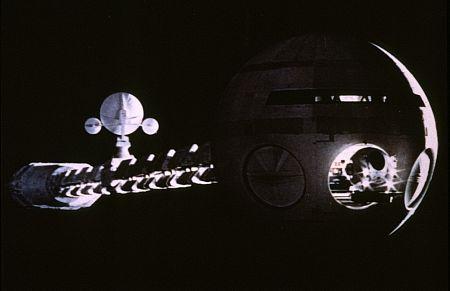
The Story: The Deadly Cuts of Stanley Kubrick.
This scene from "2001: A Space Odyssey" contains probably the longest span of dialogue, in a film which meanders along without the benefit of speechifying.
It also has, as is mostly the case with 2001: ASO, some very subtle film-making.
It also contains, buried in the sub-text, some of the more outlandish humor in the script. There are other, more classic scenes, and better examples of my following thesis in the 1968 movie, but this has everything, and probably the second greatest cut in film-history.*
In it, Dave Bowman and Frank Poole, the only non-frozen humans on-board the Discovery on its wild-signal chase across the Solar System, examine the only thing that has gone wrong on their mission. A vital communications module has been reported (by their supervisory computer HAL) about to fail. They replace it as a matter of course, and upon examining it, find that it's...fine. No imminent failure. Nothing to signal home about. But the fact that their near-omniscient computer made a mistake is something to signal home about, whereupon they learn that the perfect computer keeping them alive isn't so perfect after all. There then begins an elaborate ruse to discuss the situation out of...ear-shot?...of the constantly monitoring computer. Inside the privacy of one of their mini-cooper-like space-walk vehicles, they discuss what has to be done to their space-companion HAL. Disconnection? Certainly. Better bone up on the manual. But, just as they've squirelled themselves away to get some privacy to spare HAL's feelings...(Wait a minute.)
Wait, wait, wait, wait, wait. Back up.
HAL has feelings? It's a computer! And less than that, even.
But...I digress...
What will HAL's reaction be to having his plug pulled? It concerns the astronauts enough to bring it up, not knowing that HAL is watching their lips move through the pod-window.** Without a line of dialogue or explanation, the audience understands--HAL can read lips, and once they're given a moment to let that sink in, Kubrick cuts to black (with an almost audible thump of doom), as white letters fade up to announce "Intermission."***
In a film without much drama, Kubrick cuts away at the most dramatic moment. And makes us wait. And builds the suspense.
Later on, he will show an act of murder using only computer screens and alarm sound effects, cutting from one failing system indicator to another, completely removed from any melodramatic aspects of a death-struggle.
But for now, we're concerned with the little domestic situation going on aboard the Good Ship Discovery. Kubrick directed actors Keir Dullea and Gary Lockwood to play naturally, and not emote much, so the two actors do a lot of the heavy lifting with their eyes and body language. They pass suspicious glances at each other, though knowing that betraying any thought might be picked up by HAL. Listening to the Mission Control transmission, Bowman sits stoically, his downward-glancing eyes being the only acknowledgement of bad news. The crazily re-assuring smile he "gives" HAL is priceless. Poole, the more demonstrative of the two, shifts uncomfortably in his chair, crosses his arms, and looks away. He chuckles at HAL's transference of blame and point of pride about the computer series' accuracy. Only until they're "safe" in the sound-proof pod, do they open up: Frank's not freaking out, but he's very concerned and wants to disconnect HAL now, now, now before anything else goes wrong; Dave sighs a lot (a LOT!) and worries about the ramifications, rightly so.
So, that's the underlying drama of the scene--the two men conspire to have a conversation like two kids dragging the phone into the closet so "Crazy Aunt Martha" can't listen in. The two want to talk about him behind his back (does HAL have a back?) and fret and worry like it's a Family Crisis.
Okay, that's the film story. Good stuff. HAL the computer is a major character in this (especially as everybody's talking about him...her...it), which is doubly amazing because all we see of HAL are animated screens and a representative red fish-eye lens. **** That's it (along with the crucial soft-pedaled voice of Douglas Rain)!
And that's all he needs. All Kubrick has to do to promote tension at this point in the story is to cut to that simple red fish-eye lens. And audience pulses rise.
It's an elaborate set-up, directed very simply and with an absolute knowledge of film-craft, but filled with hidden whimsy and philosophical ramifications, all leading up to that doom-laden delaying cut to black.
The Set-Up: Onboard the Discovery, outward-bound for Jupiter, Astronauts David Bowman (Keir Dullea) and Frank Poole (Gary Lockwood) supervise the long glide to their super-secret mission. Their three specialist crew-mates are in suspended animation until they reach the giant planet, and the ship is under the control of the Heuristically Algorithmic Logic 9000 computer (whom one addresses as HAL), and things have been going flawlessly. That is, until the crew has been alerted to a failed component in the communications array--the AE-35 unit--and makes a special walk to retrieve and replace the component. Now, they're examining the unit for the purely perfunctory fault analysis.
Action!
(In the zero gravity pod-bay, Bowman and Poole examine all the circuits of the AE-35 unit, looking for flaws.)


 (Dave Bowman sighs)


 Dave Bowman: Well, HAL, I'm damned if I can find anything wrong with it.
HAL: Yes...
 HAL: It's puzzling. I don't think I've seen anything quite like this before.
 HAL: I would recommend that we put the unit back in operation and let it fail.
 HAL: It should then be a simple matter to track down the cause.
 HAL: We can certainly afford to be out of communication for the short time it will take to replace it.
(Later, the men receive a transmission from Mission Control in the low-gravity living area in the carousel portion of the ship)
 Mission Control: X-Ray Delta-1, this is Mission Control. Roger your one-niner-three-zero. We concur with your plan to replace No.1 unit to check fault prediction.
 M.C.: We should advise you, however, that out preliminary findings indicate that your on-board niner triple zero computer is in error predicting the fault. I say, again, in error predicting the fault.
 M.C.: I know this sounds...rather incredible, but this conclusion is based on results from our twin niner-triple-zero computer.
 M.C.: We are skeptical ourselves and are running cross-checking routines to determine reliability of this conclusion.
 M.C.: Sorry about this little snag, fellows, and we'll get this info to you just as soon as we work it out. X-ray-delta-1, this is Mission Control two-zero-four-niner transmission concluded.
 HAL: I hope the two of you are not concerned about this.
Dave: No, I'm not, HAL.
HAL: Are you quite sure?
Dave: Yeah! I'd like to ask you a question, though.
HAL: Of course.
Dave: How would you account for this discrepancy between you and the twin 9000?
 HAL: Well, I don't think there is any question about it. It can only be attributable to human error.
 HAL: This sort of thing has cropped up before.
 HAL: And it has always been due to human error.

 Frank Poole: Listen, HAL, there's never been any instance at all of a computer error ocurring in the 9000 series, has there?
HAL: None whatsoever, Frank.
 HAL: The 9000 series has a perfect operational record.
Frank: Well, of course, I know all the wonderful achievements of the 9000 series, but (laughs) are you certain there's never been any case of the most insignificant computer error?
 HAL: None whatsoever, Frank.
 HAL: Quite honestly, I wouldn't worry myself about that.


 Dave: Well, I'm sure you're right, Hal...uh...fine. Thanks very much.

 Dave: Oh. Frank, I'm having a bit of trouble with my transmitter in C-pod. I was wondering if you'd come down and take a look at it with me.
Frank: Sure.
 Dave: See you later, HAL.
(The men make their way back to the zero-gravity pod-bay)

 Dave: Rotate C-pod, please, HAL.

 Frank: What sort of trouble you been havin', Dave?
Dave: Well, I've been getting some interference on D-channel.
Frank: Hmm. We'll take a look at it.

 Dave: Open the door, HAL.


 Dave(over intercom): Rotate pod, please, HAL.

 Dave(over intercom): Stop pod rotation, please, HAL.

 Dave: Rotate the pod, please, HAL.
Dave: Rotate the pod, please, HAL. I don't think he can hear us.
 Frank (shouts): ROTATE THE POD, PLEASE, HAL! Yeah. I'm sure we're okay. (sigh) Well, whaddya think?
Dave: I'm not sure, what do you think?
 Frank: I've got a bad feeling about him.
Dave: You do.
Frank: Yeah. Definitely. Don't you?
Dave: (sigh) I dunno, I think so. You know, of course, he's right about the 9000 series having a perfect operational record. They do.
Frank: Unfortunately, that sounds a little like famous last words.
Dave: (sigh) Yeah. Still it was his idea to carry out the failure mode analysis.
Frank: Hm.
 Dave: Should certainly indicate his integrity and self-confidence. If he were wrong, that'd be the surest way of proving it.
Frank: It would be if he knew he was wrong.
Dave: Hm.
Frank: Look, Dave I can't put my finger on it, but I sense something strange about him.
Dave: (sigh) Still I can't think of a good reason not to put back the Number 1 unit and carry on with the failure mode analysis.
Frank: No, no, I agree about that.
Dave: Well, let's get on with it.
Frank: 'Kay. But look, Dave. Let's say we put the unit back and it doesn't fail. That'd pretty well wrap it up as far as HAL was concerned, wouldn't it?
 Dave: Well, we'd be in very serious trouble.
Frank: We would, wouldn't we?
Dave: Mm-hmm.
Frank: What the hell could we do?
Dave: (sighs) Well, we wouldn't have too many alternatives.
Frank: I don't think we'd have any alternatives. There isn't a single aspect of ship operations that's not under his control. If he were proven to be malfunctioning, I wouldn't see how we'd have any choice other than disconnection.
Dave: I'm afraid I agree with you.
Frank: There'd be nothing else to do.
 Dave: It'd be a bit tricky.
Frank: Yeah.
 Dave: We'd have to cut his higher brain functions...
Frank: Mm-hmm.
Dave: ...without disturbing the purely automatic and regulatory systems. And we'd have to work out the transfer procedures of continuing under ground-based computer control.
Frank: Yeah. Well, that's far safer than allowing HAL to continue running things.
 Dave: You know, another thing just occurred to me...
Frank: Hm.
Dave: Well, as far as I know, no 9000 computer has ever been disconnected.
Frank: Well, no 9000 computer's ever fouled up before.
Dave: That's not what I mean...
 Frank: Hmm?
Dave: Well, I'm not so sure what he'd think about it.


2001: A Space Odyssey
Words by Arthur C. Clarke and Stanley Kubrick
Pictures by Geoffrey Unsworth and Stanley Kubrick
2001: A Space Odyssey is available on DVD from Warner Home Video
* The first can be found here.
** And by the by, this is the one thing that the late Arthur C. Clarke thought was hooey about the story. He thought there was no way a computer could be trained to read lips...certainly not by 2001...and maybe not ever, one of the few times that Clarke said that something was impossible.
*** Something he did...and probably over-did...with the shrieking titles in "The Shining."
**** It might even be the same shot—the same strip of film— that Kubrick keeps cutting back to for HAL's "eye," with the exception of the one shot you see here of Bowman and Poole getting up from their chairs. What Kubrick uses to evoke HAL is so spare, but completely effective.