Thursday, June 30, 2011

The Big Trail

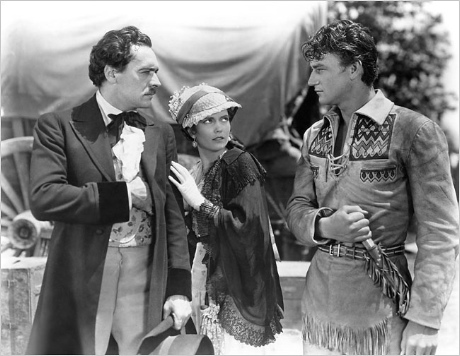
The Big Trail (Raoul Walsh, 1930) Wow, this one is kinda fun.  Made in 1930, in the transition between the silent and sound eras,* The Big Trail is a big sprawling "wagon train" movie filmed in 65mm and stereo sound (although it only played that way in New York and Los Angeles—it was filmed twice by Walsh,*** in this format and in the standard Academy approved box format,** where more traditional close-ups were employed), the wide screen taking advantage of large vistas of horizon in gen-u-ine outdoor locations and long meandering lines of properly scrabble-wood wagons and hastily improvised buildings—there isn't a right angle in any of the construction along the route—and the buck-skin and gingham costumes look lived in, sweat-stained and grubby.  It actually has a more authentic feel than later films that covered the same territory.  As films progressed, the pains director Walsh took to create that realistic thread-bare look were replaced by the studios' efforts to make everything well-scrubbed and travel-worthy.  But here, everything is in a state of chaos in need of some permanence.  That'll happen when everything stops moving.


But, at this juncture, less than a hundred years after such odysseys actually occurred, the portrayal of the way west feels more real, despite the simplistic story, the "Big Misunderstanding" love story (the path of love, like cross-country trails, never runs smooth) and some quite amazing set-pieces.  Fording a river actually looks dangerous with cattle swimming downstream with the swift current, and overturning wagons featuring some inelegant (because it wasn't planned) stunt-work.  And there's a sequence, unscripted and jerry-rigged, of lowering wagons and cattle down a cliff-side by ropes, that is just fascinating to watch, especially when things literally go "south" (Walsh and his cameraman managed to to catch the mayhem as some knots slipped).


Along the way, we see every sort of terrain: plains, desert, rivers, cliffs, mountains and forests, and because the trip takes a year, four seasons of various weathers, all giving Walsh a new impediment to the travellers to exploit for drama, from blistering desert heat to nearly white-out conditions of snow—and there's one torrential down-pour that bogs wagons, horses, and men alike in a constant slick of mud.  Who needs melodrama when God and Nature are throwing everything in the pioneers' path to slow them down?  For a film of this era, it is amazing to see the efforts made to bring it all to the screen...and with the added use of on-set sound—in the outdoor settings—it is quite the stunning achievement.

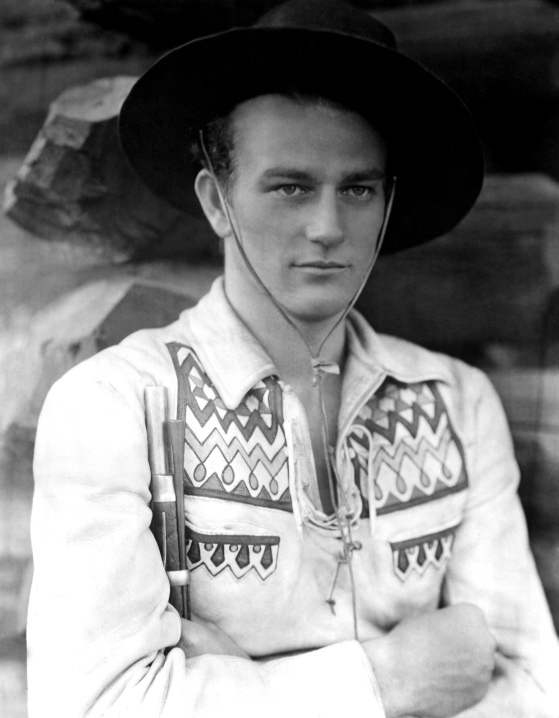
But, there's one other thing The Big Trail is known for: It is also the first starring role of a full-time prop-master and part-time bit player named Marion Morrison, who, starting with this film would operate under the name given him by director Walsh, "John Wayne."


Interesting to watch this kid who would become a screen legend.  He had yet to learn the pausing cadence that would give his sentences more weight, and there's a tendency to put a little too much of everything into the role, the glowers, the tightening jaw-muscles, the "hail-fellow-well-met" jocularity—if you want to see how Wayne plays it, there's a lot of similarity to how Ricky Nelson ambled through the role of "Colorado" in Hawks' Rio Bravo).


But, the casualness is there, always was.  Even here, his first starring role, there is the informal grace of how he'd just lean back in a scene.  There's a sequence where Wayne is talking to a large group of elders—because of the primitive sound equipment in camera trucks, everyone is encouraged to shout the dialogue a bit as it was filmed outdoors—while he sits cross-legged on a horse, as naturally as if he was draped over a dining room chair, the horse shuffling nervously despite having steadying hands on him, and Wayne balanced effortlessly, not missing a beat, even swinging his foot in conversation.


There are things that are a little wince-inducing: it's all very white hat/black hat with the bad guys (Tyrone Power Sr., Charles Stevens, and Ian Keith all pushing villainy at the top of their lungs that you almost think there should be a "hiss" track whenever they walk on-screen), Marguerite Churchill is a trifle too "fiddle-dee-dee" for my taste, and there's some rather antiquated humor about mothers-in-law, and goofy ethnics (hard to place...Swedish?) that's just a step away from the "gag-men" antics of the silent era.

But, I spent the majority of the movie goggle-eyed at the incredible shots by Walsh and his cinematographer Arthur Edeson**** (a mainstay at both Fox and Warners, Edeson has an impressive list of credits, in which he managed to squeeze in among the B-pictures and programmers Frankenstein, The Maltese Falcon, The Old Dark House, and Casablanca) that take advantage of the western locations and The Big Sky (still remarkably free of air-traffic), artfully composed as if they were framed by Frederic Remington.


Look past the dated material, and some of the more vaudevillian (and vaude-villain) moments and there are many visual wonders to behold here, brought about by one of the great directors who doesn't get nearly enough attention: Raoul Walsh.


* Transitions are handled by the insertion of title cards anticipating the action of the next episode.

** In addition, there were foreign language versions shot at the same time—Spanish, French and German—with different casts.

**** The first outdoor sound film—In Old Arizona—was made the year before, photographed by Edeson and planned out by Walsh, who was set to star (as the Cisko Kid, no less) and direct until the traffic accident (a jackrabbit smashed into his windshield) that cost him his right eye.


***


Wednesday, June 29, 2011

The Dead


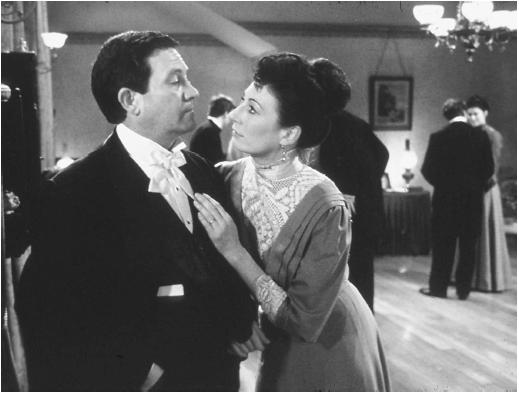
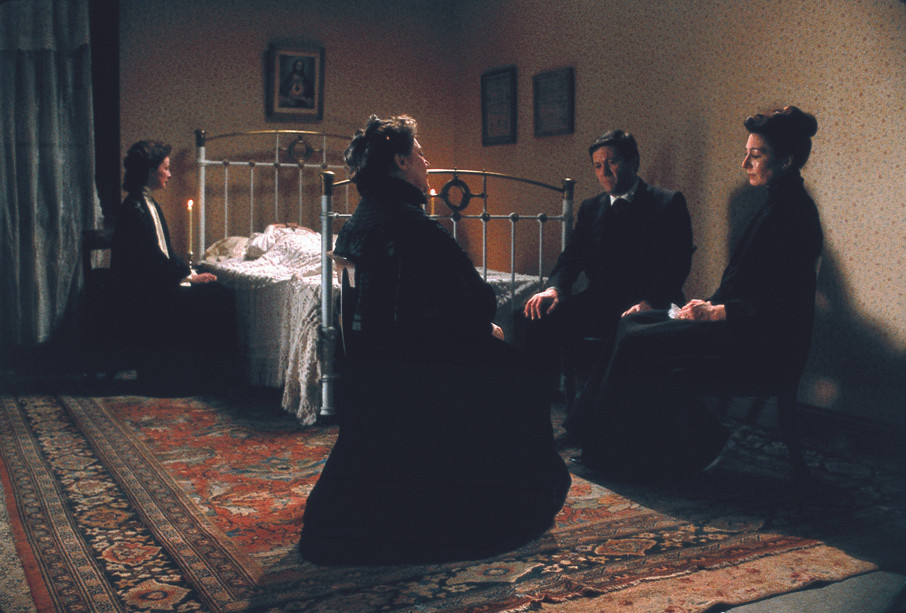
The Dead (John Huston, 1987) An annual Epiphany dinner held by the Morkan sisters (Helena Carroll, Cathleen Delany) creates an epiphany for their nephew, Gabriel (Donal McCann) and his wife Gretta (Anjelica Huston) in the legendary director's last film, a film every bit as strong as his first (The Maltese Falcon way back in 1941) and in many ways far, far more subtle.

You look back on the accomplishments of Huston's career—the classics like Falcon, The Treasure of the Sierra Madre, The African Queen, The Man Who Would Be King, the grandiose films of the '50's, his WWII documentaries, and "unfilmable" projects like Moby Dick, The Bible: In the Beginning..., Reflections in a Golden Eye, Wise Blood and Under the Volcano, and the occasional mis-step like Beat the Devil, Casino Royale, The Life and Times of Judge Roy Bean, Phobia, or The MacKintosh Man*—to "go out" on this simple, elegant adaptation of one of his favorite authors' (James Joyce) short stories, working with his kids (Tony wrote the screenplay, Anjelica stars and in many ways is the "center" of the film), set in the land he loved—Ireland—where he lived and filmed for so many years.  An insatiable gambler on- and off-set, this one he was "all in" and left the table a winner.

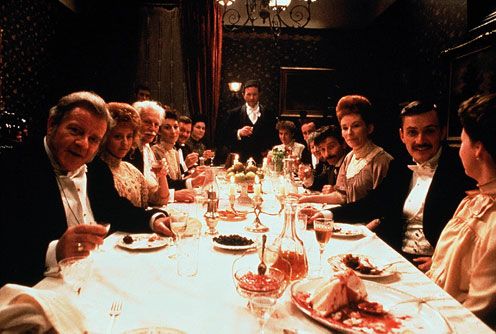
Tough project, too.  Most of it set in one room, a large part around a dinner table, with fine singing (and in one case, not—but the guests are graceful in their praise—and the director moves away from the elderly actress singing, having trouble with lip-syncing the dubbed song, and charitably meanders to another room, dwelling on the cherished collections of that character's rich life, instead).  Huston was in frail health, directing from a wheelchair using a monitor in another room to keep the sound of his by-now always required air compressor from the filming.

Graceful is the word for The Dead, and despite the title, it only periodically succumbs to Irish melancholy.  It centers around a celebration, after all, a once-a-year special ocassion in which, who knows, it may be the last time some of the group might be thereBest to keep the spirits up, the praise high, and the liquor slightly rationed.  And there aren't any small parts here, if the lines are unevenly distributed, there are bits of business, reaction shots, ensemble acting and quite a bit of dancing to keep things busy.

I just wish (selfishly) the host had stuck around to throw another party.


There is a lot of love in this shot, displayed on-screen and off


* Just imagine if his last film was Annie—which, in itself, was a weird untypical chancey project for him to take on!

Tuesday, June 28, 2011

The Art of Getting By

"Whatever..."
or
"What's Next, Basquiat? (Whoa-Whoa-Whoa-Who-o)"

George (Freddie Highmore, the excellent kid from Finding Neverland and Charlie and the Chocolate Factory, practically grown up) is a senior at a tony prep school in New York, in danger of getting kicked out.  He's depressed.  Not because he's going to get suspended, but because he's coming to grips that life is short and nobody gets out alive.  So, he doesn't pay attention in class, doesn't do any work and uses his books as doodle-canvas, some of which is not bad.  His teachers (Jarlath Conroy, Ann Harada, Alicia Silverstone) know he's smart but are frustrated that he couldn't begin to apply himself.  His principal (Blair Underwood) cuts him every break, but he just doesn't apply himself.  "Life is meaningless," he tells a teacher when picking up assignments. "And that includes the homework, unfortunately."

He tells his mother (Rita Wilson) and step-father (Sam Robards) "I've got it under control," but it's just a delaying tactic.  He's too smart for his own good, but like most students, he doesn't know what he doesn't know.  That's where life comes in.  But he won't get there, by being so insular, cut off from everybody.

After another stale-mate with the principal, he goes up to the roof to smoke, where Sally Howe (Emma Roberts) is smoking.  A teacher comes up and George becomes Sally's knight-in-shining armor by pretending to be the one dragging.  Later, she confronts him about why he did it.  "I'm the teflon slacker," he says.  "I'm more used to getting into trouble and I'm better at talking my way out of it."  He and Sally become friends...then things get complicated.

They do, but they don't.  

His failure to commit extends to their friendship, as well, and it's a little hard to determine why—maybe he's just not willing to apply himself, or maybe he has such a fear of failure (or a fear of success, where he could lose everything).  But it's pretty clear that he'll take a "wait and see" attitude with everyone...and everything.  He enjoys spending time with Sally, who's popular and a knock-out and seems to find him intriguing in that way that geek-writers think women are attracted to geeks.  And she seems to want to "go there," but he's all "we're just friends" despite the time he spends with her when he'd normally be in his self-imposed solitary confinement.  No wonder she sees other guys...which he thinks of as some kind of betrayal. 

What does he think would happen?

That question, and so much of the film, is intriguing and keeps your interest, as long as there are no consequences to his actions.  But, once they all start piling up, The Art of Getting By stops getting away with it.  Then, it becomes frustrating (in about the same capacity as that "me stupid" feeling you get for delaying writing that term-paper for so long).*  Then, writer-director Gavin Wiesen swerves in his little game of "chicken," in a wish-fulfilment fantasy that even Woody Allen, schlub-fantasist that he is, mocks when he sees it. 

Wiesen casts his film well, and his direction of the actors shows he's not afraid to take risks.**  And the screenplay shows promise.  But, that ending is a big "Fail."  Maybe it was imposed to get distribution, but, man....  Like the protagonist, there is so much potential there, that just gets wasted. 

The Art of Getting By is a Rental.


* Notice, please, that this review is a bit late.  Points off.

** Roberts is a heart-breaker, the teachers (even Alicia Silverstone) play tough with their characters, and props to anyone who hires Elizabeth Reaser and doesn't squander her talent (as the "Twilight" films do). 

Sunday, June 26, 2011

Don't Make a Scene (Queer Film Blogathon Edition): The Bride of Frankenstein

We're re-presenting this "Don't Make a Scene" as part of the "Queer Film Blogathon" sponsored by Caroline and her fine film blog, Garbo Laughs:

The Story: This is either the best sex scene in horror movie history, or simply the worst first date in horror films. Depends on how deep you want to read it—as allegory or as reality.  In any case, The Bride of Frankenstein wants to have it both ways.

For the reality, we have this: the child-bride of Dr. Pretorius (Ernest Thesiger) and Dr. Henry Frankenstein (Colin Clive) is awakened from her lightning birth and immediately rejects her intended, the monster Henry created in the first film (Boris Karloff). The Monster can now talk, albeit with a limited vocabulary, though he gets by. Like most men, he communicates by grunts and groans, usually. But when he sees The Bride, he immediately becomes a simpering wreck, forlorn and love-sick, a parody of the romantic male, offering tender caresses initially, but eventually, when he can't get what he wants, violence. The Bride can't stand to look at him, emitting first a strangled shriek and then when it's obvious what his intentions are, a blood-curdling full-throated scream.

Director James Whale shoots her the way he introduced the Frankenstein monster—full-length, then a series of jumping close-up's until we're right in her goggle-eyed face. Whale spends a good deal more time on film examining her than he did Karloff's Monster (who got only three shots), giving her more than a once-over, lingering over her, showing her from many angles. Karloff made an appearance on "The Entertainers" once (with Carol Burnett) where he comically lamented the new horror movies: "In the old days, they lovingly applied every stitch." Whale provides more than a chance to examine Jack Pierce's subtle (the dainty jaw-line stitches) and not-subtle touches (do we dare call it a "shock" of hair?)

Elsa Lanchester who played "The Bride" based her characterizations on swans--graceful, lovely, but spitting-mean. That's why the quick, unnerving head-pivots she makes, as she takes in her new surroundings. If she looks unstable on her feet (and Whale choreographs an unnatural wobble that nearly plummets her into Dr. Frankenstein's arms), it's because the 5' 4'' Lanchester is standing on stilts strapped to her legs to appear 7' tall.

Messages in horror films burble up subterraneously from approximately six feet under and take root in our subconscious. You may think there's something very disturbing, even radical about Bride of Frankenstein without being able to rationalize what it is about it.* It's certainly different in sensibility than Whale's first Frankenstein film—this one abounds with camp humor, and plays with religion at the same time it sees compassion and companionship as a Holy Thing. It mocks matters sexual between men and women with its foppish poets and a boyish Mary Shelley in the prologue, the over-sexed miniature people of Thesiger's experiments and the rejection of "The Bride" to "The Monster." Given carte-blanche on his "Frankenstein" sequel, James Whale, gay and ostracized, made a continuation of the first film's gay metaphor of The Outsider Shunned By Society, and subjected "The Creature" to even more rejection of a humiliating variety. That the story is of two men, Pretorius and Frankenstein, who conspire against God and Nature to create children is right there on the surface, a homosexual sub-text.

So, when it comes to this scene of "Bride" and "Monster" squaring off between a phallic "lever" that he "mustn't touch," and choosing "death" that produces an orgasmic reaction from the "Bride" and the collapse of a tower...well, you see where I'm going with this—this sexual act leads to "Death" and not just "the little death" of French culture. That the Monster allows the "breeder" couple to flee, tears running down his face in sorrow, while he blows everybody to atoms (to use Pretorius' phrase), puts the tragedy into perspective**


In looking for an on-line script for Bride of Frankenstein, I noticed one of the writers calling it a "straight sequel." "Denial's not just a river in Egypt, honey."

Camp, over-the-top, melancholy, but stylish to a fault, The Bride of Frankenstein is one of the greatest of Horror films as well as in the sub-category of Gay Cinema.

The Set-Up: After coercion, blackmail and the threat of his own Monster (Boris Karloff) being set loose upon him, Dr. Henry Frankenstein (Colin Clive) agrees to co-operate in another experiment in regenerating dead tissue with the insane Dr. Pretorius (Ernest Thesiger). Their co-creation: a mate (Elsa Lanchester) for Frankenstein's original Monster.

Action!


Note: I've tried to approximate the dialogue between The Monster and The Bride to the best of my ability, but the vocal subtleties of such lines as "Aa..!" and "N-gah!" get a little lost.


Frankenstein and Pretorius remove the Bride's bandages, allowing her to stand on her feet.

Dr. Pretorius: The Bride of Frankenstein!

The stunned "Bride" takes a tentative couple of steps forward, her gaze darting about the room in quick "takes."


Unstable on her feet, the now-living woman wobbles and sways back and forth.

The Monster returns from the Tower, and is aware of another presence in the laboratory.

As if by instinct, the Bride reacts to the Monster's presence, but he approaches warily and tentatively asks:

The Monster: Friend?

At the sound of his voice, The Bride turns to look at the Monster and a strangled shriek escapes her throat...

The Bride: ....Aa...!

The Monster: Friend?

The creature extends his burned, melted hands to The Bride, who acts repelled by him, and then...

...when he reaches out to touch her arm.

...She emits a full-throated terrified shriek.

The Bride pulls away, and turns to Frankenstein, who takes the Bride and sits her down. Pretorius, meanwhile, tries to calm the Monster, who insists on following The Bride.

Pretorius: Stand Back! Stand back!!

The Monster: Gnah!

The Monster brushes Pretorius aside and sits next to The Bride.

He takes her hand and caresses it,

...The Bride reacts in horror and emits another more intense scream.

Frankenstein pulls her away. The Monster is hurt, then angry, realizing:

The Monster: She hate me. Like others.

Broken-hearted, the Monster goes beserk, determined to destroy everything around him in a rage.

He stops at a control panel, one that contains a handy (and very large) "Destroy Everything" Switch:

Henry: (yelling) Look out! The lever!

Pretorius: (warning) Get away from that lever.

Pretorius: You'll blow us all to atoms.

Dr. Frankenstein's betrothed, Elizabeth, manages to escape from her bonds and runs to the tower door which she pleads for Henry to open the laboratory door.

Elizabeth: Henry!

Elizabeth: Undo the door! Henry!

Henry: Get back! Get back!

Elizabeth: I won't, unless you come! Henry!

(Henry opens the door and embraces Elizabeth.)

Henry: I can't leave them, I can't.

Frankenstein must choose: his work or his life. The Monster, however, makes the most compelling argument, giving Frankenstein and his bride a chance to escape.

The Monster: Yes, go!

The Monster: You live!

The Monster: Go!

The Monster: (To Pretorius) You stay!

The Monster: We belong dead!

The Bride throws a passionate hiss at him.

A final tear rolls down the Monster's sorrowful face.

The Monster grasps the lever and pulls it down, starting a series of explosions that destroys the lab and everything in it.


***


The Bride of Frankenstein

Words by William Hurlbut and John L. Balderston

Pictures by John J. Mescall and James Whale

The Bride of Frankenstein is available on DVD from Universal Home Video.


* The gay aspects of Bride of Frankenstein have now become accepted as part of the film's culture, due mostly to Gods and Monsters Bill Condon's bio-pic of director Whale—but I'll always remember the film-class where this theory was first laid out. The Rosetta Stone for the discovery was the peculiar Una O'Connor's line describing Pretorious: "And a very queer-looking fellow he is..." The instructor went through his dissertation and when he was through, he found himself no longer in the usual room of unforthcoming students "with attitude," but a bunch of open-mouthed geeks, stunned, like "The Bride" at her unveiling. "I've shocked you into silence," he said. "Well," one of the students meekly offered, "It's kind of a mind-blowing theory." And with exquisite comic timing and a professor's active restraint said, under his breath: "...I'm glad you said mind-blowing..."

** Presumably, after the tower collapses, everyone smokes (oh..sorry...camp humor).


*** Notice in this shot of the collapsing lab, Dr. Frankenstein is the fellow cringing against the wall. "Saved by a re-write..."