Sunday, August 29, 2010

Don't Make a Scene: Rear Window


The Story: Perfection.  Broken, wheel-chair-bound photographer L.B. "Jeff" Jeffries has a problem with it.  Too bad he's in such a nearly perfect screenplay (by John Michael Hayes, with the visual supervision of Alfred Hitchcock).  When we first encounter him, Hitchcock, in one of his greatest instances of visual story-telling, informs us of Jeffries career, and how he probably ended up with his leg in a cast, panning over an example of his studio work (in negative), his broken camera equipment and a hair-raising shot of an accident at a race-track.

Jeffries prefers to photograph life in chaos, so it is no wonder that in his narrow view (through a view-finder), he questions perfection.  now, in an insular world, with his injury providing the blinders, he can ruminate on his world-view, and his romantic "problems"—his relationship with Lisa Carol Fremont (played by a stunningly gorgeous Grace Kelly).  It doesn't help that through the limited scope of his "Rear Window," he can see a virtual museum filled with dioramas of relationships going sour.  Window-boxes of love, like flowers in varying stages of decay.  For a man who thrives on excitement (though he merely observes it through a lens), it is disheartening, dis-spiriting, and throws him into a dour curmudgeonly funk that darkens his room and colors his perceptions.

That window also provides the means of escape for a trapped man—trapped in his frailties and also his world-view.  Through it, he will find—or perceive—a mystery, one that will threaten the woman he doesn't want to commit to, but realizes he can't live without.  And, discovering that, he will throw himself, again, into harm's way to resolve the situation in his limited, vulnerable way.  He will risk everything to protect the woman that, before, he so blithely has taken for granted.  He will come full-circle, the events of the film showing him the reality of the relationship, rather than seeing it, prismatically, through his own preferred filters.

A perfect screenplay.

The Set-Up: "Jeff" Jeffries (James Stewart) is a broken man. Laid up with a work-related injury, it is time for his visit from the insurance company nurse, Stella (the wonderful Thelma Ritter) for a little re-adjustment, and maybe some slapping around. At the end of this scene, he will begin the journey to the cure for what ails him.

Action!


Sections not appearing in the final film appear in RED.

INT. JEFF'S APARTMENT - DAY - CLOSE SHOT


The CAMERA is very low at one end of the divan. Jeff's head,
half-buried in the sheet, is large in the fore-ground.

Beyond him Stella looms large and powerful-looking.

JEFF I think you're right. There is going to be some trouble around here.

Stella takes a handful of oil, slaps it on his back. He winces.

STELLA I knew it!

JEFF Don't you ever heat that stuff up.
STELLA Gives your circulation something to fight.
(Begins massaging his back)
What kind of trouble?
JEFF Lisa Fremont.

STELLA You must be kidding. A beautiful young woman, and you a reasonably healthy specimen of manhood.
JEFF She expects me to marry her.
STELLA That's normal.
JEFF I don't want to.
STELLA (Slaps cold oils on him) That's abnormal.

JEFF (Wincing) I'm not ready for marriage.

STELLA Nonsense. A man is always ready for marriage -- with the right girl. And Lisa Fremont is the right girl for any man with half a brain, who can get one eye open.

JEFF (Indifferent) She's all right.

She hits him with some more cold oil. He winces again.

STELLA Behind every ridiculous statement is always hidden the true cause.
(Peers at him)
What is it? You have a fight?
JEFF No.
STELLA (After a pause) Her father loading up the shotgun?

JEFF Stella!

STELLA It's happened before, you know! Some of the world's happiest marriage have started 'under the gun' you might say.

JEFF She's just not the girl for me.
STELLA She's only perfect.
JEFF Too perfect. Too beautiful, too talented, too sophisticated, too everything -- but what I want.

STELLA (Cautiously) Is what you want something you can discuss?
Jeff gives an exasperated look.

JEFF It's very simple. She belongs in that rarefied atmosphere of Park Avenue, expensive restaurants, and literary cocktail parties.
STELLA People with sense can belong wherever they're put.
JEFF Can you see her tramping around the world with a camera bum who never has more than a week's salary in the bank?

JEFF (Almost to himself) If only she was ordinary.
Stella sprinkles powder on his back, spreads it around.

THE CAMERA PULLS BACK as she helps Jeff to a sitting position. He buttons on his shirt.


STELLA You're never going to marry?

JEFF Probably. But when I do, it'll be to someone who thinks of life as more than a new dress, a lobster dinner, and the latest scandal.

JEFF I need a woman who'll go anywhere, do anything, and love it.
THE CAMERA MOVES IN as she helps him into the wheelchair, listening to him with exaggerated attention. He, stops as he notice her attitude. Then he goes on with less conviction:

JEFF The only honest thing to do is call it off. Let her look for somebody else.

STELLA I can just hear you now. "Get out of here you perfect, wonderful woman! You're too good for me!"

JEFF (After pause) That's the hard part.

She swings him around in front of the window. He starts to look out.

STELLA Look, Mr. Jefferies. I'm not educated. I'm not even sophisticated. But I can tell you this -- when a man and a woman see each other, and like each other...

STELLA -- they should come together -- wham -- like two taxies on Broadway.

STELLA Not sit around studying each other like...

STELLA ...specimens in at bottle.
JEFF There's an intelligent way to approach marriage.

STELLA (Scoffing) Intelligence! Nothing has caused the human race more trouble. Modern marriage!
Jeff swings his chair back to look at her.

JEFF We've progressed emotionally in --
STELLA (Interrupting) Baloney!

STELLA Once it was see somebody, get excited, get married -- Now, it's read books,

STELLA ...fence with four syllable words, psychoanalyze each other...

STELLA ...until you can't tell a petting party from a civil service exam.

JEFF People have different emotional levels that --
STELLA (Interrupting again)Ask for trouble and you get it. Why there's a good boy in my neighborhood who went with a nice girl across the street for three years. Then he refused to marry her. Why? -- Because she only scored sixty-one on a Look Magazine marriage quiz!

Jeff can't help smiling.

STELLA When I married Myles, we were both maladjusted misfits.

STELLA We still are. And we've loved every minute of it.

JEFF That's fine, Stella. Now would you make me a sandwich?

She relaxes.

STELLA Okay -- but I'm going to spread some common sense on the bread. Lisa Fremont's loaded to her fingertips with love for you. I'll give you two words of advice. Marry her.

JEFF (Smiles) She pay you much?
Stella leaves for the kitchen in a huff. Jeff turns his chair to the window.


"Rear Window"

Words by John Michael Hayes

Pictures by Robert Burks and Alfred Hitchcock

"Rear Window" is available on DVD from Universal Home Video.


Saturday, August 28, 2010

Speculations in the Bond Market


So, who's your favorite actor who has played James Bond (if, in fact, you even give a rip about the series)?  It depends on a lot of factors, and a lot of it depends on the time factor.  There are some who say the first Bond you encounter is your favorite (this is not true for me, as my first Bond experience was On Her Majesty's Secret Service!), and I know a lot of Brits who prefer Roger Moore's Bond to all others, which seems odd to me.  I've also read that as you get older, the first James Bond younger than you has a hard time being accepted (Again, that's not true for me).

Then there's the Bond you're talking about; are you a fancier of Ian Fleming's "book" character or of the one portrayed in the movies?  They differ.  The book Bond is a bit of a stick-in-the-mud professional with a penchant for fast and easy living, owing to his inevitable expiration date.  The movie Bond knows-all, tells-all, is a gourmand, a sartorial snob, and quips...a lot.  He has no expiration date.  The book Bond had a fussy housekeeper.  The movie Bond is the fussy house-keeper.  The book Bond not only smoked and heavily imbibed, but was known to have a benzedrine habit before going out "in the field."  The movie Bond has dropped all but the watery vodka martini's.

Do you see Bond as the cruel-mouthed, scarred resembler of Hoagy Carmichael (right), or is your Bond so male-model-fresh that you can't imagine ever having his perfect nose broken in a scrap?

The Broccoli kids at Eon Productions, Bond's film maker, have maintained their father's code that it's not the actor that audiences come to see, it's Bond (this was useful in salary negotiations).  And one need only look at the track record of each actor's non-Bond films to bear that out.  But in their time in the gun-harness, they had the world's attention, whether they wanted it or not. 

Everyone has their favorite Bond, if they have one.  And to end this week of the 80th birthday of Sean "Big Tam" Connery, I thought I'd do my own personal ranking of the actors and their interpretations of the characters,* as factored in today (tomorrow may be different).  Everytime such a list, and my reasons, have appeared in various places, they've generated controversy. 

This one will be no different.

From least to best:


George Lazenby: There are some who consider Lazenby's one film, On Her Majesty's Secret Service the best Bond film.  Especially "shippers."  I might agree.  But the one thing that keeps it from being a classic (and fronting Bond retrospectives rather than being an after-thought) is the black hole sucking the thing.  George Lazenby is a bit of a stiff as Bond, going through Connery's motions, trying to look casual.  And God knows, director Peter Hunt uses all his editing wizardry and over-dubbing to try to imrove his performance.  But, he might have taken the "blunt instrument" description too literally by playing Bond as a block of wood.  He has two really good scenes: the "those girls" confrontation with Blofeld (Telly Savalas) and the post ski-chase confrontation with his boss, "M" (Bernard Lee).  But, the rest of the time he's lost at sea, looking unsure or overly confident.  The man shouldn't have been put in the position—he'd never acted before, while "the other feller" had done Shakespeare and already made his embarrassing moves in ten years of supporting film-roles.  Lazenby's were front and center and bathed in neon for all the world to see.  It was like he was set up to fail. 


Roger Moore: Moore never believed in Bond, but he loved the pay-check. He saw Connery's humorous take on the character and took it even further.  In fact, when Moore roughs up a woman it seems really distasteful—he was much better at seducing (which were always a little too "instant" in the Moore Bonds, his era being marked by the producers relying on a "bond-formula" short-hand in the scripts).  But, he was cool, collected, looked great in suits—even in India, extending the sartorial jokes, despite the age of bell-bottom tuxedoes—hit his lines and smirked winningly. He's actually much better than he's been given credit for.  He was the class "A" Brit, maintaining the Colonial Attitude even after the Empire had turned to dust and blown away. That seemed to be part of the joke, too—Moore walked around with an air of superiority through some of the world's dustiest hell-holes, looking elegant.  A fine satiric point for an age cynical about spies and subterfuge.  But Moore's Bond was never Fleming's secret agent. Not when played for laughs.


Pierce Brosnan: If Brosnan had taken over after Moore, he might have continued in the same vein, cut by Remington Steele.  But Dalton buffered Moore and Brosnan with a more serious, more respectable Bond, and Brosnan built on it, throwing in more elements of humor, while also turning Bond into a round-firing machine.  Despite his male model looks, Brosnan did extraordinarily well, winning back Bond's popularity, and there a moments in each of his Bonds where he does something uniquely his own that I admire.  But, he had a tendency to over-dramatize, and his insistence on making Bond more of a romantic weakened the character.  A Bond made up of elements of his predecessors, ultimately Brosnan's Bond is a little dull and unmemorable, and...generic, his first film, Goldeneye, containing his best performance.  Want to see him at his best?  The Tailor of Panama or The Ghost Writer.


Sean Connery: Yeah, yeah, I know.  Sacrilege. Connery created the screen-Bond. He made Bond in his image and every actor has been chasing Connery's for years. But, I hew to Fleming's Bond, and as perfect as Connery is, he just ain't it. That was part of the humor that director Terence Young ("He should have played Bond" says Connery) and he brought to the role. The effete snob with the soft purr in the voice, and a lorry-driver's hooliganism combine to make Teflon-Bond, who may get a little dusty, a little smudged—only shaken, not stirred. Plus, the violence towards women grates, especially as it's played so jokily in Goldfinger and Thunderball, whirling women into the paths of black-jacks and bullets.  The girls get slapped around in From Russia With Love and Diamonds Are Forever.  And, really, isn't the barn-clinch from Goldfinger a rape (which...excuse me?..turns Pussy Galore "straight" and "good?").  Then, there's the sexual blackmail against the spa nurse in Thunderball.  You could try to defend it as "the times," but the argument doesn't hold up against, say, lynching, also an act of violence.   Connery's Bond makes me cringe at times.  But, as someone wrote about him in "Total Film's" letters section, "There might be better Bonds, but he'll always be the alpha-wolf."  Just so. 


Timothy Dalton:  Maybe he's not as good as I remember him—there was some over-emoting on occassion, but you knew, watching Dalton, that he'd read his Fleming, and made the huge actorly leap of making a 50's hero work in the 80's, even after 15 years of mocking the character through the "Less-is-Moore" years.  I had worries about Dalton.  Before Bond, he was king of the mini-series, the "male" lead, the chiseled pretty boy you couldn't believe had ever taken a blow to the face.  But, Dalton roughed himself up for the role, threw out most of the one-liners, treated the character and the "out-there" situations as real—outlandish, but real (even his Bond can't believe some of them)—and added an element missing from Bond for many years: danger.  Dalton's Bond worried you.  At moments of stress, his Bond might go off the handle and pop a few innocents.  His Bond got angry, could snap, and was a bit of a Byronic cad towards the ladies.  Oh, he was civil, even romantic, but he'd lie like Connery's rug to get information.  He was a stark contrast (and for me, a welcome change) from Moore, but, as it is apparent now, he was ahead of his time, and audiences couldn't make the transition.  Brosnan would provide that, and from Dalton to Brosnan to Craig, the Bonds would build on each other's performances to strengthn the character.


Daniel Craig:  No, he doesn't look like Hoagy Carmichael...well, he does through the nose, but the face and hair are not Fleming's description.  But, damn.  Craig kind of nails it, right down to the dichotomy of Bond acting differently in front of his boss and then loosening up "in the field."  Craig's "soccer-tough" of a Bond makes you believe in the foot-chases, the fast-thinking short-cuts, and the pit-bull-on-two-legs tenacity that has always made those extended chases probable.  And, he's dangerous.  He's the only Bond who kills the way the book Bond does, by strangling a man with his bare hands, gadgets be damned (one can imagine Craig in a "Q" scene, the way they used to be played, with an air of "What is this crap?").  His Bond is impetuous, diffident, an asshole at times, feeling his way through an investigation without trying to feel too much, drinking heavily (and suffering the effects), and keeping the sexual conquests to a manageable level.  The squabbling bantering between Bond and Vesper Lynd (Eva Green) in "Casino Royale" was some of the best dialogue ever written for Bond, and certainly for the "Bond-girl," and reflected the book-Bond's annoyance with women "getting in the way" of the assignment.  Craig's version is full of surprises, sometimes unpleasantly, and is the best thing in his movies, whether the script is good (Casino Royale) or bad (Quantum of Solace).  That's why I think he's the best Bond...today.

Who's your Bond? Take your shot.


* I've excluded the actors who've played Bond in the "non-canon" films outside of the Eon Productions Empire, those being the first Bonds of the first "Casino Royale" adaptations, Barry Nelson and David Niven, and Sean Connery's Bond in "Never Say Never Again" (although he's a bit closer to the book Bond's in it than his others—he drives a Bentley)


Friday, August 27, 2010

Scott Pilgrim vs. The World


"Getting a Life"

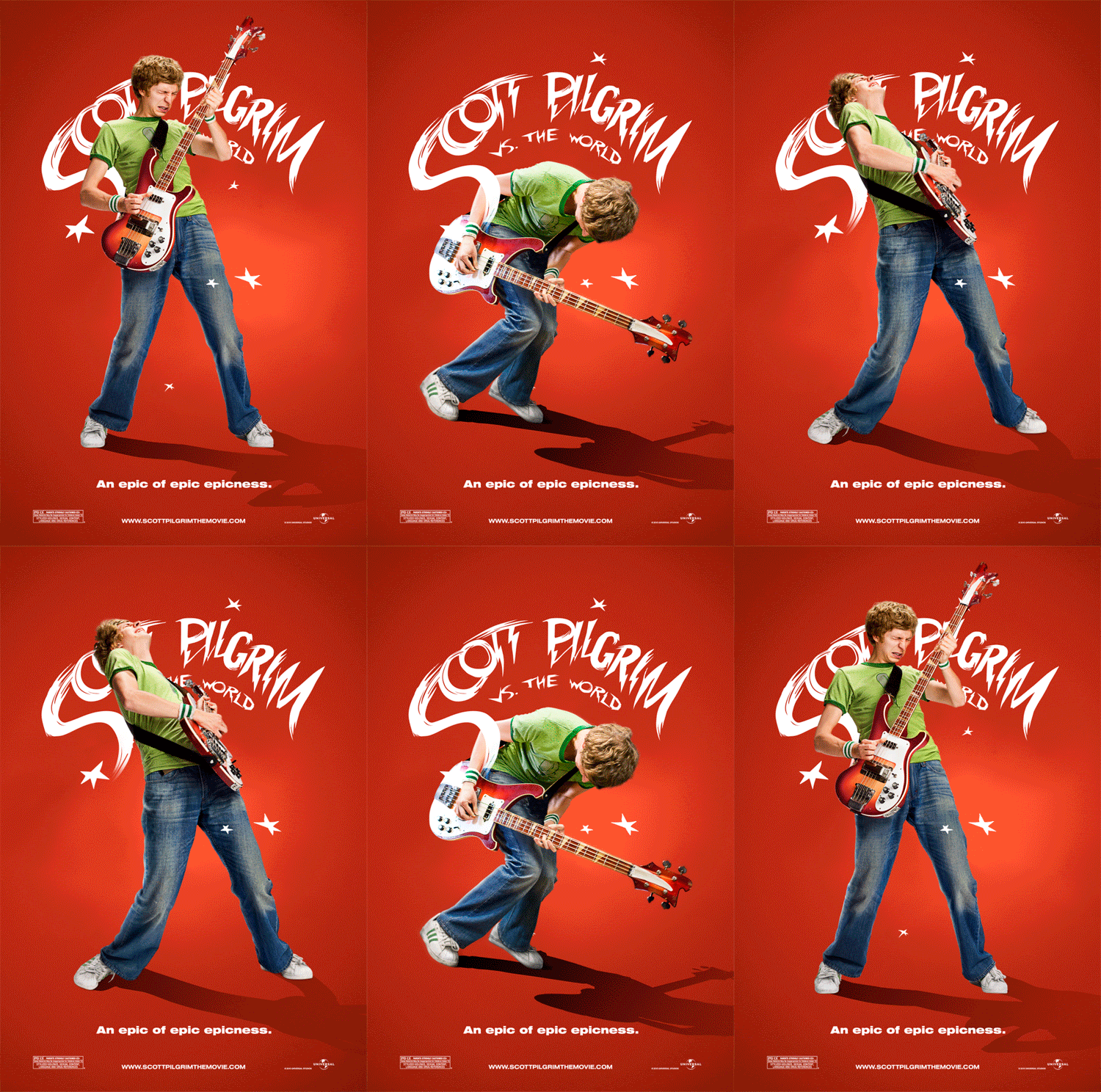
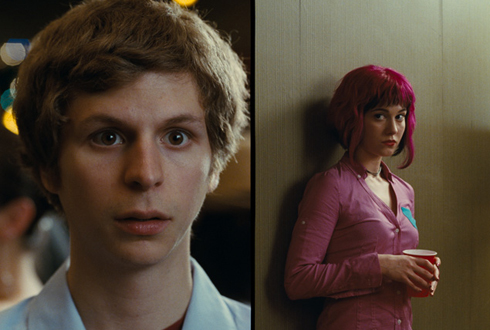
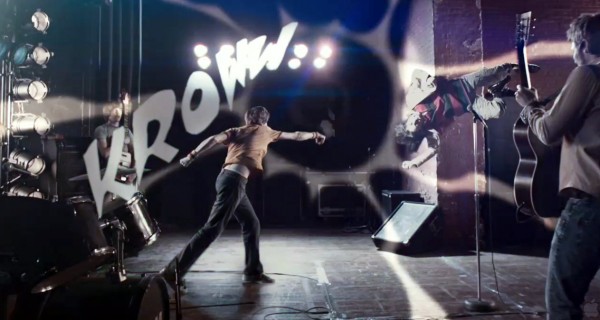
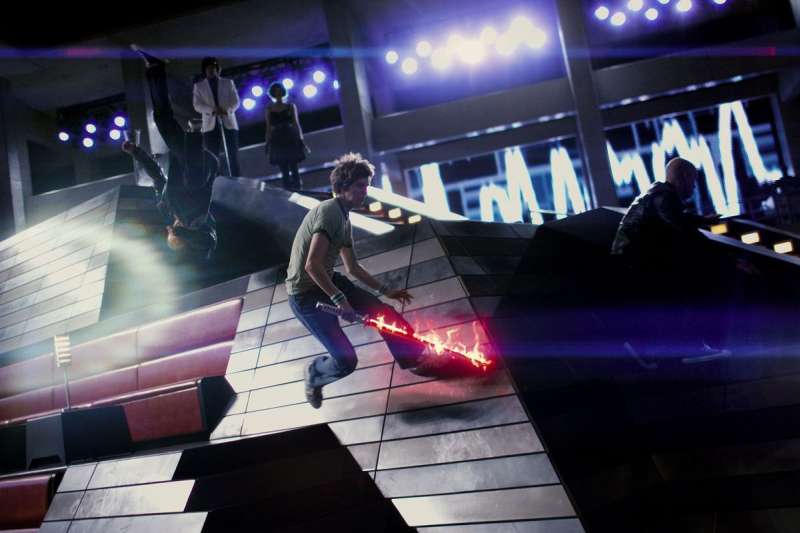
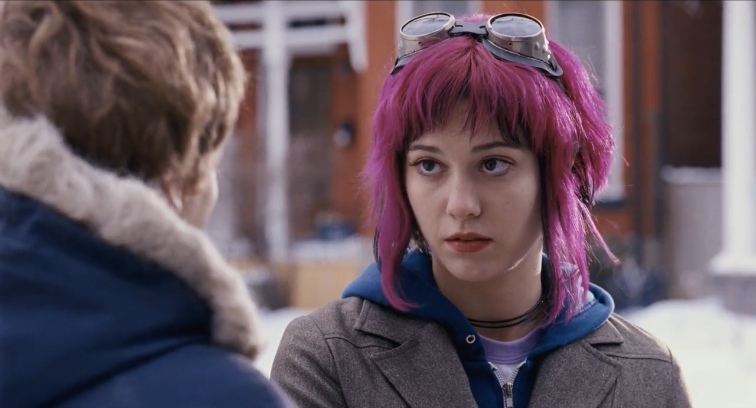
Finally.  A comedy that's ambitious, funny, and definitely not "coasting."  If anything, "Scott Pilgrim vs. The World" might be working too hard for its laughs by violating every rule in the book: episodic, fast, edited in a deliberately outre style with images crashing into each other, stepping on and crushing dialogue, seamlessly merging, not unlike "The Archers," reality and fantasy.  Indeed, you're never sure if what you're seeing is reality, or merely the Red Bull fueled fantasies of its lead character, Scott Pilgrim (Michael Cera, appearing "scruffy," thin and even more chinless than usual) young adult, but in name only.  And the movie manages to sustain the breathless pace its entire length, without losing its inventiveness or attitude.

That's something of a surprise as director Edgar Wright's previous films, like "Shaun of the Dead," and "Hot Fuzz," outwore their welcomes at the 2/3 mark but kept on going.  "Scott Pilgrim vs. The World" starts out of the gate fast and only lets up at its resolution (appropriately), in a melange of styles and techniques, while also shifting the narrative into over-drive with cartoonic and comics graphics touches that invade and overlay photo-reality.  "Fight Club" and "Stranger Than Fiction" did the same with a formalist style, but "Pilgrim" suffuses it with an energetic slacker zeal, as if these things were appearing off the top of its protagonist's head (which, in the narrative, it probably is).  A movie hasn't been this anarchistically fun to watch tearing apart movie-sensibilities since...oh..."Fight Club," "Moulin Rouge!," or, hell, "Citizen Kane."*  Film-making rules are bent almost in two, but never break the narrative flow.  This is good stuff.**

I've stayed away from reading any reviews (which is my M.O.), but a scan of headlines leads one to think that the film has turned off its "Gamer" audience.
I can see where the argument would come: it's really not about gaming (not in the electronic sense) and whimsically lampoons the culture using its tropes and excesses against it.  On a deeper level, however, it manages to take the insular mind-set and short-term rewards and gratification of gaming and place it in context into the real world.  And finds it wanting in the course of a life.  At the same time, it manages to make the sensibilities of gaming concepts—the nexus-choices of "Continue?," "Adding a life," and "Game Over," and draw parallels to painful life-lessons—real ones—that legitimize the story-line, gaming structure and the very reason for making the movie.  Very, very smart.

Now, this is a lot of "deep thought" for a teen-relationship (kinda) movie, and I run the risk of gilding the lily, and worse, building high anticipation which might kill the appreciation for what is there in the theater.***  But, more light-bulbs went off for me in this one, about how to use the craft to tell a story, and, in context, of achieving something more than the instant gratification that permeates our society (and the damage it can create) than anything I've seen in awhile.


It also managed to save, for me, what has been a rather disappointing movie Summer.  It's also the kind of high-concept circus act that the director can only pull off once—another movie in this style would lay him open to suggestions that he's a "one-trick pony."  But, if he can bring this kind of sensibility to this project, imagine where that mind could go in the future.  It makes one anticipate, and excited for, what can happen in the future.  As for now, Wright's taken things to a whole new level.

"Scott Pilgrim vs. The World" is a Full-Price Ticket.  Game Over.


* Okay, lest this be taken out of context ("He's comparing 'Scott Pilgrim vs. the World' to 'Citizen Kane?'!) and I'm accused of Kael-esque hyperbole, I found the same sense of film-making brio in this one that I've found in the others.  I always find this exciting, whoever does it, even if the results are ultimately to a less than satisfying experience.  I'm all for pushing the envelope, but the results have to be more than a good-looking envelope.  There's got to be a good message inside it, too.

 ** And, there's another layer—the sound design.  This one may be my winner for "Best Use of Sound" for the year, tossing in music and effects in a giddy montage that's constantly inventive and supportive.  I've tried to do this sort of stuff in my work—specifically for the old "Bill Nye the Science Guy" show—but, I could only aspire to the level that "Scott Pilgrim" does.  Bravo. (Clapclapclap)

*** Notice, please, that I haven't done a plot synopsis, quoted good lines (which there are, a-plenty) or said anything about the movie other than a basic wash-and-rinse of the film-going experience.  There are too many surprises, and too fine a resolution, to go about spoiling one's viewing.  I want to keep your pre-conceptions of this movie (which I hope you'll do) as spoiler-free as possible.  Go in expecting nothing, and this will be a better film—for you—for it.