Sunday, May 31, 2009

Don't Make a Scene: The Hospital

The Story: It must have been Hell to live with Paddy Chayefsky. You look at movies like "Network" and "The Hospital" with their "No Dolby/No Squelch" dialog and think "Did this guy ever patiently reason with the madness" or, like his movie scripts, did he just go around snuffing candles in the dark?

...with merely the Wind of his Righteous Invective.

"Dear me. What an outburst."

This scene is relatively calm. But it still seethes.

By now, thanks to TV, we've gotten used to Big Corridor Conversations, laced with arcanic medical jargon that would choke Dr. Kildare, delivered with a furrowed brow (to disguise the poor actor's panic), but "The Hospital" was something else back in the day. It's Oscar-winning script was full of vituperative denunciations, a steady drip of medical terminology, and a turbulent social satire on a medical system that could simultaneously perform miracles by design and murder by bureaucracy. It could be seen as a cry for medical reform...what?...nearly forty years ago? (Let's say that again...FORTY years ago) It was also taking advantage of grittier depictions of surgical life (thanks to Robert Altman's "M*A*S*H") by showing bloody gowns and open chests.

And hospital humor that was, well...sick.

But in 1971, this was hip and happening and now, baby—which sounds like some of the dialog from this movie. Try as Chayefsky might, he did not have a good grasp of youth culture.

Neither did George C. Scott, who was Oscar-nominated for this performance (not that it mattered to him). He has two other speeches in this scenario...another Corr-Con that ends with a ferocious "I mean...where do you train your nurses, Mrs. Christie—Dachau?!!" and a somewhat embarrassing monologue equating medical impotence with male menopause...but Scott makes it work and work brilliantly. He could be counted on to make the material better than it is.

But this is a great scene with a great point and some poignancy for the continuing factory-like nature of most modern hospitals and their co-pay-conspirators, the insurance companies. You say you want a revolution? We'd all love to see the plan.

The Set-Up:
It's been a bad day for Dr. Howard Bock (George C. Scott), Chief of Medicine at a Manhattan teaching hospital. He's down a member of his staff. Seems a temp nurse mistook him for a patient and killed him. That's bad. He's also depressed and going through a messy divorce. That's bad. He's not exactly the go-to guy for advice, but Dr. Brubaker (Robert Walden) has an ethical and procedural question for Bock. His timing could be better.

Brubaker: We've got a little thing here, Doctor.

Brubaker: The girl over there is the daughter of the patient in room 806. He is at the moment comatose and requires intravenous feeding and meds. The thing is the daughter wants to take the father out of the hospital and back to Mexico where they live.

Brubaker: The patient's name is Drummond. He's apparently some Methodist missionary and he and his daughter run...

Brubaker:...some kind of religious mission among the Apache Indians. The daughter claims to be a licensed nurse,

Brubaker:...so she can give the necessary IV's and treatment. I certainly don't think he should be let out of the hospital. The attending, the guy in brown over there, concurs.

Dr. Bock: Now, wait a minute, uh, let me have all of that again now.

Brubaker: As a matter of fact, Doc, this is Dr. Beigelman's case.
Bock: Never mind the professional ethics. What happened?
Brubaker: (Brubaker sighs) I don't know why I'm covering up for that son of a bitch in Farkis Pavilion anyway. The patient, a man of 56, was admitted to the hospital 10 days ago in good health for a check-up. No visible distress. We did the mandatory work-up on him: Blood cultures, stools, LE preps, chest EKG—all negative. However, there was some evidence of protein in his urine. I don't know how that son of a bitch in Farkis Pavilion found out about it. Maybe he had one of, uh, a deal with one of the girls in the lab. Anyway...

Brubaker: ...he turned up the next day, conned the patient into signing an authorization for a biopsy.

Bock: (Bock holds up hand) What...son of a bitch in Farkis Pavilion?
Brubaker: Some post-grad guy named Ives, sir. Elroy Ives. I never met him. He's on one of the immunology research programs.

Bock: You tryin' to tell me some post-grad fella came up here and did a biopsy on the patient?
Brubaker: Yes, sir. He conned Biegelman with that old story about...
Bock: Protein in the urine.
Brubaker: Yes, sir!
Bock: And he biopsied the man?

Brubaker: And he knicked a vessel in it (Bock reacts) At two in the morning, they woke up Biegelman 'cause the nurse found the patient in shock. Biegelman called the kidney people for a consult right away. W...what was there to see? The patient was sour and bleeding. We spoke to this fellow, Sutcliffe, he referred us to a surgeon named Welbeck.

Bock: Welbeck! That barber?
Brubaker: You ain't heard nothing yet. We finally got Welbeck around four in the morning. He said go ahead, so they laid down the surgery for 8. Welbeck shows up half-stoned, orders up an IVP, clears him for allergies...
Bock: Without actually testing...
Brubaker: Right.
Bock: And the patient went into shock.
Brubaker: And tubular necrosis. They lopped out the bleeding kidney, ran him back to the room, we sat around waiting for urine. Fever began spiking like hell, uremia, vomiting. So we arranged hemodialysis. Well, he's putting out good water now. But some nurse goofed on his last treatment.

Brubaker: A shunt separated, something. Blood pressure plunged. They ran him up to ICU, gave him two units of whole blood, all vital signs are normal now, except he's comatose. That was two days ago.

Bock: In short, a man comes into his hospital in perfect health. And in the space of one week, we chop out one kidney, damage another, reduce him to coma and damn near kill him.

Brubaker: Yes, sir.

(Bock chuckles acidly)

Bock: You know, Brubaker. Last night I sat in my hotel room... reviewing the shambles of my life...and contemplating suicide. I said "No, Bock. No, don't do it. You're a doctor, you're a healer."

Bock: "You are the Chief of Medicine at one of the great hospitals of the world."

Bock: "You are a necessary person. Your life is meaningful." (Brubaker stifles an uncomfortable laugh)

Bock: Then, I walk in here today, and I find out that one of my doctors was killed by a couple of nurses who mistook him for a patient because he screwed a technician from the Nephrology Lab...

Brubaker: Hematologist...

Bock: ...And then you come to me with this Gothic horror story in which the entire machinery of modern medicine has apparently conspired to murder one lousy patient.

Bock: Now how am I to sustain my feeling of meaningfulness in the face of this?(Brubaker laughs uncomfortably) I'll tell you something, Brubaker. If there were an oven around here....

Bock: ...I'd stick my head in it.

Bock: Now, what was the name of that son of a bitch in Farkis Pavilion again?
Brubaker: Ives, sir. Elroy Ives.

Brubaker: Somebody oughta ream his ass.

Bock: I'm going to ream his ass. I'm gonna break that Welbeck's back. I'll defrock those two cannibals, they will never again practice in this hospital, I'll tell you that.

Brubaker: What do I tell the girl, sir? She says we have no legal right to stop from taking her father out. She's willing to sign an AOR form.

Bock: Let him go...

Bock: ...before we kill him.

Brubaker holds his head.


"The Hospital"

Words by Paddy Chayefsky

Pictures by Victor J. Kemper and Arthur Hiller

"The Hospital" is available on DVD from MGM Home Entertainment.

Saturday, May 30, 2009

Up

"Let Go/Don't Let Go"

First, the important stuff: Go.

Don't even hesitate. This is another of those Pixar films that not only entertains, but pushes the form of animation, the more specific discipline of computer animation...and basic film language.

You do not have to see it in 3-D, as the effects are subtle, though expertly done. 3-D does not make or break "Up" and I suspect it will be just as lovely and dimensional on a cyclopian screen (in fact, it might even be better, as the provided 3-D prism glasses tend to mute the film's Maxfield Parrish-like color pallette).

Though just as rollicking as other animation films, "Up" stays somewhat down-to-Earth—no super-annuated cars or toys, no anthropomorphic mice (however, there are talking dogs, thanks to their master's creating speaking collars for them, in a situation that recalls "The Island of Dr. Moreau"—I kept expecting them to break into "Be Our Guest" at some point), and pains have been taken to keep the natural world natural: water-falls feel wet, however improbably they may be, you can practically feel the spray in a fog-bound scene, sunlight lazes across a wall convincingly, and vistas of escarpments or clouds seem picture-perfect.* It takes your breath away.


But there's a maturity to "Up" in its story-telling that's quite unlike any other Pixar film before it, not that the kids will care. As with the previous "Wall•E," the opening sequences are the killer, as directors
Pete Docter and Bob Peterson map out the life of Carl (Edward Asner) and Ellie Frederickson, two kids with a mutual passion for adventure, dare-devil Charles Muntz (Christopher Plummer), and eventually each other. The sequence is done with a moving simplicity (with a stunning attention to detail) and no dialogue, just images telling the story of a marriage in all its depths. That sequence haunts the entire movie, not only for its subject matter but also for the task of trying to top it.

It gets enticingly close many times** and when
it doesn't you're usually roaring with laughter,*** but the rest of the movie seems almost prosaic in its predicaments and complications. You don't want this one to end like your typical chase movie, and even though it does, it does so better than the vast majority of them. Even while the hi-jinks ensue you can't help but think that even these situations work best as allegory in setting up the big gambit of the movie, with precipitously floating dirigibles and houses and many, many situations of making the vertiginous decision to let go or not let go.

For technique, creative thoughtfulness and a painter's eye, Pixar's team of magicians and imagineers are unsurpassed in continuing to influence the art of film.

"Up" is a Full-Price Ticket

Update: Glenn Kenny has a concise "halleluia" for "Up" at "Some Came Running" that addresses some of the many joys encountered therein, but also touches philiosophically on the critical ennui of writing about the latest Pixar release ("Ho-hum, another brilliantly conceived and executed Pixar film"). There's no pleasing some people ("Hello, Stephanie Zacharek and Joe Morgenstern!" Perhaps their reviews were "inspired" by a bad meal at Cannes with a snooty waiter...) who have become so jaded with consistent quality that they wouldn't know A Great Movie if they tripped over it in a darkened theater.

* And for me, the favorite sound design element is the sound of the balloons above the house bouncing together, sounding like rubber petals.

*
Including a "taking flight" sequence that is among the best in cinema


*** Best line: "Well, that won't work..." The adults in the audience laughed for a full minute. You have to be there.

Friday, May 29, 2009

In a Lonely Place

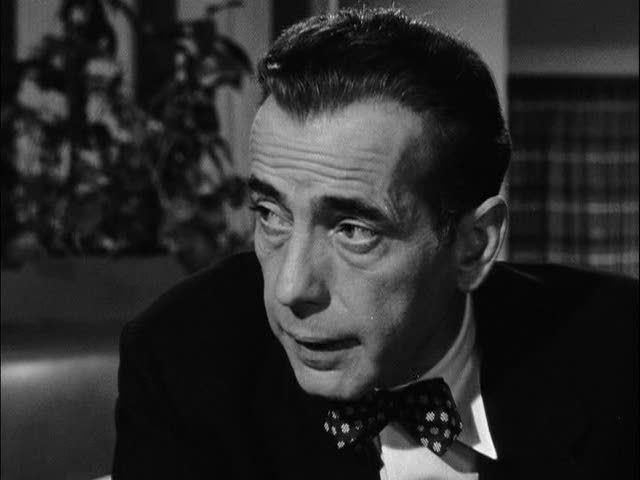
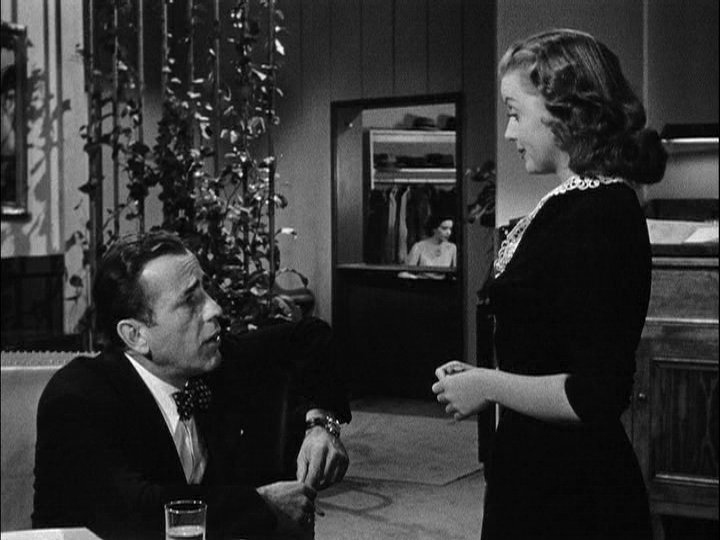
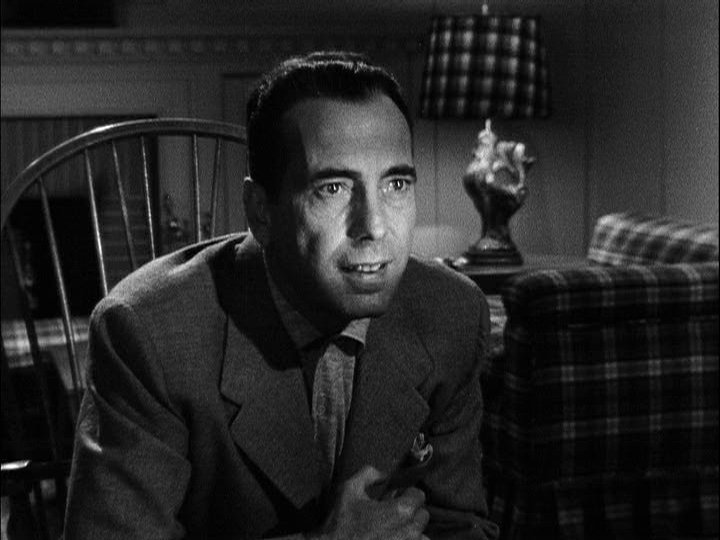
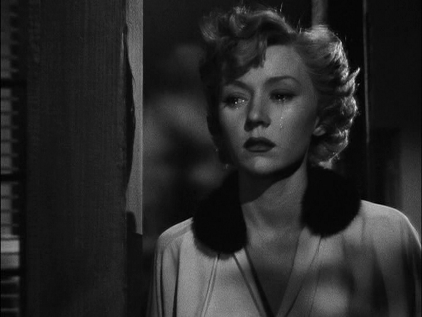
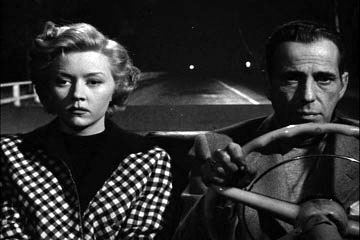
"In a Lonely Place" (Nicholas Ray, 1950) Risky Hollywood-noir/murder mystery/psychological drama produced by Humphrey Bogart's Santana Production Company and directed with a sure grip by the great Nicholas Ray. Bogart plays Dixon Steele, a hot-headed screenwriter on a cold streak. His temper has gotten him into a lot of violent scrapes that the studios have managed to sweep under the rug. Now, a hat-check girl that was in his apartment the night before has turned up strangled and the police are certain he was the culprit.

His one alibi is his neighbor, Laurel Gray (
Gloria Grahame), part-time actress, who has a fairly air-tight alibi for Steele, and the two of them subsequently begin an affair that keeps Steele on the straight-and-narrow and the police suspicious. They'd be less tenacious if he didn't have that long rap sheet, the sick sense of humor and the unhealthy glint in his eyes when the subject of murder comes up. Steele is an odd bird who can't control his temper and pretty soon the police's suspicions make Laurel have her doubts which Dix only amplifies by his actions.

Can love survive?
Can Laurel?

This is a great mystery in which the central murder ultimately doesn't matter; the players and their ability to destroy each other in a cynical battle of survival
when they're at their most vulnerable does. Gloria Grahame, who would endure a career of also-ran women's roles, displays the gifts of a great character actress in the lead. And Bogart exploits his dual persona playing a bad-good man (or is that the other way around?) who has no control and betrays a self-loathing that's painful to watch. He and Grahame are great together—she's one of the few women who doesn't kiss Bogart awkwardly, and their relationship feels real and not phoney—and the screenplay crackles with the good dialogue that makes great Bogart movies. That the movie is taking shots at Hollywood and the loungey L.A. lifestyle is merely a refreshing bonus (What was it about 1950 that turned out all these anti-Hollywood movies?). Bogart is at his best when he's taking chances with his material, and "In a Lonely Place" provides a wealth of opportunities: a creative murder mystery with a great romance and the possibility of mutual self-destruction. It's a stunning noir that's a highlight of the careers of all parties.

Thursday, May 28, 2009

Anytime Movies Reloaded: Wrap-Up

It's Spring-Break for me. Times are busy. The Summer Movie Season is already begun (and I'll be writing about the new ones) and the Film Festivals are grinding away like creaky mills separating wheat from chaff. It's as good a time as any to re-boot a feature I started years ago, when it was suggested I do a "Top Ten" List.

I don't like those: they're rather arbitrary; they pit films against each other, and there's always one or two that should be on the list that aren't because something better shoved it down the trash-bin.

So, I came up with this: "Anytime" Movies.

Anytime Movies are the movies I can watch anytime, anywhere. If I see a second of it, I can identify it. If it shows up on television, my attention is focused on it until the conclusion. Sometimes it’s the direction, sometimes it’s the writing, sometimes it’s the acting, sometimes it’s just the idea behind it, but these are the movies I can watch again and again (and again!) and never tire of them. There are ten (kinda). They're not in any particular order, but the #1 movie IS the #1 movie.

Making a list of this sort always has a way of bringing up more issues than it solves.

It's amazing what movies aren’t on the list. It’s amazing to me, and I made the list! “
Dr. Strangelove” isn’t here because “2001” is. A lot of defacto “classics” aren’t here. Where’s “Casablanca?” (Love it!) Where’s “Star Wars?” (Love that!) Where’s “The Godfather?” (Love…and respect...that!)

THX-1138” was a big influence. Not here. Where’s “Gone with the Wind?” (Easy. I hate “Gone with the Wind,” though I’ve seen it five times) There’s no Hitchcock (That’s interesting). No Spielberg (ditto). "The Wizard of Oz?" (Not here...not in Kansas, either!) No superhero movies (Not so surprising, really). No foreign films. Hmmm. “Seven Samurai” and “Yojimbo” (natch!) and “Nights of Cabiria” would have made the list, but my history with them is short, and I didn’t feel I could write about them well, so, no…unless you count “Once Upon a Time in the West” and it’s so influenced by American westerns, I don’t really consider it a foreign film.

I think “
The Wild Bunch” and “Silverado” are perfect screenplays. Not here. There’s a lot of John Ford films I love, and Howard Hawks. They get a delegate apiece. “It’s a Wonderful Life”—but not as wonderful as “Mr. Smith Goes to Washington.” And then there are the missing persons: Where’s Bogart? Cagney? “Patton,” “Lawrence of Arabia,” “Willy Wonka.” Hey, no musicals, though I think “Singin’ in the Rain” is a classic film. And “Goldfinger?” Yeah, yeah, I know. It’s a peccadillo, but it's also my list. Go make your own.

There were some interesting coincidences, Two films set in Monument Valley. Two with
Jean Arthur (and Thomas Mitchell). Three (four, actually) about “lost causes.” All different genres. Different decades.

The other thing is I called them “Anytime Movies”—not the typical “desert island discs,” (or, more appropriately for what they are, "OCD Movies"). Also, I think I’d want a desert island movie like a Time/Warner handyman film on “How to Build a Boat” or “25 Interesting Recipes You can Make Using Sand,” or that “Gilligan’s Island” episode where
the Professor makes a radio out of a cocoanut.

And none of these movies contain my favorite moment(s) in film. That one is pretty obscure.

It’s the last fourteen minutes or so of
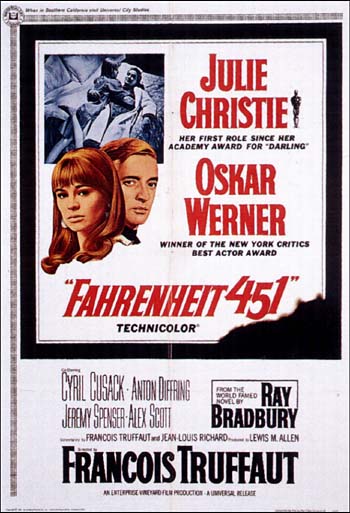
Francois Truffaut’s Farenheit 451.” The combination of Ray Bradbury’s ideas (a literal translation of RB is usually problematic), Truffaut’s screenplay and direction and Bernard Herrmann’s yearning music make the most sublime moments of film I’ve ever loved. It’s the “Book People” sequence, where Montag, the Fireman who has rebelled against the repressive textless society and escaped never again to burn books (well, except for one) makes his way out of the city to a fragile wooded area (by a lake) and finds a village of people who have committed to memory one beloved book. As fall turns to winter, these people walk and recite their treasures. One little vignette has a little boy being taught a book by a man, dying, and in a fade, it is the boy who recites by himself, and there is a moment…a moment…when he can’t remember. If that kid loses the book…it’s gone. That moment has always chilled me right down to the bone far more than any horror movie could, because it shows the fragility of an idea…as fragile as a life. Maybe it’s the sense that those books will go on, life after life. Maybe its because these people have taken on one sacred thing to devote their life to, like monks of literature. Maybe because it’s an island of sanity in a world of madness. Maybe because it’s the perfect melding of picture and sound. But the cumulative effect makes me want to check in with the sequence every couple of months. To make it easy for me, here it is:


Now, once again, for the last time, here are my “Anytime Movies.”

Wednesday, May 27, 2009

Anytime Movies Reloaded: 2001: A Space Odyssey

It's Spring-Break for me. Times are busy. The Summer Movie Season is already begun (and I'll be writing about the new ones) and the Film Festivals are grinding away like creaky mills separating wheat from chaff. It's as good a time as any to re-boot a feature I started years ago, when it was suggested I do a "Top Ten" List.

I don't like those: they're rather arbitrary; they pit films against each other, and there's always one or two that should be on the list that aren't because something better shoved it down the trash-bin.

So, I came up with this: "Anytime" Movies.

Anytime Movies are the movies I can watch anytime, anywhere. If I see a second of it, I can identify it. If it shows up on television, my attention is focused on it until the conclusion. Sometimes it’s the direction, sometimes it’s the writing, sometimes it’s the acting, sometimes it’s just the idea behind it, but these are the movies I can watch again and again (and again!) and never tire of them. There are ten (kinda). They're not in any particular order, but the #1 movie IS the #1 movie.


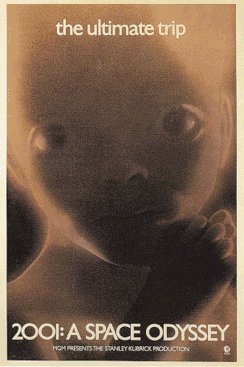
Why is “2001” my favorite film?

1. It completely does away with the three-act play structure that hems in most films. It’s four acts—like a symphony.

2. It contains very little dialog, and insists on telling its story (about discovering extra-terrestrial life) and providing key dramatic information visually and aurally—something that too few films actually try to do--fully utilizing the strengths of the medium.

3. It dispenses with the traditional sense of screen-acting which depends on emoting high-points (which is not standard drama, but is, in fact, melodrama), that has long been the crutch of what is considered great screen acting.

4. It comes up with a rather nifty solution for the Evolution versus Creation argument, which is: “Why can’t it be a little bit of both?” Trust
Kubrick to answer a question with another question.

5. It is that very rare item in movie history—a true Science Fiction film. It is not a standard genre film (ie. a western or detective story) set in the future with gadgets, like “
Star Wars” or “Close Encounters” or “Blade Runner” or “Outland” or “Forbidden Planet.” There are no comfortable, reliable concepts in “2001.” It asks audiences to consider the inconsiderable and make leaps of knowledge and faith. And it doesn’t wait for that audience to catch up, despite protestations of a “glacial” pace.

6. It obeys the rules of space and uses them dramatically. There is no sound in space. Trips in space take a long time. Isolation is a problem. Don’t get caught without your helmet. Ask your computer how its doing every so often. When you're dining over at a stranger's house, don't break the crystal. If a black monolith crosses your path, don't reach for it unless you're prepared for your life to change. Rules like that...

7. It takes advantage of the one unique element that separates film-making from any other art form, and presents the single greatest edit in movie history. To wit:

My Dad took me and my friend Jerry Fortune to see "2001: A Space Odyssey" on my thirteenth birthday. I was a space kid. I lived and breathed the Apollo program. I knew every Astronaut’s name and every mission. What went right and what went wrong. The names of landing sites and prominent craters nearby.

But I couldn’t make heads or tails out of this movie. Like my father, I “liked the middle parts,” but I couldn’t figure out what was up with the monkeys, what all that weird screaming was about, what was with those streamers when they get to Jupiter, who was the old guy and what was that baby at the end?

I mean, huh?

I was determined to figure it out. It was a space-movie for cryin’ out loud. And, at that time, they only came around once in a blue moon (the last being “
Planet of the Apes,” hardly a space-movie) and I wasn’t going to waste this one.

So it made me dig. I researched. I found out it had to do with the search for extra-terrestrial life (it did?), then I read Clarke’s book, and although Clarke and Kubrick deviated quite a bit, it let me in to what Kubrick was trying to communicate.

Then I got it. It made me realize why he did what he did, why he chose particular scenes to portray, why he framed shots the way he did, and what he could get away with without making his movie look stupid. For Kubrick, a suggestion was better than hitting you over the head by showing bug-eyed children in baggy suits and rubber masks ala Spielberg. There was no narrator to tell you what it all meant (Kubrick had cut out a prologue of talking heads discussing E.T. concepts). The film-maker trusted that his audience would figure it out. Some did.* Some just liked all the colors.

And it left a lot of people (including one thirteen year old and a good number of complacent critics) in the moon-dust.

It still boggles this mind that Kubrick was able to take Arthur Clarke’s slim concept in “The Sentinel” (alien beings leave a "burglar" alarm of sorts on the Moon), and take it to a logical beginning, wrap it in mythic proportions and take it to an inevitable, and, for me, heroic, end. It still is one of the few movies that purport to be science fiction with a deep sense of mystery and wonder, even a kind of visual poetry--something its sequel, the literal-minded “2010,” dispensed with to its drab, short-shelf-lived detriment.

Where did that inspiration come from? How did those concepts appear? For me, the movie fits the description of the Black Monolith in the film (and are its last spoken words) “It’s origin and purpose, still a total mystery.”

I may have seen "2001: A Space Odyssey" over a hundred times, and it never, ever bores me or fails to thrill me.

Such is the power of this movie over me.


*A site that "explains" "2001" and touches on some philosophical aspects

Here's the oldest running web-site about "2001". Lots of handy info.

The 2001 Internet Resource Archive. Lots of neat things here, too!

A pretty comprehensive Kubrick web-site

"Welcome to the Hal Corporation"

The Hal project


2001: A Space Odyssey
Citizen Kane
Once Upon a Time in the West
—Only Angels Have Wings
The Searchers
Mr. Smith Goes to Washington
Chinatown
American Graffiti
To Kill a Mockingbird
Goldfinger
Edge of Darkness

Large Association of Movie Blogs


Tuesday, May 26, 2009

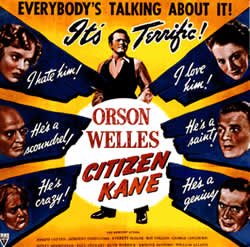
Anytime Movies Reloaded: Citizen Kane

It's Spring-Break for me. Times are busy. The Summer Movie Season is already begun (and I'll be writing about the new ones) and the Film Festivals are grinding away like creaky mills separating wheat from chaff. It's as good a time as any to re-boot a feature I started years ago, when it was suggested I do a "Top Ten" List.

I don't like those: they're rather arbitrary; they pit films against each other, and there's always one or two that should be on the list that aren't because something better shoved it down the trash-bin.

So, I came up with this: "Anytime" Movies.

Anytime Movies are the movies I can watch anytime, anywhere. If I see a second of it, I can identify it. If it shows up on television, my attention is focused on it until the conclusion. Sometimes it’s the direction, sometimes it’s the writing, sometimes it’s the acting, sometimes it’s just the idea behind it, but these are the movies I can watch again and again (and again!) and never tire of them. There are ten (kinda). They're not in any particular order, but the #1 movie IS the #1 movie.

So obvious a choice.

Yet Citizen Kane (or RKO 281) has been fielding off re-appraisals and critical backlash since the day of its premiere. Is it really "the greatest American film ever made?"

Yes.

So far….

Part of the argument against it is that it can’t be since it was the product of a 26 year old who had never made a film before. But
Orson Welles was a 26 year old who grew up pampered and precocious—who read Shakespeare at an age when other kids are reading Seuss. As a teen he made his way in the world by his brio and his considerable talents and his nerve to try just about anything. He was an artistic sociopath who staged alternative Shakespeare productions and avant-garde radio plays for years before be given, as Kane puts it, the candy store”—a carte blanche contract with a film studio to make any film of his choice, any way he wanted with final cut and a stipulation that said no one could alter it in any way in perpetuity (This is the reason why Turner Broadcasting in its rush to colorize movies could never put so much as a pink pixel to “Citizen Kane.” Some contract!). With it, he gathered his seasoned Mercury Theater actors (some of whom would go onto major Hollywood careers), one of the most innovative and painterly cinematographers, Gregg Toland, young, daring editor Robert Wise, the arrogant and brilliant composer Bernard Herrmann, and the amazing technical crew at RKO who produced such amazing feats as “King Kong” and the Astaire-Rogers musicals and turned them loose on Herman Mankiewicz’s long-in-the-planning screenplay that he believed could never be produced.

Out of all that talent at the top of its game, Welles produced the best American movie ever made, and as a reward he was never allowed that freedom again. Ever.

No good movie goes unpunished.

His next film, “
The Magnificent Ambersons” was a more mature and accomplished–looking film, but RKO chopped it up. re-shot the ending into a certain incomprehensibility and threw it on the bottom of a cheesey double bill. Welles’ Falstaff movie “The Chimes at Midnight” was the project closest to his heart, and might be better if not for the logistical and technical hurdles Welles had to jump in order to make it.

But “Kane” is the grail—the stuff of legend, and has been looked on ever since with avarice by would-be auteurs with more guts than talent, and therein lies the danger. That reputation could make "Kane" as cold and lifeless as one of the statues in Xanadu’s basement. It’s actually more like one of Susan Alexander Kane’s puzzles—intricate and maybe unsolvable without a lot of effort. There’s one shot where Welles shows his hand. It occurs after Susan has left him, accompanied by the screeching cockatiel superimposed on the screen (“I wanted to wake the audience up at that point,” Welles joked. Really, Orson? Right Linkthere?) and right after he trashes her room—destroying the acquisitions of her life—and Kane picks up the snow-globe that will fall from his hand at his death. “Rosebud,” he murmurs (both times) and then walks as in a daze out of her room, into the hall, and past the servants. He then crosses through a mirrored hallway that reflects an endless line of Kanes that recede and disappear. After Kane (and his many reflections) has passed, the camera then pushes into the mirror and out of the reverie of the butler (“Sentimental fella, aren’t you?” “Mmm. Yes and no.”)


That shot is the exit from the worlds of memory through which we have seen many reflections of Kane—the house of mirrors that makes up the bulk of “Citizen Kane,” the movie. It is also our last image of Kane, himself, in the film. He’s talked about through to the end, of course, but that splintered mirror-shot is our final impression of him (Kane—and Welles—are not even seen in the End Credits review of actors). At that point it becomes clear (as crystal) that the entire film is like that hall of mirrors that reflected back the aspects of Kane important to each narrator—a process that began with the newsreel that quickly jumped through the highlights of Kane’s life as a public figure and set up the film’s surface mystery—what is the meaning of Kane’s last word (and so serves as a stand-in for “who was Kane, really?”).

In the course of the various reflections there are all sorts of legerdemain—little tricks and in-jokes—that Welles, who was an amateur magician, clearly loved pulling off even if an audience didn’t immediately “get” them. One of my favorites is the craning shot through the model of the “El Rancho” nightclub where Susan Alexander performs and drinks herself into a stupor every night. The night of Thompson’s first visit it’s storming outside and flashes of lightning hide the camera’s passage through the roof sign and through the glass transom into the nightclub inside. When, half the movie later, we again travel through that transom it’s broken—presumably by our first trip through it. In the film’s original framing (unfortunately not in the DVD presentation) there is the slightest nudge of the camera to the right in the rather severe shot of Mrs. Kane signing little Charles away to the banker, and we see, just on the edge of the frame, that significant snow-globe that keeps popping up in dramatic moments. In the newsreel there is a shot of a newspaper of the entire Kane family. Later in the film, we actually see that shot being taken. Another is the way Kane’s hectoring “Sing-Siiiiing!” to “Boss” Jim Gettys is cut off by a shutting door, but continues by a braying car-horn out on the street. These are little filigrees to the grand architecture of lighting, framing and editing tricks that Welles and his crew pull off.*

But that central question “who was Kane?” is purposely never answered, not by a word, not by an object, and not by a person. In the end, the film says that it can’t solve the problem, that it can only present it, and leave us with the acknowledgement of its complexity.

So what are we left with as the remnants of Kane and his life fly up from the furnace of Xanadu? An answer to the mystery of "Rosebud," but not an answer to the man. For Kane was many things, but as Kane himself passed judgment on himself, he was never great. Given gifts that many of us will never ever have, he ultimately squandered them. Insular, wasteful, in his house of mirrors, he is left alone to contemplate himself.

We all have our gifts. What do we do with them? “Citizen Kane” is like that glass globe that we can peer inside and see the illusion of life…and consider our own lives. And in the end we are left with its final image to contemplate, and one may consider that Kane was a master illusionist himself, pretending greatness where there was none, and utilizing the very same tools used by those other illusionists—magicians and very young film directors--to create those illusions.

Those tools being smoke…and mirrors.


* Orson Welles is unique in the group of directors of movies that I’ve seen in that every time I exit from a new film of his, I come out looking at the world with new eyes…or with a new perception of the old world--one that seems filled with possibilities.


Citizen Kane
Once Upon a Time in the West
-Only Angels Have Wings
The Searchers
Mr. Smith Goes to Washington
Chinatown
American Graffiti
To Kill a Mockingbird
Goldfinger
Bonus: Edge of Darkness

Monday, May 25, 2009

Run Silent, Run Deep

"Run Silent, Run Deep" (Robert Wise, 1957) One of those general entertainment movies that manages to do so many things exceptionally well that one comes away grateful for the experience. Directed by Robert Wise with a true sense of claustrophobia, the script by John Gay maintains a strict military accuracy while displaying a keen sense of drama, psychology and brevity. A psychological drama, a war film, a story of mystery as well as redemption, the film manages to pull everything off with a propulsive rhythm and fine performances throughout.

Produced by Hecht-Hill-Lancaster,
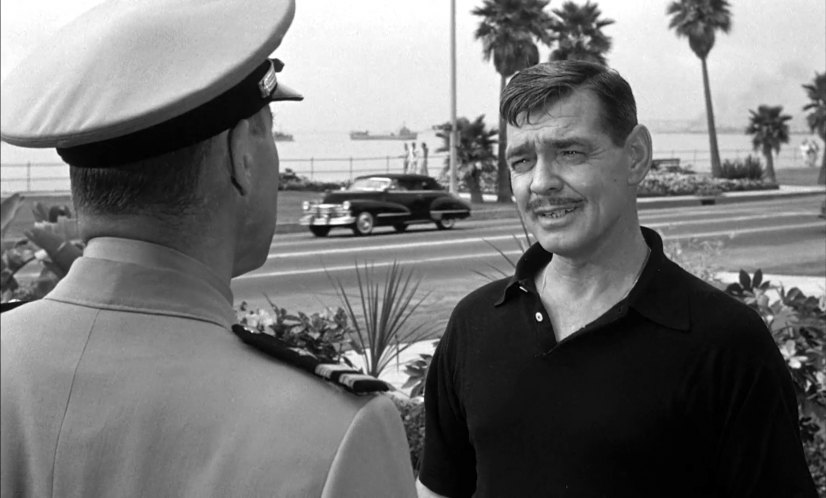
Burt Lancaster the producer takes a back-seat to his star, Clark Gable, the older actor in one of his understated roles that takes into account his age. Gable's the flawed figurehead with shades of Ahab who finagles his way into the command of the S.S. Nerka patrolling the Pacific during World War II, having already lost one sub and and a frustrating convalescence at a desk-job.

Lancaster's exec Jim Bledsoe is torqued because Gable's Cmdr. "Rich" Richardson has pulled rank to get command—his command—and is now drilling the men to dive and shoot a torpedo within a record 35 seconds. The already suspicious crew starts to snarl about all this practice with nothing to show for it. Then a lucky strike convinces some of them the new Captain is golden, while the other half think he's out to torpedo their mission. Lancaster turns into a reluctant arbiter.

But, in their first attempt to sink Richardson's unsinkable Japanese war-ship things don't go so well leaving crew-members dead and injured and Lancaster in command.

Robert Wise is a master of filming people at work with a story-teller's eye for finding the perfect angle (without calling attention to it and himself) and an editor's sense of pace and construction. Wise is also a chameleon of style tamping down his presentation of professionals doing their jobs while also being able to ramp up the spectacle for the unreal worlds of musicals and science fiction. Given his work on this film, you could see why he'd be the perfect choice for the similarly set-bound "Star Trek: The Motion Picture."

He also makes goods use of the usual crew of character actors who make up the Nerka's lovable mugs:
Jack Warden, Brad Dexter, Don Rickles, Nick Cravat and Joe Maross. The close quarters of a submarine makes the authentic plainness of their faces all the more important and brings them to a prominence near the bright lights of Gable and Lancaster. Both those lights are shaded somewhat, with Lancaster doing subtle, measured work, the kind that would dominate his later career. Gable, even subtler, is the King, here in his twilight, still burning brighter than the vast majority of actors. By this time, Gable was moving slower and had learned the power of economy and his Captain Richardson draws you in.

Finally, the story is a cracker-jack construction. Just when you think you've got it figured out, screenwriter Gay throws in an added complication that ramps up the idea that these are men strategizing in chaos and only repeated dips into the boiling oil of battle can make them seasoned enough to think clearly through the smoke and death.

"Run Silent, Run Deep" is an intelligent tribute to the fighting services without resorting to jingoism, racism or choired flag-waving. The film-makers' respect for the professionalism under duress of sub-crews runs silent and deep.

Memorial Day, 2009

Tomorrow: An "Anytime Movie" with a magician's touch

Sunday, May 24, 2009

Don't Make a Scene: The Straight Story

The Story: The story of Alvin Straight is true. The real-life Alvin actually did what transpires in the film, and I remember seeing it on the news. But David Lynch turned it into a lyrically strange, G-rated movie for Disney—a reminder that Lynch is a multi-faceted director, not an odd-ball, who can make powerful, moving films of great beauty*—movies that find the miracle in the everyday, in the way sun shines and smoke curls, and how life is strange on its own without having to pour on the gothic melodrama. Lynch is adept at turning over a rock to examine what's underneath, but he's just as fascinated with the rock without embellishment.

So, Lynch made "The Straight Story" about an elderly farmer who drives a John Deere mower across state to visit his ailing brother. The story transpires, moving slowly, topping out at 5 miles an hour, but there's a lot of country to see, and many stops along the way. One of them occurs while Alvin has some repairs done on his John Deere. During that respite, this scene occurs, though giving no comfort.

I once asked a grandfather-in-law about his participation in the Normandy Invasion. "What was that like?" I asked, naively. There was a pause. "Well," he said, fighting off the dark clouds. "I got through it..."

I guess that was the good part.

My Uncle (Bill) served in Europe, and he and some of his boys took a trip back there to look at some of the places he'd been during the war during the overland campaign with Patton. He showed them a field he and his troop had to sprint across under fire, and he mentioned how long it took them to do so. His kids were all athletes and one of them said "...Doesn't look so far..." to which the father replied, "Well, you're not seeing it with bullets!"

When I was going through my Father's things, I found a lot of interesting things: one was a letter that he got—I presume everyone got one—saying that their tour was over, and that they should go home and put it all behind them. "Just live your lives and forget it."

"Well, you're not seeing it with bullets."

Because we have not fought a war on our soil in 150 years, we've become somewhat inured by the thought of our nation at war and, probably, the idea of war in general. Our image of war is the sanitized, censored version our government (made up mostly of prominent sons who got deferments) lets us see. There is always feigned shock when there's a reported incident of friendly fire when we should be used to it by now, as used to anything that can go down in the chaos of war.

As I was going over this scene, I couldn't proceed without also including the next scene of "The Straight Story, where Alvin, still thinking of the war, and as he does many times in the film, looks up at the stars at night, which Lynch subtly, importantly, sets in motion.

This is why Lynch is one of our greatest directors.

It's why this is the scene for the day before Memorial Day.

The Set-Up: Straight (the late, great Richard Farnsworth)** is on a cross-state ride on his customized John Deere mower to see his ailing brother (Harry Dean Stanton), maybe for the last time. Among the people he meets on the way is Verlynn Heller (Wiley Harker), who eyes him during one of Straight's mis-adventures, and one day turns up at his temporary quarters to see if he'll have a beer. Straight is wary (after all, it is a David Lynch movie), but once bellied-up to the bar, it's time for old war-stories and some Straight talk.

Action.

Alvin Straight: I picked up a mournful taste for liquor in France. When I came back I couldn't drink enough of it. I wasn't worth a stick of stove-wood.

Straight: I was mean.

Straight: A preacher helped me put some distance between me and the bottle. And he helped me see'd the reason I was drinkin' I was seein' all them things here that I'd seen over there.

Heller takes a swig.

Verlynn Heller: Lotsa men came back drinkin' hard.

Straight: Oh. Everyone tryin' ta forget. I can see it in a man right away.

Heller looks at him.

Heller: Yep.

He takes another pull.

Heller: There was one time....

Straight knows what's coming, and steels himself.

Heller:...when we just...

Heller:...were waiting for that first warm meal in ten days. (chuckles) We'd thought we'd seen the worst. We hadn't had much trouble from the air.

Heller: I was on the rise.

Heller: There was a quartermaster workin' on some more coffee for me and my buddies. A stray Fokke-Wolff came over the tree-tops and dropped an incendiary on the mess-tent...

Heller: All my buddies.

Heller (struggling now): The kraut then banked right in front of me on that hill,...and...

Straight nods.

Heller: ...and I can see the swastika. (Heller is shaking, trying to maintain control).

Straight: That is one thing I can't shake loose. All my buddies' faces are still young.

Straight: And the thing is, the more years I have, the more they've lost.

Heller's barely holding on.

Straight: And it's not always...

Straight: ...buddies' faces that I see. Sometimes, they're German faces. Near the end we were shootin' moon-faced boys.

Heller looks at him.

Straight: I was a sniper. Where I grew up, you learned how to shoot to hunt food.

Straight: They'd post me up front, darn...

Straight: ...near ahead of the lines. And I'd sit...forever.
Straight: It's an amazing thing what you can see while you're sittin'.

Heller smiles.

Straight: I'd look for the officers, their radio-guys, or artillery spotter.

Straight: Sometime, I'd spot a gun-nest by the smoke. An' I'd fire into it. Sometime, it was just a movement in the woods.

Straight takes a ragged breath. Heller glances at him.

Straight: We had a scout. A little fella...name o' Kotz. He was a Polish boy from Milwaukee. He'd always take recon and he was darn good at it. We went by his word, and he saved our skin many a time. He was a little fella. We'd broken outta the hedgerows. We were makin' a run across the open. And we come upon the woods. We started drawin' fire. I took my usual position. And I saw somethin' movin'...real slow-like. I waited ten minutes. It moved again...and I shot. The movement stopped. The next day we found Kotz...head shot. He'd been workin' his way back toward our lines. Everyone in the unit thought a German sniper had taken him.

Straight: (takes a breath) Everyone all these years. (takes a breath)

Straight: Everyone but me.

The two old men sit at the bar, shaken.


"The Straight Story"

Words by John Roach and Mary Sweeney

Pictures by Freddie Francis and David Lynch

"The Straight Story" is available on DVD from Walt Disney Home Video.


* And let's drop the sophistication long enough to acknowledge that...sometimes...Disney can drop the princesses and the "Mickey Mouse" attitude and take a truly creative chance on a project that might be worthwhile (although, don't think that if the movie had made money there would be an "Alvin Straight" tractor ride in Disneyland-Florida.

** Farnsworth was dying of cancer when he was making this movie. He'd started an acting career late in life, starting out as a wrangler, stunt man and extra. You can see him in odd little roles throughout the 60's and 70's, and if you're from the Pacific Northwest, you might remember him as the Olympia Beer groundskeeper who saw "Artesians." His first major role was in Alan J. Pakula's "Comes a Horseman," for which he was nominated for an Oscar (as he was for "The Straight Story") When he finished the film, he did the press junkets, the Awards circuit, he participated in the selling of the movie. He won the New York Film Critics Circle Award for Best Actor. Then, he went home and finished his battle, which ended when he took his own life on October 6, 2000. I met him once when he was doing publicity for "The Grey Fox,", and he was as gentlemanly and cordial and...courtly...as he was on-screen.