 "Say That Again, But a Lot Slower and Dumber"
or
"Know What the Worst Part of Being a Good Guy is?"
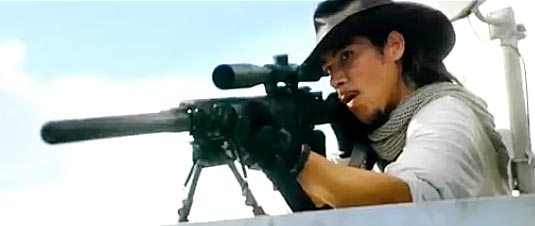
A rag-tag team of combat specialists are assigned to take out a drug-king-pin in Bolivia. They are Clay (Jeffrey Dean Morgan), Roque (Idris Elba), Jensen (Chris Evans), Pooch (Columbus Short), and Cougar (Óscar Jaenada); they mark the target for a devastating air-strike, then sit back and wait. Set and forget.
They continue monitoring and notice that a van carrying children—destined to be drug-"mules"—has pulled up at the compound. That changes everything. You can't kill kids. Ignoring orders, Clay makes the decision to go in, take out the kids and get out before the strike in 8 minutes. There'll be collateral damage...and Hell to pay, but they have to do it. There's no damn choice.
"The Losers" was initially a part of the DC Comics line of combat comics set in World War II, then morphed into their odd hybrid line of soldiers versus dinosaurs stories,* and were conceived and illustrated by some of the great comics-scribblers of the 60's including Robert Kanigher, Joe Kubert and even Jack Kirby. The concept of a squad of last men standing was too good to go fallow, and the series was updated as a "soldier of fortune" series in 2004 by Andy Diggle and artist Jock (who does a lot of design work for this movie). It retained the spirit of the originals, keeping the concept of fighters who are supposed to be dead, but don't know enough to lay down an die...not without taking a few bad guys out with them, anyway.**
But, as adapted by Peter Berg ("Friday Night Lights") and James Vanderbilt ("Zodiac"), these guys have more in common with "The Magnificent 7" crossed with the Impossible Missions Force; nobody's a GP, they're all specialists—a well-integrated team that complete each other and have each other's back dodging bullets, whether from drug cartels, or their own former bosses in the C.I.A. They're all considered dead from that disastrous Bolivia job, so they double back and decide to kill the masters who set them up for a suicide mission without the decency of telling them. Being dead, they have nothing to lose.
With the help of the beautiful but deadly Aisha (again with the Zoe Saldana), they smuggle themselves back into the country and plan their revenge against the mysterious Max (Jason Patric), whose idea of Homeland Security is a little passive-aggressive.
This is action-piffle, tarted up with Tarantino graphics,*** fights choreographed like dance-moves—director Sylvain White's last film was "Stomp the Yard"— and ramp-edited down to "300"-style freeze-frame-kills. There's even a Michael Bay-parodying slo-mo-perp-walk before a billowing American flag brings down the curtain on it (at least, I HOPE it was a parody!) The good-guys hit their targets at a dead-run, and the bad-guys wear the latest in bullet-magnet suits. There's a bit of sci-fi hokum with "green" weapons of mass disappearance—snukes—sonic de-materializers, that cork-screw a target into oblivion with no clean-up and no background radiation. Neat. Set and forget. The locations zip by, things blow up REAL good, and the good-guys fist-pump with an "Outstanding!"
Standard. Operating. Procedure.
And yet. And yet...
"The Losers" zips along like a freight-train, produces several hi-falutin' set-your-watches set-pieces efficiently and entertainingly, and carries it out with a heavy existentialist air of time-running-out/nothing-to-lose. These guys do what they do because they can't do anything else, but are careful enough to choose non-lethal methods when necessary. They don't kill on a whim and won't die on one, either. They get shot, bicker and fight (and for once, act on their threats), do it under the radar, if possible, but do it anyway if not, and always think about the exit strategy, frequently to the sound of sirens. It's a caper movie with bigger explosions and modest means.
It's what the "Mission: Impossible" films should be if they weren't fronted by a Big Dog with a Bond-fetish.
And for such a "star-less" movie, it still manages to be nicely played by every member of the cast.**** Morgan, who's the missing link between George Clooney and Brad Garrett, has the leading-man confidence needed to pull it off, and Chris Evans proves again that he can be a reliable actor of off-kilter inventiveness. Idris Elba plays his tough-guy with a nice dead-pan humor without minimizing the tough-act. And Jason Patric's arch-villain Max is weirdly out-of-sync with the rest of the movie, like a petulant Joker, but without the theatrics.
In another time, "The Losers" would be revered as a solid B-movie, as good as that strata could achieve given the limitations of budget and cast. But today, when anything except straight-to-video is considered an "A-list" release, it gives off the appearance of being second-tier—appropriate given the reputation of its title characters. But don't be fooled. There's a lot of interesting, solid work being done in this movie, while keeping it anarchic and entertaining. I found it amusing and respectable.
"The Losers" is a really, really cheap Matinee.
* Note to Hollywood: Could you do worse than this for a movie-concept?
** But, then, there are a lot of "anonymous" soldier-of-fortune groups in comics: "The Challengers of the Unknown," "The Sea-Devils," "The Doom Patrol," and the most successful, "The X-Men." Did I mention that "Pooch" was the dog-mascot of "The Losers?"
*** ...which Tarantino appropriated from his own love of four-color adventures, so it's a bit of a Mother-Child reunion, as it is whenever a comics adaptation does it.
**** Well, let me amend that: Holt McCallany, who plays First Henchman, Wade, just sorta stands there with a tight jaw and does nothing much. Can't blame him, really. His priority is to keep a straight face during Jason Patric's camp, but comically precise performance as Chief Villain (sans white cat).
Friday, April 30, 2010
The Losers







Thursday, April 29, 2010
The Girl with the Dragon Tattoo
 "Tinker, Tailor, Soldier...Spy"
Investigative reporter Mikael Blomqvist (a nom de plume purloined from the fictional detective Kalle Blomqvist) has just been found guilty of libel for an article he wrote about a powerful Swiss indutrialist. In six months he's set for the barry hotel, but in the meantime, he has down-time. He gets an invitation for a job—the coldest of cases, literally and metaphorically—on the remote wintry island that serves as a compound for the Vanger family.

The Vangers are the Swiss cousins of all the encrusted old-money families of British and American detective fiction. Be they Baskervilles or Armstrongs or Sternwoods, the "storied" elite families stood in for the Rothschilds and Lindberghs and Morgans and Rockefellers in a literary class warfare that assured the punters that bad things happened to the rich, as well. In fact, it was more than likely to happen to them as money is the root of all things evil. Perhaps.
Money was on the family's mind that Children's Day weekend on the Island, as a family board meeting was taking place, when one of the daughters disappeared, and her father drowned in a boating accident. One of the patriarchs wants to know, finally, forty years after the fact, what happened to the girl, who killed her, and charges Blomqvist (Michael Nyqvist) with the task. For the discraced newsie, it's a case of interviews and solitary visits to the caked-in-dust morgues of newspaper offices and libraries. But, though isolated on the Island, he's being watched, not only by the family, but by a security investigator who's hacked his computer.


She's Lisbeth Salander (Noomi Rapace),"The Girl With the Dragon Tattoo,"* a 22 year old full-time goth-punk chain-smoking, bisexual, PTSD'd borderline schizophrenic, sociopathic, fire-fixated security-investigator-computer-hacker...and part-time judge, jury and executioner. And where Mikael is dusting off old store-rooms, she's mining hard-drives through the back-door for any information that might be useful, like, say, on the creep who's been appointed her guardian. Life has rumpled Mikael, but it's deeply scarred Lisbeth, and the two tarnished angels are linked by more than cyberspace in a mutual interest making peoples' forgotten pasts their field of play.


They were made for each other, and, as both are incapable of seeing a mystery without inserting themselves, fated to team up to solve the question, if it is to be solved.

"The Girl With the Dragon Tattoo" is one of those whodunnit's much in love with every squeaking trope, and dangling aringarosa of the detective literary genre, and the puzzle is of the classic "Closed Room" variety—a traffic accident cut off the one exit to the bridge when the skull-duggery happened, so the scope of the search is limited to who might have been on that island to perpetrate it. The clues are varied in sources and nature, an old diary the girl kept with no entries that might lend suspicion, the few photographs taken that week-end...and Blomkvist's own memories—the girl was his nanny on Island holidays—provide nagging evidence, as does a single portrait that haunts him, like the Mona Lisa.


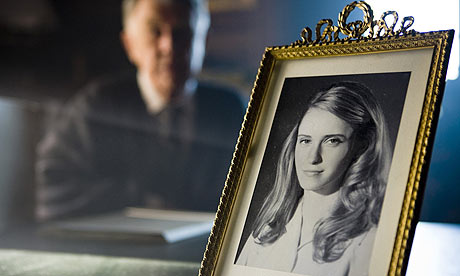
There are so many referrals to past films noir and sleuth-cinema that one could get lost in many a blind-alley (not that there are many on a rural Swedish island), but there are more than enough cousins and butlers and drawing rooms to go around—as with the best mysteries, no one is a suspect, but everyone is.
It is violent—there are two upsetting rape scenes that are essential to the plot, ultimately—but there is a cross-running sub-theme of sexual tyranny equating male sexism and domination as a form of fascism (it's an in-bred cousin to the feminism issues that made "The Silence of the Lambs" more important than a "boogey-man" story) that makes the film interesting philosophically in the genre. Director Niels Arden Oplev stages those scenes in a brutal manner that divorces them from any sexual act and makes them sadistic acts of violence, but one should be warned that there is rough stuff, far beyond cloak-room murders and high tea. The film is unrated, but consider it a hard "R."

It's a cracking pastiche, with the best thing about it being the (English version's)titular character. A product of the very brutality embodied by the mystery itself, the stakes are personal for Salander (and Blomkvist, certainly), but, like the Hannibal Lecter character in "Silence of the Lambs," she is such a wild-cannon on deck during the proceedings that her motivations keep your thinking cap distracted from the mystery at hand. As played by Rapace, she is a kabuki-like presence than can turn ninja on a dime, a literal smoking gun, who can make things better or worse, depending on her buried mood, making the film categorical as "Suspense" as well as "Mystery."


The other films in the trilogy will be released later in the year. Then, an American remake is planned...at this writing starring Brad Pitt and Carey Mulligan.
"The Girl with the Dragon Tattoo" is a Matinee.
* That's what it is known as in English-speaking publishing circles where mysteries series need a unifying "hook" like John D. McDonald's colorful titles for the Travis McGee novels, or "Cat" series of Lilian Jackson Braun. In its native Sweden, the title—"Män som hatar kvinnor "— translates to the more straight-forward and to-the-point, "Men Who Hate Women." The popular series of novels, dubbed the "Millennium Trilogy" (for the publication Blomqvist works for) stopped at three due to the untimely death of its reporter/author Stieg Larsson of a heart attack at age 50, before the first could be published.
Wednesday, April 28, 2010
The Bad and the Beautiful
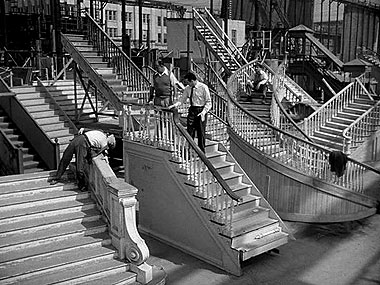
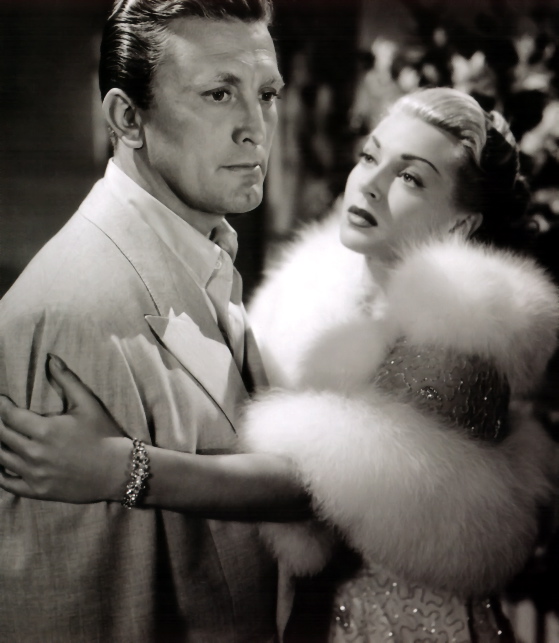
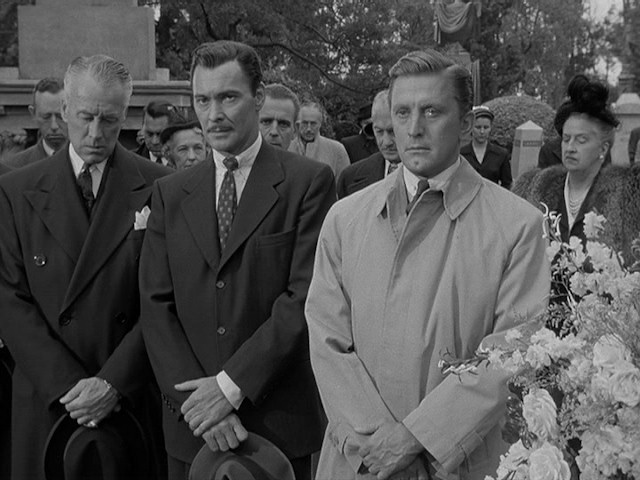
 "The Bad and the Beautiful" (Vincente Minelli, 1952) Hollywood movies about Hollywood generally stink; the best ones (and they're usually by Howard Hawks) make their odd collections of professionals in a field of endeavor working toward a single goal act as a metaphor for a film-team. But, when Hollywood hits the nail on the head it's usually with a gilt sledge-hammer, giving off the air of bitterness and back-stabbing lit by klieg lights—as opposed to merely doing it behind the scenes. "The Bad and the Beautiful," produced by John Houseman, could be about many Hollywood inmates, one can see allusions to Houseman's old partner (and bitter enemy) Orson Welles here—the structure is basically that of "Citizen Kane," (also produced by Houseman) with the story told by the principals in multiple flash-backs. Louis B. Mayer (the former head of the studio that produced "The Bad and the Beautiful" seems familiar in the penny-pinching sanctimony of studio head Harry Pebbel (Walter Pidgeon), Irving Thalberg (who would be the model of F. Scott Fitzgerald's "The Last Tycoon") could be part of the personality of demon-producer Jonathan Shields (Kirk Douglas), but it's also a bit of Darryl F. Zanuck. You could drive yourself gossipy in this guessing game.
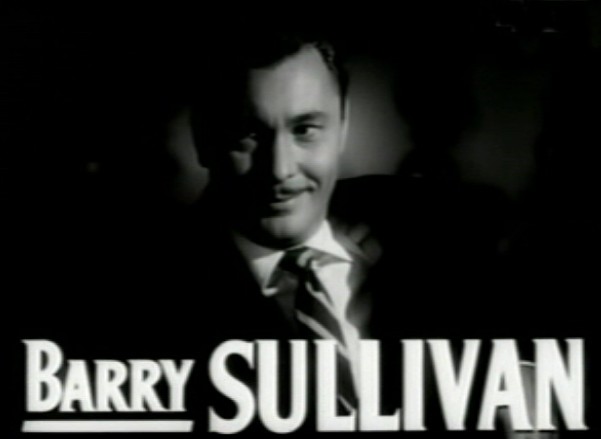
Three toilers in the Hollywood Valley—director Fred Amiel (Barry Sullivan), box-office sensation Georgia Lorrison (Lana Turner) and screen writer James Lee Bartlow (Dick Powell) are summoned to Shields Productions by studio head Pebbel. He wants to take them to task for avoiding the phone-calls of Shields, whom they've all had run-ins with. Shields is responsible for their success, but it has always come at a cost. Amiel had a dream-project taken from him by Shields, Lorrison was promoted and prepped for stardom by him, but rejected becoming romantically involved with her, and Bartlow still blames Shields for the death of his lusty wife (Gloria Grahame), while he and Shields were on a screen-writing retreat.
All of these stories are told in flashback sequences that recall the ones in "Kane" by the surviving partners and wives. But where the "Kane" stories interlock and enhance each other, the ones in "The Bad and the Beautiful" sir apart with little connective tissue between them. It plays like "The Three Faces of Jonathan Shields" as opposed to the stories being facets of the same character, building to a whole. In "Kane," the stories are all aspects of Kane's quest for love. In "Bad..." what unites them is that Shields is a manipulative producer—one would think that would go without saying. Amiel's story hints that Shields has "Daddy" issues owing to his Father's resentment in Hollywood ("I'm going to take the name of Shields and ram it down their throats!"—you can hear Douglas saying that). There may be something of the "sins of the Father" storyline here, but even that is undercut by the film's ending, a contrivance that makes a mockery of everybody's motivations.
"The Bad and the Beautiful" won five Academy Awards: best Supporting Actress for Grahame's fine work, and for the Black-and-White categories of Costuming, Art Direction and Cinematography (Robert Surtee's work is amazing in this), as well as a screenplay award for writer Charles Schnee (presumably in black and white, as well). Why this ad hominem pot-boiler would win Best Screenplay is beyond me.
But, that's me. "The Bad and the Beautiful" was one of the 2002 selections for inclusion in the National Film Registry.








Tuesday, April 27, 2010
Prefontaine
 "Prefontaine" (Steve James, 1997) The first of the two movies (the other being Robert Towne's "Without Limits") lionizing the patron saint of the running culture (especially in the Northwest) Steve Prefontaine. I've mentioned in the review of the other, some particulars and "Prefontaine" covers the same territory, but owing to who's telling the story and who gave rights to be portrayed, some of the emphases are different for bragging and story-rights. For instance, more is made of "the girl he left behind" in Coos Bay, "Pre's" relationship with fellow track team members (especially Mr. Shot-Put Guy), and the assistant coach. Because the film was produced by the producer-director team of the documentary "Hoop Dreams," the film is staged with scripted "interviews" with actors aged with not-too-convincing make-up, and a reliance on "found footage" of the real Prefontaine (and fortunately, Jared Leto looks just like him so there's no disconnect between the two sources). More emphasis is put on the college recruitment process (a main theme in "Hoop Dreams"). But it is pretty much the same story. Bill Bowerman as portrayed by R. Lee Ermey is more of a military hard-ass than Donald Sutherland's crazy-like-a-fox mystic in "Without Limits."
Towne's film is more assured, technically and scriptually, and the "Hoop Dreams" team can't avoid over-dramatising certain things...like changing Prefontaine's accident the night of his accomplishing the goal of staging an amateur track competition in Eugene. Does "Pre" have to look one of the Black September terrorists in the eye across their balconies at the '72 Munich Olympics? Does Ermey have to emphasize the point at the final race by looking at the camera and saying "I want all the people to know that what they are looking is the kind of runner who comes along only once in a lifetime." Thanks for the tip, but a little unnecessary.
"Prefontaine" was filmed in Tacoma, so quite a few Seattle sports reporters have quick-as-a-blink cameos.
But, when it comes to the finish line, "Without Limits" comes out a few lengths ahead as the better "Pre" film.
Sunday, April 25, 2010
Don't Make a Scene: Dr. Strangelove
 The Story: The story goes that Stanley Kubrick lured Sterling Hayden out of retirement for "Dr. Strangelove"—the two had worked before in "The Killing"—but both men had changed in the years between the two films. Hayden was not quite as precise as he'd once been—not as sharp on his marks—and Kubrick, never a slouch due to years of discipline behind a chess-board and camera, had become frighteningly, even aggravatingly, precise.
Hayden confessed to some jitters about all the uninterrupted technical babble his character, General Jack D. Ripper, had to espouse—he was worried that he might not be able to get it all in one take, no matter how many takes it took.
Kubrick, it has been reported, looked at him calmly (no doubt sizing up the words like they were an odd tactic with a rook) and said "You know, the panic in your eyes may be just the quality we need..." and anyway, he could cut around it, don't worry about it. Hayden was somewhat relieved at those words, but they weren't really meant to comfort. They were the words of someone making lemonade out of lemons, and liking the taste.
Anyway, Hayden is brilliant in "Dr. Strangelove," playing an insane part absolutely straight with no hint of irony or humor...and doing so opposite Peter Sellers, whose penchant for ad-libbing could throw any actor off their concentration.
The economy in this scene is brutal, comprised almost entirely of three shots (five if you count the preamble down the hall and the brief insert uncovering the gun): the room shot of the two military-men having a conversation, the close-up of Mandrake reacting to the soliloquy of Ripper, and Ripper's close-up, which doesn't occur until Mandrake has discovered that he is trapped in the room with a mad man while the nuclear clock ticks off down to the last seconds. Then, as they say, things get interesting.
To look at the scene in screen captures makes you believe that Hayden is frothing and spitting at the mouth in his role; he is not. He is speaking slowly and measuredly, as if Mandrake were a small child. It just looks like he's a teeth bearing maniac because Hayden is having to speak his precise lines with a very big (very big) phallic cigar in his mouth. It calls for very extreme enunciation and a lot of compensation to say things clearly with that stogie, and the effect is chilling. As is the occasional break Hayden has to make in order to breathe.
The Set-Up: Wing Attack Plan "R" has been sent to the U.S. SAC bombers routinely trafficking the skies during the Cold War in anticipation of a surprise nuclear attack from Russia. The unique plans of Plan "R" call for radio silence, in the event that normal command channels are rendered obsolete or destroyed, and a lower echelon General be empowered with launching a reprisal attack. General Jack D. Ripper (Sterling Hayden) has set the plan in motion, and only a unique set of secret circumstances can recall the planes from their mission. Group Captain Lionel Mandrake (Peter Sellers), assigned to Burpelson Air Force Base in the Officer Exchange Program (OEP), notices something amiss: if an attack, requiring such an action, were occurring, the Emergency Broadcast System (EBS)* would be broadcasting instructions to the citizenry through all broadcast channels. And that doesn't appear to be happening.
Action!
Cut to: Int. BURPELSON AFB.

 GROUP CAPTAIN LIONEL MANDRAKE walks hurriedly through the halls with the portable radio producing another jazz tune, now upbeat. Mandrake enters GENERAL JACK D. RIPPER's office.

 GROUP CAPTAIN LIONEL MANDRAKE: Excuse me sir, something rather interesting's just cropped up. Listen to that.
 MANDRAKE: Music. Civilian broadcasting. I think those fellows in the Pentagon have given us some sort of exercise to test our readiness.
 MANDRAKE: Personally, I think it's taking it a bit too far; our fellows will be inside Russian radar cover in about twenty minutes.
 MANDRAKE: You listen to that. Traffic chock full of stations all churning it out.
GENERAL JACK D. RIPPER: Mandrake...
MANDRAKE: Yes sir?
RIPPER: I thought I issued instructions for all radios on this base to be impounded.
MANDRAKE follows RIPPER as he rises from his chair to lock his office door
MANDRAKE: Well you did indeed, sir, and I was in the process of impounding this very one when I happened to switch it on. MANDRAKE: I thought to myself with our fellows hitting Russian radar cover in twenty minutes, dropping all their stuff, I'd better tell you, because if they do, it'll cause a bit of a stink, what?
 RIPPER: Group Captain, the officer exchange program does not give you any special prerogatives to question my orders.
 MANDRAKE: Well I realize that sir, but I thought you'd be rather pleased to hear the news.
 MANDRAKE: I mean, after all...well, let's face it we... we don't want to start a nuclear war unless we really have to, do we?
 RIPPER: Please sit down. And turn that thing off.
 MANDRAKE: Yes sir.
 MANDRAKE: Ah, what about the planes, sir? Surely you must issue the recall code immediately.
RIPPER: Group Captain, the planes are not going to be recalled. My attack orders have been issued and the orders stand. MANDRAKE: Well, if you'll excuse me saying so, sir. That would be, to my way of thinking, rather... well rather an odd way of looking at it. You see, if a Russian attack was in progress...
 MANDRAKE: ...we would certainly not be hearing civilian broadcasting.
 RIPPER: Are you certain of that, Mandrake?
 MANDRAKE: I'm absolutely positive about that, sir, yes.
RIPPER: And what if it is true?
 MANDRAKE: Well I'm afraid I'm still not with you, sir.
 MANDRAKE: Because, I mean, if a Russian attack was not in progress...
 MANDRAKE: ...then your use of plan R...
 MANDRAKE: ...in fact your orders to the entire wing...

 MANDRAKE: ... oh.
 MANDRAKE: Well I would say, sir, that there was... something dreadfully wrong somewhere.
 RIPPER: Now, why don't you just take it easy, Group Captain. And please make me a drink of grain alcohol and rain water, and help yourself to whatever you'd like.


 MANDRAKE:(snaps to attention and salutes) General Ripper Sir --
 MANDRAKE: -- as an officer in Her Majesty's Air Force, it is my clear duty, under the present circumstances, to issue the recall code, upon my own authority, and bring back the wing.
 MANDRAKE: If you'll excuse me sir.
 Mandrake tries all exits and finds them locked
 MANDRAKE: I'm afraid sir, I must ask you for the key and the recall code. Have you got them handy sir?
 RIPPER: I told you to take it easy, Group Captain. There's nothing anybody can do about this thing now. I'm the only person who knows the three letter code group.
 MANDRAKE: (voice cracking): Then I must insist, sir, that you give them to me.


 Ripper lifts a folder off of his desk and tosses it aside, revealing a blued, pearl handled .45 automatic.
 MANDRAKE: Do I take it, sir, that you are threatening a brother officer with a gun?
 RIPPER: Mandrake, I suppose it never occurred to you that while we're chatting here so enjoyably, a decision is being made by the President and the Joint Chiefs in the war room at the Pentagon.
 RIPPER: And when they realize there is no possibility of recalling the wing, there will be only one course of action open --
 RIPPER: -- total committment.

 RIPPER: Mandrake, do you recall what Clemenceau once said about war?
 MANDRAKE: No. I don't think I do sir, no.
 RIPPER: He said war was to important to be left to the Generals.
 RIPPER: When he said that, fifty years ago, he might have been right.
 RIPPER: But today, war is too important to be left to politicians.
 RIPPER: They have neither the time, the training, nor the inclination for strategic thought.


 RIPPER: I can no longer sit back and allow Communist infiltration, Communist indoctrination, communist subversion,...
 RIPPER: ...and the international Communist conspiracy...
 RIPPER: ...to sap and impurify all of our precious bodily fluids.


"Dr. Strangelove: Or, How I Learned to Stop Worrying and Love the Bomb"
Words by Terry Southern, Peter George and Stanley Kubrick
Pictures by Gilbert Taylor and Stanley Kubrick
"Dr. Strangelove: Or, How I Learned to Stop Worrying and Love the Bomb" is available on DVD from Sony Home Video.
* The EBS system continues to operate, requiring regular tests on all broadcast channels, to this day.
