Wednesday, December 28, 2011

The Adventures of Tintin: The Secret of the Unicorn


"Adventures in the Uncanny Valley"
or
"Spielberg Straight Up, No Chaser"

Everyone knows how dynamic and visceral a film-maker Steven Spielberg is.  At times, he can even approach overkill, bouncing along on his little adventures, then, happily, sailing right over a cliff.  Take 1941, for example, or Indiana Jones and the Kingdom of the Crystal Skull, both films of such excess that they immediately inspired ridicule.  That exuberance tries the patience of many film-goers who want the director who features the Moon in his corporate logos to come back down to Earth. The term "nuking the fridge" was derisively created for the fourth Indy film (as if credulity hadn't already been crossed in the  series before...)

But, imagine (if you will...or even can) Spielberg without any constraints.  I'm talking the regular constraints of film-making, the type that keep things down to the possible and even legal.  Things like time, budget, light, focal-lengths, physics, natural laws (like gravity), and even the constraints for safety imposed by studio legalities and The Humane Society.  Take those away—take them all away—and imagine what sort of film Steven Spielberg would make.

Scary thought, isn't it?

Now, with Peter Jackson producing, Spielberg has made his first "Avatar"-style movie, with mostly motion-capture technology, but virtually all CGI—there's no angle he can't shoot from, no perspective he can't take, no transition he can't achieve...whatever Spielberg can think, he can put on the screen, with no compromises and The Adventures of Tintin: The Secret of the Unicorn (based on three of the many Hergé books), shows what an unfettered Spielberg is capable of...and it is amazing.

And a bit headache-inducing, which I imagine would happen even without 3-D (the format I saw it in).  It even approached the stage where my brain started to shut down (a phenomenon I've noticed in myself with very few movies, except for those directed by Terry Gilliam), a kind of movie-narcolepsy where I have to fight sleep, so intense and detail-filled is the movie-going experience.*  Fortunately, Spielberg is so intent on making his 3-D cartoon a movie-movie, that it's quite easy to put oneself in the mode that this is happening through photographic means—only shinier, and with less dust.

So, the story of the Belgy reporter (voiced by Jamie Bellfollowing clues and bad guys to all points of the world, trying to find the answer to the riddles of a model ship he bought at a street vendor's (and why unscrupulous people like chief villain Rackham—voiced interestingly by Daniel Craig**—might want to acquire it, by any means necessary).

And it's all done in a semi-realistic style (although tribute to Hergé's cartoony style is paid early in the film).  Things are made to look real, even if the human forms are semi-cartoony.  That's worked better for Pixar, whose human characters have always looked better the further they diverged from realism.  Here it's a bit of a problem, especially early on in the proceedingsthere's a deadness to the eyes,*** what has been identified as "The Uncanny Valley"—the point at which, when trying to create a human simulation, the human brain (that is, a "real" human brain) rejects it, and even may be horrified by it.  Examples that the film industry have taken notice of have been audiences negative reaction to the CGI baby in Pixar's first full short "Tin Toy," and the reaction of test audiences to a first-draft version of the human-looking Princess Fiona in the first ShrekThe learning curve is high in Tintin, and very quickly the issue is side-stepped with squints and off-camera looks, but it's there, initially (and, to be fair, Hergé never gave Tintin or his other characters eyes, but round pools of india ink. Imagine the horror if they did a motion-capture movie of "L'il Orphan Annie?").  But soon, events overtake our heroes, and we no longer have time to look them in the eye—it's tough enough just trying to follow them.

And that is a case of pure, undistilled Spielbergia.  Enjoy.

The Adventures of Tintin: The Secret of the Unicorn is a Saturday Matinee.


* It's hard for me to explain what is going on (or even admit to it) when this happens. Partially, it might be because I'm not thinking much or analyzing what is happening, but just letting the images wash over me without much interpretation.  When a movie makes me think—for good or ill—I can't fall asleep.  But when there's nothing to really interpret—and there isn't much in Tintin—my mind tends to drift and be lulled.  With Gilliam and Spielberg, it might be because their movies are so full-formed and specific, there's not much for me to do.  It's like TV (which always puts me to sleep), which Marshall McLuhan labeled a "cold" medium, not asking much of its participants (if there's any participation at all), as opposed to a "hot" medium, like radio or books, where the participant's mind is active and fully functioning, filling in gaps, providing pictures and imagineering the story being fed to the brain.

** One of the really keen ideas that Spielberg brings to the table is his independence in creating the characters.  None of the voice-actors resemble their real-life counterparts—stands to reason, animators and Pixar have been doing that for years—but the recent motion-capturers, like Bob Zemeckis and James Cameron have tied their actors' likenesses to their characters, in an attempt to capture the humaness to the pixel-people.  Producer Peter Jackson, though, had no qualms about abandoning any semblance to Andy Serkis when bringing full-life to Gollum in the "Ring" trilogy.

*** One is tempted to recall Quint's soliloquy in Jaws, comparing a shark's eyes to "lifeless eyes, black eyes, like a doll's eyes. When he comes at ya, doesn't seem to be livin'."

Tuesday, December 27, 2011

The Girl With the Dragon Tattoo


"The Girl With the Dragon, Take Two"
or
"Once More...with Feeling"

"We come from the land of the ice and snow
from the midnight sun where the hot springs FLOW

How soft your fields so green,
can whisper tales of gore,
Of how we calmed the tides of war.

We are your overlords.
On we sweep with threshing oar,

Our only goal will be the western shore."

"Immigrant Song"  Led Zeppelin


The American production of The Girl with the Dragon Tattoo advertised itself (amusingly) with the tag-line "The Feel Bad Movie for Christmas."  Compared to the Swedish-TV version (with Michael Nyqvist and Noomi Rapace), it's actually, if one can believe it given the subject matter, a "kinder, gentler" version.

So, what's different?  For those familiar with the first version, many of the locations reveal themselves to be the same.  Resolutions are slightly different. The casting certainly is (and more on that later).  Editors Kirk Baxter and Angus Wall keep things moving very fast, sometimes abruptly, and scripter Steven Zaillian delivers punchy dialogue dripping with icyclic irony, while keeping the circumstances equally savage and shocking (what else can you expect from from a murder mystery involving in-bred families crusty with krona, corruption, Nazi affiliations, serial killers, sexual violence and "men who hate women"—the original title of the book when published in Sweden?).  It's how director David Fincher (Se7en, Zodiac, The Social Network) approaches the tone that's slightly different, and though still mordantly frigid, this version is a bit more clever in presentation, adding a darkly humorous slant.  Sure, the violence is still sickening, but blunted, even handled at times more discretely, making the impact contrarily even more squeamy, while, at the same time, counter-pointing with sly musical choices.*

But, it's the casting where the main differences occur.  Daniel Craig, no less intense, but muted and reduced to human scale with a world-weary familiarity, plays Mikael Blomqvist, co-publisher and chief reporter for an investigative magazine, MillenniumDisgraced by a libel suit gone against him and to shake off the publicity and the hit to his reputation and bank account, he takes on a murder investigation for the patriarch of the industrialist Wanger family (Christopher Plummer)—a literal cold case of the forty year old disappearance of the elder Wanger's granddaughter, although distinctive clues point to her either being alive, or the killer is cleverly taunting the old man.

It's soon clear that Blomqvist may be over his head and he calls on an "assistent"the same background investigator who cleared him for the job for the Wangers.  She's the titular "girl with the dragon tattoo"—Elisabeth Salander and "she's different."  "In what way?" asks Wanger's lawyer, Frode (Steven Berkoff).

"In every way," says her employer.

Too true, not only in terms of Society, but also from the actress who previously took the role (Noomi Rapace, currently starring in Sherlock Holmes: A Game of Shadows).  She's still the same Salander, the goth-punk, vegan, pierced, bi-sexual hacker-savant who becomes the focus of the series, zipping around the bleak Swedish countryside on her black-on-black motorcycle, but this movies version, in the form of Rooney Mara, is slight (she had to be starring opposite the 5'10" Craig), tiny and even more startling in appearance than Rapace.  There's still the same shock of hair, but with her elfin face, shaved eyebrows and eyes sunk deep into her face, she has the appearance of the walking dead, her head looking often like a skull, and speaking in a dull, listless monotone.  Rapace looked like she could kick serious ass (and did in the Swedish productions), but Mara is deceptively tiny, even looking sickly frail, so when she goes on the attack, it's doubly alarming. 

We learn more about the little spit-fire in the second and third books of the series (hopefully they'll have their own versions with this cast—as with the Swedish films—because this cast is too good to waste, but the film's poor box-office showing—"The Feel-Bad Movie of Christmas," remember?—may make that unlikely), but Mara's dead-inside interpretation, that only slightly blossoms through the film, is an interesting take, doubly tragic, keenly felt and puts both her character and Blomqvist's into an interesting perspective.

I actually like this version better than the first.

The Girl with the Dragon Tattoo is a Full-Price Ticket.


Not the actual main title, but the video of the Trent Reznor/Karen O version of the Led Zep song.
It's somewhat in the same visual style, and might consist of "outtakes.".


* The best being what was used in the initial trailers—Led Zeppelin's "Immigrant Song," subtly adapted by producer-composer Trent Reznor (the perfect guy to score this film) for female vocal, while keeping the brutal orchestrations of the original intact.  The Main Title sequence accompanying it, is visually arresting, suggestive and creepy, almost a mission statement in tone—black and white, reflecting the film's dark muted color scheme—while suggesting minds, trapped, tortured and squirming like toads. 

Sunday, December 25, 2011

Everybody De-Constructs Rick, Part IV

Continuing December's look at scenes from "Casablanca," particularly those where players speculate on the character and motivations of saloon owner Richard Blaine, and right to his face...

Everybody De-Constructs Rick, Part 4: Victor Laszlo

The Story: I was going to end this series with what will now be next week's classic scene from "Casablanca," but I'd forgotten about one very important, even pivotal, player in the drama—freedom-fighter and husband of Ilsa Lund, Victor Laszlo. He, too, thinks he knows Richard Blaine, and gives him some un-asked for advice, semi-judgementally, talking about Mister Blaine's "destiny" like he was Obi-Wan Kenobi or something.

Fat lot he knows. For example, he doesn't know that, at that very moment, his wife is sneaking out the back-way of Rick's Cafe Americain so she won't be seen by him. And he doesn't know that his wife was up there to threaten Rick into giving her the letters of transit and ended up in a clinch with him.*

But the more I watched it, I realized that this scene is crucial to get to the scene next week. It's essential in the decision-making of Richard Blaine. Like everybody else, Victor Laszlo comes to some conclusion about Rick,** and, as with everyone else, it's some reflection of their own character. Laszlo looks at the saloon-keeper and sees a potential ally in The Cause and a rival in love. He tries to plead his cause by its merits, and then by appealing to Rick's relationship to Ilsa, betting that Rick will at least protect her. I think it's Laszlo's unselfish offer of saving Ilsa at his own expense that throws Rick to take the course that he does. Rick admires Laszlo (see the previous scene with Louis Renault) and his willingness to sacrifice himself for his wife surprises and moves Rick.

On closer examination there are many subtleties: Bogart's way with props and timing is on display as he lights his cigarette just as Laszlo says "Each of us has a destiny." (just as he tossed a nut-shell with a sentence-ending *ding!* in his first conversation with Laszlo) He clenches his jaw when Ilsa is brought up. In deference to his co-star, he doesn't blow a lot of smoke obscuring Heinreid's face, but there is smoke--a kind of veil that surrounds Rick in an amoral haze and separates him from Laszlo. Paul Heinreid, when talking about "something between (him) and Ilsa" looks not into Rick's eyes, but at his fore-head, as if trying to read his mind. And when Rick churlishly throws a crack about "destiny," mocking Laszlo's appraisal of him, Laszlo is surprised at the cruelty of the remark, and we exit the scene with Rick smiling and blowing out his existential smoke.

Even at this late point in the movie, what actions Richard Blaine will take are still uncertain.

Today—Christmas—would have been Humphrey Bogart's 111th birthday.

The Set-Up: Well, here's an embarrassing situation: Your former lover comes to your room to threaten you to help her husband escape, and you end up in an emrace. Then, who shows up? The husband, seeking asylum and some first-aid after a Free-French meeting is raided. Rick (Humphrey Bogart) sees to it that Ilsa Lund (Ingrid Bergman) is escorted home down the back-stairs. Then, Rick sees to Victor Laszlo's (Paul Henreid) medical needs. And what does he get in return? A lecture! From somebody else who "knows all about him."

Action!


Rick descends the stair-case from his office and goes to Laszlo, who is bandaging his arm with a tea-towel.

Laszlo: It's nothing—just a little cut. We had to get through a window.

Rick: Well, this might come in handy. (Rick grabs a bottle and pulls Laszlo a drink)
Laszlo: Thank you.

Rick: Had a close one, eh?
Laszlo: Yes. Rather.

Rick: Don't you sometimes wonder if it's worth all this? I mean what you're fighting for.

Laszlo: We might as well question why we breathe. If we stop breathing, we'll die. If we stop fighting our enemies, the world will die.

Rick: Well, what of it? Then it'll be out of its misery.

Laszlo: You know how you sound, M'sieur Blaine? Like a man who is trying to convince himself of something he doesn't believe in his heart.

Laszlo: Each of us has a destiny.

Laszlo: For good. Or for evil.

Rick: Yes, I get the point.

Laszlo: I wonder if you do.

Laszlo: I wonder if you know that you're trying to escape from yourself.

Laszlo: And that you'll never succeed.

Rick: You seem to know all about my destiny.

Laszlo: I know a good deal more about you than you suspect.

Laszlo: I know, for instance, that you're in love with a woman.

Laszlo: It's perhaps a strange circumstance that we both should be in love with the same woman.

Laszlo: The first evening I came here into this cafe, I knew there was something between you and Ilsa.

Laszlo: Since no one is to blame...I demand no explanation. I ask only one thing:

Laszlo: You won't give me the letters of transit.

Laszlo: All right. But I want my wife to be safe.

Laszlo: I ask you as a favor to use the letters to take her away from Casablanca.

Rick: You love her that much?

Laszlo: Apparently, you think of me only as the leader of a cause. Well, I'm also a human being.

Laszlo: Yes, I love her that much.

(The police break into the cafe in force, and storm up to Rick and Laszlo)Adjutante: M'sieur Laszlo?

Laszlo: Yes?
Adjutante: You will come with us. We have a warrant for your arrest.

Laszlo: On what charge?
Adjutante: Captain Renault will discuss that with you later.

Rick: It seems that destiny has taken a hand.

(Laszlo is escorted out, as Rick watches)


Casablanca

Words by Murray Burnett, Joan Alison, Julius J. Epstein, Philip G. Epstein, and Howard Koch

Pictures by Arthur Edeson and Michael Curtiz

Casablanca is available on DVD from Warner Home Video.


* There is a short story called "You Must Remember This" written by a guy called Robert Coover, which starts in that room and that scene, and covers all the details skipped over in the long discreet fade-out between Rick and Ilsa's kiss and his cigarette-by-searchlight. If you've missed it, it's probably better, as the story's your basic crass porn. Without it, you'll always have Paris.

** If you haven't noticed by now, its interesting to note that just about everybody calls him something different. To Ugarte, he's "Rick." To Ilsa, he's "Richard." To Louis, he's "Ricky." To both Laszlo and Strasser (tellingly), he's "M'sieur Blaine." To Sasha and Sam (and all the guys called "Emil"), he's "Boss." And they all call him something different because they all see him differently, which he never discourages. It's one more subtle way that Rick maintains an elusiveness of character, and keeps the audience guessing about him.

Merry Christmas from LNTAM (and Terry Gilliam)


Saturday, December 24, 2011

Mission Impossible: Ghost Protocol

"Mission: Incredibles"
or
"I'm Spit-Balling—It's Not All Going to be Gold"

The first Mission: Impossible film (based on Bruce Geller's TV series) was darned good—script tinkered by Robert Towne, nice set-pieces by Brian De Palma—while the second, not so much, a Woo-fest where star-egos and director-eccentricities clashed—and the third, directed by J.J. Abrams, a slight improvement, more gritty and down-to-Earth if nothing to really write home about.

The fourth, numerically neutral and titled Mission Impossible: Ghost Protocol, is actually the best of the bunch, much more in keeping with the original series' intent: a team of operatives plan out an unlikely spy-mission, fading into the wood-work, disguised and deceptive, insert themselves into scenarios that inevitably go wrong at some point, and they have to punt in order to get out alive and successful.  The big problem with the movie series (and its chief departure from its small-screen inspiration) is that Tom Cruise is the star and everybody takes second-seat to him, the other members of the team being merely escort planes to the Big Cruise Missile.  His character, Ethan Hunt, is supposed to be something of a cypher—all the IMF agents are—but more attention is paid to his character, while not really defining who he is, and as a result, you don't really care what happens to him.  There are no character peccadilloes or habits that one can relate to or identify as such, and what there is—no vodka martinis, but he always favors a celebratory beer at the end—is rather pedestrian.  So the movies are this weird yin-yang of Big Star/Small Character that crowds everybody else out.  The stunts are the stars.

That changes here.  Even though it is a "Tom Cruise Production" (executive-produced by J.J. Abrams), MI:GP is very much a team effort, with nice strong characters in the group (Cruise, Paula Patton, Simon Pegg and Jeremy Renner) who are thrown together from a previous mission that goes "somewhat" awry and leads the President to invoke "the ghost protocol:" The IMF is entirely "disavowed" and The Secretary (there's been one each movie—Henry Czerny, Anthony Hopkins, Laurence Fishburne, and this time Tom Wilkinson, the job must be the least secure in Washington D.C.) arranges for the closest team—Hunt's—to carry out a risky mission as they're already privy to inside information, and they're already deeply implicated in what has happened—which could see the resurgence in Cold War rivalries that will accelerate to nuclear-hot mighty fast.

So, it's just the four agents against the world, on a tight timeline and even tighter high-wire act to prevent terrorists from striking the match to the series' signature fuse.  And the nice thing is, it's not Cruise's show alone, it can't be, and Renner, Patton and Pegg are strong enough personalities, that Cruise doesn't even have to generously step out of the limelight for themIt is a team effort, finally, the way the series was initially envisioned.  And the writers and director have set up some nifty clockwork scenarios that nicely merge into each other to create a steady stream of nifty sequences that make you stop and say..."Huh...Haven't seen that one before."

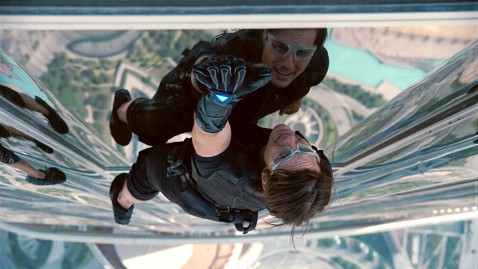
A lot of the credit should go to director Brad Bird, former animator and Pixar grad (he made The Iron Giant, The Incredibles, and did the "save" on Ratatouille), who keeps things elegantly focused, tightly synced, and throws in more than a dash of surprising absurdism throughout the film.  Yeah, a lot of it's over-the-top—that's kind of the way it is with the MI films—but there is no stoic acceptance of the risks this time.  In fact, there's a bit of slap-dashery to the whole thing—everything that can go wrong does—the timelines, the tech and the teamwork, and the four are left scrambling trying to pick up the pieces.  Along the way there are nice little touches, like the comic bend given to the usual "this message will self-destruct in five seconds" bit, or an extended sequence of guard-fooling that wouldn't seem out of place in a "Roadrunner" cartoon.  Even the big set-piece—Hunt in Dubai having to spider-man up the glass face of the world's tallest building ("eleven stories up and seven over") is played for grins, albeit with the teeth chatteringThere is no Cruise brio in evidence for the stunt, his character doesn't want to do it, but he's the only one who can and...the clock's ticking.  That Bird milks it for all the tension it's worth and manages to make it pay off spectacularly and...with humor...shows he owes more to Buster Keaton than to typical action-directors who take this stuff so deadly seriously (credibility issues).

Credibility is the least of the concerns for the director of The Incredibles.  Instead, he and the MI team have provided a spy-romp that aims to be a thrill-ride that leaves one chuckling.  In that case, mission accomplished.

Mission Impossible: Ghost Protocol is a Matinee.

Thursday, December 22, 2011

Sherlock Holmes: A Game of Shadows

Bullet-Time
or
"Forewarned is Fore-armed (and Don't Call Me 'Shirley')"

"'Well, well,' said he, at last. 'It seems a pity, but I have done what I could. I know every move of your game. You can do nothing before Monday. It has been a duel between you and me, Mr. Holmes. You hope to place me in the dock. I tell you that I will never stand in the dock. You hope to beat me. I tell you that you will never beat me. If you are clever enough to bring destruction upon me, rest assured that I shall do as much to you.'

"'You have paid me several compliments, Mr. Moriarty,' said I. 'Let me pay you one in return when I say that if I were assured of the former eventuality I would, in the interests of the public, cheerfully accept the latter.'

"The Final Problem" Sir Arthur Conan Doyle


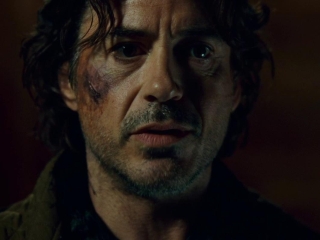
Sherlock Holmes: A Game of Shadows is the inevitable (and one should say quick-on-its-heels) follow-up to Guy Ritchie's Sherlock Holmes, and as an adaptation of Conan Doyle's "The Final Problem," It has as much source-relationship as the later Bond films have to Fleming—the bare-bones structure is there, but it's pumped, plumped, and trumped-up to fulfill the needs of action, humor and modern audience identification.  Really, "The Final Problem" is enough, we don't need the world-conquering machinations of Professor Moriarty (The Napoleon of Crime, the Scourge of London, and Holmes' best match) to make him a worthy adversary.  He merely needs to be omnipresent by means of his web of chicanery, rather than an omniscient history-maker.  In fact, Conan Doyle's Moriarty would rather his bad work went undetected, as opposed to this movie's version producing a shattering World War.  Here, in the words of Robert Downey Jr.'s Holmes, the plot is "so overt, it's covert," involving twins who aren't twins, TB, the Romany, anarchists, darts for various purposes, intricate explosive devices and not-so-intricate shell-firing ones, countries that can't be named ("although they speak French and German"), and the prospect of "war on an industrial scale."

20/20 hindsight always looks like genius when set in the past.

Actually, it's pretty clever how the doom-laden inevitability of "The Final Problem" is translated into the fore-shadowing of the war-torn 20th Century (the screen-writers are the wife-husband team Michele Mulroney and Kieran Mulroney*), and its focus on large artillery and semi-automatic "machine-pistols" has a nice hard edge as opposed to the original film's emphasis on the psuedo-occult.  But, director Ritchie seems to have lost of his somewhat, the fight-sequences (there are many) are nicely fore-shadowed with flash-cut Holmsian cognitive pre-functioning, but when the fisticuffs and baritsu moves start flying, the action is hard to follow, even when the action is slowed to a crawl—there is far too much ramp-editing and Matrix-y "bullet-time" FX in the film for no good purpose other than to slow down the practical and digital effects and give us the illusion of "wow, that was close." (Thanks, we assume that fire-fights and shellings are dangerous things).  However fast the editor can manipulate images, one still gets the impression of the film being a bit too "fussy" for its own good, delaying information or simply obfuscating it for a later time, giving one the impression that one is seeing a lot of the movie twice.  Efficient, it ain't, even if the titular character is supposed to be the heighth of it.

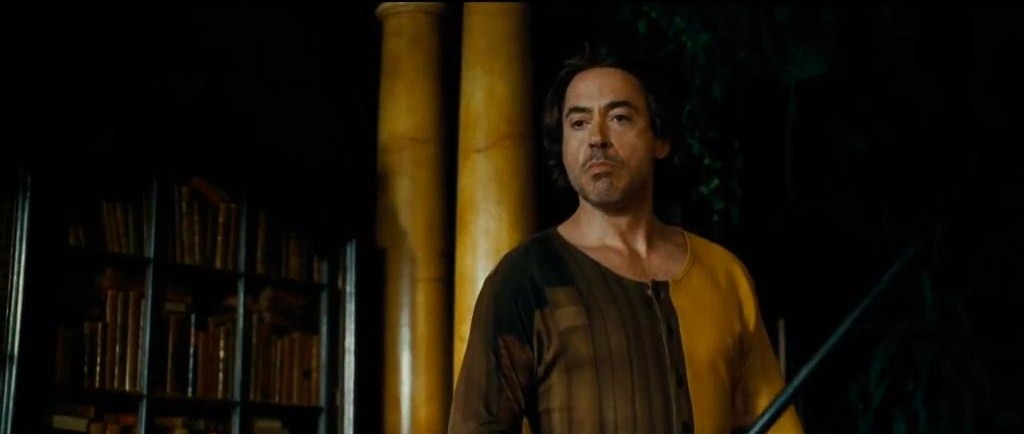
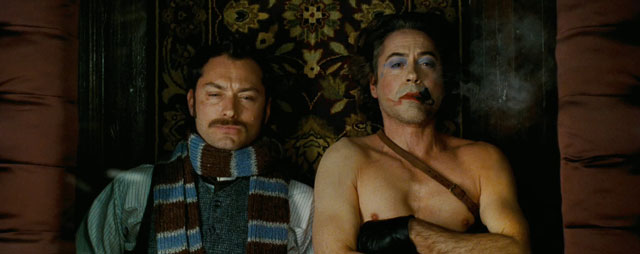
Also, although the first of Downey's adventurings could be seen as being a nicely nuanced (if scruffy) interpretation of The Great Detective, here the character is allowed to go a little more broad, dressing in comedic drag ("I admit, it's not my best disguise") and another, which is actually taken from The Pink Panther series (mind you, Steve Martin's "Pink Panther" series), the comedy is played up and not necessarily in character, and Holmes is seen to be practically infallibleeven his getting seriously hurt is all part of his plan.  

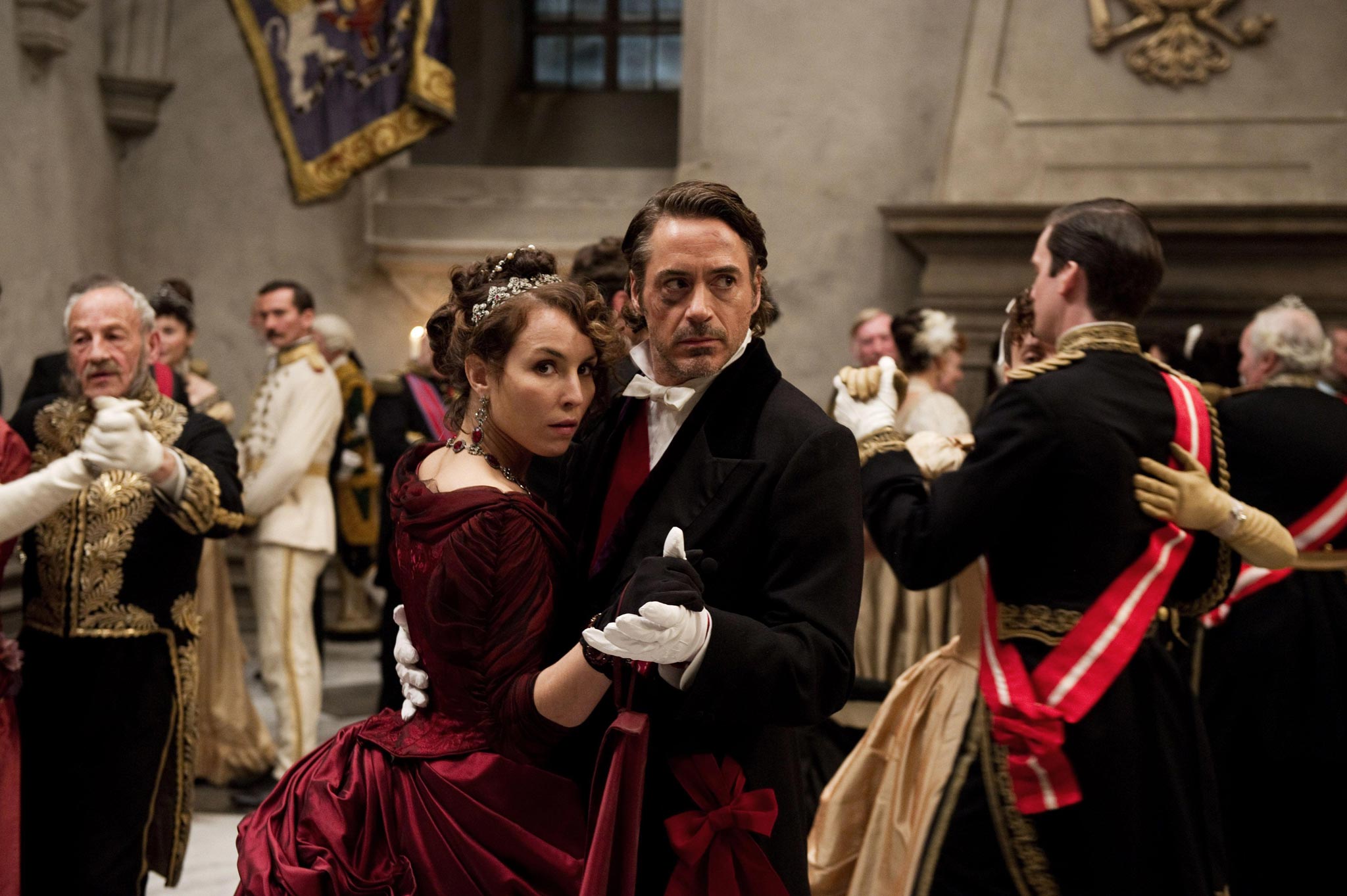
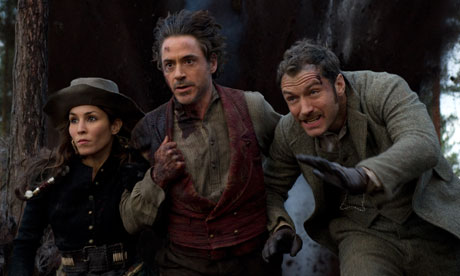
Downey, Jr. is great at playing this, even if it's a more absurd version of Holmes, and Jude Law again plays Dr. Watson (now with a severe limp and who is only now about to be married to Mary Morston, again played by Kelly Reilly) and it's one of Law's best performances, quick as Downey and capable of the slowest of "burns." Law's role is expanded somewhat and he makes the most of itThe two are joined (briefly) by Rachel McAdams, reprising her role as "the woman" Irene Adler, but is soon replaced by Noomi Rapace's gypsy princess Simsa.  Aiding and abetting is Stephen Fry, as Holmes' smarter, drier brother Mycroft (it might actually be considered type-casting), with Jared Harris as the coolest of Moriarty's (Brad Pitt was initially considered for the role), as well as being one of the youngest.

As fun as it is, one can't help but look at it as a step down—the filmmakers are getting further afield of the Holmes characterization, and it's only a matter of time before the Downey, Jr. version is locked into buffoonery and slapstick, and it comes perilously close to teetering off the edge here.  As it is, this plot is more reminiscent of the Basil Rathbone films set during WWII, entertaining if anachronistic fluff.

Sherlock Holmes: A Game of Shadows is a Matinee.


Paget's Strand Magazine illustration of the first of two Holmes-Moriarty encounters.

* Kieran is the brother of Dermot Mulroney, husband of Michele, and you may best remember him from "Seinfeld" as the fellow who gets bent out of shape at a funeral reception when he see George Costanza double-dipping a chip.

Sunday, December 18, 2011

Don't Make a Scene: Everybody De-Constructs Rick, Part III

Continuing December's look at scenes from Casablanca, particularly those where players speculate on the character and motivations of saloon owner Richard Blaine, and right to his face...

Everybody De-constructs Rick, Part 3: The Nazis

The Story: Everybody's got an opinion. For being one of the most mysterious people in Casablanca, Richard Blaine sure has a lot of people surrounding him who think they know all about him, and don't mind telling him that. No wonder he's developed that cynical aloof shell. A shell that he seldom sticks his neck out from, as he is so fond of saying. He's already had to endure listening to Renault talk about him like he knows his secret, now he's got the Nazis Renault is trying to impress with him doing the exact same thing. Must get to sound like a broken record after awhile.*

Rick is very patient with the Nazis--he plays them carefully, the arrogant Krauts. He charms them with witty responses, but occasionally the innocent eyes turn baleful and the lilt goes out of his voice. In his over-confidence, Major Strasser dismisses those moments.

He shouldn't.

Then there's Louis over there, smiling like the cat that ate the canary, singing Rick's virtues...or lack of them. Of course, Rick and Louis have made a bet whether the men sitting with him at the table will be able to capture the Czech freedom-fighter Victor Laszlo.

But in that betting game, there is a wild card, and she's on the arm of Victor Laszlo as he enters the Café in the very next scene, in the very next shot, and her presence could swing the denouement of the bet in either direction.

Place your bets.

The Set-Up: Richard Blaine (Humphrey Bogart) has just seen the fellow who's entrusted valuable letters of transit arrested by the local authorities for murder. Not only that Chief Inspector Renault (Claude Rains) seems to want to spear-head a trap for Nazi fighter Victor Laszlo (Paul Henreid) in Rick's saloon. And now, he's invited his new best pals, the Nazis, led by Major Strasser (Conrad Veidt**) over for a drink to impress them. To Rick, it's all brown-shirt-nosing, but Louis is handy to have in your corner in order to keep your business' doors open. So....

Action!


Renault: Rick? Rick, this is Major Heinrich Strasser of the Third Reich.

Strasser: How do you do, Mr. Rick?
Rick: How do you do?

Renault: You already know Herr Heinz of the Third Reich?

Strasser: Please join us, Mr. Rick.

Renault: We are very honored tonight, Rick. Major Strasser is one reason the Third Reich enjoys the reputation it has.

Strasser: You repeat "Third Reich" as though you expected there to be others.
Renault: Personally, Major, I will take what comes.
Strasser: Do you mind if I ask you a few questions?

Strasser: Unofficially, of course.
Rick: Make it official, if you like.

Strasser: What is your nationality?

Rick: I'm a drunkard.

(They all laugh)
Renault: And that makes Rick a citizen of the world.

Rick: I was born in New York City, if that'll help you any.
Strasser: I understand you came here from Paris at the time of the occupation.
Rick: There seems to be no secret about that.

Strasser: Are you one of those people who can't imagine Germans in your beloved Paris?

Rick: It's not particularly my beloved Paris...

Heinz: Can you imagine us in London?

Rick: When you get there, ask me.

Renault: Oh. Diplomatist!
Strasser: What about New York?

Rick: Well, there are certain sections of New York, Major, that I wouldn't advise you to try to invade.

Strasser: Who do you think will win the war?
Rick: I haven't the slightest idea.

Renault: Rick is completely neutral about everything...

Renault: ...and that takes in the field of women, too.

Strasser: You were not always so carefully neutral. We have a complete dossier on you. "Richard Blaine, American. Age: 37. Cannot return to his country." The reason is a little vague.

Strasser: We also know what you did in Paris, Mr. Blaine, and also why you left Paris. Don't worry, we aren't going to broadcast it.

Rick: Are my eyes really brown?

Strasser: You will forgive my curiosity, Mr. Blaine. The point is...

Strasser: ...an enemy of the Reich has come to Casablanca and we are checking up on anybody who can be of any help to us.

Rick: Well, my interest in whether Victor Laszlo stays or goes is purely a sporting one.

Strasser: In this case, you have no sympathy for the fox, huh?

Rick: Not particularly. I understand the point of view of the hound, too.

Strasser: Victor Laszlo published the foulest lies in the Prague newspaper until the very day we marched in. And even after that, he continued to print scandal sheets from a cellar.

Renault: Of course, one must admit he has great courage.
Strasser: I admit he's very clever. Three times he's slipped through our fingers. In Paris, he continued his activities. We intend to not let it happen again.

Rick: Well, excuse me, gentlemen. Your business is politics. Mine's running a saloon.
Strasser: Good evening, Mr. Blaine.

Renault: You see, Major, you have nothing to worry about Rick.
Strasser: Perhaps.


Casablanca

Words by Murray Burnett, Joan Alison, Julius J. Epstein, Philip G. Epstein, and Howard Koch and Casey Robinson.

Pictures by Arthur Edeson and Michael Curtiz.

Casablanca is available on DVD from Warner Home Video.


Next week: The fox


* I realize that may be a cliché past it's expiration date. A "record" (re'-ckerd) was the precursor of the CD (compact disc), was made of a petroleum-based vinyl, stamped into a flat disc. The sound was lathed into the vinyl, and a needle scratched those wave-etchings and converted it into sound (Some aficionados claim that this scratching produced a better sound than digital one to one conversion, but I digress). Imperfections in the vinyl would produce "pops" in the sound, and a scratch or break in the record, would cause the needle to jump the groove of the rotating record, and repeat the same 1.5 second section over and over and over and over and over...until someone removed the needle from the playing surface. Francis Ford Coppola and Walter Murch used this to great effect in "The Godfather" when Michael Corleone visits his father in the hospital only to find that the guards hired to protect him have left, and in a hurry, as he finds an abandoned Christmas party in the lounge and a record-player that keeps repeating one word: "To-niiight-To-niiight-To-niiight-To-niiight"


** Veidt was already a part of film history before he came to "Casablanca:" he starred as the somnambulist, Cesare in Wiene's "The Cabinet of Dr. Caligari," and also "The Man Who Laughs." He died six months after "Casablanca" was released.