 The Story: The scene that everyone remembers from Billy Wilder's "The Lost Weekend" is the hallucination scene in his room late in the movie with the mouse in the wall, and the attacking bat, and Miklós Rózsa's weird theremin theme that ends with Ray Milland's alcoholic writer screaming at the top of his lungs while blood runs down the walls.
Good stuff, that.
But not for here. That scene is mostly visual with...well, with NO words, and without the squeeks, the whooping and screeches, there's no way to do justice to it.
But, this scene popped out at me. In fact, when it came on, I sat upright on the couch, as we see Don Birnum change. An infusion of rye and he becomes a completely different person—gifted, articulate, fun. Before we'd only seen the watched-over Birnum, the dry Birnum, shifty, paranoid, diffident and surly. But in his element, hanging on to the lip of a glass, he's the man he wants to be...and never can be, sober.
Ray Milland's Oscar-winning performance was stiff before this, but here he's wild and over-the-top—and more than reminds one of another Billy Wilder creation five years down the cinematic road, Norma Desmond from "Sunset Boulevard"—another character drunk, but on themselves. For Norma, her memories are her scotch, and she comes alive only in their presence. In fact, it's not too much of a stretch seeing writer Don Birnum in Hollywood, ducking into Norma's driveway to avoid the cops...probably, they'd have quite the party, and things might have turned out better than they did for Joe Gillis.
The Set-Up: Aspiring writer Don Birnum (Ray Milland) has been going through "the treatment"—trying to quit drinking. This week-end, he's supposed to further his sobriety by going upstate to get out of New York and spend some time in the fresh air. But all he can think about is his next drink. His brother Wick (Phillip Terry) and his girl (Jane Wyman) are off to a show (at Don's insistence), but they'll leave for the train station at 5:45. Left to his own devices, Don has found some money that Wick left for the cleaning lady, and he's gone to the liquor store and stopped off at Nat's pub (run by Howard Da Silva) to do a little pre-functioning before his trip away.
Action!
Don drinks his drink, puts down the glass. DON (To Nat) Nat, weave me another.
NAT You'd better take it easy.
DON Don't worry about me. Just let me know when it's a quarter of six.
NAT Okay.
He pours.
DON And have one yourself, Nat.
NAT Not me, Mr. Birnam.
DON I often wonder what the barman buys, one-half so precious as the stuff he sells.
Nat has poured the drink. Don points at it. DON Come on, Nat. One little jigger of dreams.
 NAT Nope.
DON You don't approve of drinking?
NAT Not the way you drink. DON It shrinks my liver, doesn't it, Nat? It pickles my kidneys. Yes. But what does it do to my mind?
 DON It tosses the sandbags overboard so the balloon can soar. Suddenly I'm above the ordinary. I'm competent, supremely competent. I'm walking a tightrope over Niagara Falls. I'm one of the great ones.
 DON I'm Michelangelo moulding the beard of Moses. I'm Van Gogh, painting pure sunlight. I'm Horowitz playing the Emperor Concerto.
 DON I'm John Barrymore before the movies got him by the throat.
 DON I'm a holdup man -- I'm Jesse James and his two brothers, all three of them.
 DON I'm W. Shakespeare.
 DON And out there it's not Third Avenue any longer. It's the Nile. The Nile, Nat, and down it moves the barge of Cleopatra.
 DON C'mere! Listen:
 DON "Purple the sails, and so perfumed that
The winds were love-sick with them; the oars were silver,
Which to the tune of flutes kept stroke, and made
The water which they beat to follow faster,
As amorous of their strokes. For her own person,
It beggar'd all description." During the last two lines he has picked up the jigger of rye. THE CAMERA is on the wet rings which the wet glass has left on the bar. Gradually the music swells under the Shakespearean quotation and drowns it out.
 In two QUICK DISSOLVES we see the five rings, then six, then nine. Over the last, the light has changed.
"The Lost Weekend"
Words by Charles R. Jackson and Charles Brackett & Billy Wilder (and W. Shakespeare)
Pictures by John F. Seitz and Billy Wilder
"The Lost Weekend" is available on DVD from Universal Home Video.
Sunday, January 31, 2010
Don't Make a Scene: The Lost Weekend

_02.jpg)


Saturday, January 30, 2010
Battle in Seattle
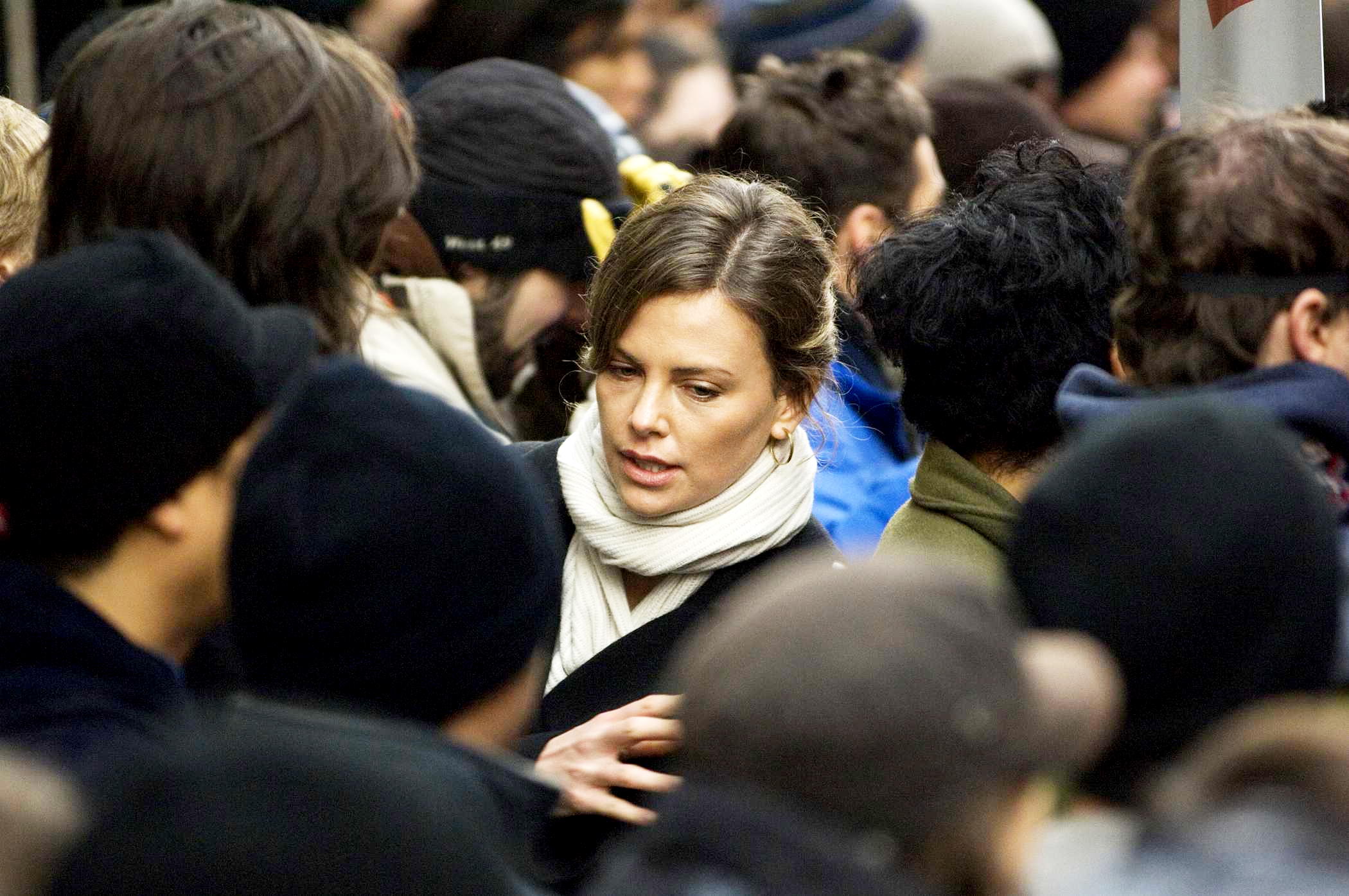
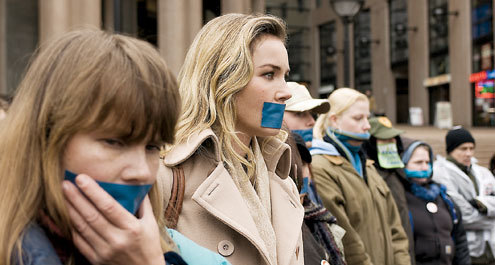
 "Battle in Seattle" (Stuart Townsend, 2007) I admit I have a bit of a chip on my shoulder regarding this movie. Written and directed by actor Stuart Townsend, the film was yet another Seattle movie that was photographed, for the most part, in Canada, specifically "Seattle" North, Vancouver British Columbia. It was post-produced in Montreal, Canada, and for authenticity, they cast a few American actors, shot a day or two in Seattle (actually!) and spent the rest of the time writing and shooting around the story. Give it credit, there is a lot of Seattle in it, but mostly from the archive footage of many news sources and folks present on the scene. In Townsend's version, Seattle looks a lot more "Caucasian" than it is, and feels entirely phony. But then, this isn't even trying to be a true telling of events, other than its advocacy. It's a disaster movie, with all the tarted up (they use that phrase in Vancouver) melodrama of an Irwin Allen picture. There's even that standard of the D-movie: "Pregnant Woman in Peril," played by the director's squeeze, Charlize Theron.
In his commentary, Townsend acknowledges he didn't know much about what went down in 1999 at the Seattle-housed WTO conference, but, like everyone else, he was grabbed by the headlines and that phrase "Battle in Seattle." Research into the WTO and the complications from its basic philosophy of "you can't have a war with someone you're economically tied with (but you can sure as hell exploit them)" led to him finding a reason to make the movie in the second place. But, ultimately, although the message is there in the graphics-laden sections, the story still boils down to police versus demonstrators and bricks versus windows. The message, like with the riots, can't be seen for all the tear-gas.
And Townsend tries to represent all sides—the demonstrators', the delegates', the mayor's, the governor's, the reporters', the merchants,' as well as that of the police—to the point where the only folks to blame are those darned anarchists (much like the surface spin of the event) for not towing the line of having an orderly demonstration, albeit one with as many different agendas as there were countries in attendance. Lip-service is given to the fact that things didn't get dicey until Madeleine Albright called to gripe to her boss, President Clinton, that she couldn't get out of her hotel room, thus throwing the fellow local Democratic administrations to get their own brown-shirts in a twist and over-react.
Townsend even shoots himself in the foot by showing delegates of the WTO with legitimate concerns having them over-shadowed and ignored by...those darned uppity protesters. By showing all sides, ultimately Townsend doesn't take sides and the movie becomes merely about the relationships of the demonstrators and the hurdles the National Guard presence threw up for all concerned. A political riot should be about more than delaying True Love, which, according to "Battle in Seattle," it does, until the movie ends in an extended group-hug.
A making-of documentary has a clutch of representatives from a few of the protest groups pay lip-service to the film, and they're all cheery about it, despite the fact that everybody got their own black eyes from the occurrence. But, then, if you want to get your message out there, there isn't such a thing as "bad" publicity; it's what happens when idealists become egotists and politics becomes show business (or is it the other way around?).
The performances are fine, although Ray Liotta is far too young to be playing someone elected mayor of Seattle—and the guy they've got playing Gary Locke sounds like the first one they found from Central Casting who fit the description "Chinese." Among the protesters, Jennifer Carpenter is merely okay as a lawyer representative for the protesters—she rocks on "Dexter"—there is a token African-American (André Benjamin from Outkast), a token Latina (Michelle Rodriguez), and a token New Zealander (Martin Henderson) and that's about it. Attempts at cast diversity is merely skin-deep. Although two of the delegates are played by Rade Serbedzija and Isaach De Bankolé, their roles are small and, like Woody Harrelson, they spend most of their time looking frustrated.
If so, I'm walking in solidarity, brothers.






Friday, January 29, 2010
It's Complicated
 "Karma is the Ultimate Bitch in this One"
or,
If You Can't Stand the Hot-Flash, Get Out of the Kitchen.
It's refreshing to see a movie about a mature couple of advanced age—mine—dealing with post break-up issues. I just wish they weren't being so immature while doing it.
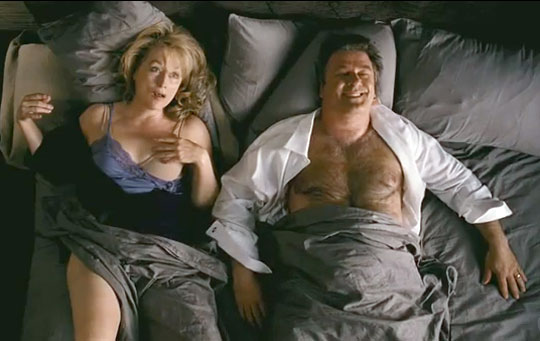
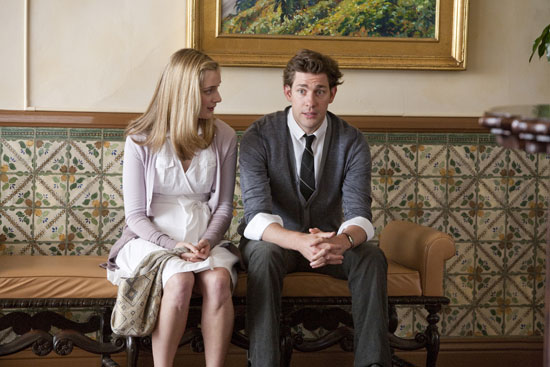
Jane Adler (Meryl Streep) is reaching a transition point in her life—approaching "empty nester" age: her oldest daughter Lauren (Caitlin Fitzgerald) is engaged to Harley (John Krasinski), middle daughter Gabby (Zoe Kazan) is moving out of the house, and youngest, Luke (Hunter Parrish) is graduating from college. Her ex-husband Jake (Alec Baldwin) is now married to young "Ms. thang" Agness (Lake Bell), with an inherited son (from her last affair), Pedro (Emjay Anthony). She has decided that she's going to expand her nest...er, house so she can have "the kitchen she's always dreamed of;" she runs a salonish bakery, and she can cook (second movie this year—"Julie & Julia" from Nora Ephron, this one from Nancy Meyers, both of whom seem to be trying to keep Streep in the kitchen).
Youngest son's graduation pulls the whole family together in New York, with Jake "flying solo" due to family illness. Once there, the two old marrieds hook up, and once Jane is tanked, there occurs a "once more for old times' sake" canoodling that leaves him satisfied and her vomiting.
Most guys would take that as a sign, but not Jake. Soon, he's spending too much time at Jane's, telling his ex-wife that his wife doesn't understand him, and while it may seem like sweet revenge for Jane, she's also creeped out by it, so much so that she won't tell the kids, and allows it to interfere with a budding romance with her architect (Steve Martin). Now, maybe I've been watching too many "Nature" shows on elephants lately, but I could have used David Attenborough to explain this mating ritual to me.
Maybe it's that Martin and Baldwin are playing the roles the other should have taken: Martin's love interest is a deferential, shell-shocked divorcee with a manner that reminded me of Charlie Ruggles, and Baldwin's in full pursed lips obnoxious priss mode (without the "30 Rock" irony) that makes his character not so much funny as alarming. And Streep, consummate pro that she is, works the material for all its worth, fluttering and kvelling and kvetching, making Jane seem two pastries shy of a brunch. There are times when there seems to be some acknowledgment of time—Jane is constantly fanning herself, as if caught in a hot-flash, but the next instant she's giggling like "Juno."
The one guy who seems to be doing something interesting is John Krasinski, as the not-yet husband who finds he's baby-sitting his future in-laws, and is the only one who seems to rise above the material to be doing something interesting—interesting and funny. As the only fully-informed character in the cast, he manages to convey the screwball nature of the situation, acting as the surrogate audience, eyes widening with each embarrassing compromise. He makes Meyers the director—with her sledge-hammer reaction shots and uneven pacing seem far more successful than she is.
"It's Complicated" is simply a Rental.





Thursday, January 28, 2010
The Palm Beach Story
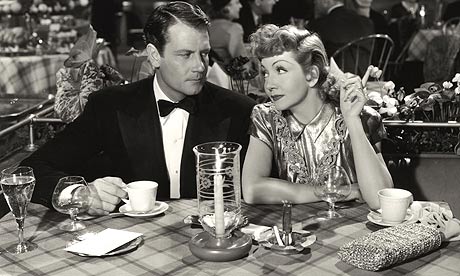
 "The Palm Beach Story" (Preston Sturges, 1942) Why did the maid scream and faint? Why is the bride trying to hail a taxi? Why did the maid scream and faint-again? Why is there a woman bound and gagged in the closet? Why are both the bride and groom late for the wedding? Why did the maid faint--again?
And that's just what happens in the credits!
Sturges is having fun with movie conventions, that is the conventions of screwball romantic comedies that involve the idle rich, the ones that George Cukor liked to direct and Katherine Hepburn liked to star in, where the couple getting married at the beginning of the movie might not be the the couple connecting at the end...or will they? Maybe they'll get back together. Don't like the answer? Wait two hours. It will probably change.
Sturges thinks (rightfully) that if such capricious creatures did hook up, their eccentric screwballishness would self-destruct their union within a matter of months, in which case this is Preston Sturges is making a sequel to "The Graduate" twenty-four years before "The Graduate." Such pairings can't work for love or money: when the money runs out the love goes out the window, and the love isn't enough to sustain a relationship under such pressures.
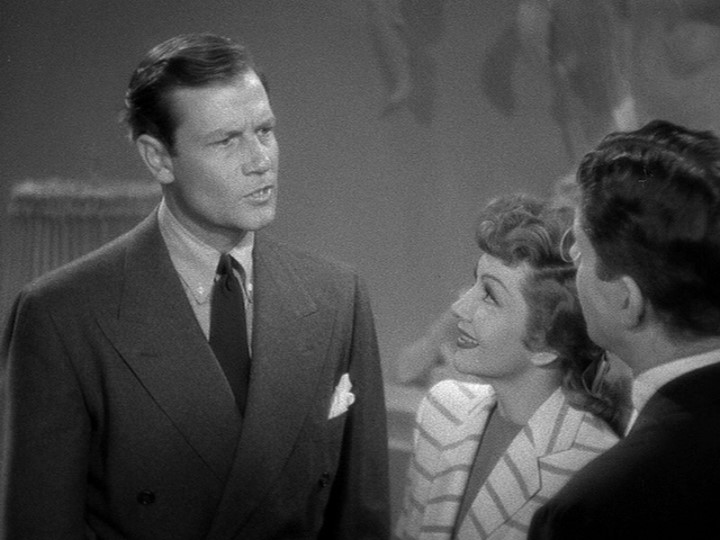
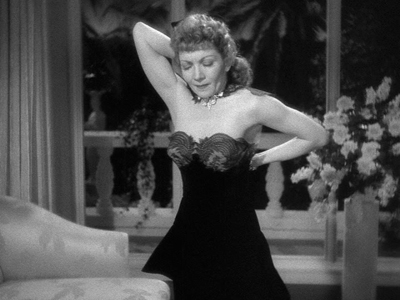
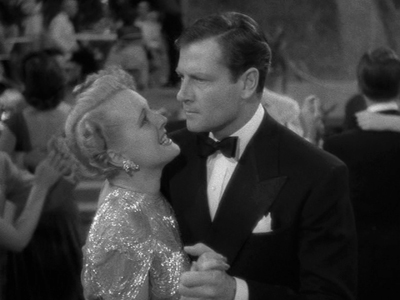
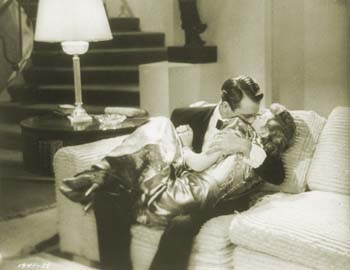
Meet Tom (Joel McCrea) and Gerry (Claudette Colbert), a cute movie couple who fight like cats and mice. We meet them in the kerfluffle that is the Opening Credits, and when next we see them five years later, they're splitting up. She's an eccentric heiress with a taste for the High Life and has this knack for attracting men—this could be the further adventures of Colbert's character in "It Happened One Night"—and he's an eccentric dreamer who can't make a nickel selling his "Big Idea" of taking those camouflage nets they build over airplane plants and reversing the idea by putting airstrips across the building tops of cities. The kids are broke, and she knows she can always attract some guy lousy with money and relieve him of trying to keep her in the style to which she is accustomed. So, because they're both so headstrong, she leaves and he pursues, all the way to Palm Beach, Florida, where the two (now posing as brother and sister) hook up with two rich-nicks in the Hackensacker clan, played by Rudy Vallée and Mary Astor. The Hackensackers are two of the oddest peas growing up in a single pod: he's bookish and wormy and has never been married, she's flighty and flirty and been married five times. Neither one seems to have a brain in their heads and are all-surface. He's careless with money; she's careless with love. They were made for Gerry and Tom.
But, this is still a screwball comedy, so complications arise, such as the married couple still being a married couple; "This is going to cost us millions," groans Gerry as they go into a clinch.
Sturges is already busting through the movie-screen to hold a fun-house mirror to those romantic comedies. But he still has one or two aces up his sleeve that manages to resolve the situation and still remain true to the "Anything Goes" spirit of them, the "Love is Anarchy" and Convention Be Damned attitude that keeps digging pot-holes into the Path of True Love. By the end, he's created a scenario as convoluted as a Shakespeare play in the classical comedy sense.
The principals are all having fun. Colbert and Astor frolic with their images and McCrea gets to perfect his slow burn. The only dirt in the gears of the fun machine is Rudy Vallée, who plays his role of dunderhead John D. Hackensacker III, as if he was playing it for real. His funny lines are brushed aside, his physical comedy made minor annoyances: one wonders exactly what Sturges saw that he would cast the 20's crooner in such a role—after having guided Henry Fonda expertly in such a role in "The Lady Eve"—and then have the man get a contract from the studio as a result of it. Vallée was a phenomenon not unlike "Pee-wee Herman"—a little goes a long way— and his fame having ebbed to be re-discovered here, he would again fade until the 1960's and "How To Succeed in Business (Without Really Trying)." One wonders where Ralph Bellamy was—he could play guilelessness without sliding into cluelessness. But then, Sturges would often hire dull actors to play the dull love interest.
He's the only fly in this ointment to film comedy conventions. Funny and absurd and a bit surreal at the beginning and end, "The Palm Beach Story" is a fine film to enjoy pre-, post-and during a love affair.


Wednesday, January 27, 2010
Defiance
 "Defiance" (Edward Zwick, 2008) 1941 and the Nazis have invaded Bellarussia,* rounding up the Jews, separating child from parent and slaughtering them, often with the help of quisling neighbors. Four brothers (Daniel Craig, Liev Schreiber, Jamie Bell, George MacKay) find their parents murdered, their home ransacked and take to the woods in survivalist mode, evading capture first, and then, discovering other families hiding in the forest, organize them. What starts as a personal quest for revenge—taking offensive action against their oppressors—turns into an experiment in existence. They start with one pistol and four bullets.
It's a good start.
Conducting raids on local Nazi strongholds and supporters, they're able to confiscate food, weapons, and medicine, as a steady stream of survivors join their ranks and task their supplies, but the brothers manage the skills of the refugees to create make-shift shelters, even a hospital, in the Naliboki Forest, all of
which must be adandoned when word of imminent attack reaches them. A practical commune with no regard for class in the "outside" world, both men and women are trained as fighters, schools created to share knowledge among the partisans, all things being equal.
Like many stories of wartime before it, it is a case of losing your family in order to find another, and the Bielski boys, who not only lose their parents, but also wives and children in the genocide, find themselves patriarchs, protectors and governors. Along the way, they split over how best to carry out their survival—as assassins or as a shred of civilization in the wild—but ultimately see it as a situation where the only absolute is survival, by any means necessary, defying the Nazis hunting them, while rejecting the tactics of their oppressors.


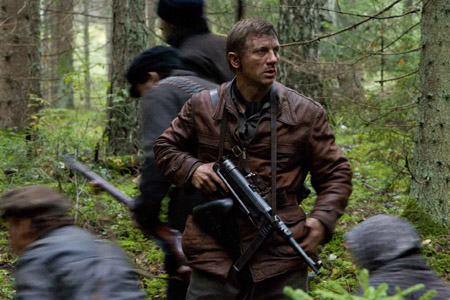


More than 1200 of the Bielski Otriad walked out of the forest, after the war. True story.
Craig, as oldest brother Tuvia Bielski, with more of a war-face than the one he wears as James Bond, does a fine job of etching a performance from withholding emotion. He's matched by Schrieber, as his more volatile brother, and director Zwick, whose record as a director is spotty (but broaches subjects others are loathe to touch—watch "Special Bulletin" or his pre-9/11 "The Siege" sometime) makes one of those interesting movies that challenges the viewer and makes subtle points, and still works as an entertainment that keeps you wondering what will happen next. But more than the explosions and the fire-fights, it's a movie of how a small band of refugees attempted an experiment in civilization, when the rest of the world—even the United States—had seemed to abandon it.


After the war, Tuvia Bielski moved to Israel, then moved to the United States where he lived the rest of his life.
1981 portrait of Lilka and Tuvia Bielski flanking their children
* For you sticklers, it became Belarus in 1991.
Tuesday, January 26, 2010
Crazy Heart
 "Breaking Bad" (I Used to Be Somebody, Now I'm Somebody Else)
At the end of each filmic year, theaters are filled to their google-plexes with all sorts of movies. Because of the Holidays, there's plenty of people wandering around major areas of assembly with the occasional two hours to kill, so Christmas is as profitable a time to the studios as Summer. Every conglomerate pushes and shoves to squeeze in one more blockbusting crowd-pleaser to blacken the year-end red ink.
Then there are the films that have been positioned to impress the critics' societies and are launched into Los Angeles and New York, so they can be eligible for awards, most pointedly The Oscars. And in that sub-category, there are the waifs—the ones that open in those markets and take a little longer to reach Biloxi, because, frankly, the studios would rather launch heavier weights during the Holiday Crunch, then release the films they feel will have only a niche market, that might have a respectable run in the projection booth, before reaching a more sizable audience in the rental market. The reason they're there is for the Awards, and usually for an acting honor to someone who does consummately good work, but has never played a "disease" role, or worn heavy make-up to win.
I'm talking about films like, recently, "Venus" with Peter O'Toole, "Being Julia" with Annette Bening, even last year's "The Wrestler" with Mickey Rourke. Earnest films with Oscar "buzz" for their stars, the kind that were mocked by Christopher Guest's "For Your Consideration."
This year's it's "Crazy Heart."
The story of an alcoholic country singer-songwriter, on a Southwest tour of what they call (in the biz) "toilets," merely reflects the downward spiral "Bad" Blake (Jeff Bridges) has put himself into. Perpetually boozed up, touring in the same old station wagon (old "Bessie") he used in the early days when he was more successful, his life is comprised of using things up and tossing them away—cigarettes, bottles of booze, ex-wives (five of them, maybe four, he can't seem to remember), he still has the talent—his reporter-inquisitor, a single mother (Maggie Gyllenhaal) from a Santa Fe newspaper that he begins a relationship with, says he can still toss off a song instantaneously that most people would struggle years to write—hasn't completely left him. But, that may be the last thing to go. He hasn't written a new song in years—the writing skills are there, but the inspiration has long ago moved on. It's one more thing taken for granted in a career that brought easy success that couldn't be maintained in the living of it.
The fur-bellied snark in me would say I'd been to this rodeo before in a fine film two decades back called "Tender Mercies," which spotlighted Robert Duvall (and in a mirror reflection, he has a small role in, and executive produced, this feature), and had more of a spiritual nature to it. There's no God in "Crazy Heart" (scripted and directed low key by Scott Cooper), as reality and responsibility is tough enough to fathom for Bad.
But it's a good movie for Jeff Bridges, who is always so good—his small part in "The Men Who Stare at Goats" was a comedic and dramatic gem, he being the only actor in it to quietly evoke deep sympathy, let alone belief—that he's always in danger of being taken for granted in the periphery of other folks' vehicles. This time, though, the spot-light's on him, and he's buttressed by a solid cast of actors lending their own mega-wattage to the brightness surrounding him. That includes Colin Farrell, buried deep in the credits to not attract attention, in a terrific performance that reflects kindly on his "mentor." Another nice thing is that T Bone Burnett and the late Stephen Bruton have composed clever, old-style country songs in the keys of both Farrell and Bridges, so they never seem less than authentic on-stage.
That extends to the story, too, which resists the epiphany lesser hands might have constructed. But like an old country song, the emphasis is on transitioning, rather than succeeding, maintaining rather than overcoming, in being rather than having dreams come true. Sometimes the triumph is in recognizing what one's taken for granted for so long.
Hope he gets that Oscar.*
"Crazy Heart" is a Rental.


* I say that with some caution because I know the "entertainment press" won't be able to resist saying that Bridges won for a "Bad" or "Crazy" performance.
Sunday, January 24, 2010
Don't Make a Scene: The Searchers
 The Story: You start with one story and you end up with another, such is the complexity of the films of John Ford. For this scene, from Ford's landmark "The Searchers," I wanted to show the chilling "They ain't white" scene that ends with a rare Ford move—a camera truck. And I'll end up telling another story about John Ford. About his incredible frugality in film-making.
Before zoom lenses became the norm, presenting a transfiguring moment required the entire camera set-up to be pushed towards the subject, an intricate move that required tracks, and since the subject is still, rather than in motion, the move must be fairly smooth with no jarring bumps of the camera. Ford, although he loved the moving camera in great vistas, used this device sparingly. He did it in one other instance in this film, to reflect elder niece Lucy's sudden realization and panic that her family was about to come under Comanche attack.
More famously, he used it to highlight a young star named John Wayne.
Away back in 1938, Ford shot the first sight of Wayne's "Ringo Kid" in "Stagecoach" with such a truck shot—one done on the stage rather than in Monument Valley, where the rest of the footage of the sequence was shot. That move simulates a stagecoach braking to a stop in front of Ringo, but it is also a shot to make you notice the man, helped by John Wayne's added fluorish—a rifle flip.
For the truck into "The Searchers," the purpose is different. We've seen many sides of Wayne's character Ethan Edwards during the film, mostly just that side of surly. But, for this particular scene, this track shot is important. Edwards is a bitter hate-filled racist, determined to kill every Comanche warrior in his path in his quest to find his niece Debbie. But confronted with white survivors, that push-in shows an altering of intent...and fear. Naked fear. For if what he is beholding is what Debbie has become, Ethan is bent on killing her, which means killing the last remnant of the woman he once loved—his sister-in-law, his brother's wife. It is meant to mirror the earlier shot of his other neice's panic at her first realization of a pending attack.
The shot into Wayne's face is bone-chilling, and as Wayne was possessed of one of those magical faces that communicated every emotion to the camera, he didn't have to do much to carry it. It's a precise head-turn that managed to keep his eyes just under his shadowing hat-brim, and once he's registered the emotion, he tilts the head just so, shadowing his eyes as he looks at Keefer, before entering the room to identify the dead.
Now, I try to go to the source for the scripts and have, in the past, done some on-line correction of the continuity shifts between script and on-screen changes. But here, the differences are too vast. And telling. I've included the original script that Ford was going to shoot—he always worked closely with his script-writers—after the presentation of the scene as it appears in the film. I've taken key passages from that earlier script to illustrate some of those scenes.
The core of it is the same. The herding of First People—refugees from a raid, actually—to cavalry camp for confinement. Then, Ethan and Martin entering to see if there were any white women recovered in the raid about Debbie's age. The scene in the chapel with the mad women. "It's hard to believe they're white."
But Ford and screen-writer Nugent planned a lot more—a whole scene with a Custer-like colonel (Custer isn't mentioned but heavily alluded to in Nugent's precise notes), feathering his nest to the Press about the raid. Then Edwards comes in and derides him and the Union Army for killing women, much to the colonel's consternation.
But that scene's not in the movie, and in fact appears not to have been filmed. Ford cut it, whether for budgetary reasons (they were nearing the end of the shoot, just doing the studio interiors), or because the extended conversation tended to slow things down when the search should be speeding up, I haven't been able to verify. The next sequence in New Mexico was also going to contain a lengthy conversation, and so Ford probably just ripped it out of the script as he was wont to do—he loved to do it sadistically in front of producers badgering him to hurry up! Leaving it in might have cast Ethan in a better light comparatively, by badgering the colonel for his cowardice killing women. It almost feels like Ethan is sticking up for the dead Comanches, and that would be a counter-productive aspect of his character that might weaken the suspense to the ending.
Whatever the reasons for doing so (and combining them stregthens the case for removal), Ford boiled it down to the essentials—looking for white women, the chapel, the screaming, "they ain't white" and that devastating move to close-up. That's all he needed to do before moving on to New Mexico. John Ford was an intricately fastidious director, who could achieve the maximum effect with economical pruning of dialogue and the use of action as character. Ford preferred to show you, rather than tell you. That defines a great visual story-teller.
And a master film maker.
The Set-Up: Former Confederate soldier Ethan Edwards (John Wayne) and his part Cherokee nephew-by-marriage Martin Pauley (Jeffrey Hunter) are years into tracking down the last surviving member of their shared family—Debbie (Lana, and then Natalie Wood), taken during a bloody Commanche raid. Years ago, they had the same mission—find Debbie. But now, with the passing of years, Debbie is "of an age," in Edwards' turn of phrase, to be made a squaw. Martin is still desperate to find Debbie and bring her home. To the Indian-hating Edwards, he will track her down...and kill her.
Action!
EXT. SNOW COUNTRY - WIDE ANGLE - THE CAVALRY AND PRISONERS - DAY
A long line stretching across the landscape -- women falling and being prodded along by their captors. From behind CAMERA ride Ethan and Martin and move to intercept the column.


 SOLDIERS: Come on, move along! Come on!


EXT. THE NOKONI AGENCY - WIDE ANGLE - DAY
The column of cavalry and prisoners enters the agency (COLORADO FOOTAGE). We see the dead and wounded on travois; the agency Indians watching stoically; the prisoners -- some of them -- being herded into a chapel. KEEFER: Yes?
EDWARDS: We're looking for a girl. A white girl. A captive.
Should be about fourteen now.
KEEFER: Fourteen? We have two about that age. -All the white women are in the chapel.
 KEEFER: What's this girl to you?
MARTIN: She's my sis-
EDWARDS(interrupting, cutting him off): She's my niece.
KEEFER: One moment.

INT. THE CHAPEL - MED. CLOSE SHOT - ANGLING TO DOOR - AFTERNOON
The door is opened by a guard and Ethan takes a step into the room -- then stops in manifest shock. Martin is at his heels, eager and expectant. Beyond them stands Keefer, grave and compassionate. There is a keening sound in the room -- almost an animal sound.
INT. THE CHAPEL - REVERSE SHOT - FULL
It is a simple log-sided room with plank benches without backs. Up front is a small box-like pulpit, no altar.
Across the front of the room, set up either on benches or on boards over saw-horses are four blanket-covered figures -- at least two being the bodies of children.
Squatting on the floor near them is an elderly white woman with hair hanging loosely down her back and clad in Indian robes. Standing, facing the newcomers, is a woman who may be no more than in her mid-thirties.
She is mad -- wild-eyed, frightened, with matted, unbrushed golden hair, torn garments. It is she who has been making the keening sound, the animal moans. Now she crouches at the sight of them and looks desperately for a means of escape. Two girls are asleep, heads together and backs to the door. One has light hair, like Debbie's; the other brown hair. The afternoon sun coming through a high window touches the light hair. KEEFER: White women?
OFFICER: Yes, sir.

Now the madwoman begins her screaming, running from side to side like a trapped animal. Ethan follows Martin into the room, Keefer behind him. Martin comes to a stop, realizing the woman is afraid of him. The two sleeping girls stir, but do not turn.


 MARTIN: Debbie?
OFFICER: Will you stand up? Stand up, please.
 MARTIN: Debbie?
He fishes the rag doll from under his coat and holds it out to the girl. She looks at it... and we may almost suspect it is rekindling a memory.


Martin relaxes... and in that instant the madwoman has the doll in her hands. She cradles it and she croons.
Martin reaches to take it away. But she calmly sits, cradling the doll, and rocks to and fro, humming a lullaby. He can't take it. Ethan returns. KEEFER: It's hard to believe they're white.
 EDWARDS: They ain't white!
 EDWARDS: Not any more. They're Comanch'!
 EDWARDS: Where are your casualties?


"The Searchers"
Words by Frank S. Nugent
Pictures by Winton C. Hoch and John Ford
"The Searchers" is available on DVD from Warners Home Video.
DISSOLVE TO:
EXT. SNOW COUNTRY - WIDE ANGLE - THE CAVALRY AND PRISONERS -
DAY
A long line stretching across the landscape -- women falling
and being prodded along by their captors. From behind CAMERA
ride Ethan and Martin and move to intercept the column.
EXT. THE COLUMN - FULL SHOT - DAY
as Ethan and Martin come closer and look at the shawled
prisoners stumbling along.
EXT. OPEN COUNTRY - FULL SHOT - ETHAN AND MARTIN - DAY
as a young OFFICER spurs out of the column and rides toward
them.
OFFICER (inquiringly) Yes?
ETHAN We're looking for a girl -- a white girl...
MARTIN She'd be about thirteen now...
OFFICER We got two around that age...
MARTIN (eagerly) Where?
OFFICER You'll have to wait until we reach the agency... Fall in behind the column...
MARTIN (protestingly) But couldn't you...?
OFFICER Sorry... (shouting it) Keep the column moving!... Close
ranks there!
The officer spurs out to rejoin the column. Martin looks at
Ethan, his face alive with hope. But Ethan is just looking
stonily along the line of passing prisoners.
WIPE TO:
EXT. THE NOKONI AGENCY - WIDE ANGLE - DAY
The column of cavalry and prisoners enters the agency (COLORADO FOOTAGE). We see the dead and wounded on travois; the agency Indians watching stoically; the prisoners -- some of them -- being herded into a chapel.
INT. OFFICE OF NOKONI AGENCY - FULL SHOT - DAY
The office has been set up as a temporary army headquarters. The GENERAL is being interviewed by two Eastern newspaper CORRESPONDENTS. At a table beyond is a telegrapher, sending out a report of the victory.
A pot-bellied stove supplies heat and the General is warming his hands at it, intermittently. An adjutant is rather wearily filling out a long official form.
The General, for all his mudded boots remains a beau sabreur and is loosely modeled upon a certain other well-known glory hunter of the Indian wars. He wears a colonel's straps, but insists upon his brevet rank.
GENERAL And it was clear to me the hostiles outnumbered us four to one... with all the advantage of terrain...
CORRESPONDENT Four to one! What did you do, general?
Ethan and Martin enter, stand in the doorway.
GENERAL (impressively) Sir -- we charged!... Gentlemen -- and I hope you will quote me -- I cannot say too much for the courage
of the men who followed me into that Cheyenne camp...
ETHAN (blurting it) Cheyenne! What Cheyenne?
GENERAL (turning and staring) I beg your pardon?
ETHAN That camp you hit was Nawyecka Comanche... Chief Scar's bunch...
CORRESPONDENT (fascinated) Scar? What a wonderful name!...
GENERAL (to his aide) Are you getting this, Keefer?
CORRESPONDENT (to Ethan) How do you spell that word -- Nawyecka?
Ethan ignores him, still facing the General.
ETHAN My name's Edwards... I'm looking for my niece... she was in that camp when you attacked...
GENERAL (uncertain) Well... I know there were some captives recovered...
MARTIN (bitterly) Four of 'em dead... so we were told...
GENERAL (uncomfortably) Unfortunately, the hostiles murdered them as we developed the village...
ETHAN Are you sure they didn't die of carbine shots fired by a bunch o' Yank bluebellies so scared they couldn't tell the difference between a Cheyenne and a Comanche?
GENERAL Keefer!... Put this man under arrest!
ETHAN That'll be the day... (scornfully) 'As we developed the village'... Next time you develop a village, hit it where the fightin' men are... You won't get any headlines for killin' squaws.
Keefer coughs.
KEEFER Shall I show him the captives, sir?
GENERAL Just get him out of here!
KEEFER Yes sir... (he crosses to Ethan) This way...
INT. THE CHAPEL - MED. CLOSE SHOT - ANGLING TO DOOR - AFTERNOON
The door is opened by a guard and Ethan takes a step into the room -- then stops in manifest shock. Martin is at his heels, eager and expectant. Beyond them stands Keefer, grave and compassionate. There is a keening sound in the room -- almost an animal sound.
INT. THE CHAPEL - REVERSE SHOT - FULL
It is a simple log-sided room with plank benches without backs. Up front is a small box-like pulpit, no altar.
Across the front of the room, set up either on benches or on boards over saw-horses are four blanket-covered figures -- at least two being the bodies of children.
Squatting on the floor near them is an elderly white woman with hair hanging loosely down her back and clad in Indian robes. Standing, facing the newcomers, is a woman who may be no more than in her mid-thirties.
She is mad -- wild-eyed, frightened, with matted, unbrushed golden hair, torn garments. It is she who has been making the keening sound, the animal moans. Now she crouches at the sight of them and looks desperately for a means of escape. Two girls are asleep, heads together and backs to the door. One has light hair, like Debbie's; the other brown hair. The afternoon sun coming through a high window touches the light hair.
MARTIN Debbie?... DEBBIE?
He has seen the light hair and starts crossing the room.
Now the madwoman begins her screaming, running from side to side like a trapped animal. Ethan follows Martin into the room, Keefer behind him. Martin comes to a stop, realizing the woman is afraid of him. The two sleeping girls stir, but do not turn.
MARTIN Don't be scared, ma'am...
The madwoman crouches behind one of the benches, looking at them with frightened eyes.
KEEFER Just don't pay any attention to her...
Martin swallows and nods and crosses to the light-haired girl. He reaches a hand gingerly to touch her shoulder.
MARTIN (softly) Debbie?
At the touch, the girl is on her feet, crouching -- one hand, like a claw, drawn back to rake his face. She is unmistakably a white girl, but she is painted like a Comanche woman --her ears red inside, streaks of paint accenting the savagery of her face. Her eyes are frightened, yet full of hate.
GIRL Pabo-taibo! (White man!)
The other girl has risen almost in the same instant -- but more out of fear. She is younger, but painted like the other. She moves to stand behind the savage one.
MARTIN (slowly) No... She's not...
ETHAN I ain't sure... Where's that doll?
Martin stares at him, then realizes what he has in mind.
He fishes the rag doll from under his coat and holds it out to the girl. She looks at it... and we may almost suspect it is rekindling a memory -- but then she spits at it. The other girl laughs. Martin turns away and he's sick.
KEEFER Was your niece about their age?
ETHAN Not far from it...
KEEFER Hard to realize they're white, isn't it...
ETHAN (grimly) They're not white any more -- they're Comanche!... Let's see the bodies...
Martin nerves himself for the ordeal, turns to follow.
ETHAN I don't need you...
Ethan and Keefer move away. As they do, the madwoman -- eyes fixed on the rag doll in Martin's hand -- begins creeping up behind him. Martin is torturedly watching Ethan and Keefer as first one blanket then another is raised -- we will never see the dead. During this:
KEEFER (the dispassionate pro) I'd like you to see them all... It
might help us identify them... Shot in the head -- flash-burn range... The boy got his skull cracked... Here's the girl...
Martin stiffens, waiting.
ETHAN No...
Martin relaxes... and in that instant the madwoman has the doll in her hands. She cradles it and she croons.
Martin reaches to take it away. But she calmly sits, cradling the doll, and rocks to and fro, humming a lullaby. He can't take it. Ethan returns.
ETHAN Well, we only got the one lead -- Scar... And where we begin to look, I don't know...
KEEFER There's one thing. We recovered a bushel of trinkets in that camp... cheap stuff... trade goods... Couldn't help noticing that most of it was Mexican... Maybe if you could talk to some of those Mexican traders along the border... What do they call themselves?
ETHAN Comancheros...
KEEFER That's the breed... Course it might take time.
ETHAN Time's running out... But I'm obliged to you.
They leave.
CUT TO: