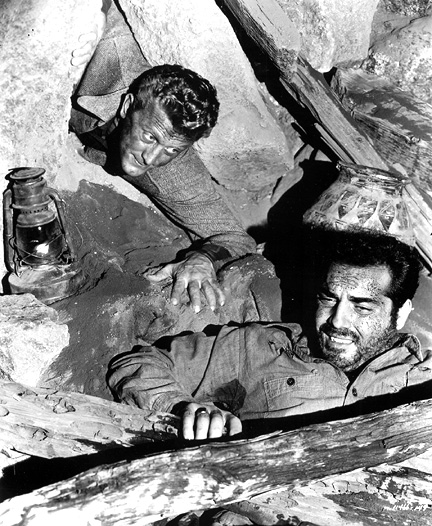
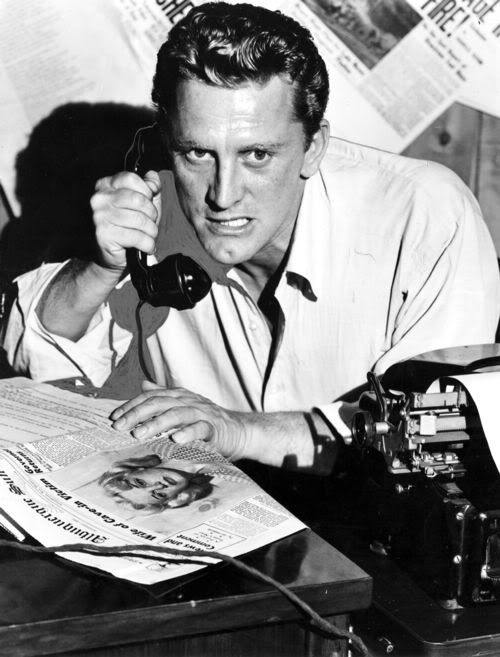
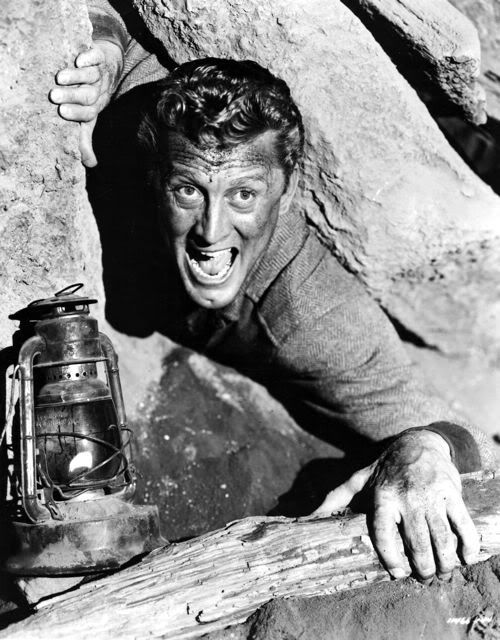
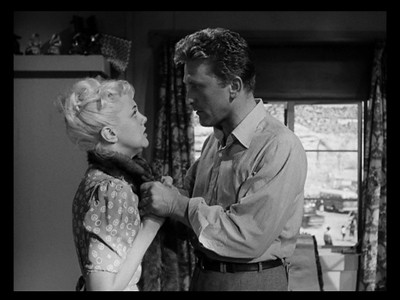
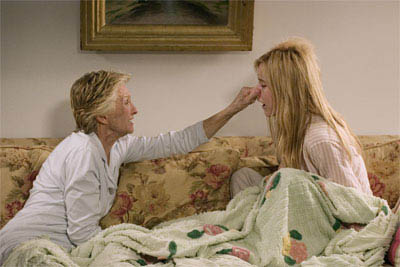
"Ace in the Hole" (Billy Wilder, 1951) Probably more familiar under its name-change-in-desperation "The Big Carnival" (which sounds happier and more fun–which it isn't) "Ace in the Hole" is Billy Wilder's most acid-tongued movie to date (and considering it was coming off the heels of "Sunset Boulevard," that's saying something).
Charles Tatum (Kirk Douglas) rides into Albuquerque, New Mexico literally on the hook, and convinces the small-town newspaper to hire him. But after a year, Tatum feels trapped and is desperate for the Big Story that will get him back into The City Beat again. He stumbles onto a minor cave-in that has trapped Leo Minosa who was caught while looking for indian arrow-heads. Not a big deal to get him out, but it will take some work. But, as Tatum was on his way to cover a rattle-snake festival, the incident gives him a whiff of a potentially Big Story.
He should have stayed with the other rattle-snakes. 
Working with the corrupt sheriff and the bored-out-of-her-skull wife, Tatum prolongs the rescue, turning it into a major (and unnecessary) drilling operation that will keep the story alive for days. The reporter keeps his fingers on all aspects including access to other news-services, and pretty soon he's the Only Game in Town. No one associated with the rescue does anything without his say-so, lest they risk the promises Tatum's made.
Then the curious start showing up. Then the hopeful. Then the carnivorous. The Story becomes a vigil, and where there are crowds of people, comes the salesmen, and the site becomes "The Big Carnival" of Paramount's cheery alias. Meanwhile, Leo is getting weaker and the pounding of the drills is slowly driving him crazy.
The screenplay, by Wilder, Lesser Samuels and Walter Newman, has its ink mixed with venom (the most quoted line is from Minosa's wife (Jan Sterling): "I don't go to church. Kneeling bags my nylons."), but it's no worse than the cynical lines from Wilder's previous film, "Sunset Boulevard." The difference is Wilder's not looking at the easyily-satirized egotism of Hollywood, he's looking at us, and the American capacity to make a buck while wallowing in tragedy. "Ace in the Hole" is before its time, before the mawkishness and the trivial pursuit of the 24 hour news cycle made the trend easier to spot.
And there's one other thing: "Sunset Boulevard's" dispassionate cynic was William Holden, "the golden boy," whose snide wise-cracks passed for intelligence. Here, he's Kirk Douglas, who is a more energetic performer, and so that constant cynicism is seen as more of a constant attack that just seems mean-spirited. And where Holden's self-loathing seemed somehow relaxed and noble, Douglas's is never less than actively self-destructive. It's a smarter, more satisfying performance that doesn't try to be likeable, or a wolf in sheep's clothing, but audiences found it repellant (as well they should!). They didn't want their movie-heroes (or anti-heroes) to be too unlikable. So, even though there is no redemption for this character, and no happy ending in sight, the crowds stayed home from "The Big Carnival."
That doesn't stop it from being the classic that it is, of Billy Wilder (who famously said "You're only as good as your best movie") in his prime.
Saturday, February 28, 2009
Ace in the Hole
Friday, February 27, 2009
Olde Review: All About Eve
This was part of a series of reviews of the ASUW Film series back in the '70's. Except for some punctuation, I haven't changed anything from the way it was presented, giving the snarky, clueless kid I was back in the '70's a break. Any stray thoughts and updates I've included with the inevitable asterisked post-scripts.
This is a companion piece to "Sunset Boulevard."
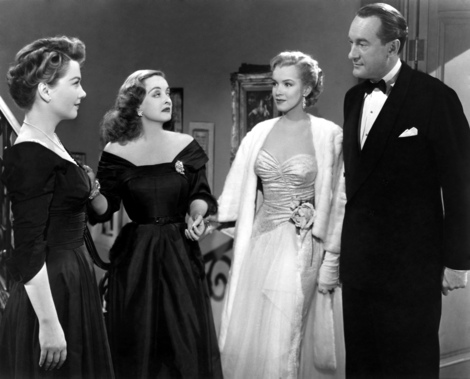
"All About Eve" (Joseph L. Mankiewicz 1950) "All About Eve" is
not unlike "Sunset Boulevard." It deals with the lust for glamour in show business—in this case, the theater in New York, not the neighborhoods of studios in Hollywood. It, too, was made in 1950, its female characters, for the most part, actresses, are...uh, abnormal. And it, too, is biting, but places its knives-in-the-back in a ci-vi-lized manner, and twists it...delicately...not with Wilder's carving techniques.
What we have is Bette Davis as Margot Channing, a spoiled child-actress, now on the shady side of 40, but still playing ingenue roles. What we have is Anne Baxter as Eve Harrington, a young ingenue who gazes adoringly at her idol, Margo Channing. What we have is Addison DeWitt (played by George Sanders as drily as a total-vermouth martini), the chief stiletto of the critical press, but you've also got Gary Merrill, Celeste Holm, Thelma Ritter, (and, in a very brief role, Marilyn Monroe) in a highly literate script which gives almost everyone some role they can sink, or cut, their acting teeth on, in a story that has "everything but the blood-hounds snapping at their rear end" (and, in a way, that happens, too.)
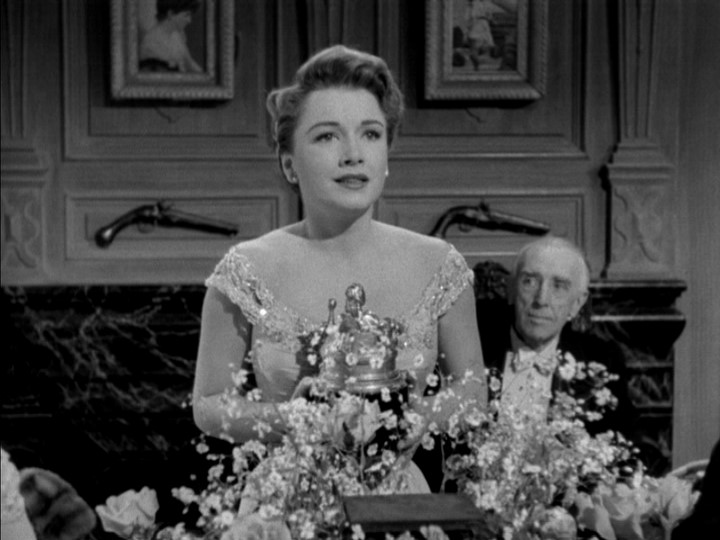
You see, we meet all these people as Eve is receiving the Sarah Siddon Award for Best Stage Performance of the Year. A joyous occasion for everyone, right? The very young actress gets a big break—everyone's happy, right?
No, the principal characters are either looking embarrassed, wonderingly perplexed, mad, or just cold to the event. It's flashback time to see why such a double-reaction to the prestigious theater event. And in a "Citizen Kane-switch," one flashback is narrated in turn by several people. And we are through this told "All About Eve"...but also Margo, Addison, everybody. Everybody's soul is laid bare through the dialogue and the quirks and pops of the performances of the cast. It's a thoroughly entertaining two and a half hours, and its light cynicism will take of the staleness of "Sunset Boulevard" out of your mouth. It will do that, but will hardly make hopeful young starlets complacent.
Broadcast on KCMU-FM on February 3-4th, 1976
I still love this movie and I find it invaluable as a source for great lines. Go ahead. Go to the IMDB listing for "All About Eve" (all you have to do is click on the name at the head of the review*) and go to "Memorable Quotes." There's at least a couple pages of them. All smart, literate and bitchy. I used one in January 2009, as a sub-head for the blog-title (Addison DeWitt's non-self-deprecating "While you're waiting you can read my column. It'll make the minutes fly like hours." Only he could say that about himself--everybody else would be cut down for a remark like that, sort of like only Nixon being able to go to China.) Another favorite of mine is in this olde review: "Wow. Everything but the blood-hounds snappin' at her rear-end" as expressed by the inimitable Thelma Ritter. There's one involving Marilyn Monroe's hungry starlet, Miss Casswell, as she enters a theater-party. She scans the room looking at the producers: "Why do they all look like unhappy rabbits?" DeWitt leans in and confides: "...because they are." Smart. Literate. Bitchy.
And curiously old-fashioned. One doesn't get too far in that list before it comes to the Margo Channing monologue about the value of her life—a speech that always made me uncomfortable: "Funny business, a woman's career - the things you drop on your way up the ladder so you can move faster. You forget you'll need them again when you get back to being a woman. That's one career all females have in common, whether we like it or not: being a woman. Sooner or later, we've got to work at it, no matter how many other careers we've had or wanted. And in the last analysis, nothing's any good unless you can look up just before dinner or turn around in bed, and there he is. Without that, you're not a woman. You're something with a French provincial office or a book full of clippings, but you're not a woman. Slow curtain, the end."
Oh, really! Pretty prosaic for a smart script. Even though this was written in the late 1940's, it still rankles a bit unless you're, say, Anita Bryant. There's also the way Addison DeWitt and Eve Harrington come across as asexual monsters for whom career is everything and a "normal" lifestyle is to be shunned and mocked.** Being a careerist is a bad thing in "All About Eve." Chasing after love, whether you're good at it or not is the holiest of holies. As I said, this was written in the 40's. One of my favorite quotes from 2008 is Richard Dreyfuss' one about being directed by Oliver Stone in "W.": "You can be a liberal and still be a fascist." Just as you can be smart, literate, and bitchy, and still come across like a schoolma'rm.
"All About Eve" was one of the first films to be made part of The National Film Registry.
It has a "100% Rating" on the Rotten Tomatoes site. Can't do better than that.
* That would be the start. It's an old habit of mine to think interms of "reels." The "head" is the start, and the "tail" is the finish, or the part that tucked into the reel's hub.
** The wikipedia article on "All About Eve" suggests that Addison and Eve are gay, thus making their aberrant behavior a result of their sexuality. "Okay, but whatever you do, don't tell Chuck."
Thursday, February 26, 2009
Copying Beethoven
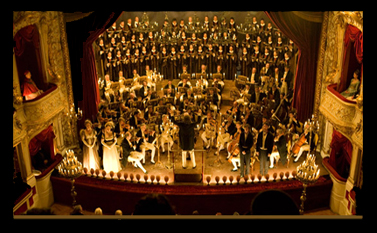
"Copying Beethoven" (Agnieszka Holland, 2006) The story's pure hokum–there was no young female copyist to help Beethoven complete the parts for his Ninth Symphony in time for its premiere. Nor did she help him conduct it–Michael Umlauf, the theater's musical director helped the deaf composer keep the rhythm, in full sight of the audience, and not in hiding as this film would have you believe it.
But if one can get beyond the subterfuge (and it's the biggest crock of classical fiction since "Amadeus"), one can find a few things to recommend it. Diane Kruger, as copyist Anna Holtz, takes on "The Beast," and the herculean task of finishing the manuscript. The presentation of the music is all-important—as it should be—and Holland excells at the staging of that premiere for both Holtz and Beethoven becoming enraptured with the bond they share of his music. And Holland made a brilliant choice of picking Ed Harris to play Beethoven. Harris is an actor who likes to walk the edge and his Beethoven is a crazed, passionate misanthrope, always talking uncomfortably loud (due to his deafness) no matter the subject matter, but utterly un-ironic in speaking of his gift for the music that God sends into his head. The movie is worth seeing merely for his charged performance.
One thing that Holland does (and she mentions it in the commentary track as inspired) is to take the end of the film and start it with that—an unconventional approach that can lend suspense to a movie with a fore-gone conclusion. But here, there is no suspense: the sequence of Anna going to Beethoven's death-bed to tell him that she finally understands his last composition is all pictures and stray music and no explanation. Beethoven's goal was to communicate the natural sounds of the world in a musical presentation (that approaches jazz in its form!) and Holland juxtaposes her journey with images of the country-side with Beethoven's strange music accompanying it, communicating that Holtz "gets" it. It's disorienting, obtuse, and a terrible way to introduce an audience into the piece, robbing the film-goer of a proper beginning and a satisfying end.
Even Beethoven knew enough not to put the coda at the beginning.
Still, one can be thankful that the makers were wise enough not to make this a love story, ala "Immortal Beloved," and saved the mutual passion for the high fidelity of the music.
Wednesday, February 25, 2009
The Crying Game
"The Crying Game" (Neil Jordan, 1992) I contend this "character" study is one of "the" great love stories, as it rather scrupulously deals with "love" and doesn't stray into the sexual category.
Well, it does stray, but not too far from home.
Sure, the story surrounding the film is about "the secret," but that's just a device for setting up a story about the nature of love, and what this "crazy little thing" is, and why it holds such sway against our better judgements, even against our natures, better or otherwise. And it does so in one of the better traps a film-maker has devised for its protagonist, worthy of a Hitchcock or a Kubrick.
When first we meet Fergus (Stephen Rea), he's a flunkie of a foot-soldier in a radical IRA organization. He's not well-respected in the group, so he gets the job of guarding over the British soldier kidnapped for political concessions. Fergus doesn't have the spine, the bite, the drive, the Cause-fueled sociopathic energy of Maguire (Adrian Dunbar) or Jude (Miranda Richardson, as ferocious a femme fatale as has been created for the screen). And he's just not ass-hole enough to be a terrorist.
Three days of holding Jody (Forest Whitaker) in Thatcher's non-negotiating Britain makes Fergus and the soldier form a Stockholm-ish bond. So when it comes time for Fergus to dispose of the evidence—kill Jody—he can't do it. He's spent too much time with him, become too sympathetic. Too empathetic. Fate, however, isn't so discriminating. And Fergus is left with the pact he's made with the fallen soldier.
The vow is to break the news to Jody's true-love, Dil (Jaye Davidson), and as the rest of the group go underground, Fergus fulfills his pledge and, along the way, becomes smitten with the hair-dresser/chanteuse.
The rest of the movie details Fergus's struggle to stay underground and protect Dil from his vengeful mates. It gets complicated. Very complicated.
What's love got to do with it? Everything. Like "Vertigo," "The Crying Game" brings into the open the question of what "love" really is. Fergus, and Vertigo's protagonist both share a name fragment as well as a vision of love that is their own, one that may have nothing to do with reality. But, it's real in some way. It has to do with responsibility and commitment and loyalty and all the things that go along with love and the bond it ties you up in.
At two points in the screenplay, writer-director Neil Jordan uses the fable of the frog and the scorpion and the bond they form to cross a river. Orson Welles used it in his "Confidential Report" (aka "Mr. Arkadin") to explain the unexplainable. For Fergus, it's acknowledgement that he's learned something...if only about himself. "It's my Nature" is the last line of the fable.
Well, that's half-right. But, there are no absolutes. As with the old debate, one has to acknowledge that "Nurture" plays a hand as well.
"She's...She's On!" Dil (Jaye Davidson) performs—
a sequence seamlessly designed and directed by Neil Jordan,
realized only after you've seen it a second time.
Tuesday, February 24, 2009
Spanglish
"Spanglish" (James L. Brooks, 2004) I think it's a case of worrying too much. Brooks has had a history of vivisecting his movies in the editing room—for example, he made a musical "I'll Do Anything" and during the editing stage removed all the songs. Here, he took out two crucial lines: one, to shorten the journey of Flor Moreno (the adorable Paz Vega) and her daughter Christina (Victoria Luna, growing into the amazing Shelbie Bruce) into America—originally they flew in with a pilot whom Flora was attracted to, but made a silent vow to never again get involved with irresponsible men (That scene is crucial, but it's not in the version released to theaters); the other is a scene where it's quite apparent that although they have a lot in common, the two protagonists in that scene come from distinctly different emotional cultures, and that what they share comes down to empathy, rather than love and that's an important statement to make. Again, it was cut out, making the film a bit more undefined and quite a bit more "safe" from controversy.
"Spanglish" probably takes enough chances that it made its makers very nervous. Brooks does extensive research, drenching his films in the worlds they inhabit and making them seem unconventional when their stories are actually quite in line with conventional wisdom. Brooks takes worlds spinning out of control and contains them, returns them to the status quo, achieving the normal or what will pass for normal.
Here, it is a Latina single mom, with no English to speak of, assimilating into a well-to-do dysfunctional Hell.A. family. He's a five-star cook who'd settle for three (Adam Sandler, nicely played*), and she's a hopeless neurotic (Téa Leoni, taking scary chances)—so self-aware she's oblivious to the havoc she creates around her. Leoni's neurotic California wife is the biggest risk in the movie, because she's an intelligent woman who has made herself as dumb as a stump, stuck in a loveless relationship with herself and trapped in a never-ending downward spiral of self-improvement. She's irritating as hell, mostly because the actress does not cut her any slack (you want to give her an award, then slap her upside the head with it). You can feel her self-absorption suck the feel-good out of the movie, but without her, it would go nowhere, and, frankly, it wouldn't be a convincing portrait of Los Angeles.
Rounding out the cast is Cloris Leachman, who reminds of why she's such a talent and can mine worth out of badly written parts, but especially out of good ones. Again, Brooks does amazing work with kid-actors, and each of the youngsters in "Spanglish" are unconventional and scary-good. But there is one scene between Sandler, Vega, and Bruce that is as deftly played as any I've seen as it's a conversation between Sandler and Vega with Bruce translating. It's good conversation, too, done at top-speed and lots of sub-text that all three actors excell at. It's a classic scene all around showcasing optimal writing, direction and acting. Brooks is that good. He just needs to trust himself and his material.
The film got a bit of a critical drubbing, probably for the superficial reasons that it starred Adam Sandler (never a hallmark of quality up to that point in his career) and the Leoni character is such a train-wreck (that's the point, I believe) But despite that reputation and its poor box-office, "Spanglish" is one of those movies that "got away"—a love story where "love" has the best of intentions and is more in line with the old bilblical term "Charity."
* Although it's certainly not something to hold out as indicative of the entire performance, check out Sandler's "blind" perfect beer pour. It's one of those character details that displays something would wouldn't associate with the actor/comedian—discipline.
Sunday, February 22, 2009
Don't Make a Scene: The Last Picture Show
The Set-Up: What is this called love? As fragile as a whisp...a rememberance of perfume or after-shave. As powerful as the way the sun shines bright and ignites the light of shadowed memory.
Which brings us to "The Last Picture Show."
Ben Johnson didn't want the part. The old veteran of John Ford westerns from horse-wrangler to stunt-rider to lead-actor had been doing mostly character-parts and was alright doing that. He was particularly memorable as one of Sam Peckinpah's "The Wild Bunch," but this one he didn't want to do. There was too much bad language, nudity and whoring around in the screenplay for his taste. "Oh, come on, Ben," said film historian-turned-director Peter Bogdanovich. "If you play this part, you'll win an Academy Award!"
Bogdanovich gambled. Sam "the Lion" was a pivotal part of Larry McMurtry's "The Last Picture Show," but not a big part. And not just anybody could play it. It had to be an old war-horse, a veteran cow-poke who had dust in his lungs, dirt in the lines of his face, and a lot of years under his belt. And integrity. It couldn't be just anybody. And Bogdanovich, who idolized John Ford and revered his pictures, couldn't think of anyone more right than Ford's star for "Wagon Master," Ford's Sgt. Tyree of the Cavalry Trilogy to play the role. Johnson was film-history to Bogdanovich, and so he was history. He had to be Sam "The Lion."
So, when it came to this monologue, Bogdanovich wanted it to be special. He wanted it to be in one continuous shot (and it would have been if not for a blown cue--there's a edit and a second, more blurry take continues the scene). But, miracles can't be stopped. When Johnson starts his reminiscence on the first take, the sun pokes through the overcast and lights on Johnson's back and shoulders bathing it in a glow. It's a quiet, spooky moment, and don't kid yourself: Bogdanovich saw the light changing and wanted to catch whatever it did—he gambled—as his heroes Ford and Hawks had on previous pictures. That it should happen at that precise moment, lighting Sam's reverie, is something that can't be explained...like love.
Or omens.
Ben Johnson won the 1971 Best Supporting Actor Oscar for this role.
The Story: There's one man the boys (and ladies) look up to in Anarene, Texas. That's Sam, "the Lion" (Ben Johnson). He owns a block of store-fronts in the downtown (or what passes for downtown). The picture show, the hardware store, the diner. There he holds court over the old folks, who hang around without much to do, and the high-schoolers (who hang around without much to do). The kids with money and their parents—they go out of town. Not the arid dustbowl of the old downtown.
Sam has had a falling-out with the local boys over some foolishness they played with Billy (the late Sam Bottoms), the kid who's a bit simple, but that's over and done with. Put away. And Sam and Sonny (Timothy Bottoms, Sam's older brother) and Billy go out to the fishing tank (long since fished out) to spend the day and talk like men.
Action!
(Sam the Lion pulls out rolling papers and a tobacco pouch, and looks at Sonny and Billy skipping stones)
Sam: I thought you boys wanted to fish? C'mon, keep an eye on them corks, Billy!
Sonny: I don't think there's anything in this tank 'cept turtles.
Sam: That's what I like 'bout it, tell ya the truth. Wanna try one?
Sonny: Sure!
(Sam finishes making his cigarette)
Sam: Never liked to clean fish, or eat 'em, either. Spend half your time pickin' out bone.
Sam: Yeah, I just come out here to get a little scenery. Too pretty a day to spend in town.
Sam: You wouldn't believe how this country's changed.
Sam: First time I seen it, there wasn't a mesquite tree on it...or prickly pear neither. I used to own this land, you know. First time I watered a horse at this tank was...more than forty years ago. I reckon the reason why I always drag you out here is probably I'm just as sentimental as the next fella when it comes to old times.
Sam: Old times. I brought a young lady swimmin' out here once, more than 20 years ago.
Sam: It was after my wife had lost her mind and my boys was dead.
Sam: Me and this young lady was pretty wild, I guess. In pretty deep. We used to come out here on horseback and go swimmin' without no bathin' suits. One day, she wanted to swim the horses across this tank. Kind of a crazy thing to do, but we done it anyway. She bet me a silver dollar she could beat me across. She did. This old horse I was ridin' didn't want to take the water. But she was always lookin' for somethin' to do like that...
Sam:...Somethin' wild. I'll bet she's still got that silver dollar.
Sonny: Whatever happened to her?
Sam: Oh, she growed up. She was just a girl then, really...
Sam: Here, let me help you with that.
Sonny: Why didn't you ever marry her after your wife died?
Sam: She was already married.
Sam: Her and her husband was young and miserable with one another like so many young married folks are. I thought they'd change with some age, but it didn't turn out that way.
Sonny: Bein' married always so miserable?
Sam: No, not really. About 80% of the time, I guess. We oughta go to a real fishin' tank next year. Naw, too late to think about things like that too much.
Sam: If she was here, I'd probably be just as crazy now as I was then in about five minutes. Ain't that ridiculous?
Sam: Naw, it ain't really. 'Cause bein' crazy 'bout a woman like her's always the right thing to do.
Sam: Bein' a decrepit old bag of bones,that's what's ridiculous...
Sam: ...gettin' old.
"The Last Picture Show"
Words by Larry McMurtry and Peter Bogdanovich
Pictures by Robert Surtees and Peter Bogdanovich
"The Last Picture Show" is available on DVD through Sony Home Video
Saturday, February 21, 2009
The Reader
"Thus Conscience Doth Make Cowards of Us All"
I'm quoting Shakespeare, so obviously this is a very "serious", and "important" film. But just to raise the hackles of any Weinstein Co. "readers" out there, here's a snarky little blanket quote to start things off:
Take "The Summer of '42" and strip all the fun out of it and you have "The Reader."
No, really. You've got the moony kid, but instead of 40's Nantucket, move it to early 60's Berlin. Instead of said moony kid having friends who provide the comedy relief, this kid is absolutely friendless, so there is no comedy or relief to be found, and instead of the lovely nubile widow-to-be showing him the ways of the world, you have the dour, nubile former SS-guard showing him just about every position in the book (I counted).
Still, I saw "The Reader" with a nearly sold-out crowd, possibly because it's nearing the end of its run in theaters, but also because Kate Winslet is nominated for an Oscar for it (and is most likely to win).* Stephen Daldry's previous film was "The Hours," and this shares that film's chilly demeanor, and emotional opaqueness. But where "The Hours" resonated over several story-lines to come to a dramatically satisfying conclusion, "The Reader" moves along its clear-cut path, as the principles age, but seem not to mature. One would think that wisdom would creep into any of these creatures at some point, but it is not to be found. One is left to sit in frustration while actions are carried out—or more specifically, not carried out—despite some ample history lessons contained therein teaching the folly of such a philosophy. Relationships do not alter, although a lifetime of experience may be contained within the boundaries of them. And finally, the film makes a mockery of the word "responsible."
One comes away impressed by a line of dialogue every once in a while (David Hare wrote the script), the period detail seems right, the performances are "correct" (as they both play different ages of the same character, they seem to have found a perfect actor in David Kross who can match Ralph Fiennes for miserableness), but ultimately it's all for naught. This is a film without lesson, without moral, rightly or wrongly, but insists on trying to instill some shred of sympathy for a person responsible for inhuman behavior, based on their shame of a condition that they have the power to change at any time. What a waste.
"The Reader" is a dreary Rental.
* Man, you can get cynical with this, but the part has everything: the character is sympathetic/unsympathetic; has an affliction (illiterate, so no appliance-work, or physical moods to use) and a role that requires a lot of de-glamming make-up, as the character is required to age from 40 to 80. I tell ya, it's got everything to grab the gold...and then there's this YouTube video, that refers to this YouTube video.
Friday, February 20, 2009
The Wrestler
"Career Suicide"
or
"Falling at the Meat Market"
The body is bulked up like a Macy's balloon. The face is lumpy and puffed from bad plastic surgeries to enhance his cheek-bones. The voice is full of razor blades, punctuated by phlegm-caked gasps. For awhile now, Mickey Rourke has only taken roles that hide his mangled features. But he's been never less than interesting in those roles (even when he's been less than intelligible). Whether with sunglasses or the elaborate make-up that turned him into Frank Miller's "Marv'" in Sin City,"* Mickey Rourke has hidden himself as he does his sporadic film work. Whatever demons drive the actor have made securing financing for films featuring him difficult at best.** There have been a lot of missed opportunities: can you imagine Mickey Rourke in a Quentin Tarantino film? There's a sleaze-match made in back-water heaven.
So, here he is, Main-Eventing "The Wrestler," freak-showed out, his face obscured for the first few minutes of the film, as if delaying the inevitable and pretty soon, you ignore the puffery and start to see the performance, as restrained and gentle as anything he's done in years. He's getting all the acclaim for the film's "broken-down piece of meat" scene in the trailers, but there are moments of brilliance here—the animal-eye-of-panic that occasionally creeps out of Robin ("Call me 'Randy'") Ramzinski, aka Randy "The Ram" Robinson during a match, and an extended scene that begins as "The Ram," a heart attack forcing his retirement, steels himself for a shift working the deli counter at his day-job super-market. He spends a sullen couple of hours learning the ropes, and then—Ram-Jam!—his natural entertainer's instincts kick in as he starts dealing with customers. It's a scene that brings out a smile because Rourke is ad-libbing his way through it, glorying in the eccentricity of it all. It's as good as it gets for Rourke and his anti-Rocky character.
It is not fair to say that Rourke is the only reason to see "The Wrestler." Marisa Tomei does good tough work here as a working-class stripper, and Evan Rachel Wood makes a lot of the under-written role of Randy's estranged daughter. And while Darren Aronofsky became overly-stagey in his last film "The Fountain," here he's dogging Rourke's path with tight point-of-view compositions that breaks the faykabe and paints the world of the small-time pro wrestler—at least from the point-of-view of a face at House shows.. The petty rivalries and the macho camaraderie, the brief pre-show negotiated calls, and the sweaty stage-craft of brutality are all on hand-held de-glammed display. It's a world of soiled bandages and card-tables and getting back into the ring. It's as sordid a picture as Aronofsky can make it, but it doesn't hide the moments of personal grace between screw-ups and free-falls. It also shows that the biggest falls these post-modern gladiators take are the self-inflicted ones. It's final shot is one I've been thinking about for days.
"The Wrestler" is a Matinee. Not quite top of the card.
Portrait of the Artist as a Young Man:
Mickey Rourke as he appeared in "Diner"
* The man even did his press interviews for the film in the camouflaging "Marv" make-up. How twisted is that?
** He was nearly fired from "The Wrestler" even after Arronofsky had secured a deal for making it for less money than intended. The actor in the wings? Rourke's "Rumble Fish" co-star Nicolas Cage.
Thursday, February 19, 2009
LNTAM is 1 Year Old: To Repeat...
Time to fill in some blanks about this place:
Who The Hell Are YOU?
Who? Me? I'm nobody. For some biographical information, go to the right (for all the good it'll do you). I've loved movies ever since I was a dirty rotten little whelp, but it wasn't until I saw "2001" on my thirteenth birthday (and couldn't make heads or tails of it!!) that I've actually been studying film. Lately, prices have been going up, and with home-video and so many cheap alternatives to going to the theater, it just seemed like the right time to say "This movie you won't miss anything watching at home, but THIS movie you should see in a theater."
You can tell from my bio that I've done some post-production work in my career, so the process isn't some "dream factory" concept to me. It's hard work and long hours. That's something I keep in mind writing reviews. But that "sense of wonder" I look for, too.
2009 Update: Right now in the Pacific Northwest where I'm writing from (Seattle is, supposedly, the #7 movie city in the U.S.--eh?) a Full-Price Ticket is $10.50. Matinees are $8.00. With Net-Flix and instant Internet access breathing down their necks (and the cost of gas fluctuating)--you'd think they might want to be more competitive. Meanwhile, in Seattle, you can still buy an evening movie ticket for $5, if you look in the right places.
Why Another Movie Blog?
I'm asking that myself! Next question--
When Does This Thing Get Updated?
There's no set-in-stone schedule. It gets updated when new things appear. I hate deadlines, and there are times I need to "digest" a movie before I write something about it that satisfies me.
2009 Update: There's still no "Set in Stone Sked" (or "Shed" for our British readers). But Sundays are "Don't Make a Scene" Days, where we look at one specific movie scene that resonates. Reviews are generally posted Tuesday, Thursdays and Fridays, while Saturday has become the de-facto "Take Out the Trash" day, where a particularly critical review gets posted. But, I want this thing to be flexible enough that I can change things around at a moment's notice. Rarely will there be more than one entry a day (although it's been known to happen in the past!), and if I see a relatively new movie over a weekend, chances are good that a review of it will show up in one of the open spots on Monday or Wednesday morning. Because a lot of work goes into "Don't Make a Scene" every Sunday I prefer to let that be front-and-center for a couple of days. A new movie review, though, can take precedence.
What if I want a review for something that hasn't opened yet?
Tough noogies, I guess. Until I can cadge previews, you'll see things when I do--maybe sooner! We'll work on that this year.
How do I find a movie I'm looking for?
I should have called on you first, Miss Dickerson. There's a link to another blog "The Index," which has all the films listed in alphabetical order (I ignore "A's" and "The's" in the titles), and they have links directly to those entries on this blog. You can also use the "Search" feature--the films have a limited "Label" base to look for (Years, Directors, Titles, Major Stars). Don't be disappointed if you don't find what you're looking for, though. We're just getting started.
And I STILL haven't found what I'M looking for.....
Some of these reviews are really LONG. Some are really short! What gives?
The Long ones--with the posters on the LEFT<--those are for new films. The reviews are new and take a look at the film in some depth. The short ones--with the posters on the RIGHT-->they're reviews of films on video, and capsule summaries. They also don't have the "Full-Price/Matinee/Rental" designation the longer ones do. If there's enough of a demand, I'll put them in, but I figure since these things are on video anyway it nullifies the designation a bit.
Basically, with the exception of the newest films, all the reviews are cobbled from a blog I started a couple of years ago called "An Unpublished Life is Not Worth Living." They came from a variety of sources and formats--that's why some reviews look different from others. There's been some experimentation with color--that sort of thing. Sorry if it's confusing.
Got any Top Ten lists?
I don't really "do" top ten lists. I don't like them much. There IS something I did from the old blog called "Anytime Movies" which is a series of films that turn me into a drooling movie-watching zombie who doesn't have the sense to turn them off any time they're on. There were ten of those. Well, actually eleven. There are also essays about some subjects of film whenever the fancy strikes me. There are a couple of movie-related "personal heroes" themes I've written. There's also a series (though since only one's been written, that's a bit of a misnomer!) called "Missed It By That Much!"--a look at films that were almost classics. Also, you'll find a bunch of films bunched in an on-going director series called "Now I've seen Everything!" that looks over a director's entire career touching briefly on each film. There's one on Kubrick, Lucas, Spielberg, Hitchcock, and "the Bond's" and we'll be tackling the Coen Brothers and Christopher Nolan in the coming months...or years. There's other fun things we'll do, too--look at trailers and posters for up-coming movies, I'll put up a few pivotal classic scenes up as well. 
What's Your favorite film?
That would be answered in the "Anytime Movies" series.
What's Your Least Favorite Film?
How to choose? For a look at what I thought were "Cable-watchers" last year, which is really low, check out the 2007 in Review--it's a bit varied. I think the lowest for me in awhile have been "Hollywoodland," "Shoot 'em Up," "Planet Terror," and "The Spirit," which gives you some idea of my tastes. I like my entertainment to have a brain in its head, rather than bullets in the clip.
Where'd You Get That Weird Name For This Place?
I'd solicited ideas from friends and readers, and I got quite a few (that will be a column some time). Every few days I want to change it to my runner-up--"Looking For Ponies," as in "Getting a pile of manure and optimistically searching through it, saying 'There's gotta be a pony in here, somewhere!'" which is as good a metaphor for writing about films as I've ever heard, if a trifle negative.
But I was at a birthday party where the conversation was fast and lively, and somebody brought up movies, and the Hostess (Olaiya Land) sank in her chair and sighed "Let's not talk about movies!" And so, contrarily, we did. It dominated the evening to an alarming degree. We all love movies. We all have our favorites, and our Golden Turkeys. We've all been dazzled by the flickering blue light, and occasionally wondered why we bothered. It's a Ribbon of Dreams going at 24 frames per second, 30 if it's HD-video projection--a simulation of life, blurred photographs that take advantage of a property of the eye--we very briefly retain an image flashed on our corneas--to present the illusion of movement, when it's actually a fast-moving collection of stills. Moving Pictures.
The "Movies."
We've all made movies in our heads, maybe written a screenplay, replaced dialog or said it along with the film. We've all admired the Stars, even though we know it's all a crock and they're nothing like that in real life. We watch the Oscars in disgust...year after year after year.
We talk about movies, and we do it all the time.
That's why the title. You can't judge a book, or a movie by it, though.
2009 Update: When I started this blog, I had two co-horts whose contributions I valued, even though I might have disagreed with them. If you've been reading the by-lines you know that they've not been contributing lately for reasons that are their own. No fights, no behind-the-scenes wrangling—they're always welcome back—it's more of a life-style choice for both of them for different reasons and I respect and sympathize with them. I've been nudging friends who've seen a movie or two to write and contribute, but no takers—although submissions are welcome (but subject to editing).
If you want to contribute, the e-mail address is prominently displayed in the right margin along with a nice shot of Jimmy Stewart from "Mr. Smith Goes to Washington." That's the place to send all correspondence.
Also:
- It's a simple matter to put the highly decorative (and informative) "Let's not Talk About Movies" "blidget" on your web-site. Just follow the link in the upper right hand corner under the top photo and follow the instructions. It's easy, it's fun and it's free. And so rewarding.
- What's with that picture in the upper-right, anyway? It's just something film related that struck a chord with me. It might be a celebration of a recently passed film-person (I hate writing obits). It might be funny, or heart-warming or be a memory-stirrer. It very well might be an Easter-Egg with a link to something special. It's a whim. Go with it.
Wednesday, February 18, 2009
LNTAM is 1 Year Old: To Repeat...
A good film is when the price of the dinner, the theatre admission and the babysitter were worth it.I've been writing reviews on a blog for awhile now, and I've always had a "bottom line" approach to them. Every review does, to one degree or another, no matter how idiosyncratically (maybe that should be "idiosyn-critically") they disguise it. There's always some short-hand way of distilling the work--the sweat and blood and talents of those who make films or put up the money for them. And entertainment editors bend over backwards to find an interesting way to award those ratings, each with some arbitrary value of mythical importance. Stars, popcorn bags, smiley faces, reels of film--if it's associated with movies it can be used as the currency on which a film is judged. How many of these little pictograms constitutes a classic? 5 stars? Too much like a restaurant or hotel review for me, plus for a film, five is not enough. Ten stars? That's about right. Then, of course, you can low-ball it the way those Romans, Siskel, Ebert and Roeper do with the decidedly unchristian "Thumbs Up" or "Thumbs Down." Not a lot of wiggle-room there. It's either good or bad, black and white (even in Technicolor), even if they occasionally hedge their bets with the limp "thumb somewhat up."
For me, it comes down to economics: How much is this movie worth? Not in terms of the creative accounting Hollywood is known for, but in the most important coin of the realm there is: Yours. How much of your hard-earned money should you be expected to shell out for this disaster? A lot, or not?
So, there are five basic categories, all extremely practical--all with one-on-one corollaries to the real world--no having to fudge whether 6 out of 10 stars constitutes a full-price evening ticket or a cheaper matinee. We take the guess-work out of it.
These are my completely non-objective, biased (though one has to admit, realistic) categories for films:
1) Full-Ticket Price. The cost of a first-run evening show. The movie is worth seeing in a theater for whatever reason, even at full price.
2) Matinee Not worth a full-price ticket, but still worth seeing on the big screen, but save some of your money because it's no "Citizen Kane."
3) Rental For whatever reason, pick it up on your own terms, in your own home. Not worth making an appointment or going out of your way.
4) Cable Less than Net-flix, because cable gives you more options for viewing. Don't schedule your life around this film, in fact, there are probably better options channel-surfing. If it's a distraction, and it just happens to collide with your eye-balls, this is it.
5) A Waste of Time (or film, or video--don't get technical!) Don't waste your life along with it. There's nothing to get from this film, and the only thing the makers got was another notch on their resume/IMDB site.
Now, the rationale: There are four factors (well, 4.5) that combine to make these ratings. Bear with me. This was distilled from a ten page treatise on film "worth" that ultimately wasn't worth it to repeat (or even type).
1) Blatant Con$umeri$m
How much entertainment does the movie provide for YOUR dollar? "Pirates of the Caribbean" is a big entertainment that provides a lot of swashle for your buck. Is it worth seeing in a theater? Hell, yeah? I don't care how big your home-screen is, you won't get the same visceral thrill as seeing it in a theater--where it is meant to be seen and heard (Don't even start with me about your I-pod). Is POTC a classic? Nope. History will be the ultimate judge, but I don't think so. I'd call it a Matinee.
Is it worth going to see "How to Lose a Guy in 10 Days" at the Cinerama? Nope. "The Simpsons Movie?" Nope. You may looooove these movies, but it's not worth seeing them in the theater. It's just not. Stretching them to 80 feet across will not improve them one bit.
So, am I saying that it all comes down to the movie's budget? No. "X-3" was one of the most expensive movies ever made, but I'd say it's only worth a Rental. "American Graffiti" was one of the cheapest, yet deserves to be seen on the big screen. It's not the money spent (or sometimes sunk) on a movie that matters. It's what's done with it, and whether that's reflected on the screen.
2) The Shock of the New
There are new ideas and new ways to present those ideas cropping up all the time. It's much better to see it in a hive-environment, like a theater, than it is isolated at home. The film-makers intend their movies to be seen as a group experience (well, that's the hope, anyway!), a shared experience. Comedies work better this way, as do horror films. It's just another case to be made in the economic equation of the choice of venue for seeing a particular film.
3) The Devil's in the Details
With movies swooshing over your corneas at 24 frames per second (30 for video), there's a lot to take in, but here are two aspects of it:
a) Creativity: Film-making has a lots of arts embedded in it (writing, photography, writing, acting, composing, writing), but two main communicative tools, encompassed by two French words:* Montage (how things are put together-that is, edited), and Mise en Scène (what's in the frame to see--basically photography). It's the intricacy of the latter concept that pays off in theater-viewing, whether it's the burning ships of "Starship Troopers" or the isolated figures in a landscape of "The Searchers." On the other hand, the blurred CGI swoops of "Spiderman III" are as indecipherable on your home system as in the theater.
b) Technology: A bit tough to explain, but I'll give an example. Despite the protestations of some anal-retentives, there has been a move of late to improve the special effects of older films (I'm thinking specifically of the first "Star Wars" films and the "Star Trek" television series). Both underwent extensive re-vamps owing to the improved capacities of digital effects, and the way older "matte" effects were exposed in higher resolution formats, IE. "Star Trek's" shuttle-craft always had moving blocks of emulsion surrounding them, from the comparatively sloppy "travelling matte" effects techniques of the 1960's.
It looked bad on late model TVs. It would look even worse with the advent of HD, and plasma-screens. So, efforts were made to fix them, as Lucas had scrapped the "travelling matte" shots of the early "Star Wars" films, for
4) The Big Picture (or not)
What's the intent of the film-maker? They all want their films to be seen "wide," of course, by a mass audience. For them, that's the economic best case. But not all films need that large canvas to tell the story. Do the films of Wes Anderson need the big-screen? Or Judd Apatow ? Or Nora Ephron? Or Quentin Tarentino ("Kill Bill," maybe, but not "Pulp Fiction" or "Jackie Brown.")?
It's an odd equation. Spectacle versus content. Quality versus worth. And how you view things at home is just as important a factor.
What is a movie worth to you? It's personal, but there can be consensus. I can only offer my opinion where your most important non-renewable resources (money and time) should go.
That's my focus and my ultimate goal for this site.
Tomorrow: We'll take some questions from the audience..... (well, things you should be asking)
* Thank you, "Cahiers du Cinema" School of Criticism. You may think Jerry Lewis is a genius ("He's a very funny man!"), but for those concepts, and your bucking-the-trend appreciation of Hitchcock, Hawks and Ford, we salute you. Thanks for all those films, too. (Now about that "putting all your eggs in one basket" auteur theory...)
* I have a friend who, after years of watching "2001: A Space Odyssey" on video, finally saw it on the big-screen. "Th-there were people in those windows!" he said. Yes, there always were. You just couldn't see them on your 36" Sony. "People in the windows" is an important part of "2001: A Space Odyssey:" You have to see the little ants in their out-sized constructions to give them their due as a species...
Tuesday, February 17, 2009
LNTAM is 1 Year Old: To Repeat...
This site purports to be:
--An outlet for people to gauge the economic worth of a film to their lives.
At a time when going to a movie theater costs ten bucks per person (your grandfather paid a quarter), when the concessions are north of a fiver, and a family of four can spend close to $100 for one theater trip, someone should tell you whether it's worth it, with little pretensiousness, with an eye toward value and a knowledge of what has come before. And maybe...with luck and watching real close...that movie with real staying power can be found.
--A portal where trailers and previews can be viewed as a counter-point to the expressed opinion.
Everybody in the theater likes it when the commercials end and the trailers come on--except they're commercials, too. Damned good ones. Persuasive ones. And sometimes they're better than the movie they're promoting. The studios spend big bucks on these things to persuade you their product is worth it. They're there as the opposing view, or a further inducement. And they're fun to watch.
--Beyond that, this site will serve as access to other critical opinions, no matter how stupid, knee-jerk or fraudulently bought and paid for by the Studios.
Film criticism runs the gamut, from the newspaper vet who's been given a cushy job before he's put out to pasture, to the film-studies professor who measures every shake of the camera for some auteurist "significance." Here, it falls somewhere in-between. "Value" is this site's coin of the realm. "Worth" is it's gold-standard. And no one's paying for my opinion...not even you.
--This site will serve as a link to publications, and professional societies in the motion picture arts and sciences
There's a bunch over there on the right, and there'll be more in the weeks and months to come and there are some movie-mag's, and good publications on special effects and cinematography and sound (my area of interest) and selections of poster art sites, some composer fan-sites of note (heh!) as well as some of the prominent film-critic circles. But if you want juicey gossip, that's in another part of town. The news-wire at the bottom of the page is as low as we go.
One Year Later, nothing's changed in that Declaration of Principles. The lists on the right margin have gotten bigger, we've added a widget or two (and taken them away), there's a place to write to us if you have a mind (but a computer and e-mail access will do), and we're still concerned with Whether It's Worth It (or not).
To you.
That sometimes makes us rank things differently than we would if we were just applying stars to the reviews, rather than imagining you applying dollars to them.
But these days that mission is more important than ever. So, you'll know whether a movie is worth the exorbitant price, or whether it's even worth putting the brakes on it while Cable-Surfing. Now, with free on-line services like Hulu (check out the movies they've got), you have even more choices, with more on the way.
Tomorrow: The Way We Rate the Things We Do
Thursday: Who, What, When, Where and Why Not