 "How Do You Solve a Problem Like Fellini?"
or
"There Ought To Be Clowns (Don't Bother, They're Here)"
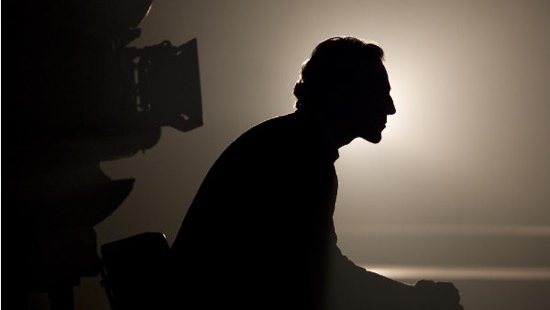
There is a great movie, I'm sure, to be made of the Tony Award winning musical "Nine." But this isn't "it." Nor, I think, was "it" an intention for the production company to do so.
In fact, it is hard to determine what "it" is, and what "it" intends to do. Is it a musical adaptation of Fellini's "8 1/2," or of Fellini's life? Is it even an adaptation of the original musical, as there are far more songs left out of it than are in it?* Locations are changed, circumstances and motivations are sliced and diced. One wonders what was so wrong about a hailed musical confection that the late Anthony Minghella and Michael Tolkin (who wrote the script), current director Rob Marshall, and the producers seem to be running away from it.
They aren't the only ones, merely they slowest of the pack. Daniel Day-Lewis was a last minute first tier replacement for the more suitable Javier Bardem when Bardem walked off the project pleading "exhaustion"—but not exhausted enough to flee, evidently. Bardem makes very wise career choices. Nicole Kidman replaced Catherine Zeta-Jones after the producers wouldn't accomodate her demands to expand her part. One wonders why they'd balk about making any more changes for their "Chicago" Oscar-winner after making so many of their own.
But, truth be told, the thing is a sorry, sorry mess. Not true to its source, its inspiration, or even to itself, one reads the description of the original musical and wonders why it is not the movie. But one gets an inkling. Fellini's film, made about a creator's inability to create a harmonious chorus of the voices in his head, his muses, his collaborators and backers all clamoring for attention had a structure, a purpose and an approach. But it did not have a lift, a creative inspiration until Fellini made it about a director rather than a writer. Fellini had no trouble making it, letting his conscience and unconscious be his guide (or Guido, if you will). On the contrary, he was energized by it. His "film that got away" would not occur until a bit later in his career.
The creators of "Nine" saw it as about themselves, and the difficulty of achieving a vision. One sees the disconnect with the Fellini inspiration as soon as the musical Guido's obsession with the Folies Bergiere is brought to song. Folies Bergiere? Mama Mia! Where's the Circus? Fellini equals circus! Comprende? But, "Nine" the musical—not the film, that gets even worse—is glitz and spangles and presentation with a smattering of psychological insight embroidered in a mash-up (one can't call it a mixture) of half-inspired and un-inspired songs.
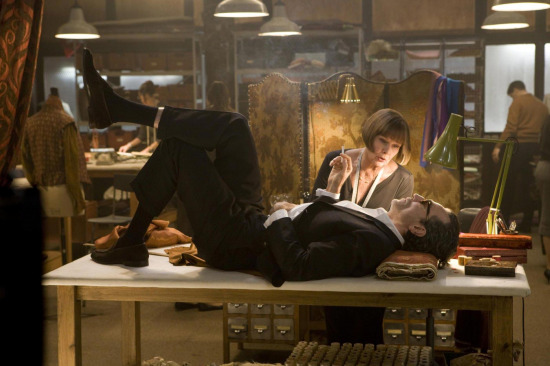
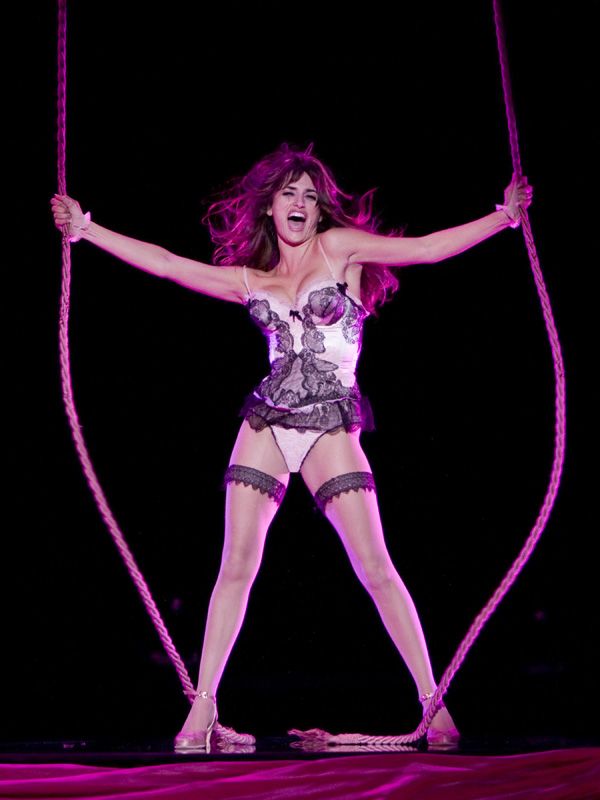
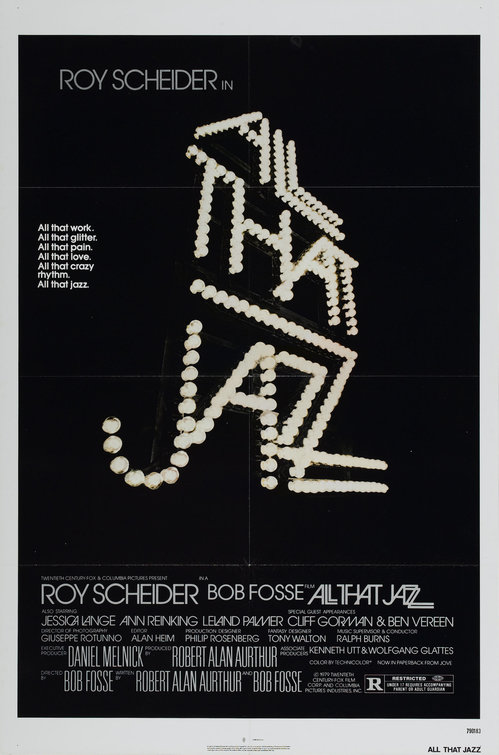
"Nine," the movie, is a whoring down of that concept. Big stars. Small ideas. A polyglot of a tribute to a movie it doesn't understand, and the broadway production that the money-men didn't feel had enough pizzazz** to put keisters in the seats (Because nothing makes you want to "Fosse, Fosse, Fosse" and booty-shake like ennui and creative stagnation!***). So, we've got Day-Lewis (he's fine—not too believable, but at least he's not doing a John Huston imitation this time).**** We've got Nicole Kidman and Penélope Cruz (wonder what they had to talk about on-set?), Kate...Kate Hudson (??), and....Fergie?(!!). Then, to give it some ethnic legitimacy they throw in Sophia Loren***** and Miramax staples Judi Dench and Marion Cotillard. Cotillard is heart-breaking as the Giulietta Massina look-alike wife—played by Anouk Aimée in Fellini's film (she's even got Massina's brave smile down). Dench does fine by her number, silly and irrelevent as it is, but as if to gin up any excitement, they work over-time trying to make it entertaining. Cruz gets a sizzling number as director Guido Contini's mistress-played by Sandra Milo in the original film. Kidman plays Contini's past star Claudia (based on the Claudia Cardinale character in "81/2"—which would have tied in with Zeta-Jones' participation, but goes back to the original inspiration, "ice queen" Anita Ekberg for Kidman's participation). Loren plays Contini's domineering Mamma, usually a grotesque in Fellini's films.
Director Rob Marshall undercuts the material by over-cutting, editing all the momentum out of the music, which veers from worthwhile ("Be Italian" given a rip-roaring rendition by...give her credit, she's the best thing here...Fergie of "The Black Eyed Peas") to the filler ("Cinema Italiano" given sass by Kate Hudson, but shot and edited like an MTV version of the old '60's "Shindig!" program).
I was looking forward to this one, but very high expectations leave the biggest craters when they fall. Not a fan of musicals, "Nine" only confirmed why I've rarely enjoyed them, as they can be false and irrelevent to anything resembling life or the inpulse to song that it might evoke.
This adaptation of an adaptation of a somewhat autobiographical work by the artist, even though titularly and musically adjusted for inflation, just isn't worth as much as the original. Artistically, it is bankrupt.
"Nine" is a Cable-Watcher.
* Three new songs were written for it, all of them unmemorable—in a bid to score more Oscar nominations for The Weinstein Company which oversaw this sorry mess.
** Imagined conversation: "Y'know? Everybody's singing about their feelin's an' everything! There's not enough dancing with women with big bazooms, and Alfa Romeo's and Fiat's!! Know what I'm sayin'?"
*** Although Fosse did make a musical based around a heart attack!
****...which reminds me, the last movie I've seen that ended (like "Nine") with the director-figure saying "Action" was Clint Eastwood's "White Hunter, Black Heart"—where Eastwood was playing (and imitating) John Huston!
***** Did it occur to the makers that the only Italian in their film celebrating Italian cinema is Loren? And that she didn't work with Fellini?
Thursday, December 31, 2009
Nine








Wednesday, December 30, 2009
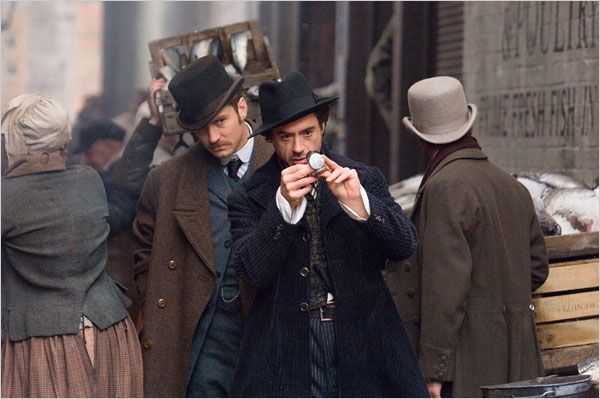
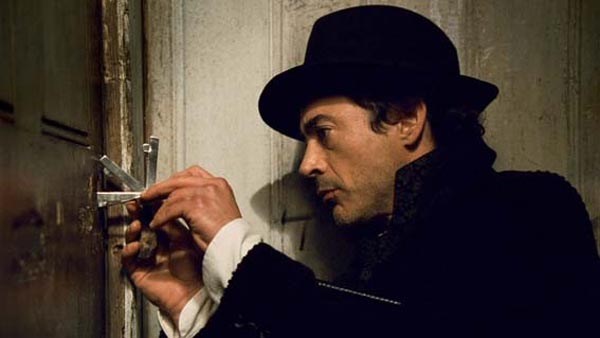
Sherlock Holmes
 "The Lord, The Woman, the Ginger Midget and the Parisian Giant"
or
"The Peripatetic Plot of the Madonna's Husband"
The wife and I have been looking forward to the new "Sherlock Holmes" with anticipation and dread. We're both fans, though hardly "Baker Street Irregulars," and Robert Downey Jr. is always worth watching—even when he's not, able to suck nuance out of even claustrophobic camera set-ups and able to project a fiendish intelligence out of every role. Fans of the Great Victorian Detective, we've liked several incarnations—particularly Jeremy Brett's encyclopedic and eccentric interpretation, and suffered through the attempts to get another Holmes series started. Brett left a long shadow—one that not even a good choice like Rupert Everett could dispel.* And clues in the trailer led one to deduce that they would try and make Holmes more of an action figure than Conan Doyle might have intended—more like a Bourne-again Holmes than the amateur pugilist of the books.
There are elements of that here, but done cunningly by writers Michael Robert Johnson, Anthony Peckham, and Simon Kinberg; Holmes, ever the synthesizer of information-bits diagnoses his battles first using his observations of his opponents, then carries them off with judicious speed, making note of their potential recovery time, both physical and psychological. Neat touch that, as is a nice summing up of Holmes' misanthropic characteristics—sitting at a restaurant table awaiting Watson (Jude Law,** as good as Law has ever been) and his intended, Mary Morstan (Kelly Reilly),*** Homes observes every argument, every petty theft, every peculiarity of his fellow diners—without his mind disciplined in pursuit, the vagaries of the world must drive him mad. Both Robert Stephens and Brett maintained that the difficulty in playing Holmes is that there is no center to him—a brain with no heart. Bur even an unbridled intellect must react to the world, and in Downey, jnr. there is quicksilver in those reactions.
The game that is afoot is one that will challenge Holmes to his core in a battle of facts and logic against magic and the dark forces.**** When we first see Holmes and Watson in action, they disrupt a ritual sacrifice by the fiendish Lord Blackwell (Mark Strong), who is already responsible for three murders before the fourth is disrupted. Sentenced to hang, Blackwell informs Holmes he will rise from the dead to usher in a new destiny for England. Holmes is skeptical, but intrigued, especially after Blackwell is hanged, declared dead (by Watson), then escapes his coffin. At a time in History, when engineering marvels such as London Bridge are being accomplished, it seems more imperative than ever for Holmes to dispel the superstitious.
Disrupting his concentration is a visit by the one woman who has out-foxed Holmes, Irene Adler (Rachel McAdams, far too contemporary an actress for the part—one expects her to huff and say "whatever..." at any moment), in the story "A Scandal in Bohemia." Adler is an adventuress, to be sure, but she is almost a secret agent here, more in line with the fictional series of stories that been built up around her by Carole Nelson Douglas.
There is far less drawing-room discussion and far more darting about and cane-dashing than in previous incarnations. The humor is amped up considerably, and the effects of injury down-played, but for all that it's a good representation of Holmes, adrenalized and puffed up as it is. Guy Ritchie shows that he has evolved from mumbling street-thug films to something with more than empty panache. His breathlessly paced opening half of the film stumbles somewhat with an extended fight with a Parisian giant, but manages to regain its footing with some genuinely well-done sequences that manages to clue the audience in to eke out its suspense. There has been some criticism of late that Ritchie doesn't have the depth or focus to pull off a big-budget film, although he's been angling for them for years. "Sherlock Holmes" is his defiant reply.
And not only are Law and Ritchie showing their best games here—composer Hans Zimmer, long an adherent of the generically grinding over-the-top symphonic score (he supervised all three "Pirates of the Caribbean" scores, which, frankly, are hard to tell apart), his work for "Sherlock Holmes" is folk-song based, with clever rhythms and instrumentation—kudos to orchestrator Kevin Kaska—that keeps the period alive amidst the clutter of the art direction.
Fans of Sherlock Holmes can relax.
"Sherlock Holmes" is a Full-Price Ticket.
* Although I'd like to see Ralph Fiennes, or better, Daniel Day-Lewis, try.
** Law appeared in the Granada version of Doyle's "The Adventure of Shoscombe Old Place."
*** Although why Watson feels the need for Holmes to meet her in the first place is rather odd. She did, after all, hire him in "The Sign of Four."
**** Conan Doyle's stories focussed on matters that challenged the societal structures of Victorian England and elaborate plots of thievery, and rarely dealt with the occult, although some of the modern stories—like "Young Sherlock Holmes" (1985), which also featured an occult presence, as it was produced by Steven Spielberg, not long after "Indiana Jones and the Temple of Doom," have featured Holmes against more supernatural threats. There was always that element to Doyle—such as the monstrous "Hound of the Baskervilles"—but they were usually explained away in bursts of Holmesian fact-checking.






Sunday, December 27, 2009
Don't Make a Scene: Patton
 The Set-Up: The story is basically true with a couple of small details: It wasn't snow that was preventing air-cover for his Third Army, it was incessant rain; it wasn't only Patton using the prayer, but the entire Third Army reading from 250,000 cards Patton ordered printed of the prayer (with a signed Christmas greeting on the reverse—see below); and Patton ordered the prayer over the phone, not in person. Other than those details, its a true story.
And the rains did cease. They'd've goddamned better.
He did yell the "Let no man come back alive" threat—it was the sort of thing the real Patton did to get attention, and delivered in his high, reedy voice (instead of George Scott's gravel-bass) it must have sounded blood-curdling.
The other notable things are the mention of Patton as "actor," which, no doubt, informed George C. Scott's hailed performance. Patton was an actor, theatrical and florid, dressing impressively, giving off the air of authority and privilege, and absolute command. That was in the strategic palaces. With the troops, he was basic and personal and emotional. He was a disciplinarian, yes, but weaker than the accepted portrait that the Scott personification has embedded in the nation's consciousness—Scott wasn't one to show Patton weep, as he was known to do with the troops—indeed, Patton was a fairly anonymous presence to all but the soldiers and war historians up until the film's release. Those who hero-worship the movie-Patton are like prison widows who fall in love and marry inmates, as long as they're behind bars. They would probably run from the room coming in contact with the real general. Patton was hardly a complacent man. And he did not suffer fools.
The other aspect of this sequence is how it walks the tight-rope of presenting Patton as warrior and war as brutality during the height of the anti-Vietnam sentiment. That "Patton" was popular and a box office smash during those fevered days is fairly amazing and a testament to the filmmakers and promotion people who walked the edge of the razor blade to position the movie for both hawks and doves. And backed by Jerry Goldsmith's eerie score, the ambiguous nature of the fighting sequences can leave both birds with their feathers unruffled, thinking their side has been represented. The brutality of the action, the desperateness of the situation and the waste of a single human life are all represented.
The Story: The Third Army is making its way through The Battle of the Bulge, led by disgraced Lt. General George Patton (George C. Scott in his Oscar-winning role). But the fighting is not going according to plan. For Patton to continue advancing his troops, he needs support from the air and the winter weather has the planes grounded. If Patton can't get help from above, he's going to have to go up the chain of command over everyone's heads.
Action. Now, dammit! Colonel GASTON BELL: Sir, Von Runstedt’s thrown another Panzer division against Bastogne. The first Airborne is hanging on by its finger-nails.
Lieutenant Gen. GEORGE PATTON: Damn air-cover is what we need. If we had 24 hours of decent weather we might make it. Brigadier General HOBART CARVER: General Mason, sir!
 PATTON: Hello, Mace? Listen, we’re short on foot-soldiers. I want you to cannibalize your anti-aircraft units and turn them into rifle-men. Yes, every damn last one of them you can find.
 Lt. Col. HENRY DAVENPORT: Evening, General. I just got the weather report for tomorrow. More snow.
CARVER: There goes our air-cover. Sir, we may have to pull up and wait for better weather. PATTON: There are brave men dying up there. I’m not going to wait. Not an hour. Not a minute. We’re going to keep moving!
 PATTON: Is that CLEAR?! We’re going to attack all night.
 PATTON: We’re going to attack tomorrow morning! If we are not VICTORIOUS…LET NO ONE COME BACK ALIVE!!


 Lt. Col. CHARLES R. CODMAN: You know something, General? Sometimes the men can’t tell when you’re acting, and when you’re not.
 PATTON: It isn’t important for them to know. It’s only important for ME to know.
 CHAPLAIN: You wanted to see me, general?
PATTON: Oh, yeah, Chaplain. I’m sick and tired of Third Army having to fight the Germans, the Supreme Command, no gasoline and now this ungodly weather. I want a prayer. A weather prayer.
CHAPLAIN: Weather prayer, sir?
PATTON: Yes, let’s see if we can’t get God working for us on this thing. CHAPLAIN: It’ll take a pretty thick rug for that kind of praying.
PATTON: I don’t care if it takes a flying carpet.
CHAPLAIN: Well, I don’t know how this is going to be received, general…praying for good weather so we can kill our fellow man… PATTON: Well, I can assure you, sir, because of my intimate relations with the Almighty, if you write a good prayer—we’ll have good weather.
 PATTON: I expect that prayer within an hour.
 CHAPLAIN: Yes, sir.
(Leaves. Chaplain shakes head) PATTON(VO): Almighty and most merciful father. We humbly beseech thee of Thy great goodness...
 PATTON(VO): ...to restrain this immoderate weather with which we’ve had to contend.
 PATTON(VO): Grant us fair weather for battle.
 PATTON(VO): Graciously hearken to us...
 PATTON(VO):...as soldiers who call upon thee...
 PATTON(VO):...that, armed with thy power...
 PATTON(VO): ...we may advance...
 PATTON(VO): ...from victory to victory...
 PATTON(VO): ...and crush the oppression and wickedness of our enemies...
 PATTON(VO): ...and establish thy justice...
 PATTON(VO): ...among men and nations.
 PATTON(VO): Amen.
"Patton"
Words by Edmund H. North, Francis Ford Coppola and Chaplain James H. O' Neill
Pictures by Fred J. Koenekamp and Franklin J. Schaffner
"Patton" is available on DVD from Fox Home Video.

Saturday, December 26, 2009
Fly Away Home
 "Fly Away Home" (Carroll Ballard, 1996) I mentioned to a co-worker that I'd seen this movie and liked it. "What!" she gaped. "The goose movie?!"
Yes, damn it, "the goose movie."
Based on the true efforts of naturalists who imprint orphaned geese how to migrate, it's been shapoed into a fun, odd movie that imprints young minds with a story of responsibility while creating a film with the same sense of wonder, but a little less of the austerity that Ballard brought to the 1985 "The Black Stallion" and 1990's "Never Cry Wolf."
Fairweather father Tom Alden (Jeff Daniels) flies to New Zealand where his daughter (Anna Paquin) and ex-wife have been involved in a car accident that kills the mother. Alden takes the traumatized Amy back to his Canadian farm, where he continues his experiments in perfecting ultra-light gliders and activism for protecting the surrounding wild-lands from developers. An early bulldozing of green-space disturbs a nest of geese, and Amy takes the eggs and oversees their hatching.

 But geese are odd ducks. Amy being the first human they see, the goslings assume she's their mother, and so she feeds, cleans, exercises and cares for the birds, to the grudging acceptance of her father and girlfriend (Dana Delany). "Imprinting" goes both ways. The geese are stuck on Amy, and she is devoted to them. This runs them afoul of the local game warden who insists that their wings be clipped to prevent them from flying off during migratory season. See, geese learn the paths from their parents...and orphaned geese...well, their proverbial goose is cooked.
 Horrified, Amy and her father hatch a plan to imprint the migration path on the geese by piloting a pair of powered ultra-kights from Canada to the sunnier climes of Florida. First, Amy must learn to fly. Then, they have to coax the birds to follow her ultra-light. Then...well, the task has all the potential catastrophes as a "Mission: Impossible" plot. Experts are skeptical. The air-space is restricted. The flights unauthorized. One of the geese is injured. But, as they say, the plan is so crazy, it...just...could...work.
 Freely adapted from Bill Lishman's book and own experiences imprinting new migratory paths on geese and whooping cranes, it's one of those perfect children's movies that doesn't speak down to kids, keeps them engaged, and gives them something to get excited about, while also keeping adults intellectually enthralled rather than insulted. And Ballard and his "Black Stallion" cinematographer—the gifted Caleb Deschanel—brings that same eye for the beautiful image and the defining detail that have made his other films engaging studies of man's relationship to Nature.
At the same time the film is a coming-of-age film of a child coping with the death of a parent by becoming one and fighting for the life of her new charges. Finally, it is also a film of letting go for human beings and for birds, of letting Nature takes it course and trusting in lessons taught. It's one the whole family can enjoy.

Friday, December 25, 2009
Thursday, December 24, 2009
A Public Service Announcement
Our Senate votes today at 8:00 am on the Health Care Bill—flawed, compromised, limping a little, but, if voted into law, it can be fixed. If not we have to start—again—from Scratch.
It's like going to the Hospital and having the Doctors say, "This one's broken! Let's start over."
The long arduous debate, that's been going on since 1948, has been particularly nasty this time, with political lobbies and moneyed interests, and stuffed town-meetings—why, it's mindful of the tactics "Boss" Jim Taylor uses against Senator Jefferson Smith in "Mr. Smith Goes to Washington," released in 1939, nine years before the proposition of America's first health care reform bill. I remember the first time I saw this film (in the days following the "Watergate" scandal) how timely, how contemporary, how wise and strong in the face of reality this film is. Released before the Second World War, it was argued that the film shouldn't have been made, that it would make our government look corrupt and dishonorable and bring "comfort to the enemy."
And yet...in 1942, when Germany put a ban on all foreign films in occupied France, it was "Mr. Smith Goes to Washington" that some theaters chose to present as "the last picture show." One theater played it for thirty days straight.
So, just to remind our Public Servants (who won't read this, but you might) that they are our servants, here's a little straight-talk from the Junior Senator from...we never DID find out what state he's from. JEFFERSON SMITH: "--We hold these truths to be self-evident, that all men are created equal, that they are endowed by their Creator with certain unalienable Rights--"
(He breaks off, remarking the Senators relieving each other--dryly)
JEFFERSON SMITH: Well--looks like the night shift's comin' on. "--certain Unalienable Rights--that among these are Life, Liberty and the Pursuit of Happiness. That to secure these rights, Governments are instituted among Men, deriving their just powers from the consent of the governed, that whenever any form of government becomes destructive of these ends, it is the Right of the People to alter or to abolish it, and to institute new government, laying its foundation on such principles and organizing its powers in such form, as to them shall seem most likely to effect their Safety and Happiness--"
(Finishing with a flourish and putting the book down)
JEFFERSON SMITH: Now, that's pretty swell, isn't it? I always get a great kick outa those parts of the Declaration--especially when I can read 'em out loud to somebody.
(waving the book)
You see, that's what I had in mind about camp--except those men said it a little better than I can. Now, you're not gonna have a country that makes these kinds of rules *work*, if you haven't got men who've learned to tell human rights from a punch in the nose. And funny thing about men--they start life being boys. That's why it seemed like a pretty good idea to take kids out of crowded cities and stuffy basements for a few months a year--and build their bodies and minds for a man-sized job. Those boys'll be sitting at these desks some day. Yes--it seemed a pretty good idea--boys coming together--all nationalities and ways of living--finding out what makes different people tick the way they do. 'Cause I wouldn't give you a red cent for *all* your fine rules, without there was some plain every-day, common kindness under 'em--and a little looking-out for the next fella. Yes--pretty important, all that. Just happens to be blood and bone and sinew of this democracy that some great man handed down to the human race--! That's all! But, of course, if you need to build a dam where a camp like that ought to be--to make some graft and pay off your political army or something--why, that's different!
(Suddenly--with strength)
No sir! If anybody here thinks I'm going back to those boys and say to 'em: "Forget it, fellas. Everything I've told you about the land you live in is a lotta hooey. It isn't your country--it belongs to the James Taylors--!" No, sir, anybody that thinks that has got another think coming!
(He breaks off, and starts a different tune, apologetically)
JEFFERSON SMITH: I--I'm sorry to be coming back to that and--I'm sorry I have to stand here--it's pretty disrespectful to this honorable body. When I think--this was where Clay and Calhoun and Webster spoke--Webster stood right here by this desk--why, in the first place--an' I hate to go on trying your patience like this--but--well, I'm either dead right or I'm *crazy*!
A SENATOR (looking back and calling out dryly) You wouldn't care to put that to a vote, Senator?
A ripple of laughter. The gavel pounds.
JEFFERSON SMITH: No, sir, there's no compromise with truth. That's all I got up on this floor to say--when was it--a year ago, it seems like. Just get up off the ground, that's all I ask. Get up there with that lady that is up on top of this Capitol dome--that lady that stands for liberty, take a look at this country through her eyes if you really want to see something and you won't just see scenery--you'll see the whole parade of what man's carved out for himself after centuries of fighting and fighting for something better than just jungle law, fighting so's he can stand on his own two feet--free and decent, like he was created--no matter what his race, color or creed. That's what you'll see. There's no place out there for graft or greed or lies or compromise with human liberties. And if that's what the grown-ups have done to this world that was given to them we'd better get those boy's camps started fast and see what the kids can do and it is not too late because this country is bigger than the Taylors, or you or me, or anything else. Great principles don't get lost once they come to light. They're right here. You just have to see them.
All you people don't know about lost causes. Mr. Paine does. He said once they were the only causes worth fighting for, and he fought for them once, for the only reason that any man ever fights for them. Because of just one plain, simple rule, "Love thy neighbor," and in this world today, full of hatred, a man who knows that one rule has a great trust.
Wednesday, December 23, 2009
Christmas in July
 "Christmas in July" (Preston Sturges, 1941) James MacDonald (Dick Powell) lives a life of pretense and dreams. A bean counter for a coffee company, he's just won the $25,000 prize in the slogan contest for rival caffeine-pushers, Maxford House. The winning entry: "Can't sleep at night? It's not the coffee. It's the bunk."
Well, it is the bunk and the pretenses are false ones. MacDonald didn't win any contest. It's all an impractical joke played on him by co-workers, that manages to sneak under the radar due to a contest SNAFU. But by the end of his perfect day, he's got a promotion, a new raise and an office, and bought presents for everybody on the block without spending a dime yet. You've got to have good luck to get good luck it seems, but it all comes crashing down when the check and everything with it bounces. Jimmy almost loses his new job because, let's face it, he only got it because he won the contest and, his boss, liking sure things and having made a ton of mistakes himself, needs to have something he can count on. Now that he can't count on MacDonald being a proven winner, well...
That twisted logic—the very basis of our banking credit system (You can only get money if you don't need it) forms the curvature of the spine of Sturges' short (68 minutes) winning second film. Another moral, Sturges-style is a familiar one, except in Hollywood: No good deed goes unpunished. MacDonald buys presents for everybody but himself and ends up humiliated in front of his neighbors. But at least he gets to keep his new job if he succeeds at it because "it's one thing to muff a chance once you've had it... it's another thing never to have had a chance."


Powell does measured work far subtler than his musical gigs and ingenue Ellen Drew is delightful. But the stand-out amond the Sturges stock company in this film is Raymond Walburn as the perpetually frustrated and passive aggressive Dr. Maxford, head of Maxford House Coffee. Usually these big business CEO's are played with comedy bluster, but Walburn fumes and fusses as if its as part of his everyday routine as a cup of coffee, roasted and aged. The entire movie has a fresh comic timing that's a bit off-kilter, and the results are hilarious. It's Frank Capra turned on his ear, but far more cynical and with less of a "reach" at the end.
Tuesday, December 22, 2009
Avatar
 "I Was a Marine in the Na'vi Reserve"
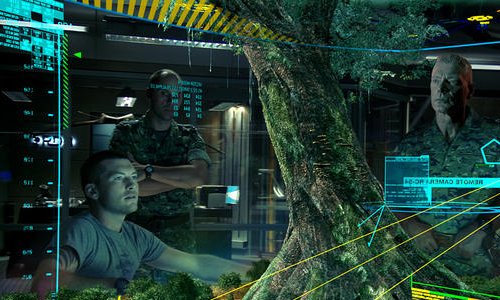
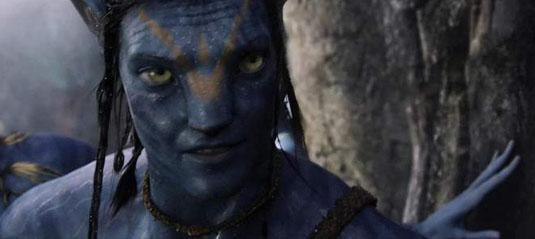
"Avatar" is this Holiday season's elephant in the room. It is too big a target to not take pot-shots at, and will probably be too successful to avoid the temptation. Not that one needs motivation; there's plenty to be critical of. Like that proverbial elephant, take away the visuals and it will be seen as bits and pieces of other films: a little bit of this, a little bit of that. Something old, nothing new, something borrowed, and mostly something blue. Yes, it's derivative* (all James Cameron's films are). Yes, it's 3-D effects are spotty (Cameron can't resist getting too close to the "lens" frequently, so that the tip of things lose their coherence, and close-up ferns tend to become transparent, and there are early sequences that just move too fast for clear 3-D optics). The right-wing pundits will blast it for being "anti-military" (Can't argue with that—an occupying Army force that is the muscle for a rapacious corporation is the villain**—we've seen that in "The Abyss" and "Aliens"—on the other hand, Cameron gives them the coolest toys). Yes, it's too expensive. Yes, it's big and obvious and dumb. I'll grant you all of that. Sure.
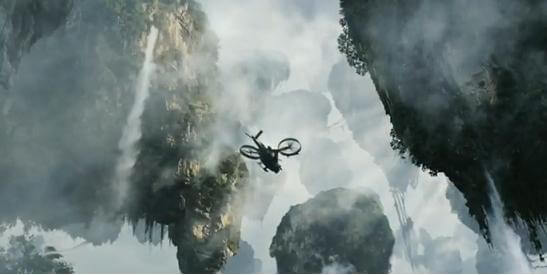
But, damn, if it isn't fun. And thrilling. And at times stunningly beautiful, even breath-taking. There are moments (when Cameron actually feels the need to slow things down so you can appreciate it) when the imagery evokes such awe that you forget that you've seen it before in other films, and sometimes done better.
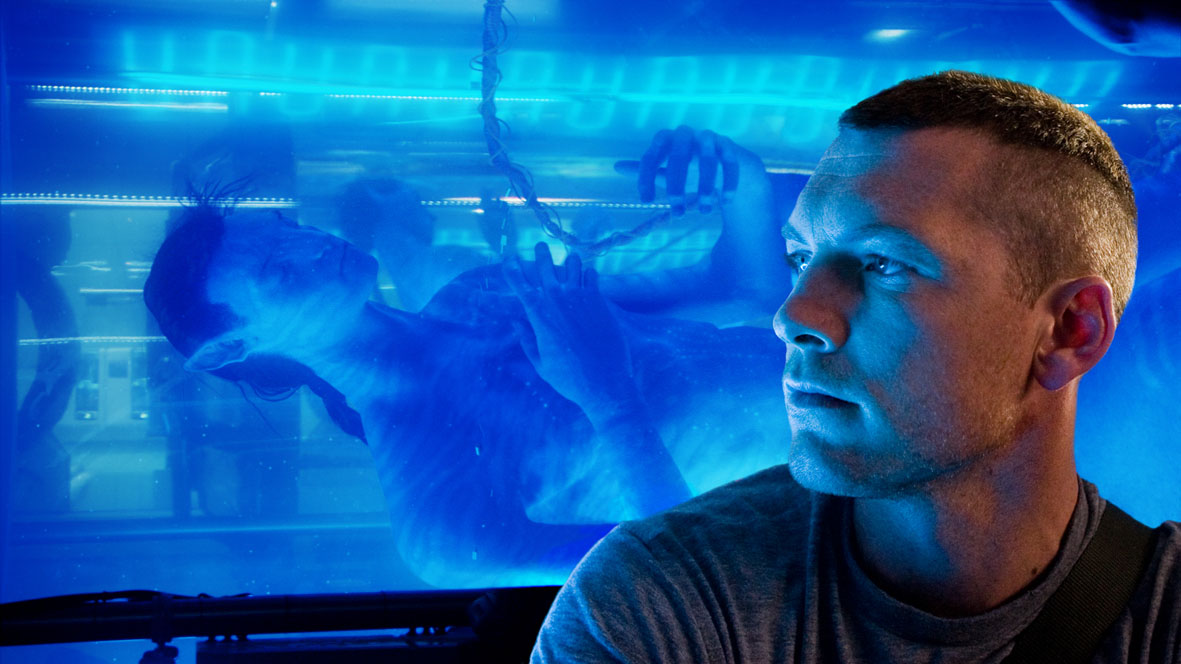
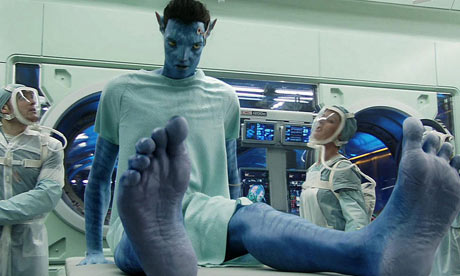
In the year 2175, paraplegic Marine Jake Scully (Sam Worthington—well, his head, anyway, the rest is an actual paraplegic) is offered the chance to replace his late twin brother in a scientific program to blend in with the indigenous tribe of ten foot tall aliens called the Na'vi. Brother Scully had been in training for years for the task, but because Jake's DNA matches his brother's, it's easier to let an untrained rookie with conflicts of interest take his place rather than train a replacement for such an essential mission. That mission is to move the Na'vi off their sacred land that contains a rich source of what the decimated Earth needs to run its machines, a floating mineral called "Unobtainium."***
There were legitimate titters in the audience at that one. It is indicative of Cameron's grab-bag approach to "Avatar" that he seriously uses a scientific in-joke, as well as exposing how little care he was taking with the story. "Unobtainium" is just lazy writing, like a detective looking for an actual "McGuffin," or a tech explaining that those scanners run using the latest "Vaporware." He couldn't come up with a more clever name like "dilithium," or "adamantium," or "Upsidaisium," or "Wedonthavenuffovum?"****
Apparently not. Because what we have in "Avatar" is a case of James Cameron becoming George Lucas. The two have been at odds over the years with competing films and competing SFX companies (although Lucasfilm's ILM—not Cameron's acquisition Digital Domain—worked on the FX of "Avatar," the majority of which were done by New Zealand's WETA) that now the Tiger-hunter has become the Tiger. "Avatar" is the equivalent of the sumptuous "Star Wars" prequels, with more care given to how ships look when they land than to how people sound when they talk. We have more of the 22nd century humans using contemporary 20th century idioms and lame wise-cracks. No one's advanced—Earth is infected with a military-industrial simplex whose short-term strategies have decimated the planet (the corporate weasel is played by Giovanni Ribisi, rather than Paul Reiser this time, and the off-his-rocker military honcho is Stephen Lang, rather than Michael Biehn--Michelle Rodriguez plays the Latina soldier in the wife-beater, and Sigourney Weaver...is still Ripley, believe it ot not.) Your afterward discussion meal will be peppered with discussions of "Well, if they could do THAT, why couldn't they do THAT?" and so on.
The Na'vi are innocent cat-like savages with golden eyes bigger than those in Keane paintings. They have three fingers and a thumb on their hands and six toes on their feet—if that sounds a little evolutionarily suspect, here's another one for you: the horses on Pandora have six legs, two in the back, four in the front. The people are based on every "noble savage" cliche ever used in the English language—everyone speaks in low, measured pronouncements and the chief is played by Wes Studi (it's always Wes Studi--I love him, but, c'mon!), his obligatorily high priestess of a wife is CCH Pounder, and their daughter, the princess—with whom Scully becomes romantically involved, opening up the floodgates to sources—is played by Zoe Saldana (Uhura of the new "Star Trek"). Nice cast, but they weren't given much to do to stretch their acting muscles—in fact, the roles are a little regressive. There's more challenges voicing a Disney film.
One watches with a gob-smacked smile on one's face, but before too long it's apparent how it's going to turn out...and what complications are going to ensue before we get there. One has to conclude that, except for his technological savvy and his rather loopy art design, Cameron just doesn't have any new ideas. If you're looking for revolutionary in your films or film-makers, it is not here.
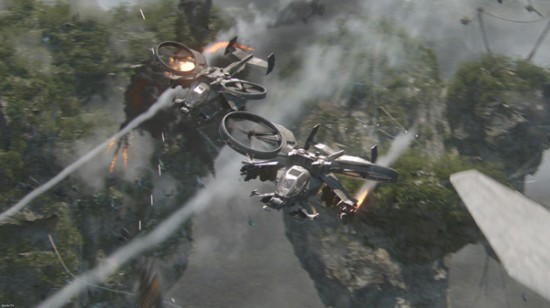
And, as you know it would, it all climaxes with an all-out battle between the Na'vi and the military, which Cameron knows how to direct so it's quite a bit more effective than a "Transformers" battle. It's mighty violent with lots of explosions and death and some nasty punctures by big Na'vi arrows. Parents should be warned—I saw a bunch of kids go into hyper-activity during the battle scenes. You're going to wish you had one of Cameron's heavy-lifting "AMP suits" to get 'em back into the car.
But, as a sci-fi re-telling of the "Native" tropes written by European writers, it's fun. Just don't be disappointed once the fancy wrappings are taken away, you find it's the same present you got last year.
"Avatar" will lose lots on the small-screen, so it's a Matinee.
* Aw, why drag it out? The sources are "Run of the Arrow," the "Pocahontas" story, Poul Anderson's "Call Me Joe"(which is about humans using brain-linked native avatars on Jupiter), "Dances with Wolves," "Dune," "FernGully," heavy doses of Edgar Rice Borroughs' "Tarzan" and "John Carter of Mars," the "Dragonriders of Pern" series, the original storyline of "Star Wars" (in which a primitive tribe defeats a technologically advanced one—a Lucas favorite theme), allusions to the decimation of the American Indians, the VietNam War and the War in Iraq. And if it's a "'civilized' man learns from indigenous tribe that they're more civilized" story, it's in "Avatar."
** There wasn't. I'd forgotten—The company releasing "Avatar" was 20thCentury Fox, part of Rupert Murdoch's News Corp. There were no conservatives grumbling until after the movie had cleared $1 billion dollars in receipts.










.jpg)













*** "Unobtainium" was also used in "The Core"—it is the metal coating plating the ships to make them resistant to molten temperatures and pressures.
**** "Dilithium cystals" power the U.S.S. Enterprise (rather than what Dr. McCoy prescribes Kirk for...his...ADD), "adamantium" is the metal that coats Wolverine's bones, "upsidaisium" was an anti-grav metal in "Rocky and Bullwinkle," and "Wedonthavenuffovum" I made up.
Sunday, December 20, 2009
Don't Make A Scene: The Apartment
 The Story: 2009 was a rotten year—the chaser to a crappy decade. Too many people lost jobs, lost pets, lost friends and family, lost love. We need a drink in the worst way.
And the worst way would be alone in a smoke-filled bar on Christmas Eve with no place else to go.
"The Apartment" is a different kind of Holiday film—almost an anti-Holiday film, for there's not a Hallmark moment that the philandering executives who have control over "Bud" Baxter's upward mobility (and the key to his apartment) can't corrupt. They give lip-service to the Sanctity of Marriage and Family, and the rest of the anatomy to their mistresses. For "Bud," turning a blind eye to the hypocrisy was an opportunity for advancement. But now, he sees the cost to the woman he's befriended and saved from a suicide attempt, Miss Kubelik, and he doesn't like what he sees now that his eyes have been opened.

So, he's drinking himself blind at the local bar.
This scene is great on so many levels. It's one of Billy Wilder's "time-capsule" moments where for an instant, a timely reference is made to "date" the film—the rest is evergreen, working in any era. I love the one-shot aspect of it, too; the two bar-flies aren't even looking at each other, except as reflections in a presumed mirrored bar, and their conversation is a bit askance, as well. There's communication, but no connection—except in the dramatic pauses where a mutual drink is called for. Both players have little intricate moments of expression change that it almost has the feel of a Burns and Allen routine.
It's just another lovely slice of Humble Pie that's served up regularly to the part-time resident of "The Apartment."

Here's how.
The Set-Up: Christmas Eve—a time for men to be with their wives and girl-friends.
And, hopefully, they'll never meet.
For fast-tracker C.C. Baxter (Jack Lemmon), Christmas Eve means a bar is his home away from home. And his home is a love nest for the executives at the insurance company, where he is employed. Tonight his heart has been stabbed with a sprig of holly, as he's found that his boss, Mr. Scheldrake (Fred MacMurray) is using his apartment for a tryst with the gal that Baxter likes, elevator girl Miss Kubelik (Shirley MacLaine). It's Christmas Eve, and Baxter is hitting the nog with a bunch of other executives and bar-flies to the point where there's no elbow-room. And he's so in the bag that he wouldn't notice that the straw wrapper that's been shot his way was Cupid's Arrow. But it's another ship-wrecked sailor on the Sea of Love, Margie McDougall (Hope Holiday), and she and Bud pass in the Night Before Christmas.
Action!

 Margie leaves her place, and carrying her handbag and her empty glass, comes up alongside Bud. Without a word, she reaches up and removes the wrapper from Bud's bowler.
 MARGIE: You buy me a drink, I'll buy you some music. (sets the glass down)
 MARGIE: Rum Collins.
 Not waiting for an answer, she heads for the juke box.
 Bud looks after her noncommittally, then turns to the bartender.
 BUD: Rum Collins. (indicating martini glass) And another one of these little mothers.
 At the juke box, Margie has dropped a coin in and made her selection. The music starts -- ADESTE FIDELIS. She rejoins Bud at the bar just as the bartender is putting down their drinks in front of them. Bud removes the new olive, adds it to the pattern on the counter in front of him. They both drink, staring straight ahead. For quite a while, there is complete silence between them.
 MARGIE:(out of nowhere)You like Castro?
(a blank look from Bud)
MARGIE:I mean -- how do you feel about Castro?
BUD: What is Castro? MARGIE: You know, that big-shot down in Cuba with the crazy beard.
BUD: What about him? MARGIE: Because as far as I'm concerned, he's a no good fink. Two weeks ago I wrote him a letter -- never even answered me.
BUD: That so.
MARGIE: All I wanted him to do was let Mickey out for Christmas.
BUD: Who is Mickey? MARGIE: My husband. He's in Havana -- in jail.
BUD: Oh. Mixed up in that revolution?
MARGIE: Mickey? He wouldn't do nothing like that. He's a jockey. They caught him doping a horse. BUD: Well, you can't win 'em all.
 They sit there silently for a moment, contemplating the injustices of the world.
  MARGIE(to herself): 'Twas the night before Christmas/ And all through the house/ Not a creature was stirring --
Nothing --
No action -- Dullsville!
(drinks; to Bud)
MARGIE: You married?
BUD: No.
MARGIE: Family?
BUD: No. MARGIE: A night like this, it sort of spooks you to walk into an empty apartment.
 BUD: I said I had no family -- I didn't say I had an empty apartment.
 They both drink.
"The Apartment"
Words by I.A.L. Diamond and Billy Wilder
Pictures by Joseph LaShelle and Billy Wilder
"The Apartment" is available on DVD from MGM Home Video.
The complete scene starts at about 2:51 on the video.