Friday, April 29, 2011

Super

"The Weed of Crime Bears Bitter Fruit"
or
"Boltie!  NO!"

There will be four major super-hero movies coming out this Summer (starting with Thor next week, Green Lantern, X-Men: First Class, and Captain America: The First Avenger), plus a smattering of graphic novel adaptations and such.  Next year, The Avengers, Spider-man, Batman and Superman movies will be released.  Comic Books are hot in the movies because they're easily digestible, easy to adapt, and they skew young in the audience demographics.

It's just too bad that so many of them are terrible, and they've created a lazy back-lash of "Oh, I'm so sick of super-hero movies" to any blogger who can put two words together.  Sure, you're sick of them.  Too much of anything gets dull after awhile. 

So, stop going to them.  That's not so hard.  With great power comes great responsibility.  Super-hero movies have a lot of power right now and you're responsible.

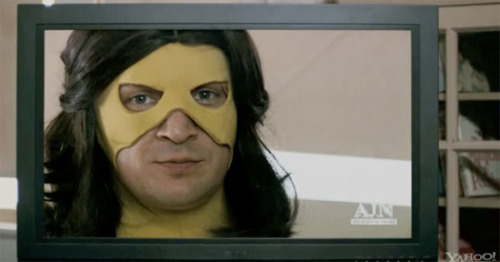
Meanwhile, there is an antidote to all this nefarious meta-human poisoning, a tonic to the wish-fulfillment fantasy that the genre unquestioningly presents: Super, written and directed by James Gunn, former Troma writer-director.  Notice that it doesn't say "Super-hero," as that label doesn't really apply—it stops just short of the "hero" as the "vigilante" aspect of the crime-fighter takes center-stage along with its brother-in-arms, revenge.

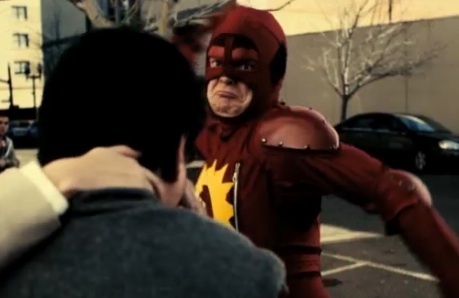
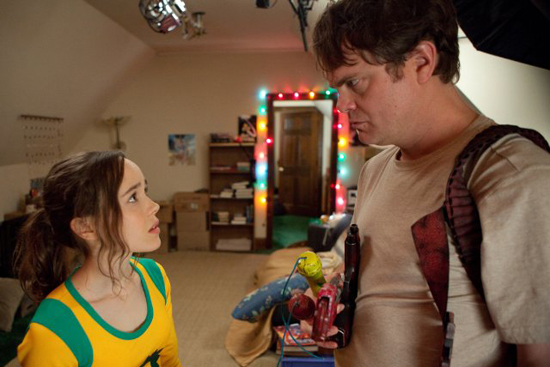
Frank D'Arbo (Rainn Wilson) is a short-order cook/man-child and the best thing that ever happened to him was marrying Sarah Helgeland (Liv Tyler), a waitress at the diner who's just come out of re-hab and is trying to get her life back in order.  Things are fine (at least from Frank's perspective) until Sarah runs off with Jacques (Kevin Bacon), a sleazy drug-dealer and then Frank melts down.  Despairing, angry and confused he's inspired by a religious station's superhero program "The Holy Avenger" (played by a smirking Nathan Fillion) and by having his brain "touched by the finger of God," to set his spinning-out-of-control back on track by taking on a vigilante role as The Crimson Bolt—his only weapons being his innate sense of "right" (no drug-dealing, no pedophilia, no butting-in in line) and a large pipe-wrench.  There are no fancy moves, no elegant acrobatic abilities pulled off with ease, just a schlumpfy guy in a leotard blundering into situations and clocking people with a big spanner.  Realistic, right down to the cranium-cracking that such action produces.  It's funny, but also slightly cringe-inducing as you see the damage that such blunt trauma can produce.  At that point, the "heroism" aspect becomes secondary to the thuggish behavior such actions create—the line between "do-gooder" and freakish assault becomes blurred and squishy.

Squishy being the operative word here.  Gunn is from Troma, the cheerily exploitative grind-house that's created such films as The Toxic Avenger, so no holds are barred in the presentation of violence with its resulting blood-splatter and meat-manufacturing.  When "The Bolt" increases his armory with guns, pipe-bombs and accelerant, things turn explosively ugly.  And that's where Super has it all over such juvenile exercises in juvie crime-fighting glorification as Kick-Ass.  However much that film tried do disguise its brutishness with smooth moves and well-choreographed stunt-work, it played fast-and-loose with the consequences of such actions, making it all 'look cool" and distracting from the carnage.  There's nothing smooth about this film; it's down and dirty and doesn't even look heroic so much as desperate and geekish, the results of adrenaline mixed with no skill whatsoever.  There's more danger in Super than anything simulated in Kick-Ass.

Things get complicated.  "The Bolt" starts to attract attention from the press and the local police, particularly one detective (Gregg Henry) who puts one and one together and connects the addled D'Arbo with the increased attacks around town.  Then, "The Bolt" gains a side-kick, the cute chick Libby (Ellen Page) at the comics store where he does his research.  A comics junkie, she also has a hyper-intense fantasy jones that makes her latch onto D'Arbo's crusade with an unhealthy zeal, becoming his junior partner, Boltie.  It's an unhealthy relationship, as Frank tries to mentor Libby ("That's inappropriate, Boltie!") in her adrenal-rush to take things too far.  And they go too far, to the point where Super jumps the genre line to become more like Taxi Driver than a super-hero film.

Super is not rated, simply because it wants to skirt the issue of taming the gore and present its message uninhibited by catering to the unfathomable whims of the MPAA.  So, the violence is squishy and upsetting, the language is pervasive ("Oh, maaan!  The Bolt-mobile is kinda fucked up!") and the places it goes only occurring to those who are seriously aware of the psychological twistedness of the genre (like Alan Moore).  It may look funny and goofy, but caution is advised if you're easily traumatized, or holding out for a hero.  Super isn't playing games or taking hostages.

Super is a rental.  Shut up, Crime! 


"This is how you fight crime...sit here and wait for it to happen?  It's so BORING!!"

Thursday, April 28, 2011

Hanna

"Grimm's Fairy Spy"
or
"Better Living Through Chemical Brothers"

Hanna isn't like any movie you've seen, if you managed to miss some of the more stylish spy thrillers at the end of the 1960's.  When the spy-craze went more mainstream more A-list directors started to get into the fray and suddenly the thrills started to be taken over by style as those film-makers attempted to impose some of their own creative instincts into the genre.  Sometimes the results were a sub-par thriller, others were just plain pretentious.  Some...were interesting (like this one is, and like The American was last year).

Joe Wright is one of the better British directors coming out BBC television work.  He's done his bit for the classics, old and new (Pride & Prejudice, Atonement) quite deftly handling the drawing room choreography and even putting a nicely modern spin on things.  But, his 2009 film of The Soloist showed a director who wanted to experiment with the form, break out of the stodgy "Beeb" way of doing things and shake the story-telling up a bit (in that film, he turned Los Angeles into a living, breathing, rumbling sci-fi character looming over its strata of citizenry).  It was interesting to see him attached as director to what looked like a common "actioner," and one wondered what he might bring to it, given his three previous films and how he appeared to be changing his style.

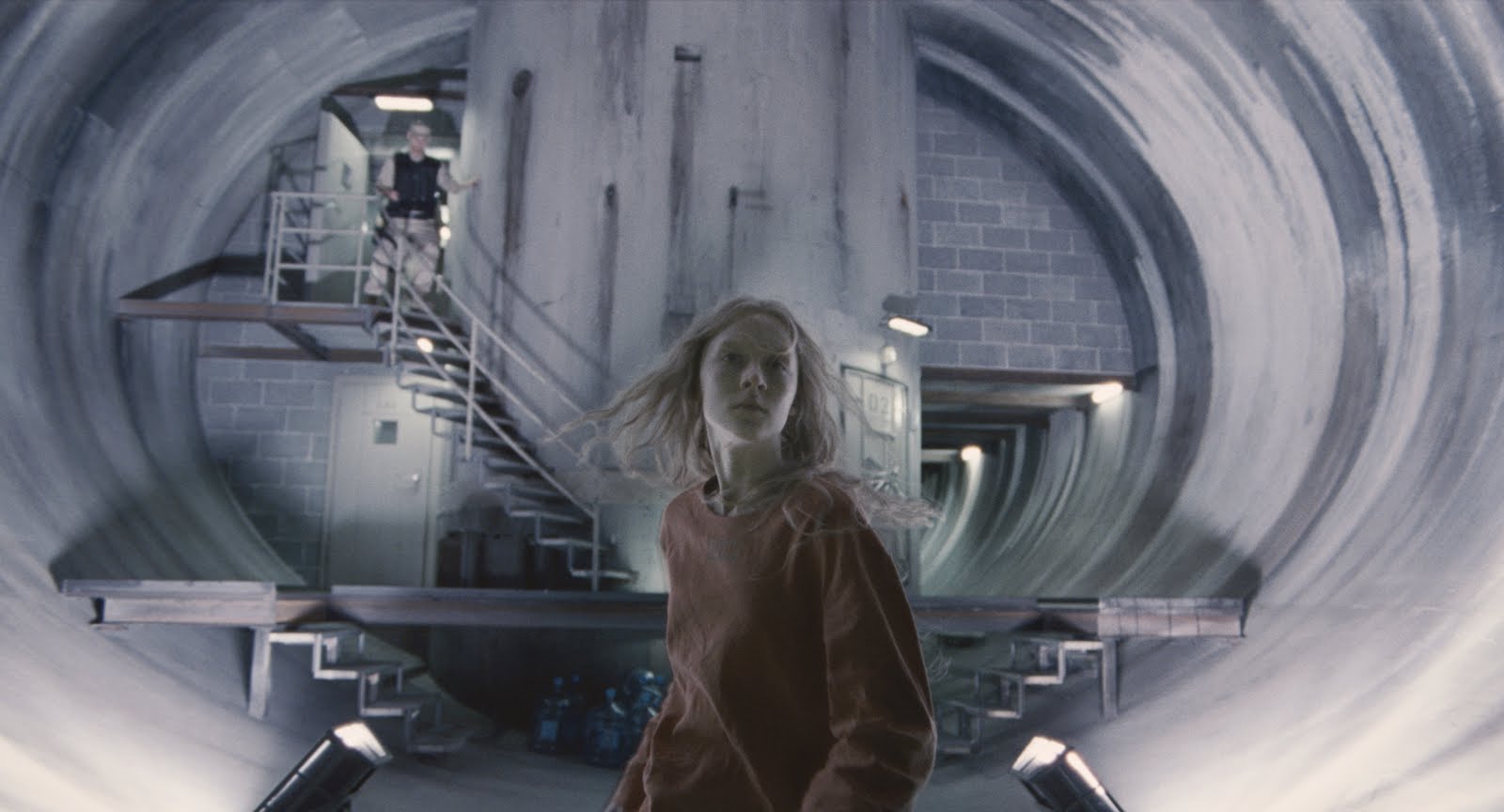
Change it, he did.  Hanna is a weird mixture of gloss and QT-perversion, with some very strange camera work that, somehow, never manages to not tell you what is going on, to whom, where and why.  No matter how over-the-top the theatrics become, Wright never forgets the basic job of keeping the audience informed, and with a screenplay spare on details and depending on the visual to tell the story, his discipline is critical (imagine, for instance, if Tom Hooper had directed it!) for any basic understanding of the film.  Hanna  heaps on the atmospherics, not only with a brazen fairy-tale sub-text, but an all-encompassing sound-design/Euro-electronica musical score by The Chemical Brothers,* that recall some of the '60's/'70's work of such composers as Mikis Theodorakis and Giorgio Moroder.  But the thumping, edgy noises permeate the entire soundtrack, not just the music, from the sweet tune that one of the Hanna-hunters (Tom Hollander, cast completely against type) whistles, quite nullifying any element of surprise,** to the pounding chase music that keeps the attention focused while Wright spins his camera or shifts perspective, *** to the creepy metal noises and animal sounds that permeate this world. 

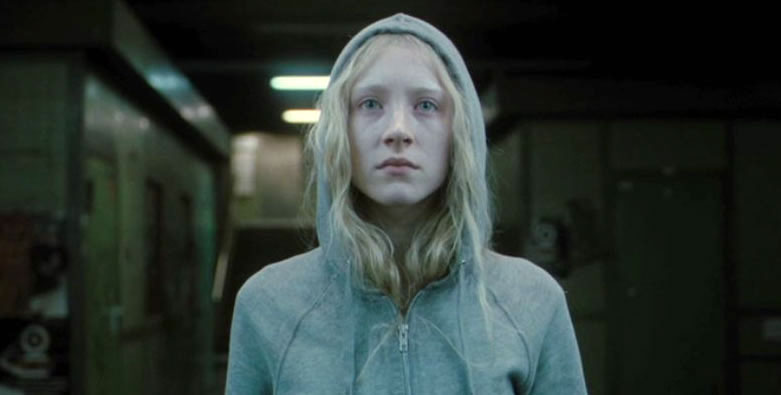
It begins in Finland, in the snow as a caribou is being hunted by a lone figure in fur.  She dispatches the animal with one arrow shot ("I just missed your heart"), and begins to dress the animal for food.  "You're dead!" says a figure behind her, and a rapid brutal fight breaks out, dependent less on fast editing than rhythm, and she is soon slammed to the ground, a snow angel against her will.  "Drag the deer back yourself," says the man, who it turns out is Hanna's father (Eric Bana).

She is Hanna Heller (Saoirse Ronan—pronounced "Seersha"—and she worked with Wright in Atonement, and specifically asked that he direct this) and it is all survivalist training.  Hanna has been raised to live on the land, kill and cook her own food, have an encyclopedic knowledge of everything (except electronics, apparently) given that her schooling is from the encyclopedia, speak several languages and have a detailed history that is nothing like her own.

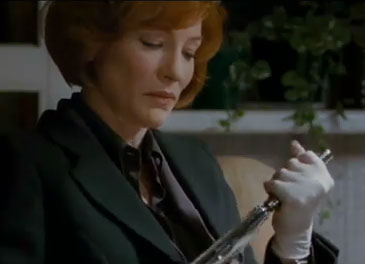
What is her history?  What is her father's?  We don't get too deep into the film before we learn he's a rogue security agent gone missing, and he's a bee in the bonnet of Marissa Viegler (Cate Blanchettimagine her being creepy and then go a few steps further), an operative high up the chain of command.  And she is Hanna's target.  And Hanna must get to her before Marissa can find her.  The why's will come, eventually, but already we've invaded a fairy-tale landscape with the sheltered princess (who can snap your neck) and an evil step-mother who stays only a few evil steps behind the whole movie.  And given Ronan's goose-like grace throughout the film, one can't help but call to mind all sorts of folk-tales of changelings and bargains and revenge.  But it's a spy thriller, too, as cold as they come, so don't expect "happily ever after."

For me, it was a simple story told well that impressed me throughout.

But it just missed my heart.

BANG!  Hanna is a Matinee.


* Their impact on the film is incredible.  I kept imagining what the film would be like with a "standard" thriller score, and always came up with a duller, less propulsive film.

** This recalls Peter Lorre's child killer in Fritz Lang's M (1931).  Hollander vaguely recalls Lorre's look, and, later,  Wright stages a fight to the tune "M" whistled from Peer Gynt—"In the Hall of the Mountain King," (after The Social Network, this piece is getting a lot of traction).

*** "What does music feel like?" Hanna asks at an early stage of the script.  Here, it feels like having a heart attack in zero-g.  One of the reasons this film DOESN't have a traditional score is that Hanna, the character, doesn't know music, and as we're following her struggles, the music reflects her mood, whether placid or on the run.  It's rather interesting where those moods show up.

Wednesday, April 27, 2011

Miss Pettigrew Lives for a Day (Take Two)

Miss Pettigrew Lives for a Day (Bharat Nalluri, 2008) A bon-bon.  A truffle.  A "ladies' pic" with just enough naughtiness to raise the blood pressure a little and maybe bring some color into the cheeks and the blue hair.  Done to a fine "fare-thee-well" and all, but at the heart of the confection is a little piece of grit that could chip a tooth if you're not careful—"careful" being the operative word here.

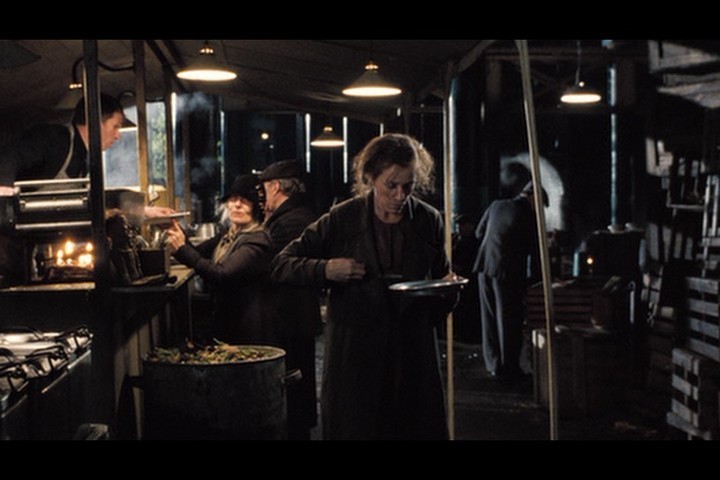
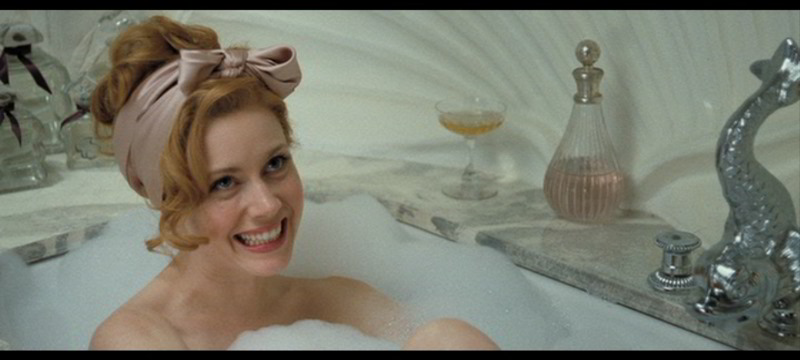
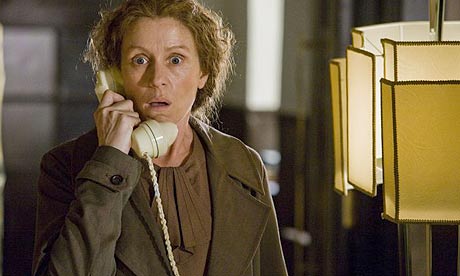
Miss Guinevere Pettigrew (Frances McDormand—what a treasure) has just been given the sack in the days before England is going to war with the Germans; the headlines are bold and the Wellingtons are flying eastward.  But Miss Pettigrew is without situation and penniless, cast adrift like the leaves scattering in the wind (which the Main Titles are animated to resemble).  She is desperate, so when she applies for another position and is roundly given the brush-off, she steals a business card and arrives unannounced at the residence of Miss Delysia Lafosse (Amy Adams)—nee Sarah Grubb "of the Pittsburgh Grubbs"—actress, semi-songstress, floozy and ditherer.

She couldn't have arrived at a better time.

Delysia is only dressed in a flimsy robe after entertaining a boy-producer (Tom Payne) in order to gain the lead in his new production, and she's doing so in the lavish love-nest of her boyfriend Nick (Mark Strong), who should be returning at any minute.  As should her other boyfriend, Michael (Lee Pace), who has just been released from prison after trying to nick a diamond for Delysia's engagement ring (the occurrence of which left Guinevere with only the clothes on her back—"small world").

It becomes immediately apparent that Miss LaFosse should not be acting but juggling and she needs a third hand to do so. 

And that's where Miss Pettigrew comes in, and quite literally.

Over the course of the day, everyone is in everyone's "business" if not in the very same room and the various conflicts conspire to creates "scenes" in glamorous settings and scandals if the back-biting and sniping become less passive and more aggressive.  The surface glitter, though, is shadowed by the twin horsemen of war and poverty and Pettigrew, who has known both, manages to be the voice of priority and reason, without completely throwing cold water on everybody's hot jazz.

It's a smart, funny screenplay, played well by an expert cast, even if the the direction gets a little swoopy and frenetic sometimes, and the music soundtrack is selected meticulously to given the film a rhythm and momentum that it desperately needs, even if some of the music chosen isn't precise to the period.

So, what's the "grit" that threatens to tarnish the gold that seems to permeate every one of Adams' costumes in this thing?  The unmistakable whiff of safety that wafts every so often.  That sentiment that everything will be alright, as long as "the right man" comes along.  Sure, the movie toys with "wrong" men, just as surely as Delysia does, but the flirting with "danger" is always casual, the consequences never showing themselves.  There are valid points that "love is not a game," and "you must not waste a second of this precious life," and particularly "there are times when decisions just have to be made, or you certainly will miss out."  All too true.

But, the insistence that all will be well with the subjectively agreed-upon "right" pairing between male and female?  Would it have been so sinful to have the ladies of the story be a little more independent as a solution as opposed to it seeming like a problem that needs to be cured?  As delightful as a movie may be, if those thoughts crop up, it has the tendency to spoil the party.


Tuesday, April 26, 2011

The French Connection

The French Connection (William Friedkin, 1971) Peripatetic police thriller with discernible street-grit in the film-emulsion, The French Connection, adapted freely from Robin Cook's "True Crime" book, tells the story of two New York police detectives Eddie "Popeye" Doyle and Buddy Russo (Gene Hackman and Roy Scheider, playing the noms de film of real-life detectives Eddie Egan and "Sonny" Grosso) tracking a high-level cocaine operation from overseas. 

The French Connection won the Best Picture Oscar, which seems like a good choice until you realize it was in contention with A Clockwork Orange and The Last Picture Show (as were Fiddler on the Roof and Nicholas and Alexandra).*  Then, the choice feels as safe and conservative as can be.  Yes, it's gritty.  Yes, it's "edgy," but does it have anything to say, besides that sometimes the good guys have to be rough with the bad guys in order to break even on the law and order scales, and that outlaws have an easier time of it simply because they're outlaws, bending the rules?

Not really.  But The French Connection did take police procedurals in another direction.**  The cops were less formal in their attire and language, and tougher in their asking questions.   Friedkin took a near-documentary approach to the subject matter (with the help of Owen Roizman's inelegant constantly searching subjective cinematography), while conveying the frustration that cops, though maybe not crossing the "T's" and dotting the "i's" on the letter of the law, go through to try to achieve a legitimate, legally-binding collar.  One is left with a morally ambiguous ending in which lines are crossed to merely achieve a semi-positive result, as opposed to the greater good.

And everyone remembers the car chase.


But, the biggest through-line of The French Connection is Friedkin's constant contrasting of the cops and drug-dealers as diametrically opposed in almost every way.  Charnier (Fernando Rey) and his traffickers travel and conspire unimpeded, while the detectives skulk and blend in with the savage streets and observe their targets working out in the open.  The criminals live the high-life, dining and dressing elegantly, while the cops sit in the cold, eating stale sandwiches and swilling bad coffee on their stake-outs, dealing with bureaucracies and competing enforcement agencies, as the bad guys routinely handle such impediments punctually with gun-fire.

It is only at the end when a police road-block stops the conspirators in their tracks that the tables are turned, and the lines blur, and the ambiguities become real.  And what is essentially a police chase has no discernible finish line.


The real-life Eddie "Popeye" Egan with the fictional Sonny Russo  (Roy Scheider)


* It was also the year of Straw Dogs, Dirty Harry, McCabe and Mrs. Miller, Walkabout, Carnal Knowledge, Klute, and Harold and Maude, none of which made the Best Picture category and in some cases, received no nominations, at all.

** Wikipedia has a funny story about Friedkin's behind-the-scenes decision-making.   The director was living with the daughter of legendary director Howard Hawks, who suggested that since Friedkin's pictures were "lousy," he should put a good chase in the movie "better than anyone's ever done."

Sunday, April 24, 2011

Don't Make a Scene: Horse Feathers


The Story: Finishing up our comedy month for April is a scene I've wanted to put up for a long time: the opening of Horse Feathers, one of those "pure" Marx Brothers movies (you know, without the extemporaneous lovers and accompanying musical numbers—oh, it has music, performed by the Brothers Marx, but the music blends and doesn't stop the movie cold).

I've said before (I think) that the former CNN news anchor Aaron Brown once stated that Marx Brothers movies was a tonic for him when he was recovering from a heart attack.  I'm with him (although I've never had one, knock wood).  A Marx Bothers film cures whatever ails you and its sense of absurdity blasts away all the scar tissue that can inform and restrict a life.  There are no sacred cows and no oxe goes ungored.  They are a beaming upraised middle finger to all things stodgy, authoritarian, self-important, and dogmatic.  The Marx Brothers breathe fresh air into any stuffy situation.  Watching them is like experiencing freedom with no cares.

Anything else is Horse Feathers.

Take your seats and hold on to your hats.

The Set-Up: As I recall, this IS the set-up; the movie's just started!

Action!


RETIRING PROFESSOR: ...And so, in retiring as President of this College, it is indeed a painful task to bid you all good-bye. 

RETIRING PROFESSOR: ...And now, with the utmost pleasure, may I present to you the man who is to guide the destinies of this great institution.

RETIRING PROFESSOR:  Professor Quincey Adams Wagstaff.

RETIRING PROFESSOR:  Professor, it is indeed an honor to welcome you to Huxley College.
PROFESSOR WAGSTAFF: Never mind that.  Hold this coat.

RETIRING PROFESSOR:  Eh, by the way, professor, there is no smoking.
PROFESSOR WAGSTAFF:  That's what you say.


RETIRING PROFESSOR: It would please the faculty if you would throw your cigar away.
PROFESSOR WAGSTAFF:  The faculty members might as well keep their seats. There'll be no diving for this cigar.

PROFESSOR WAGSTAFF: Members of the Faculty, Faculty members, students of Huxley, and Huxley students (I guess that covers everything): Well, I thought my razor was dull until I heard his speech. And that reminds me of a story that's so dirty I'm ashamed to think of it myself.

PROFESSOR WAGSTAFF: As I look out over your eager faces I can readily understand why this college is flat on its back. The last college I presided over, things were slightly different; I was flat on my back.  Things kept going from bad to worse, but we all put our shoulders to the wheel and it wasn't long before I was flat on my back again!

PROFESSOR WAGSTAFF: Any questions?  Any answers?  Any rags, any bones (sings) any bottles today, any rags...(raps gavel) Let's have some action here.  Who'll say 76? Who'll say 1776. That's the spirit! 1776!

PROFESSOR WAGSTAFF: No doubt you would like to know why I am here.  I came into this college to get my son out of it. I remember the day he left to come here, a mere boy and a beardless youth.  I kissed them both good-bye.  By the way, where is my son?

PROFESSOR WAGSTAFF: Young lady, would you mind getting up, so I can see the son rise?

PROFESSOR WAGSTAFF: So!  Doing your homework in school, eh?

FRANK: Hello, old-timer!

RETIRING PROFESSOR: My dear professor, I'm sure the students would appreciate a brief outline of your plans for the future!
PROFESSOR WAGSTAFF: What?
RETIRING PROFESSOR: I said "the students would appreciate a brief outline of your plans for the future!"
PROFESSOR WAGSTAFF: You just said that!  That's the trouble around here—talk, talk, talk!

PROFESSOR WAGSTAFF: Oh, sometimes I think I must go mad!  Where will it all end?  What is it getting you?

PROFESSOR WAGSTAFF: Why don't you go home to your wife? I'll tell you what, I'll go home to your wife, and outside of the improvement she'll never know the difference.  Pull over to the side of the road there and let me see your marriage license.
RETIRING PROFESSOR: President Wagstaff, now that you have stepped into my shoes...

PROFESSOR WAGSTAFF: Oh, is that what I stepped in.  I wondered what it was.  If these are your shoes the least you can do is have them cleaned.
RETIRING PROFESSOR: The trustees have a few suggestions...

RETIRING PROFESSOR: ...they would like to submit to you.
PROFESSOR WAGSTAFF: I think you know what the trustees can do with their suggestions.


PROFESSOR WAGSTAFF: [singing]
I don't know what they have to say 
It makes no difference anyway 
Whatever it is, I'm against it.
No matter what it is or who commenced it,
I'm against it! 

Your proposition may be good 
But let's have one thing understood: 
Whatever it is, I'm against it. 
And even when you've changed it or condensed it,
I'm against it!

I'm opposed to it
On general principles
I'm opposed to it!
(He's opposed to it)
(In fact, he says he's opposed to it!)

For months before my son was born
I used to yell from night till morn: 
Whatever it is, I'm against it! 
And I kept yelling since I first commenced it,
I'm against it.

FRANK:
Knowing Dad as I do,
I'd not advise you
to displease him
or tease him,
No, no.
Don't double-cross him
Or toss him around.
When dear old dad
once gets mad,
he's a hound!

PROFESSOR WAGSTAFF:
My son is right, I'm quick to fight
I'm from a fighting clan.
When I'm abused or badly used,
I always get my man.

No matter if he's in Peru,
Paducah or Japan,
I go ahead, alive or dead,
I always get my man.

(Oh, what a whiz this fellow is,
A will like his is rare,
for he's a square
American)

I soon dispose of all of those
who put me on the pan,
Like Shakespeare said to Nathan Hale,
"I always get my man!"

(He always gets his man!)
That's what I said!
(He always gets his man!)
That's what I mean!
(He always gets his man!)
You're telling me?
(He always gets his man!)
Oh, are you listening?

(He gets his man! He gets his man!)
I always get...
I always get...
I always get, I always get,
I always get, I always get
I always get my maaaaaaan!

Splendid, Professor.
Congratulations, Professor!
Wonderful, Professor!
Marvelous!

PROFESSOR WAGSTAFF: Alright, scram, boys.  I'll meet you in the barbershop.

FRANK: Dad, let me congratulate you. I'm proud to be your son. PROFESSOR WAGSTAFF: My boy, you took the words right out of my mouth. I'm ashamed to be your father. You're a disgrace to our family name of Wagstaff, if such a thing is possible.

PROFESSOR WAGSTAFF: What's all this talk I hear about you fooling around with a college widow?  No wonder you can't get out of college!  Twelve years in one college.  I went to three colleges in twelve years and fooled around with three college widows.

PROFESSOR WAGSTAFF:  When I was your age, I went to bed right after supper.  Sometimes I went to bed before supper.  Sometimes I went without supper and didn't go to bed at all.


PROFESSOR WAGSTAFF:  A college widow stood for something in those days.  In fact, she stood for plenty.

FRANK: There's nothing wrong between me and the college widow.
PROFESSOR WAGSTAFF:  There isn't huh?  Then you're crazy to fool around with her!
FRANK: Oh, but you don't know...
PROFESSOR WAGSTAFF:  I don't want to talk to you about this again, you snob.  I'd horsewhip you if I had a horse!  You may go now!  Leave your name and address with the girl outside and if anything turns up, we'll get in touch with you.

PROFESSOR WAGSTAFF:  Where are you going?
FRANK: Well, you just told me to go.

PROFESSOR WAGSTAFF:  So that's what they taught you in college.  Just when I tell you to go, you leave me.  You know you can't leave a schoolroom without raising your hand, no matter where you're going.

FRANK:  Dad, this school has had a new president every year since 1888.
PROFESSOR WAGSTAFF: Yeah.
FRANK: And that's the year we won our last football game. Well, I like education as much as the next fellow...

PROFESSOR WAGSTAFF:  Well, move over and I'll talk to the next fellow.
FRANK: But a college needs something else besides education.  And what this college needs is a good football team.  And you can't have a good football team unless you have good football players.

PROFESSOR WAGSTAFF:  My boy, I think you've got something there and I'll wait outside until you clean it up.

PROFESSOR WAGSTAFF:  I know it's dangerous, but I'm gonna ask you one more question.  Where do you get good football players?

FRANK: In the speakeasy down...
PROFESSOR WAGSTAFF:  In a speakeasy?  Isn't that against the law, selling football players in a speakeasy?
FRANK:  Dad, two of the greatest football players in the country hang out in a speakeasy downtown.
PROFESSOR WAGSTAFF:  Are you suggesting that I, the president of Huxley College, go into a speakeasy without even giving me the address?

FRANK: It's at 42 Elm Street.  But you can't go there, it's unethical!  It isn't right for a college to buy football players.

PROFESSOR WAGSTAFF:  It isn't, eh?  Well, I'll nip that in the bud.  How about coming along and having a nip yourself?

PROFESSOR WAGSTAFF:  Or better still, you wait here.

FRANK:  Anything further, Father?
PROFESSOR WAGSTAFF:  "Anything further, Father"...

PROFESSOR WAGSTAFF:  That can't be right.  Isn't it "anything Father, further?"


PROFESSOR WAGSTAFF:  The idea! I married your mother because I wanted children. Imagine my disappointment when you arrived.

PROFESSOR WAGSTAFF: (singing)
And I kept yelling since I first commenced it,
I'm against it.


AND EXIT.


Horse Feathers

Words by Bert Kalmar, Harry Ruby, S.J. Perelman, Will B. Johnstone and the Four Marx Brothers*

Pictures by Ray June and Norman Z. McLeod 

Horse Feathers is available on DVD from Universal Home Video.


* George S. Kaufman once said, while attending a Marx Brothers play he'd written: "I'm not sure, but I think I just heard something I wrote!"