Saturday, August 29, 2009

2010: The Year We Make Contact

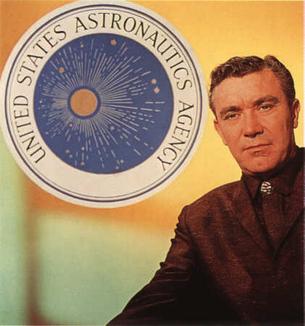
 2010: The Year We Make Contact (Peter Hyams, 1984) 2001: A Space Odyssey took scientific precepts and used them as a launching pad for a philosophical adventure about humans and their place in the Universe in a suggestive and non-narrative way. It's "official" follow-up, "2010," however, tells you what it's going to show ya—then it shows ya—then it tells ya what it showed ya, thanks to a narration by Roy Scheider's character that explains everything but what he had for dinner. It's as far afield in style from its cinematic prequel as it could be—so much so that they feel like they've come from two different galaxies, or as one IMDB poster put it, "it's like comparing apples and concrete."

Based on
Arthur C. Clarke's "romp around the Solar System" ("2010: Odyssey Two"), it proposes a fact-finding mission by Dr. Heywood Floyd (Roy Scheider in this one) to attempt to discover precisely what happened to the Discovery Mission to Jupiter and its crew. By hitching a ride on a Soviet space-craft (commanded by er, Tanya KirbukHelen Mirren) that just happens to be passing by, Floyd and his crew—Discovery engineer Dr. Walter Curnow (John Lithgow) and Dr. Chandra (Bob Balaban), the computer scientist who developed the Hal 9000 and its twin in Urbana, Illinois—attempt to find out what went wrong with the mission that ended up with a dead crew and no information on where the signal sent by the un-mooned TMA-1 anomaly went.  Where the first film revels in the leaps of evolution foisted on Man by "the Zarathustrians" (as I call them), Hyams' film is stuck with the earth-men and women merely trying to crack "what-done-it." 


Frankly, they should have just re-played the first film.

Kirbuk...d'uh...Kubrick stayed away from the machinations, unless it was visually arresting or amusing—like the zero-gravity-walking up walls, or the gravity-making squirrel-cage aboard Discovery— but Hyams, like Clarke, is only too happy to show the nuts-and-bolts of dropping into orbit with ablating bags, the stress it has on the crew by shaking the camera, the spark-emitting panels, and the requisite astronaut who flies across the control center in zero-g. This is the stuff of sci-fi melodrama in all its cheapness, precisely what Kubrick was trying to avoid in his film.

Clarke's
ultimate Big Surprise is a nifty one—educational, too, about the configuration of Jupiter—but by granting the unseen architects in both films motivations that seem like cosmic buttinskism very much cheapens the first film and its scope, making man's Creation merely all in a monolith's day's work. And the cosmic consequence of "2010" feels like an after-thought. It is eerie to hear the voice of HAL again (Douglas Rain) and to see Keir Dullea, through some artful make-up, look as young (and as old, unnecessarily) as he once was. And working from mere screen-captures, Hyams and his art department did a meticulous job recreating the Discovery sectionsthey can't keep the ships from looking like models in the FX sections, however, which is curious for a more late-model movie. So meticulous is their work that it seems bizarre that the Russian ship would look so dfferent in its interior, than what the Americans had come up with by that time.   Again, apples and concrete.

One wonders, ultimately, if it was worth doing: it was a toe-splash for M-G-M to explore the possibilities of one of its core properties, but its utter conventionality only points to the other film's complete unconventionality in
terms of belaying cheap dramatic tricks and the standard "science fiction" obsession with mechanics. It is the only sense of wonder "2010" allows, where it's progenitor was far more about wonder than the why's and wherefore's.


Friday, August 28, 2009

The Russia House

"The Russia House" (Fred Schepisi, 1990) "Nowadays, you have to think like a hero merely to behave like a decent human being!" Barley Scott Blair (Sean Connery), barely getting-by book publisher, deep in his cups at a Russian Book Fair, seals his fate with those words. He soon finds himself wanted by both British Intelligence and the Russians, both looking for a hero in a final End Game in the Cold War in John le Carré's indictment of spies who don't have the sense to come in from the cold.

Scott Blair is a hapless go-between for secrets, dispensed by a radical Russian scientist code-named "Dante"* (
Klaus Maria Brandauer) who is willing to betray his country for The Good Fight for World Peace. He's enlisted his lover Katya (Michelle Pfeiffer) to contact Blair—the one man "Dante" trusts to smuggle his journals into the West for the purpose of publishing them. But "The Russia House," that wing of the Intelligence Service looking East, gets wind of it first and enlists Barley in an effort to learn as much about Russian nuclear capabilities as they can. Soon, he's wired for sound, followed by surveillance by the Brits (working with U.S. Intelligence) and embarks for a Russia about to collapse in Sovier dis-Union. He's starting to fall himself—for Katya—but, constantly monitored and miked, he'll have to resort to whispering sweet nothings in her ear. It couldn't be more appropriate.

It's a master-stroke to get Connery to play this non-spy in John le Carré's literary world of "anti-Bond's." His long association with 007 is cast aside as
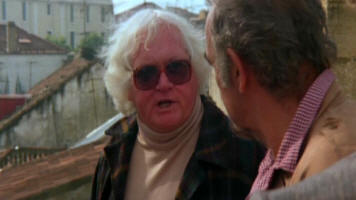
he approaches the role bearded, curley-haired and gray, crotchety...and vulnerable, set upon by the author's tweedy grey men smug in their patriotism but lacking in honor. Tom Stoppard's screenplay takes a few bends out le Carré's labyrinthine plot, but none of the complications in the ethics and politics of strange bedfellows in matters of the State and the heart. The production is top-notch, filmed in Portugal and the Soviet Union, with an eye-popping cast of character actors supporting the Connery, Pfeiffer, Brandauer troika. On the British side are James Fox, Michael Kitchen, Ian McNeice, and...Ken Russell! The Americans are Roy Scheider, J.T. Walsh, and John Mahoney, all salamander-cool and not to be trusted.

But the best part of "The Russia House" is the sub-text, which is all le Carré's. Distrustful of his brethren in the spy-hood, the author has always been able to forecast a new sin for them to exploit or fall prey to, and David Cornwell (le Carré's nom de réalité) could see the upcoming glasnost and perestroika and see the forsty battles continue unthawed. Nothing worse or nosier than a spy with nothing to do and not know it. So he looked forward and looked to the past and compared and contrasted.

Remember this, if you must: a bitter cad who sticks his neck out for nobody, a committed idealogue fighting impossible odds, and the woman who is caught in between them. It's "Casablanca." But the milieu is wrong. Where the 1945 film is about choosing "the cause" and "the good fight" in a "mixed up, crazy world," in the world of "The Russia House," lives are being lost in a quest for worthless secrets...worthless because the other side already has them. The only thing to be gained in the cat-and-mouse games being played are the budgets being authorized for the cat and the mouse. In such a compromised clime, the problems of two little people amount to much more than a hill of beans, they are a world-entire of pledges to be kept and sanctity to be upheld. They are the only ideals left amidst the corruption. In such a world, the fundamental things no longer apply. And by basing his story on that timeless tale of love and sacrifice, le Carré throws into stark relief the world of today and that world.
Of a "mature, grown-up love" held against a world playing games...no matter what the future brings, as time goes by.

* In the book, he was, more appropriately, "Goethe"—the man who wrote about making deals with the devil, rather than about his territory.

Thursday, August 27, 2009

Olde Review: Sisters

This was part of a series of reviews of the ASUW Film series back in the '70's. Except for some punctuation, I haven't changed anything from the way it was presented, giving the snarky, clueless kid I was back in the '70's a break. Any stray thoughts and updates I've included with the inevitable asterisked post-scripts.

This is a companion piece to last week's Olde Review of "Purple Noon."

This Saturday's films in 130 Kane at 7:30 pm are thrillers: one sophisticated; the other unsophisticated, but God, it's neat, and they are Rene Clement's "Purple Noon" and Brian DePalma's "Sisters"

"Sisters" (Brian De Palma, 1973) 1976 was a banner year for Brian DePalma. Two of his films, "Obsession" and "Carrie" were released (within five months of each other) and were critically acclaimed. Not only that, they made a lot of bucks. And so, Brian DePalma has achieved financial success. More power to him. I've been a DePalma fan since way back, and from "Sisters" to "Phantom of the Paradise" to "Obsession" and "Carrie," my respect and admiration for his film-making skills has only grown. Last quarter, DePalma's "Phantom of the Paradise" was shown. And from reports of the attendance too many of you blew the chance to see it. Don't miss the chance to see "Sisters"—his first feature film.* I'm not even going to hint at the plot because one of its joys is that the plot turns and twists into a maze of incidents in which the protagonists are lead. **

"Sisters," like "Obsession," borrows very liberally from the films of
Alfred Hitchcock in themes and incidents. In fact, DePalma even borrows Hitchcock's long-time musical accomplice, Bernard Herrmann, for the energetic film score. The ironies, the quirky characters, the quality of the grotesque in humor and incidents make "Sisters" thoroughly entertaining, as is Hitchcock's films, but DePalma leads them on to his own bizarre sense of humor and film-making. ("Sisters") is very much DePalma's film, no matter how many ideas he may have borrowed. And just as Hitchcock holds a fascination with special effects, so, too, does DePalma who has as much love for the devices of split-screen and the like (which he uses brilliantly) as he does in making blood spurt from a murder victim (something he does like no other director—a fact which has led one newspaper reviewer to give it the special category of "DePalmaesque Violence"). This violence, though it has a horrible humor, may upset the more sensitive in the audience. But DePalma gives you all the hints and time in the world to cover your eyes. So I hope you don't miss the brilliance of the film for the violence. At such a low budget, it is such a great movie.

Broadcast February 12, 1977

It is a good movie—but it's not a great one, as the Nervous Nellie I was in college wrote. DePalma would surpass it, and eventually lose the Hitchcock fetish he had going for a long while, and be more of his own cine-man for good or ill. But "Sisters" has a demented sense of humor that is just as sick as a ruptured (or deliberately severed) artery that even Hitchcock would try to staunch. Combined with Herrmann's mad bell-clanging, theremin-stabbing score it is one of the loopiest horror movies to shuffle spasmodically down the mausoleum corridor, with its mad scientist (William Finley), its homicidal maniac (Margot Kidder), as well as a mother-harassed girl detective (Jennifer Salt) with a dogged assistant (the wonderful Charles Durning). DePalma has calmed down quite a bit in his style, and his social conscience (which he displayed in some the features I neglected to mention he made before "Sisters"*) has come back, when he's not making fetishistic erotic thrillers with a "hook." "Sisters" was the initial stab at the movie-market outside of art films, the lowest common denominator to make a name for its film-maker in the mainstream—the same route that so many film-makers, both auspicious and inauspicious, have taken to "break in." "Sisters" is among the most ingeniously devilish of those freshman horrors and one film-maker's affectionate tribute to another.

* Those being "Murder à la Mod," "Greetings," "The Wedding Party," "Dionysus," "Hi, Mom!," and "Get to Know Your Rabbit."

** Well, I'm pretty much spoiling it in my later comments.

Wednesday, August 26, 2009

Rocco and His Brothers

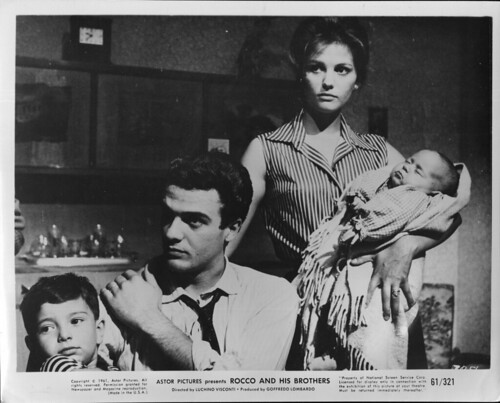
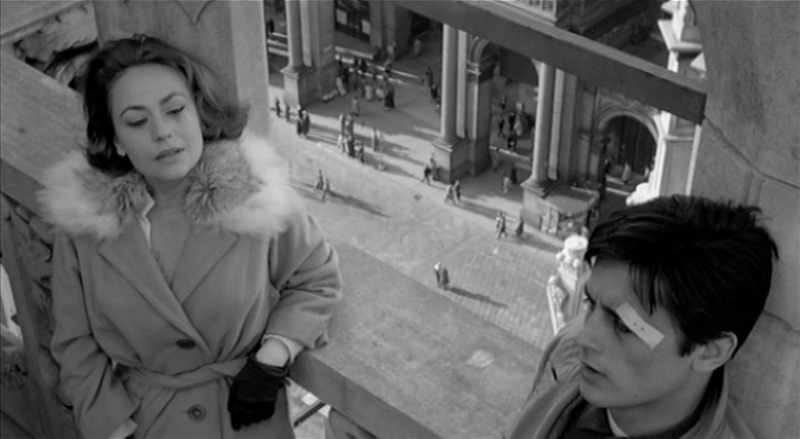
"Rocco and His Brothers" aka "Rocco e i suo fratelli" (Luchino Visconti, 1960) The Parondi family moves up to Northern Italy from the country and they find simultaneous success and tragedy in the city. It's the immigrant's story: they move to make a better life and the choices they make are wholly determined by their conditions. The widow Parondi (Katina Paxinou) moves her brood to Milano, where eldest son Vincenzo (Spiros Focás) is guest of honor at an engagement party for his intended, Ginetta (Claudia Cardinale). The family swoops in and North/South prejudices erupt and break up the party. The worst news for Vincenzo is, as eldest, he has to provide for them and arranges a short term rental that he plans to break the lease on, so they can be kicked out and depend on government housing. From there, the brothers must find work and make a life for themselves.

But it's tough to be a saint in the city. The film is divided into chapters for each brother, starting with
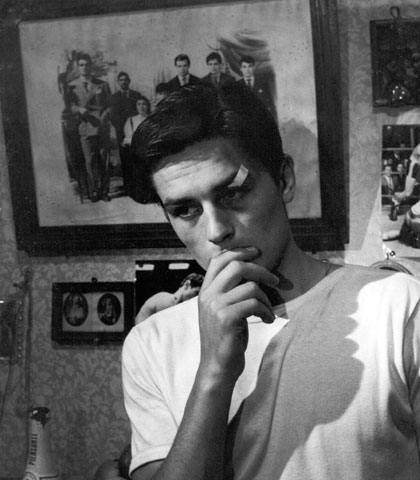
Vincenzo, then the mercurial Simone (Renato Salvatori), good-hearted Rocco (Alain Delon), practical Ciro (Max Cartier) and the innocent Luca (Rocco Vidolazzi) who looks up to them all. Simone and Rocco take the fast money way out, going into the traditional immigrant sportboxing—and its underworld of shady characters, Ciro gets an auto-workers job, while Vince ignores his mother's objections, marries Ginetta and moves out. Each brother, in turn, finds their escape from family, even Rocco whose mission seems to be to keep the family intact. The brothers are wholly unprepared for the city and their separate ways of dealing leads to internal conflict and strife, with the women in their lives often being the ones chewed up in their machinations.

It's not just the 3-hour length and terrific
Nino Rota score that suggest it, but you look at Visconti's direction of "Rocco and His Brothers" and you see the playbook Francis Ford Coppola used for "The Godfather:" the half-lit sets, the faces emerging from darkness, the "communal" shots where a lot happens in long takes of activity, the simultaneous staging of triumph and tragedy, and the bursts of violence communicated with a minute pre-echo of dread. That "Rocco" matches so many of "The Godfather's" themes—the passing of old traditions in modern times, the splintering of the family, the immigrant's plight, and the futility of good intentions—one can see how film-buff Coppola was inspired to make a silk purse out of Mario Puzo's best-selling sow's ear.

Tuesday, August 25, 2009

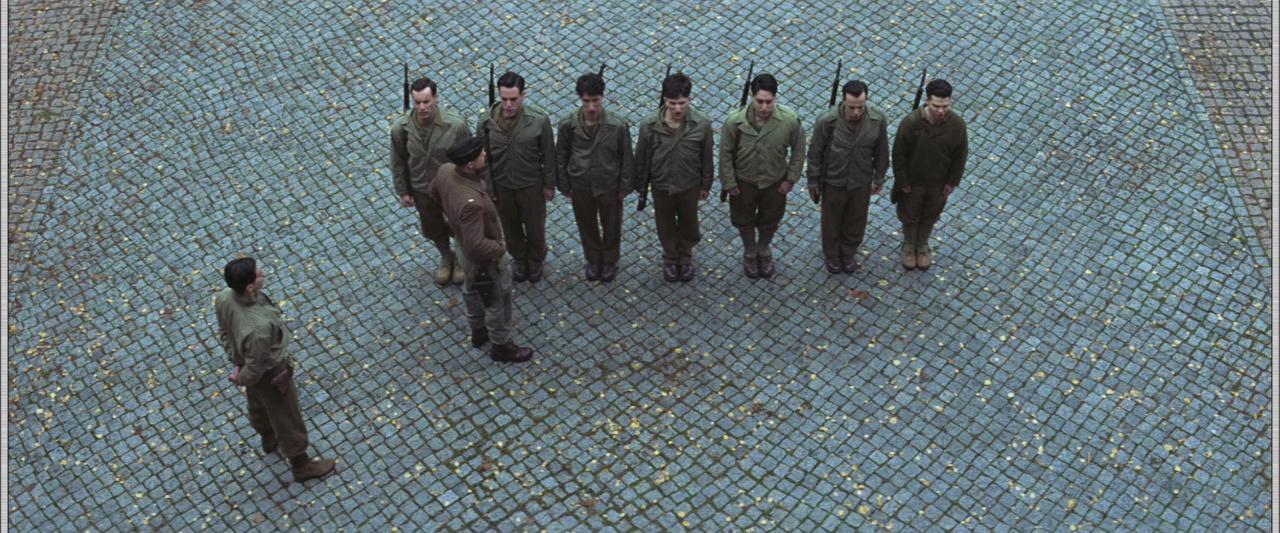
Inglourious Basterds

"Yaknow sumpin,' Utivich? Thyis Maht Be Mah Masterpyiece"

I run hot and cold on Quentin Tarantino. What most people consider his classics—"Reservoir Dogs," "Pulp Fiction," and "Kill Bill," I find one-off regurgitations of other people's films with gear-grating pop-culture references to con the kids. But I did like the Bruce Willis half of "Pulp Fiction" (written with Roger Avary)and think the world of his jazzing-up of "Jackie Brown." I was even surprised at how much I enjoyed Tarantino's half of "Grindhouse," "Death Proof." Tarantino's slavish devotion to matching other directors' techniques, combined with his lack of focus as a screen-writer (we went through four interminable hours of "Kill Bill" to get a lecture on comic-books?) have made his regard as a cinemaster seem like "The Emperor's New Clothes" to me.* Combine that with his reputation as a media-whore, who rarely says anything of much value,** explains why I'm always on the fence of QT. One film at a time, Sweet Jesus.

But I know a great movie when I see one, and "Inglourious Basterds"*** is a great war film, adventure story, spy story and movie-movie. Tarantino's influences are just as obvious, but more than ever, he puts his own sensibility to it, showing a superb command of the camera, composition, and direction in service to an interesting wish-fulfilment of a World War II story, and a paean to the unholy grip of cinema and its power to blow you away.

It's "Once Upon a Time in Nazi-Occupied France" (your first clue that you're not going to see a by-the-book WWII movie), and Tarantino begins a long prologue-like scene between a dairy farmer and the chief reason for seeing the movie,
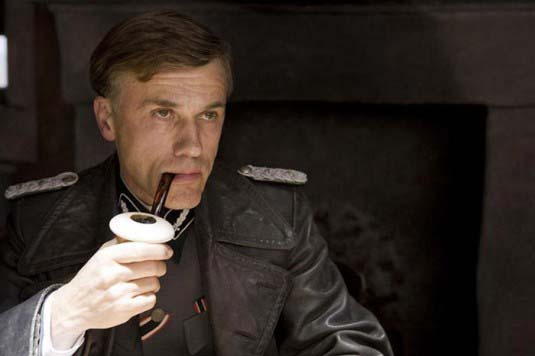
Christoph Waltz as SS Col. Hans Landa. Waltz's Landa is solicitous, polite, self-satisfied and more than a bit theatrical. That he is well-versed in languages and their subtleties is beyond question. He has a nickname (a lot of characters have nick-names and noms de guerre, few of which they like)—"The Jew Hunter"—and he has come to this farm-house to ask the farmer if he knows what became of a Jewish family who was known to be living in the sector (their current whereabouts unknown). It is a long, excruciatingly tense scene of false cordiality, heavily dependent on dialogue and subtleties of expression on which Tarantino, unable to fall back on street-language and bursts of giddy technique, maintains an iron grip.**** It's extraordinarily well-done and follows the negative contrast of Tarantino-movie-rhythms that dominates the film: a whole lot of talkin' punctuated by a brief manic explosion of violence, like a rubber band being constantly tightened until it snaps.

This episode sets up the Big Duel in the film—
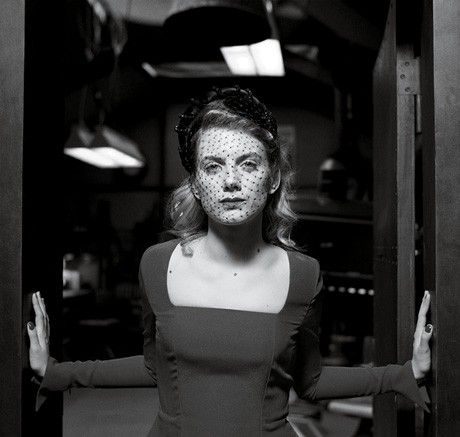
between Landa and Jewish refugee Shoshanna Dreyfus (Mélanie Laurent, very good in a multi-faceted role), who escapes to occupied Paris and is now running a movie theater, inherited from her aunt. Between the "chapter" showing us this and the opening, there is an introductory chapter to "The Basterds," a group of Jewish mercenaries dropped into France before D-Day as a "wet-ops" team. Their modus operandi is to scare the Nazis by destroying platoons through any means necessary (including clubbing them to death), then sweating information from the last one standing (and quaking). Led by Lieutenant Aldo Raine (Brad Pitt, doing a subtle turn as an unsub-tle comic-relief movie-star hero: "We're not in the prisoner-takin' business," he says at one point, "We're in the Nazi-killin' business. And, cousin', business is a'boomin'"), nicknamed "The Apache" for the way his troop mutilates the Nazi corpses to send a message, scalping the dead ones, and carving a large swastika into the fore-heads of the live ones, branding them for life.

By now, it's apparent that the level of violence in "Inglourious Basterds" is pretty high—brief, but high. The most violent of the Basterds is
Sgt. Donny Donowitz—"The Bear Jew"—the one with the baseball bat, and he's appropriately played by Eli Roth, director of the "Hostel" movies, one of the new sub-genre of horror films known as "torture porn." "Watchin' Donny beat Nazis is as close as we get to goin' to the movies," says Raines to Donowitz's next victim, setting up the major theme of the film. The violence is sometimes excruciating, but the major set-pieces are filmed with quick, intricate cuts and with an overall unsentimental sensibility. Tarantino spares no feelings and good guys get killed with the bad guys early and often and surprisingly.

"The Basterds," being in their unique position behind enemy lines, are recruited to help the British with "
Operation: Kino," as explained by General Ed Fenech (Mike Myers, doing his own version of "Basil Exposition"*****) to Lt. Archie Hickox (Michael Fassbender, the epitome of fussy), a former film-critic and intelligence officer in charge of the operation (Winston Churchill, supervises the briefing, as portrayed by Rod Taylor (!!)). But as with most espionage stories, the best laid plans...sometimes require a last-minute re-write.

Ultimately, all the parties converge onto one spot—that cinema in Paris that becomes the center-piece of "Operation: Kino" (or what's left of it), and in a confluence of hidden allies and enemies and dramatic cross-purposes
the film reaches a stunning crescendo, a "Götterdämmerung" that would have made Fritz Lang proud. This is all done with a careful precision, a precise plotting, and some superb directions and mis-directions on the part of the director, with the photographic wizardry of Robert Richardson and a soundtrack laden with bravado 60's film-music from the likes of Charles and Elmer Bernstein, Ennio Morricone, and pointed contributions from Billy Preston and David Bowie.

But...but...what the movie comes down to is a movie about movies, which seems a bit puerile, and a bit soon in Tarantino's career to have the medium eating its own tail for subject matter. Sure, he loves the movies. That's always been clear. But the movies he loves are about something...not just that they're great movies.
Howard Hawks took his arctic explorers, and air-mail pilots, and posse's and rhino-hunters, and they became metaphors for movie-making and of how disparate groups of talented people unite in a cause, but I can't remember a film he made about movie-makers that wasn't about something else. Here, Tarantino's rough-hewn coalitions band together, and it's about...what a great thing movies are. As a celebration of the cine-mah, it's an orgiastically great success, and I think its his best film.

but...but...

Can we say something more next time? Can we light up the screen to say something more than movies light up the screen? Can we have less fireworks, and more of a reason to have them?

And so I remain on the fence, hoping for the future.

One film at a time, Sweet Jesus.

"The Inglorious Basterds" is a Full-Price Ticket, with some superficial reservations.


* Miramax put out a DVD of "ChunKing Express" as part of its "Quentin Tarantino Presents" series. Frankly, Kar Wai Wong should be presenting HIM.
** I had to turn off his interview Charlie Rose on Friday, as Tarantino spouted out writerly cliches on his prowess as a writer ("First I come up with the characters and they write themselves!" I see, that's why, with a war going on—that we don't see—everybody's as movie-obsessed as QT in "Inglourious Basterds." I'd better stop or I'll talk myself out of loving this film, because in the final analysis, it's the movie that matters, not the slob who made it.

*** I'll bet you any money the title is mis-spelled like that to differentiate it from the original "The Inglorious Bastards" (or "Quel maledetto treno blindato," roughly a 1978 "Spaghetti-War" film by Enzo G. Castellari starring Bo Svenson (who cameo's in Eli Roth's Nazi film-within-a-film in Tarantino's movie), Fred Williamson, and Ian Bannen, but on a metaphorical level, it shows a total disregard for the rules, which sets up it's "How I'd Win the War" scenario, belying History. Isn't that what most movies "based on a true story" do? Isn't that the job of the fiction writer?

**** There's a nod to one of my favorite shots in Sergio Leone's "Once Upon a Time in the West" where Charles Bronson takes 30 seconds or so to relax a smile from his face in tight close-up. Tarantino doesn't copy it exactly, but there's a nod to it.


***** A late-night thought (one which might piss off folks who take Tarantino SOO seriously, but it feels like a "natural:" Myers and Tarantino both suffer from "lazy-eye writing" where it's thought that if you just recall something from a past movie and reference it that that is all that's sufficient for it to "play"—which is why the "Austin Powers" series is so weak. Tarantino has had a running feud with EON Productions in "the Press" over whose idea it was to make a film of "Casino Royale" (Answer: original author Ian Fleming)—and a balding Tarantino-like henchman named "Elvis" appeared in the last Bond movie,"Quantum of Solace"—why not put Tarantino at the helm of the next Powers-fest (which has been talked about since...well, since the last one). Tarantino would have a giddy field-day with it, the genre, and the chance to gnaw on the red meat that is the Bond movies. It would easily be the best entry of the series. Only problem: during filming, the set would be like walking into a daily cage-match, where two prima donnas walk in and only one can emerge.

Sunday, August 23, 2009

Don't Make a Scene: Catch-22

The Story: Authors cringe when you talk about making a movie from their work. I remember seeing an author on the old "Dick Cavett Show" who grumbled that helping to write the movie's screenplay was akin to "holding the coat of the man who's molesting your child."

And so, Joseph Heller's "Catch-22."

I don't know how Heller felt about Mike Nichols' film of his most famous best-seller, overall, but I do know this: he loved this scene.

He loved this scene so much, he told its author, Buck Henry, that he wished he'd thought of it for the book.

High praise, and why this is the scene for the week.

The Set-Up: Every war movie has its "scrounger," the "get" guy, the "dog-robber," the "King Rat"—the one who can acquire the things that people need and want and sets up a black-market lemonade stand of his stores. Joseph Heller took the concept and used it to satirize the monstrous greed of 50's Corporate America in the character of Milo Minderbinder ("What's good for MM Enterprises is good for America"), who would sell the pilot's parachute silk for profits, leaving the air-crews with promisary notes for shares in his "Syndicate." Mike Nichols and Buck Henry took the idea a bit further and made Heller's Milo a wheeler-deeler turned fascist dictator. In this scene, Yossarian (Alan Arkin) confronts Milo (Jon Voight) over Milo's deal with the German government to bomb the Allied air-base, which managed to kill Nately (Art Garfunkel). Milo would have no trouble sitting on the board of Enron or Halliburton. Why, who knows how far he could have gone? Or would have gone?

Yossarian runs after Milo's motorcade and attempts to board the jeep where Milo is standing in the glow of the klieg lights. Milo's police contingent hold Yossarian back.


Yossarian: Milo, I'm gonna kill you, you murdering son of a bitch!

Milo Minderbinder: Don't hurt him.

Milo: I know how you feel...

Milo: ...but it wasn't my fault.

Yossarian: Who's fault was it?

Milo: No one. Nately was the victim of certain economic pressures, the laws of supply and demand.

Yossarian: You unbelievable bastard! (The MMP's punch Yossarian in the stomach, and he crumples.) Uhhh!


Milo: Do you want me to take you to her?
Yossarian: (gasping) Who?
Milo: Nately's whore. Aren't you looking for her?

Yossarian: (gasping) You know where she is?

Milo: Of course I do.

(Milo gestures and the MMP's load Yossarian onto the Jeep)

Milo: You're AWOL, Yossarian. I thought you knew better than that. That's not smart. Nately wouldn't do anything that dumb.

Yossarian: He's dead.
Milo: It's too bad. He was a nice fellow.
Yossarian: And your boys made a nice direct hit on him.

Milo: But he died a rich man. He had over 60 shares in the Syndicate.
Yossarian: What good is that? He's dead.
Milo: Then his family will get it.
Yossarian: He didn't have time to have a family.
Milo: Then his parents get it.
Yossarian: They don't need it, they're rich.

Milo: Then they'll understand.

(Milo gestures to the MMP's and Yossarian is thrown out of the Jeep)


"Catch-22"

Words by Buck Henry

Pictures by David Watkin and Mike Nichols

"Catch-22" is available on DVD from Paramount Home Video.

Saturday, August 22, 2009

Olde Review: Purple Noon

This was part of a series of reviews of the ASUW Film series back in the '70's. Except for some punctuation, I haven't changed anything from the way it was presented, giving the snarky, clueless kid I was back then a break. Any stray thoughts and updates I've included with the inevitable asterisked post-scripts.

This Saturday's films in 130 Kane at 7:30 pm are thrillers: one sophisticated; the other unsophisticated, but God, it's neat, and they are Rene Clément's "Purple Noon" and Brian DePalma's "Sisters"

"Purple Noon" or "Plein Soleil" (René Clément, 1960)Clément's "Purple Noon" was shown on TV Thursday night under a different title—"Lust for Evil"—and in a dubbed English version. Even if you saw it on Channel 9,* you should go see it Saturday night because, let's face it, movies always lose something on the television screen,** especially if they're dubbed in a sort of ill-fitting English as the televised version was.

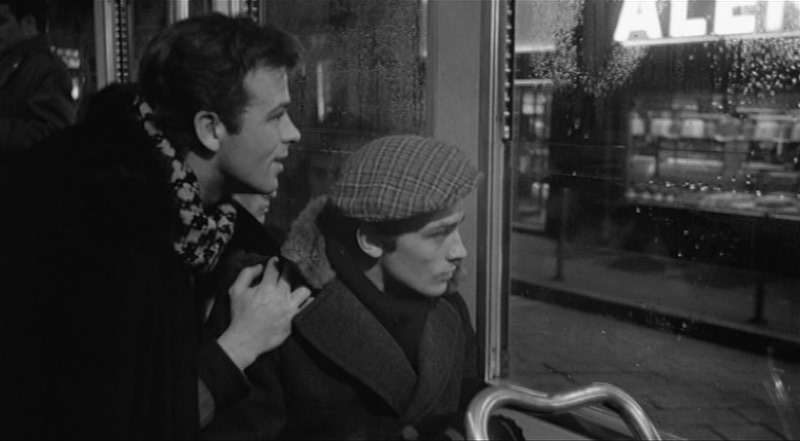
"Purple Noon" is the story of two somewhat irresponsible young men. They tour the streets at night looking for trouble, rousting whoever they can. And in the course of the plot, one of them is murdered by the other. But how can
Alain Delon, who plays the murderer, get away with it? Well, it happened out at sea, they were alone on the victim's boat (the victim's fiancé in a fit of pique had gone ashore), there were no witnesses.

But won't people, especially those close to the victim notice his disappearance?
Delon has a plan for that: he is an excellent forger, he has the victim's belongings, his passport, and he can imitate his voice. And the fascination in this story is in the second portion. Will Delon be detected by those who knew the victim—especially the fiancé? Will he get out of all the close calls? How will he avoid it? It's a run through a maze and it culminates without a nice surprise ending.

And Clément's direction can sometimes come up with pleasant little touches that leave the viewer just a little bit amazed, as in the murder on the boat (that is over so quickly) only to be replaced by the problem of getting rid of the body, a task that is made more difficult by a sudden storm at sea that seems to rise up in moral vindictiveness over Delon's act. It's a nice touch, and "Purple Noon" is a nice, somewhat sedate little thriller.

Broadcast February 12, 1977

I didn't know from Patricia Highsmith in college. I discovered her quite later. Her delightfully dark amoral little tales filled a musty little hole in my heart for years. I did not know Highsmith when I saw "Purple Noon" in college, nor could I know that what I was seeing was the original, slimmed down and altogether superior French version of "The Talented Mr. Ripley."

It's bad form to speak ill of the dead (although Ripley would do it with his usual lack of conscience), but
Anthony Minghella's 1999 version of the tale starring Matt Damon, Jude Law and Gwyneth Paltrow was too puffed up and proud of itself to make an effective thriller. It felt staged and lethargic (and that is the last thing a Ripley movie should be), whereas Clément is a witty, nimble director who will never let any cruel irony go unexploited.

Highsmith wrote five "Ripley's"—called "
The Ripliad," only three of them have been made into films, two of them twice—and five men have played Ripley, besides Delon. Dennis Hopper played him in Wim Wenders' "The American Friend" (adapted from "Ripley's Game"), Matt Damon in the Minghella film, John Malkovich in the second "Ripley's Game" adaptation, and Barry Pepper in "Ripley Under Ground." Highsmith died in 1995 of leukemia (not foul play).


* Channel 9 was, and is, Seattle's main PBS affiliate—public television—and at the time of writing plays movies on Friday nights. The fare is some package of American movies that might have fallen off the populist radar—for every "Lone Star" there's a "Fiddler on the Roof"—that are old enough that they're not on standard rotation on the so-called "movie channels." I suspect they wouldn't be caught dead playing a foreign film—unless it involved cooking.

** Bear in mind this was the 70's—pre-HD, pre-plasma-screens, pre-home theater—when the ol' cathode-ray tubes didn't do justice to the pan-and-scanned images that were culled from the wide-screen prints—which was because they were 36" in diagonal.

Friday, August 21, 2009

District 9

"Dances With Prawns"

Ridley Scott recently said in an interview, "Science Fiction in movies is dead," proving once again that as a visionary, Ridley Scott is a superb art director.*

But, like Westerns, they can continue to cast a reflection on our life and times, just as surely as the Sun sets in the West—on Earth or Mars—wherever there are flawed humans who'll make the same mistakes in the future as they did in the past.

Take the new film by South African film-maker
Neill Blomkamp—"District 9"—a re-telling of the issues of apartheid both in macro- and micro-cosm. It won't score many points for originality, but as a potent rejuvenation of how sci-fi can focus attention on an issue, it may be the best film of its type since "The Road Warrior."

Twenty years ago, a large spaceship is left, stranded, hovering over Johannesburg. When official go to take a look, they find a race of aliens— emaciated, starving—and they begin transporting the survivors off the ship and into makeshift refugee camp, dubbed "District 9." And in a repeat of history, the camps "became fenced, then militarized, and then it became a slum." The Joburg citizens of all races are barely tolerant of "the prawns," as they are called, as long as they stay on their side of the fence. They become scavengers, demoralized, living on garbage taken advantage of by human predators. They're also extremely well-armed (with weapons that only respond to their DNA, so humans can't use them), and attempting to create the fuel they'll need to get back home.

This back-story is told from rough-edited documentary footage outlining "the situation." As the human/prawn tensions become high, the M.N.U. (
Multi-National United) is recruited to move the million prawns to a new relocation camp far from Johannesburg. In charge of the operation is the son-in-law of an MNU muckety-muck, Wikus van der Merwe** (Sharlto Copley) and you just know from the documentary footage of him that 1) he's an idiot, senseless and blithely ignorant and 2) "something" happened to him, as he's always mentioned in the past tense.

What's happened is that van der Merwe's evacuation plan,
a disorganized xenophobic spree, has uncovered weapons cache's, nurseries (which are put to the torch—"Listen to them pop!" exults van der Merwe to the camera), and due to his pig-ignorance, he's exposed to an agent that begins to change him into one of the insectoid aliens, giving him a look at their world, walking a mile in their claws, as it were...and, oh, by the way, he can start using their weapons now.

Now, lest anyone get the impression this is a life-affirming lesson in just getting along, be advised that it's a parable soaked in blood and bile. It's one of the dankest, squishiest movies I've ever laid eyes on with much viscous vomiting, projectile blood-shed—the aliens' weapons are particularly nasty, exploding human bodies like blood-blisters with gout's of blood hitting the camera lens—and sequences of transformation somewhat akin to Cronenberg's "The Fly" (particularly when the hero tears out his fingernails). I saw more than enough folks who had to leave the theater when I saw it, so be warned (especially you parents being pressured to see
the "space-ship" movie).

It is also one of those surface-message movies that belies its point with its story presentation, the message being mixed in a left brain/right brain conflict. Xenophobia is certainly shown as wrong, but in as visceral a way possible, the only difference depending on what side of the electro-blaster-micro-waver you're on. And there isn't any direct retribution for actions taken—the film has a mindless video game feel to it, rather emptily getting the blood up, and providing no catharsis to diffuse it.***

However, there is a lot that makes "District-9" satisfying (if uncomfortable) from its performances, art direction, seamless motion capture effects, and design.

Oh. And in a final irony: Blomkamp's artist's representation in California is RSA...which is owned by Sir Ridley Scott.

"District 9" is a Matinee.

* One wonders why he would even say such a thing as his company, Scott Free Productions, produced the egregious (but ratings-busting) A&E regurgitation of "The Andromeda Strain." One might agree if he was talking about the line of toy-ad's masquerading as entertainment (Can't wait for "Lincoln Logs: The Movie!"), but those can hardly be counted as "science fiction."

** Here's another layer to "District-9"—it's a cultural joke. In South Africa, there is a sub-species of joke called the "van der Merwe joke," like "blond" jokes in the U.S., or "Sven and Ole" jokes in Scandinavian communities, they're self-deprecating humor about just how dumb someone could possibly be. That "D-9" starts as a van der Merwe joke and turns into a story of redemption is just one of the insidious joys of "District-9."

*** "District 9" came about as a substitute project for director Blomkamp and producer Peter Jackson after their planned collaboration of the film version of the popular "Halo" video game came to naught.


Thursday, August 20, 2009

In the Loop

"You Might Have Heard Him Say it, But He Didn't Say it, and That's a Fact!"

They say you don't want to see government at work just as much as you don't want to see sausage being made. The implication is that both involve grinders and a certain amount of evisceration. And the dropping of blood, metaphorically, and in some cases, literally.

"In the Loop," the smart, funny movie version of the British comedy "In the Thick of It" manages to bludgeon home that point, but also draw parallels with the most drop-dead dysfunctional of office settings. "In the Loop" employs the same "caught on the fly" filming and editing techniques of "The Office" and they're played out by a cracker-jack group of actors who give the impression that they're ad-libbing the whole thing (led by a startlingly brilliant performance by Scotts actor Peter Capaldi*). Only it's "The Office" with a vindictive murderous glee and what, if it had gone through the Ratings Board,** would be described as "pervasive language."

It is also an episode of "
Yes, Minister" on meth-amphetamines set in an abatoir, where the civil servants—the guys who never get voted out of office—run the show, and the show is the pantomime of a representative government working on the people's behalf. The lobbying people. The people in power. Those people. You know. There's enough invective in this movie to launch a thousand Uni-bombers, and most of it is hilarious—the kind of hilarity you feel guilty about laughing at. Especially if you didn't vote (not that it would do you much good).

In this expansion of the series,
the British Secretary of State for International Development Simon Foster (Tom Hollander) burbles through an inoccuous press interview that an anticipated war conducted jointly by the U.S. and Britain is "unforseeable" and the Prime Minister's Director of Communications Malcolm Tucker (Capaldi) begins running interference ("I'm sweating spinal fluid here!") for Foster, the PM, and American functionaries creating damage control by causing as much destruction as possible (not too unlikely a scenario). That he does it by some of the most creative uses of the Anglo-Saxon tongue makes it hilarious, cruising through the labyrinths of power filled with ass-covering lackeys like a shark through a school of puffer-guppiesbattering through so many non-functionaries "on defense" by being as offensive as possible.

This is not your father's "
Mr. Smith Goes to Washington," or even "The West Wing"—both those political dramas assume that civil servants are servants, rather than being self-serving, doing their jobs for the public good, not seeing it as a public nuisance. Those films assume the core of public service as "Love Thy Neighbor," rather than the reality of all-knowing governments—but only in the biblical sense.

"In the Loop" is a Full-Price Ticket. See it soon before it goes away.

* Capaldi may not be familiar to American audiences, but you've seen him before—deny it all you want, but you have—maybe in "Local Hero" or even "Doctor Who." In fact, he won an Oscar for writing and directing "Franz Kafka's It's a Wonderful Life." Also in the cast are James Gandolfini—as good as you'd expect him to be—Mimi Kennedy, the always entertaining David Rasche, and...anybody remember Anna Chlumsky..."My Girl?"

** It didn't, and so it arrives at theaters with the "NR" rating, the "nolo contendre" of the MPAA system.