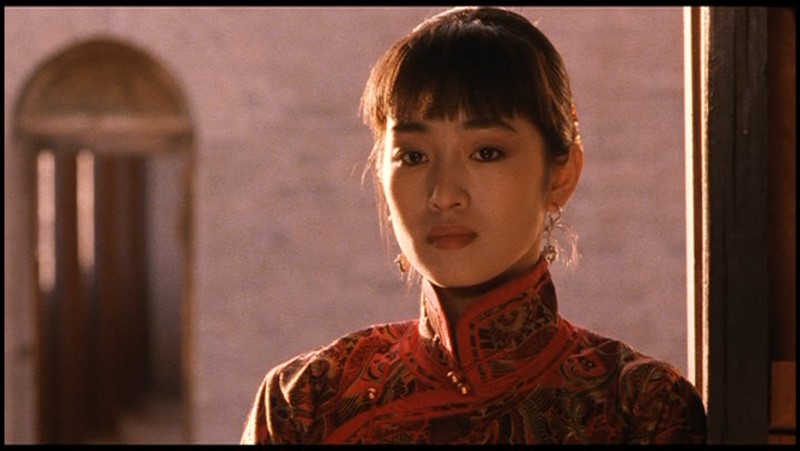
"Raise the Red Lantern" aka "Da hong deng long gao gao gua" 大紅燈籠高高掛 (Yimou Zhang, 1991) Typically gorgeous Zhang Yimou film, although at this early stage with a very limited budget. But that doesn't limit his imagination. The film is staged (with the exception of a prologue) in an clutch of houses, which are the enclave for The Four Mistresses of The Master. Wife #4 Songlian (Li Gong) was a college student who dropped out when her father died, and now is the new bride, the youngest and most frequenly sought by The Master for her favors. Every night is a competition among the wives as the one for whom the red lanterns are raised receives special treatment. This leads to duplicity and deception and Songlian is caught in the middle and learns cunning when dealing with the outwardly polite, but squabbling mistresses.
The compositions and colors are as sumptuous as one has come to expect from Zhang, but his manipulation of light is just as impressive, the film descending into murky twilight as the bitter consequences of the Mistress' actions become apparent, and the psychological wounds tear at the women. Although the acting is by and large austere, the director keeps the emotions brewing through his subtle manipulation and triangulation of passed looks and simmering reactions. Very early in his career, it shows Yimou Zhang as a master of formal cinema, and capable of great effect with merely actors and a limited location. As he embraced new technology and expanded his horizons, his cinema would explode. with possibilties. He is one of the few directors whose work I always anticipate.
Saturday, January 31, 2009
Raise the Red Lantern






Friday, January 30, 2009
Olde Review: The Conversation
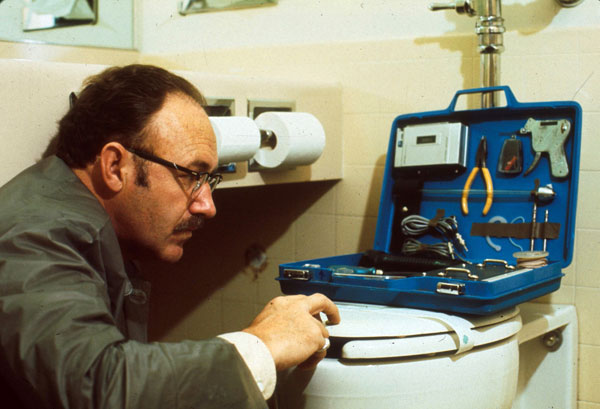
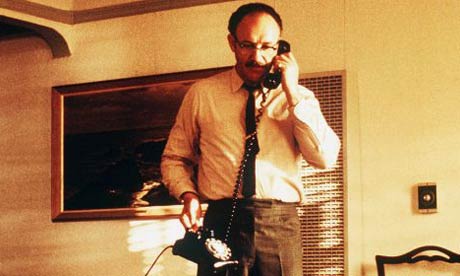
This was part of a series of reviews of the ASUW Film series back in the '70's. Except for some punctuation, I haven't changed anything from the way it was presented, giving the snarky, clueless kid I was back in the '70's a break. Any stray thoughts and updates I've included with the inevitable asterisked post-scripts. "The Conversation" (Francis Ford Coppola, 1975) Harry Caul (Gene Hackman) is an electronics expert dealing in surveillance. His latest assignment is to record a conversation between two very innocent young people in the park. It's a routine assignment, one that Harry handles with a perfectionist's care. But after he has the raw tape—after he has clarified it and re-channeled it—he hears a whispered fear that these two kids may get killed by Harry's employer. Old haunts plague Harry—past assignments he has carried out that led to his victim's deaths. And so he goes to confession to confess what may be a future sin. Confession—where one's private actions that are considered to be sins are revealed to a priest in order to free the sinner of guilt. But this too, is a surveillance—an invasion of one's privacy—ritualized in the name of religion. Surveillance is a part of our lives, then. And privacy is an illusion.
That scene in the confessional is about as close as Francis Ford Coppola comes to really dealing with surveillance in his film, "The Conversation." Despite what many critics have said, Coppola makes no judgements on this subject. Surveillance is simply there as a device to be used for the movie. It's neither good nor bad. It's there to provide Coppola with a means of getting into a rather shallow appearances-are-deceiving mystery story—it's a very weak imitation of Antonioni's "Blowup." When Harry Caul is caught in a surveillance trap ala his own devising, are we supposed to feel some satisfaction in this? Just because he's getting screwed, like he screwed all the others? Is surveillance justified in retribution, in other words? No. How can we take satisfaction in that? For surveillance — the ripping open of one's privacy — is being used, and nothing, really, not even revenge should make us condone it.
Awright, already, W______is it a good movie?
Okay, okay. Yeah, it's a good movie. It's...entertaining, in a shock-lull-shock-lull sort of way. Coppola has made a good movie, despite my reservations as to his morality on the subject. It's an o-k script—a little spare at times—with a lot of loose ends, and his direction is always assured. Gene Hackman manages to flesh out Harry Caul enough to make him an interesting person to watch for the couple of hours we do. And there is fine supporting acting from Allen Garfield, John Cazale (the weak brother, Fredo, in "The Godfather"), Frederic Forrest, Cindy Williams (she's good, despite the fact that she's totally mis-cast) and Robert Duvall (who is on for a very short time and doesn't receive a credit). But, the one thing that is technically outstanding is the sound of the film, produced by the work of its chief editor Walter Murch. Murch also worked on "The Godfathers" for Coppola, and creating what he terms "sound montages" for George Lucas' "THX-1138" and "American Graffiti." His talents with editing and sound mixing are outstanding,and hopefully Murch will, himself, be directing his own films.
Broadcast on KCMU-FM on January 27-28th, 1976
Murch would, indeed, direct one film (so far)—"Return to Oz," in 1985—and it tanked. His intention was to make a genuine adaptation of one of L. Frank Baum's "Oz" books, rather than what the public was expecting—a sequel to the 1939 classic "The Wizard of Oz." And his heart-felt, but scary, recreation of Baum's world didn't click with audiences. One would be sad if Murch didn't then personally supervise the entire post-production process of about one film per year. Films like "Julia," "The Godfather: Part III," "Romeo Is Bleeding," "The Unbearable Lightness of Being," "Ghost," "The English Patient," "First Knight," "The Talented Mr. Ripley," "K-19: The Widowmaker," "Cold Mountain," "Jarhead," and Francis Coppola's latest films. Busy guy. Eclectic talent.
This movie has dogged me my entire career, because it was assumed that, because Harry Caul could electronically filter out steel drums from the background of a murmured recording enough for you to hear what the people were saying that any sound facility could do it, too. No. Not really, you can't. You can tune, you can attenuate, you can try reversing the polarity of a channel to eliminate shared sounds on both channels of a stereo recording, but steel drums? That's a good one. They call that "Movie Magic."
But the kid is right...this is warmed-over "Blowup" without the illusion of film-making, or illusion of illusion that makes that film so compelling. At least it's better than cold, left-over "Blow-Up" like Brian De Palma's "Blow OUT" (in that, film recordist John Travolta must piece together a Chappaquidick-like incident from his sound-recordings and pictures taken from a "Zapruder"-like film--it doesn't pass the incredulity test). And Coppola has to resort to a "cheat"—he changes the actual recording, the one element in the movie that has to be set in stone, to come up with his conclusions. One could make a case...blah blah blah, the fact is, interpretation or not, he planted a card in the deck.
It is, though, a really good paranoid thriller of the type that seemed to be born of the post-Watergate era. And Hackman's insulated Caul is another example of how that actor can take an under-written part (deliberately, I should say--Caul doesn't talk much on purpose) and make him a living, breathing human being you can recognize and, despite his many failings, sympathize with. There is one actor I didn't mention because I didn't really know who he was...yet. He'd made a living doing parts on television, and done a small role in "American Graffiti," but after this film he was about to quit acting and go back to carpentry when a role in a sci-fi movie by Coppola's pal George Lucas changed things for him. Harrison Ford has a small role as "The Director's" menacing assistant.
Oh...the reason I made such a big deal of the confessional scene? I used that to start off the recorded version of this review.
In 1995, "The Conversation" was chosen to be a part of the National Film Registry by the Library of Congress seeing it as "culturally, historically, or aesthetically significant."




Thursday, January 29, 2009
Olde Review: The Lost Honor of Katharina Blum
This was part of a series of reviews of the ASUW Film series back in the '70's. Except for some punctuation, I haven't changed anything from the way it was presented, giving the snarky, clueless kid I was back in the '70's a break. Any stray thoughts and updates I've included with the inevitable asterisked post-scripts.
If you're feeling in the mood for a little paranoia, you might want to sneak a peek at Friday's ASUW films in 130 Kane. They deal with a social problem that touches us all: the destruction of the individual's right to privacy, and the films are "The Lost Honor of Katharina Blum" and "The Conversation."
"The Lost Honor of Katharina Blum" aka "Die Verlorene .jpg) Ehre der Katharina Blum oder: Wie Gewalt entstehen und wohin sie führen kann"* (Volker Schlöndorff, 1975) This is a German film, first presented to Seattle at the Moore-Egyptian Film Festival** and proved to be the hit of the many films presented there. It states at the outset that the story is based on a true incident, *** which alerts one that what is about to unfold is a very strange story—so strange that if those responsible didn't tell you it was real, you wouldn't believe it.
Ehre der Katharina Blum oder: Wie Gewalt entstehen und wohin sie führen kann"* (Volker Schlöndorff, 1975) This is a German film, first presented to Seattle at the Moore-Egyptian Film Festival** and proved to be the hit of the many films presented there. It states at the outset that the story is based on a true incident, *** which alerts one that what is about to unfold is a very strange story—so strange that if those responsible didn't tell you it was real, you wouldn't believe it.
We begin by following the surveillance of one Ludwig Götten (Jürgen Prochnow) (we are watching the surveilllance for we, the movie-watching audience out there in the dark, are the ultimate voyeurs) Götten knows he is being followed—that he is being watched, but he manages to elude them...almost. During his wandering, he runs into a girl, Kathharina Blum (Angela Winkler) and they spend that night together.
In the morning, Ludwig is gone. The police who had been surveilling him are dumb-founded, and Katharina is their only lead. And so, amid much hoopla and press coverage, Katharina is taken into custody.
"It is the duty of the police to inform the public." Recognize that phrase? It's something of a play on the old stand-by, now cliche, argument of the Press. But with this phrase comes the first hint of what this movie is driving at. The police and their tactics are openly displayed in the opening segment. Once you know it's the police you are perfectly willing to take on the air of self-righteousness and say "These police are fascists, through and through!" But, as the film progresses, you realize that that the actions of the Press are the focus of the film. Indeed, the press are working with the police; each one supplies the other with information they have scraped up. It's a very harsh picture of the Press that is presented, and many may not like it, after all, being an investigative reporter is in "in" profession—they are our latest media heroes. And it dares to question the people's right to know...that is, the people's right to know dirt. "The freedom of the Press can not be taken lightly," says the duplistic D.A. "But the freedome and dignity of mankind can be?" replies Katharina's outraged aunt. Katharina, herself,states that "it is their business to rob people of their honor, or else they wouldn't sell newspapers."
"...Katharina Blum" is very one-sided. Its arguments and its tone in presenting totally immoral reporters, grubbing for headlines may make some think the film is a total harangue. But, for my part, I couldn't help thinking of the Patty Hearst's, the Gary Gilmore's, the Jimmy Carter's and the endless string of others whose total life-histories (have been) paraded before our eyes for the sake of ratings or our money. I highly recommend this film to everyone. It might make you think twice before you smirk at the people who refuse to be interviewed on "60 Minutes."
Broadcast on KCMU-FM on January 8th, 1976 (thirteen years ago today)
I am shocked! shocked!! to find that the press do things for money! Still, one would like to think of our news-gatherers as doing a public good as opposed to directing the eyes to the ads, but the situation has only gotten worse, not better. In the 33 years since this review was written (33 years this week, in fact) we have seen the death of ex-Princess Diana, killed in a high-speed car-wreck when her somewhat inebriated driver attempted to evade a horde of papparazzi, a young mother committed suicide after being publicly accused of infanticide by braying talking-head Nancy Grace, and Geraldo Rivera's reporting of a rumor of finding all the miners safe in the West Virginia Sago mine disaster only deepened the country's gloom. Generally, the news-mongers have marched towards info-tainment while abrogating their responsibilities for access and "most-favored" status on K Street party lists. And in a scenario that expands the one of the film to national, and potentially international proportions, the Bush Administration fed self-produced "news" stories to local stations, and planted "reporters" (one, a gay prostitute) to salt press conferences and throw the conferencers some soft-balls. "Lost Honor?" One is lucky not to have their bones jellied in the gears of the News-Monster, government-sponsored or no. Jürgen Prochnow became an international star, and Volker Schlöndorff went to a Hollywood career (directing Dustin Hoffman's stage and TV versions of "Death of a Salesman," as well as the film version of "The Handmaid's Tale") and continues to work in Germany.
And "60 Minutes," with a complete turn-over of correspondents, though its been endlessly copied and co-opted, keeps on ticking.
* "The Lost Honor of Katharina Blum, or How Violence Develops and Where It Can Lead."
** Now called The Seattle International Film Festival, now far expanded from just the Egyptian Theater in Seattle.
***Hmm. So did "Fargo."
Wednesday, January 28, 2009
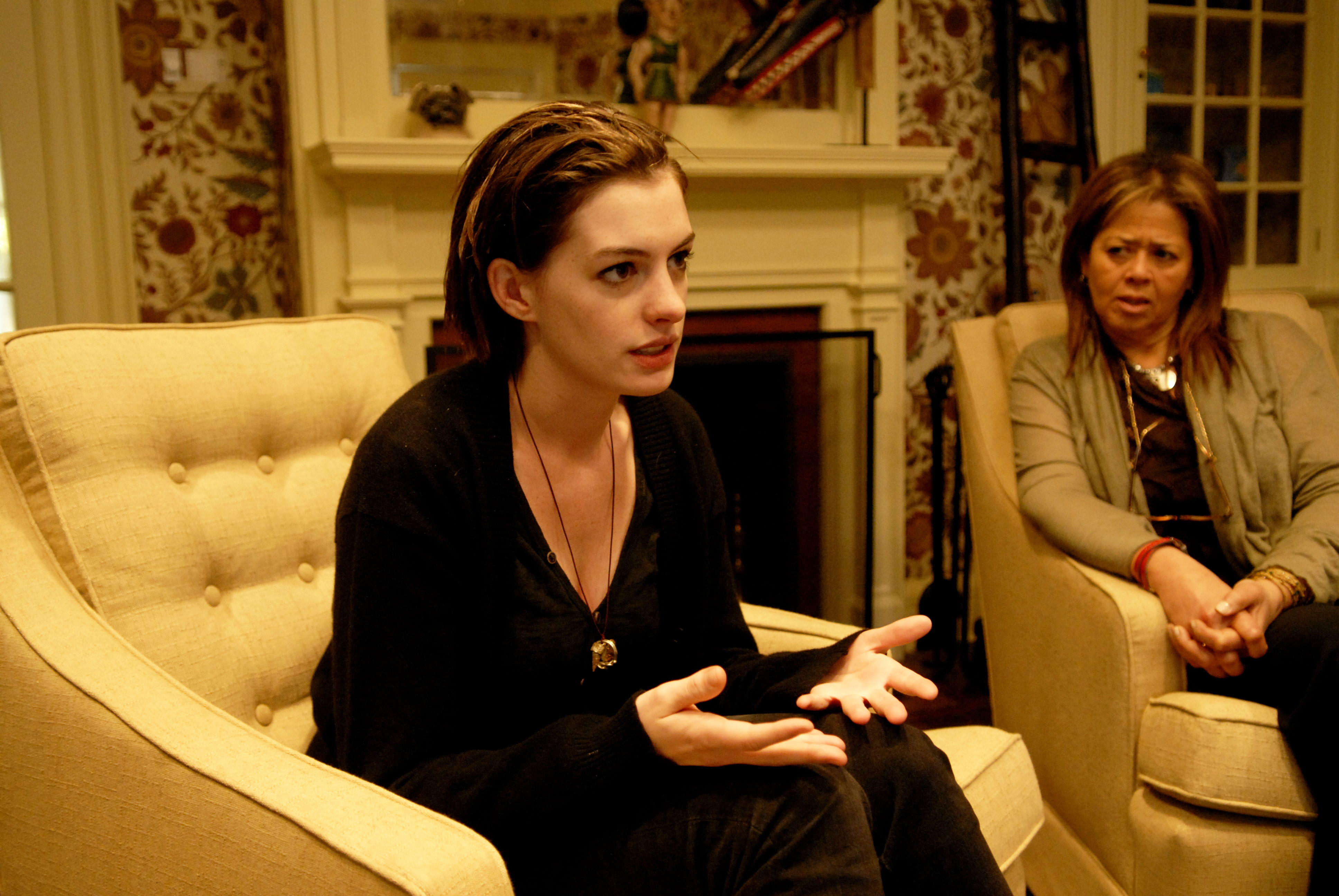
Rachel Getting Married
 "Just as Long as there's Health"
Dearly Beloved, we are gathered here to join Robert Altman's "A Wedding," James L. Brooks' "Terms of Endearment," Robert Redford's "Ordinary People," and Otto Preminger's "Tell Me That You Love Me, Junie Moon" in a Wholly hand-held digitized Indie Matrimony. Do you promise to love and cherish this movie through Sundance and Award-Season, through Oscar Campaigns and Buzz-Kill. Do you promise to watch over the dodgy home-movie-like photography, the world-music wedding sequences, the roller-coaster ride of joyful scene, painful revelation, funny scene, hysterical over-reaction, calming lull, screaming match, cathartic suicide attempt, reconciliation and subtle revelation?
You do? Really? ....(really?!)
Well...uh...then, may I present "Rachel Getting Married," a fine film with a good pedigree that manages to unfold slowly like an Altman film, but with a definite point to reach, story-wise and some terrific performances by a great ensemble cast. I've seen lots of culture-clash wedding movies before--they're a good source for forced comedy, always a little too forced. But here, from a script by Jenny Lumet (Sidney's kid), the complicated back-story is revealed organically, when the characters are ready to reveal it, with a protracted amount of time thwacking and hacking through the thicket of recrimination and resentment and nobody talking about "it," they're usually raising their voices about what's happening right NOW! There are moments you want to walk out into the lobby discretely to let them work it all out, which happens quite a bit in this movie.
The tough part in this type of thing is for the actors to carry the history without giving too much away and to prolong the interest, and fortunately, Jonathan Demme has cast a great range of actors, particularly funny-man Bill Irwin, who is a more interior and less volcanic Robin Williams. When Williams has a plot revelation, it's everything to keep it contained in a burst of hyper-volatility, but Irwin (who goofed with Williams in the "Don't Worry, Be Happy" video) is a more suppressed performer, with the discipline of a mime. Revelations have to be pulled out of him (with an invisible rope!).
As his wife (and support system), Anna Deavere Smith--a great joy in "The West Wing," and was one of the few actors to come out looking good in "The Human Stain." As Irwin's ex-wife, Debra Winger, and anytime Winger's in a movie, it's an event. Here, she's the mom-harpie that she played against in "Terms of Endearment," and where Shirley MacLaine was show-stopping trooper, Winger submerges it, and lets it out in dribs and drabs, which is the perfect strategy. Rosemarie DeWitt plays the eponymous "Rachel" (and why that title is so important becomes clear in the film) in a role that at the dawn of the indie boom would have been played by Annabeth Gish.
But over-shadowing the movie like a little black cloud is Anne Hathaway as the family member with a three day pass from re-hab, who's working on addictions to well, just about everything...booze, narcotics, tobacco, danger, sex, drama, attention ("Hello, I'm Shiva, the Destroyer," she begins her wedding toast). There's a semi-running gag of her running into people all-too-familiar with her past (A 7-11 clerk sees her enter and brightens, "Didn't I see you on "Cops?"). Hathaway is a little thunderstorm, chain-smoking, machine-gunning dialogue, hyper-needy, guaranteed to say the inappropriate thing, and every scene she's in you wait for the bomb to go off--she's your worst Liza Minnelli nightmare. And when she reaches a moment of relative tranquility, the film loses some of its charge, even though it's nice to have a little "relative" peace and quiet. Don't count her out of the Oscar race.
"Rachel Getting Married" is a Matinee.


Tuesday, January 27, 2009
The Raven
 "The Raven" aka "Le Corbeau" (Henri-Georges Clouzot, 1943) Made during the occupation of France by the Nazis, and released by a German production company, its director and crew came under attack after the liberation, and despite the film's popularity with the public, right and left wing factions both denounced the film and barred the participants from film-making for years.
As usual, the idealogues missed the point completely. Clouzot (the director of future classics, "Les Diaboliques" and "The Wages of Fear") made a movie about bearing false witness—a trademark of the German regime—and about hanging together, or hanging separately.
The plot revolves around the rather decadent life-styles of prominent physicians in a small French town. One by one, they receive anonymous "poison-pen letters" (signed only as "Le Corbeau" accusing them of adultery, abortions and all manner of poor behavior. They are outraged! Never mind that the accusations are, by and large, true! Who could be doing such an outrageous thing? Soon suspicions and speculations crop up about who might be the anonymous poster, and the learned citizens begin to turn on each other like a pack of wolves.
The emphasis is on psychological tension, as with Clouzot's finest films, and by the "Fin" card, enough damage has been done that there is no turning back. Character, or the lack of it, determines fate for good or not. And the complexity of the plot lends no easy answers, except for the complacent.
"Le Corbeau" has changed the French vernacular to mean, not only a raven or crow, but an anonymous letter-sender.


Monday, January 26, 2009
Easter Egg Hunt
If you've done any hunting-and-pecking on this blog you're aware that I like to put hidden links into the reviews--they can be anything from illustrations to videos to definitions to what-have-you
Well, you may have noticed, I've kept that tribute to the late Patrick McGoohan a bit longer than normal. That's to give you an opportunity to take advantage of it: clicking on his picture takes you to the AMC web-site (Flash-required), where you can stream every episode of McGoohan's landmark series, "The Prisoner."
That is such a great gift to people who've never encountered this amazing, bizarre, and ultimately frustrating series. Rooted in the '60's spy craze, and a bit of an off-shoot of McGoohan's ITV series "Danger Man" (or "Secret Agent" as it was known in America--that's where the Johnny Rivers song comes from), the series touched on issues of politics, philosophy, and identity.
And it was a lot of fun.
But don't go in expecting easy answers. Expect more questions.
I'll leave it up for another week--things start shuffling a bit in February (themes and such)--so take advantage of it.
Be Seeing You.
Sunday, January 25, 2009
Don't Make a Scene: Annie Hall
 The Story: Boy, if only...
I can't tell you how many times I've stood in a movie queue and wished I could pull an expert from the crowd and say "would you tell this chump what an idiot he is?" (That way I don't have to do it myself!)
"Myself." Key word. Because that's the funny thing about "Annie Hall" (one of the funny things). It's not about "Annie Hall." It's about "Alvy Singer," and by saying that we're saying Woody Allen. It is a very rare thing to find a Woody Allen movie without the "Woody Allen" character in it. Even those movies where he doesn't appear, he's in it, portrayed by someone else: Mary Beth Hurt in "Interiors"; Mia Farrow in so many of his movies; John Cusack in "Bullets Over Broadway"; Kenneth Branagh in "Celebrity"; Rebecca Hall in "Vicky Cristina Barcelona." And it's the rare movie of his that isn't focused—obsessed—with himself.*
At least that character is learning something in those movies, becoming wiser about themselves and the world. And it's amusing to see Allen view himself in a series of cultural mirrors—the reflection cantilevering through Bergman or Fellini, Chekhov or Tolstoy, German expressionism or Damon Runyon. At least, the character is learning and not fooling themselves. Much.
Which is the comedic conceit of this film—Alvy Singer is so self-involved that he can't abide an opinion opposing his own, whether from the guy behind him in line, or his girl-friend standing next to him. He's a little island of discontent in a sea of normalcy. But from his view, everybody's got a problem except him. So, he turns to the only sympathetic listener he has. He breaks the fourth wall to talk to us, the audience—we're here for him, right? But, it's clearly a fantasy—a dream-situation, not "life"—that he has absolute control over, and he can pick and choose the participants, pull out experts at a moment's notice (and they'll agree with everything he says), make fun of the people who irritate him (while making fun of his own foibles and control issues) and still control the argument. He is captain of his fate and his life, whether he acknowledges it or not—at least in the flash-back structure of the film. It is about memory, after all. And we're all directors of our own memories.
Ain't movies great?
The Set-Up: "Annie Hall" is a very episodic film about the love affair of Annie Hall (Diane Keaton) and Alvy Singer (Woody Allen). In this early scene, their relationship is already in trouble, and Alvy, on edge because of their tension, can't keep his opinions to himself about a man who can't keep his opinions to himself.
Action!

 Man in Line: We saw the Fellini film last Tuesday. It is not one of his best. It lacks a cohesive structure. You know, you get the feeling that he's not absolutely sure what it is he wants to say. 'Course I've always felt he was essentially a...a technical filmmaker.
 MIL: Granted, La Strada was a great film--great in its use of negative imagery more than anything else. But that simple cohesive core...
 Alvy Singer: I'm...I'm...I'm gonna have a stroke!
Annie Hall: Well, stop listening to him.
MIL:...you know, it must lead through an artist's work, leading from one to the other. You know what I'm talking about?
Alvy: (sigh) He's screaming his opinions in my ear!
MIL: Like all that Juliet of the Spirits or Satyricon. I found it incredibly indulgent. You know, he really is. He's one of the most indulgent filmmakers. He really is... Alvy: Key word here is "indulgent."
MIL: ...and without getting, well, let's put it this way...
Alvy: What are you depressed about?
Annie: I missed my therapy. I overslept. Alvy: How could you possibly oversleep?
Annie: The alarm clock.
Alvy: You know what a hostile gesture that is to me?
Annie: I know, because of our sexual problem, right?
Alvy: Hey, you...Everybody on line at the New Yorker has to know our rate of intercourse? MIL: It's like Samuel Becket--ya know, I admire the technique, but he doesn't, he doesn't hit me on a gut level.
 Alvy: I'd like to hit this guy on a gut level!
Annie: Stop it, Alvy!
Alvy: Well, he's spitting on my neck! You know, he spits on my neck when he talks!
MIL: And then, the most important thing of all is a comic vision... Annie: And you know something else? You know, you're so egocentric that if I miss my therapy you can only think of it in terms of how it affects you!
MIL: Weltanschauung is what it is...
Alvy: Probably on their first date, right?
MIL: It's a world-view... Alvy: Probably met by answering an ad in The New York Review of Books; "Thirty-ish academic wishes to meet woman who's interested in Mozart, James Joyce, and sodomy." What do you mean our sexual problem?
Annie: Okay!
Alvy: I...I...I mean, I'm comparatively normal for a guy raised in Brooklyn. Annie: Okay, I'm very sorry. My sexual problem, okay? My sexual problem, huh?
(A man in front of them turns to look at them and turns away)
Alvy: I never read that! That was Henry James, right? Novel...uh, the sequel to Turn of the Screw? My Sexual...
MIL: You know what it is? It's the influence of television. Yeah, now Marshall McLuhan deals with it in terms of it being a high, a high intensity, you understand? A hot medium, as opposed to a... Alvy: What I wouldn't give for a large sock with horse manure in it!
MIL: ...As opposed to print. Alvy (turns to camera): What do you do when you get stuck on a movie line with a guy like this behind you? It's just maddening!
 MIL: Wait a minute! Why can't I give my opinion! It's a free country.
Alvy: He can give...do you have to give it so loud? I mean, aren't you ashamed to pontificate like that? And...and the funny part of it is, Marshall McLuhan--you don't know anything about Marshall McLuhan's work! MIL: Oh, really? Really? I happen to teach a class at Columbia called "TV, Media, and Culture," so I think that my insights into Mr. McLuhan, well, have a great deal of validity.
Alvy: Oh, do ya?
MIL: Yeah! Alvy: Well, that's funny, because I happen to have Mr. McLuhan right here. So, so here, just let me...let me...let me...come over here a second.
(Alvy pulls Marshall McLuhan from behind a lobby standee) Alvy: Tell him.
 Marhsall McLuhan: I hear, I heard what you were saying. You, you know nothing of my work. You mean my whole fallacy is wrong. How you ever got to teach a course in anything is totally amazing.
 Alvy: Boy, if life were only like this.
"Annie Hall"
Words by Marshall Brickman and Woody Allen
Pictures by Gordon Willis and Woody Allen
"Annie Hall" is available on DVD from MGM Home Video.
* I forget the movie, but one of the prototypical Allen lines is "What's wrong with masturbation? At least it's sex with someone I love!"
Saturday, January 24, 2009
Midnight in the Garden of Good and Evil
 "Midnight in the Garden of Good and Evil" (Clint Eastwood, 1997) This may seem like an oddball project for Eastwood, but truth to tell, it fits him like a wolfish scowl. He's always been interested in "true-crime" stories, and John Berendt's fictional non-fiction book about the Jim Williams trials fills that bill. Eastwood loves to shoot in the South, and Savannah, Georgia provides a wonderful backdrop for the jazz afficianado, who can use the music of the tangentially related Johnny Mercer.
And most importantly, it's a story of outsiders and iconoclasts, and that's where Eastwood excels. He was obviously having the time of his life fitting in the kooks and eccentrics who flit about the story like one of Luther Driggers' lassooed flies. For Eastwood, it must have seemed like filming "Every Which Way But Loose" with a murder trial thrown in. And he clearly loves working with drag queen The Lady Chablis working her into as much as the movie as he can, no matter how illogically--he squawked about getting more money, Eastwood probably figured he'd better earn it. During an extended comedic set-piece where Chablis crashes a very posh debutante ball and shocks the locals you can almost hear Eastwood chuckling--John Cusack is encouraged to mug just a bit too much.
And the cast, though not so stellar, is filled with great character actors: Eastwood crony Geoffrey Lewis, Kim Hunter, Jack Thompson, Dorothy Loudon, Richard Herd, Bob Gunton, Michael Rosenbaum, and the irrepressible Irma P. Hall. Doesn't matter if you've heard of them or not, you'll recognize them from other things. Heading the cast alongside Cusack is a sly and reserved Kevin Spacey, with molasses running through his veins. The only sour note is the one struck by Jude Law as the murder victim. You only wish there were more bullets.
It was the perfect tonic for Eastwood, coming between the "Absolute Power," and "True Crime."
Friday, January 23, 2009
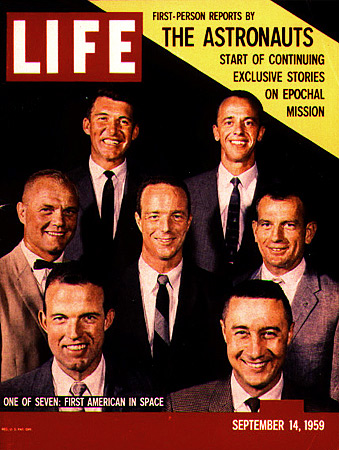
The Right Stuff
 "The Right Stuff" (Philip Kaufman, 1979) Something of a miracle. Not just getting into Space. Making a movie of Tom Wolfe's distillation of the effort from the days of breaking the sound barrier post-WWII to the age of astronauts. Wolfe stripped away the Iron Curtain of PR flakkery to tell the story of the men who put their hides on the line to go farther, faster and higher than the earth-bound. And do so on "live" TV. Or in secret during a race for Space with the Russians. Wolfe opened the guarded doors of the test-pilot fraternity and told tales and punctured myths, while simultaneously creating myths anew—of the laconic "other" quality of pilots that pulled them out of scrapes, channeled their fear and kept them climbing the pyramid: the indefinable, ephemeral "right" stuff.
The book was optioned for the movies, but was considered too unwieldy and too expensive to turn into a film. But Philip Kaufman, one of the up-and-coming USC film-school grads took a bare-bones, low-tech approach to the effects, combined it with stock footage of the well-documented space program, and combined it with an irreverent sophomoric humor that combined Wolfe's myth-busting with SNL spoofery. But just as Wolfe found a new glory glowing inside the heart of the flummery he was burning away, Kaufman found interesting cinematic ways to illustrate those truths and celebrate the gung-ho heroism of a team of competing fly-boys. Chuck Yeager is a horse-riding cowboy of Western tradition riding in to town to take on a challenge. John Glenn's description of "fire-flies" while in orbit, is tied to the bonfires of Australian natives praying for his safe return. And in this stunning sequence, two disparate incidents from Wolfe's book unite the newly-beknighted Astronauts with their spiritual mentor and comrade-in-wings.
It starts with the arrival of a new test-jet—The Lockheed NF-104 Starfighter, which Yeager believes can break a record for altitude. With his wing-man, Ridley, he does an inspection of the jet working his way back to the exhaust port, which Kaufman pulls in on. Kaufman takes us into the dark-hole of the jet-engine, and inside we hear echoing voices and whistles and the sound of drums, and before we can register the change, we're not in the negative space of the engine anymore, we've transitioned to another channelled tube of energy—we're traveling through a tunnel riding atop a limousine from an astronaut's perspective...
 ...as President Lyndon Johnson stands on a flag-draped stage and welcomes the seven Mercury astronauts to an out-sized barbecue in Houston--the new home for the Manned Space Center, as well as the astronauts and their families. Their homes, their furnishings are all paid for by the Houston developers who are benefitting from Johnson's earmarks. The Mercury 7 are living the good life, while the Man who Broke the Sound Barrier makes a run for space.
 Both these incidents happened and are mentioned in Wolfe's book, but they took place months apart, while Kaufman has them happening simultaneously. To what purpose will become clear later, but in the meantime, we follow Yeager (Sam Shepard) as he vaults into the sky, his pilot's gear now more closely resembling the astronaut's flight-suits.
 And in one spectacular shot, we see space bend and warp as we approach the feathery layer of a cloud-ceiling, then go through it...
 ...and the picture fades to an incident from that barbecue--an odd detail that Wolfe found funny and sad and a bit pathetic, but Kaufman turns into visual poetry. For some reason, the Houston event organizers chose as one of the entertainers stripper Sally Rand, now in her 60's, doing her famous "fan-dance" that had wowed 'em at the 1933 Chicago's World Fair. But that was thirty years previous. And the elderly Rand tottered around the stage. To what end, no one can say.
 But Kaufman takes that incident and marries it with a running theme throughout the film. The Moon has been a beckoning image throughout "The Right Stuff," and now, as the clouds that Yeagher is punching through become the delicate feathers of Sally Rand's fans, she dances to an orchestral version of the melancholy "Clair deLune," by Debussey.
And it's lovely.
 Kaufman stays on his images of empty space and feathers and lights, then to shots of the astronauts and their wives reacting to the irrelevence and embarrassment of it all. And then, something strange happens....
 John Glenn (Ed Harris) looks over at fellow astronaut Alan Shepard (Scott Glenn), with whom he's had a contentious relationship...
 ...and Shepard's not even watching the stage-show. He's lost in thought...
 ...as is Deke Slayton (Scott Paulin).
 Glenn turns to look at Gus Grissom (Fred Ward)...
 ...who is already looking at him.
 Grissom turns and looks at his buddy, Gordon Cooper (Dennis Quaid)
 ...who is his usual grinning self, but he's subdued. We transition back to Sally Rand...
 ... and a blaze of klieg-lights to Yeager trying to "punch a hole in the sky."
 Yeager reaches top altitude, then his engines give out and he's given one tantalizing glimpse of the stars in space...

 ...before his fighter-jet begins to rapidly tumble back to Earth.
 Unable to bring it under control, Yeager makes a fiery ejection...
 ...and Kaufman holds on him--trailing smoke, because as we'll see his helmet is on fire--and we watch his long, long fall through space as he tumbles through the silence--a modern Icarus...


 ...who disappears into the clouds.
 The clouds fade back to the feathers of Sally Rand.
 ...and to the astronauts, who are somewhere else.
 Scott Carpenter (Charles Frank) begins to look pensive.
 Walter Schirra (Lance Henriksen) acts like he hears something...
 Glenn, on edge, looks to Grissom and Cooper...
 Grissom is wary...
 Cooper, head bowed, tentatively looks up...
 as does Slayton...
 And Shepard cranes his gaze to the ceiling...
 We transition to Sally Rand, and on the soundtrack we hear a distant boom.
 With a hard cut, we're back in the California desert.
 Reverse angle to an ambulance approaching in the shimmering desert heat.
 The driver points ahead "Sir? Is that a man?"
 Amid the smoke and heat-waves, a silvery shape emerges.
 "Yeah," says Ridley (Levon Helm), "you bet it is."
 As the music swells, Yeager carrying his parachute, his face burned, but still chewing gum, approaches the ambulance.

Yeah. You bet it is. It's great film-making, too. And a brilliant sequence by Kaufman that shuffles real time a little, but makes a point about the competitiveness of air-men, giving way to a brotherhood. All of the men in the sequence have competed with each other as well as Yeager to be "at the top of the ol' pyramid," going faster and higher than any person before. The astronauts were test-pilots competing with Yeager, then signed on to become astronauts, "spam in a can" in the test-pilots' jargon, achieving a fame Yeager never would...until Wolfe's book...and this movie
Now at this Houston fete, the astronauts "tune in" to Yeager's struggle, as if linked. Backed by an echoing ochestral version of "Claire DeLune," it is haunting and haunted, communicating viscerally, if not literally, of the bond between the men—Indefinable.
"The Right Stuff."