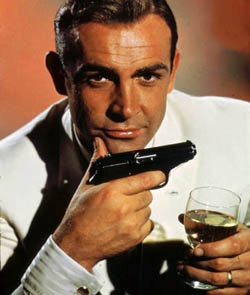
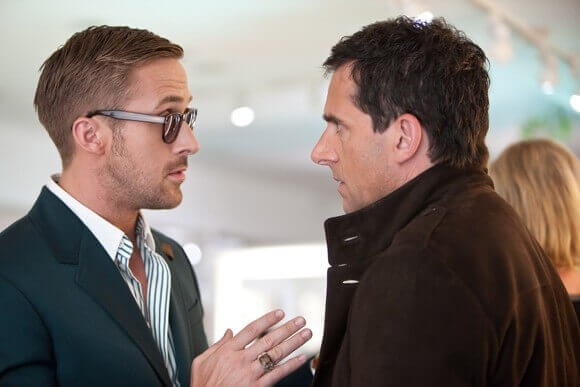
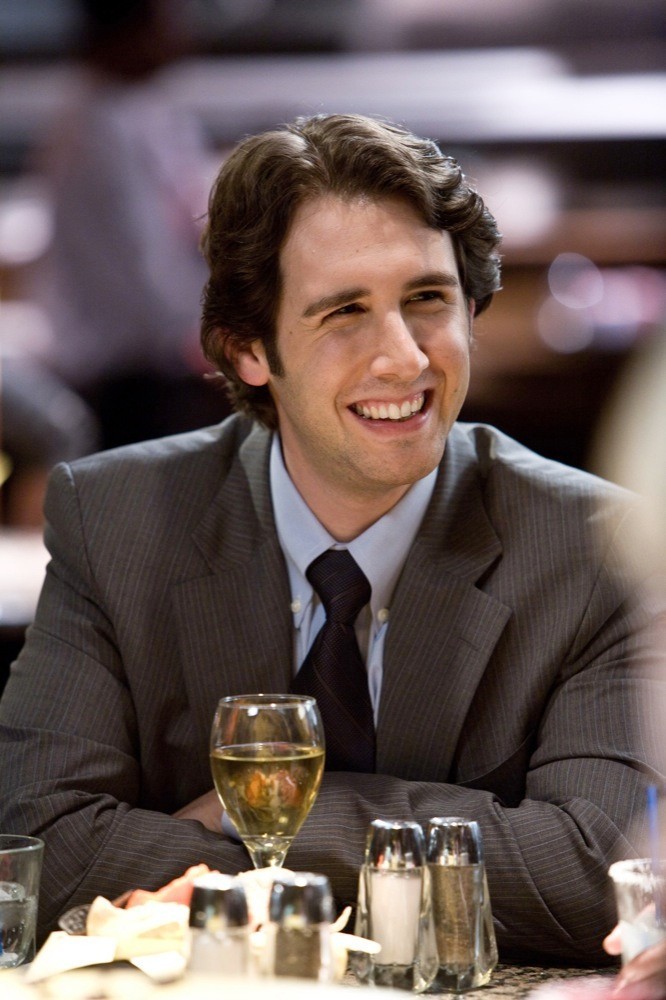
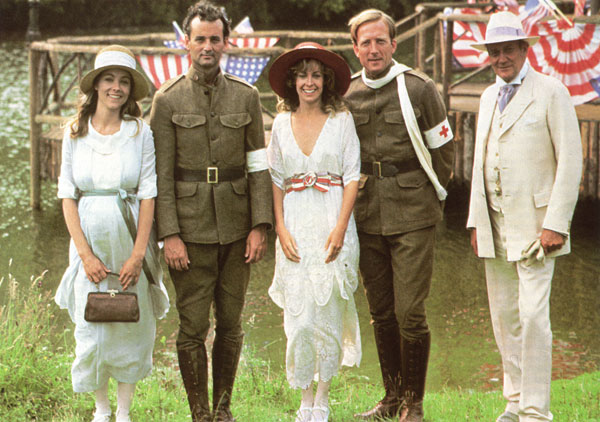
The Razor's Edge (Edmund Goulding, 1946) "The Razor's Edge" is a favorite book of mine, one I was inspired to read after a disappointing film adaptation, starring Bill Murray, who stood out from an otherwise respectful version like a howling sore thumb. But, it had been filmed before, in 1946, under the tutelage of producer Darryl F. Zanuck and directed by Edmund Goulding, only two years after the novel's first publication.
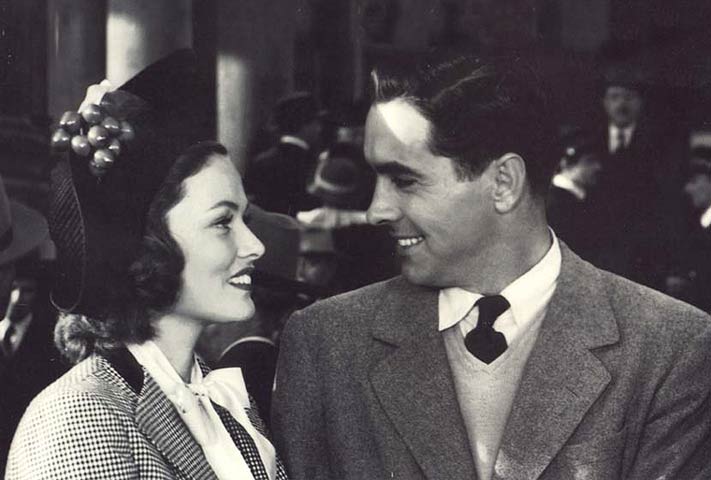
W. Somerset Maugham's book documents (in absentia) the travels of Larry Darrell (played in 1946 by Tyrone Power), who returns from pilot duties during World War I,* deeply affected by the death and devastation he's seen, and takes a period of time to "find himself"—a lot of time. This seems odd to his high society friends, especially the family of his fiancee, Isabel (Gene Tierney), who can't seem to understand why Larry won't settle down, put his nose to the grindstone and make sure that she gets to live in the manner she's accustomed to. Larry travels to Paris, ostensibly under the supervision of Isabel's prissy Uncle Elliott (Clifton Webb) (who does NOT approve), but Larry would rather live the life of a bohemian, working menial jobs. After a year's separation, Isabel comes to visit and is appalled by Larry's simple living conditions. She breaks off the engagement after taking one last attempt to seduce Larry back to her way of thinking, then returns to Chicago, where she marries Larry's millionaire friend.
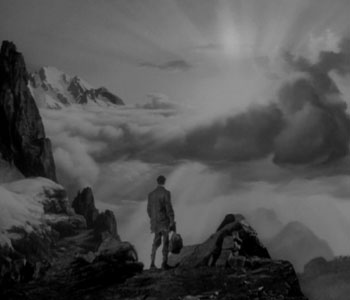
Larry continues his life in Paris, still searching for answers. Eventually, he makes a pilgrimage to India,** where, after studying and living a monk's existence in the Himalayas, he achieves a measure of happiness, finds his answers and returns to Paris to find that Isabel and her husband have lost everything in the 1929 crash, and are now living off her Uncle's charity. His old friends have all suffered various tragedies and are at a loss how to cope...and Isabel still loves him, complicating everyone's lives.
The Goulding version hews fairly close to the book, smoothing the rough edges that might have ruffled the feathers of the Hays Office, and implying what could not be said in Maugham's book—Uncle Elliott's gay, Isabel is a too-willing adulteress, and their mutual friend Sophie (Anne Baxter), who suffers her own tragedies, has turned to drink and prostitution. Larry would seem to be the answer to everyone's problems, but he knows that the problem lies in living in a material world and the cheapening of human life to get ahead. And the 1946 version also includes one character that the '84 version excluded—the author (played by Herbert Marshall). Maugham wrote "The Razor's Edge" as a roman a clef, an observance as he made his way between world wars through society as a successful author, settling in Paris and the Riviera. The post-war version relies a bit too heavily on him, while the John Byrum version with Murray manages to make due without. The author becomes a sounding board in the book and first film, revealing characters' innermost thoughts—a little too forthcoming, actually (one should never get too cozy with an author)—and revealing a little too much about what they're feeling.
Power is a good Larry, but not a great one (whereas Bill Murray could have been great, if his propensity for ad-libbing goofily hadn't gotten the better of him). It's a little too hard to distinguish just what about him changes from "troubled" to "enlightened," other than a little too much intensity in the eyes. Not the greatest of emoters, his war-weary Larry seems merely peeved and a shade brittle, but his post-pilgrimage Larry seems not so enlightened as slightly moony when reflective and somewhat superior and self-satisfied when things go his way. Gene Tierney's Isabel seems far more shallow than the actress is capable of and when she turns vindictive, its done with a raising of the eyebrows and a haughty air—it's more a pose than a performance (as opposed to Catherine Hicks who wasn't afraid to make Isabel conspiratorial. Clifton Webb has as much fun with Templeton as Denholm Elliott did (a role John Gielgud coveted), and Anne Baxter has some very good moments as Sophie, although her theatricality gets the better of her in the more demonstrative scenes (it did win her an Oscar, though), but she doesn't hold a candle to Theresa Russell's "fragility with a spine" Sophie.
One comes away with no definitive screen-version of "The Razor's Edge:" you'd like to take the supporting cast of the 80's version, find a new Larry and keep the later's travel footage as a replacement for the pristine (and wholly set-bound) ashram from the '46 version (were they trying to evoke Shangri-La from Lost Horizon? Why does it look like a Hollywood hotel lobby designed by Frank Lloyd Wright?). The dissatisfaction is high with both, with flaws impossible to overlook, but there is a great movie in there somewhere, and each film supplies some answers to what that might be like.
The pilgrimage continues.
* In the Murray version, he was an ambulance driver.
** In the the latter version, he goes to Tibet.


 President Merkin Muffley: Hello, Dimitri?
 Muffley: Listen, I can't hear you too well. Do you suppose you could turn the music down just a little? Oh, that's much better. Yes, fine. I can hear you now, Dimitri, clear and plain and coming through fine. I'm coming through fine, too, eh? Good, then. Well, then, as you say, we're both coming through fine. Good.
 Muffley: Well, it's good that you're fine and I'm fine. I agree with you, it's great to be fine. Ha ha ha ha.
 Muffley: Now, then, Dimitri, you know how we've always talked about the possibility of something going wrong with the Bomb.
 Muffley: ...The Bomb, Dimitri. The Hy-drogen Bomb. Well, now what happened is, um, one of our base commanders, he had a sort of...
 Muffley: ...we-ell, he went a little funny in the head. You know, just a little...funny...
 Muffley: And he went and he did a silly thing. Well, I'll tell you what he did: He ordered our planes....to attack your country. N'--
 Muffley: ...well, let me finish, Dimitri. Let me finish, Dimitri.
 Muffley: Well, listen, how do you think I feel about it? Can you imagine how I feel about it, Dimitri? Why do you think I'm calling you, just to say "Hello?"
 Muffley: Of course, I like to speak with you! Of course, I like to say "Hello!" Not now, but anytime, Dimitri!
 Muffley: I'm just calling to tell you something terrible has happened....It's a friendly call, of course, it's a friendly call. Listen, if it wasn't friendly...you probably wouldn't have even got it!
 Muffley: They will not reach their targets for at least another hour. I am...I am positive, Dimitri. Listen, I've been all over this with your anbassador, it is not a trick! Well, I'll tell you...we'd like to give your air staff a complete rundown of the targets the flight plans and the defensive systems of the planes. Yes! I mean if-if-if we're unable to recall the planes I'd say that, uh...well, uh...We're just gonna have to help you destroy them.
 Muffley: I know they're our boys. Alright, well, listen now, who should we call? Who should we call, Dimitri? Wha..? The People...sorry, you faded away there.
 Muffley: The People's Central Air Defense Headquarters. Where is that, Dimitri? In Omsk. Right? Yes? Oh, you'll call them first, will you? Uh-huh. Listen, do you happen to have the phone number on you, Dimitri? We..What? I see, just ask for Omsk Information. Ah.
 Muffley: I'm sorry too, Dimitri. I'm very sorry. Alright, you're sorrier than I am, but I'm sorry as well! I'm as sorry as you are, Dimitri.
 Muffley: Don't say you're more sorry than I am, because I'm capable of being just as sorry as you are. So, we're both sorry, alright? Alright!








.jpg)