 The Story: Harmony (noun): 1. agreement; accord; harmonious relations. 2. the simultaneous combination of tones, esp. when blended into chords pleasing to the ear; chordal structure, as distinguished from melody and rhythm.
One of the things missing in most modern movies these days (possibly because audiences might find it "corny") is "the sing-along," where a group of characters participate in a collective musical performance that shows they can work together as a group to a common purpose. Corny? Maybe. But it's a great audio-visual short-hand for communicating a dramatic idea—the resolving of differences. Just as an orchestra can combine rhythm, brass, and strings to a unified whole, so, too, can disparate personalities and talents come together to create a sum greater than the parts. We see this work in music groups all the time, and there's no more obvious example in the movies than the Beatles documentary Let It Be, where the four writer-musicians bicker and back-bite, but manage to put it all together in their final concert on the Apple Studio roof-top, a meshing performance that shows just how good they could be.
This month, in our "Don't Make a Scene" section, we'll present four sing-alongs from movies that display dramatically, through music, the putting-aside of differences in the creation of a unified effort—harmony.
And as music is the important element here, and really doesn't work one note at a time, we will temporarily dispense with the usual frame-by-frame breakdowns, and present the scenes in their full 24 frames per second vitality.
This one is the simplest of all. Two people, just met, one a busker (Glen Hansard), the other, a street flower-seller (Markéta Irglová), both musicians, each interested in the other's music. She's heard him play on the street and likes his songs. He follows her, intrigued, when she says she plays piano, but only has the opportunity to at a local music shop.
So, hearing her play, and impressed, he wants to see what she can add to a song of his he likes. It, "Falling Slowly," eventually won the 2007 Academy Award for Best Song. But the scene, before you hear the song that would eventually become familiar, evolves. She gets the music, he explains the chords (to which she replies, matter-of-factly, looking at his fingers on the guitar neck, "I can see"—my favorite line of the film), and they begin. Simply quietly, following the chords first, but, eventually, together, exploring the song's possibilities on their own.
It is vulnerable, tentative, then courageous and beautiful. They get swept up in it, both a little surprised at what they can accomplish together, on something and an arrangement so new. It's the start of an unspoken love affair—not completely unspoken, the only declaration is in Czech, which he doesn't understand (and as it isn't sub-titled, neither do we—nice touch, that)—that will have an ending, but will not resolve. It will be a brief moment in time, when things are special, and everything is good, like a good song performed, in memory an echo.
It is part and parcel of a nearly perfect little movie, with a single-word title that reflects the melancholy, transitory nature of the encounter, its uniqueness in time, and the special pleasure—and pain—of its pastness: Once.
Brilliant.
Sunday, January 30, 2011
Don't Make a Scene (Sing-Along Month Edition): Once

Friday, January 28, 2011
I Love You, Phillip Morris
 "The Many Lives and One Life-Term of Steven Russell"
or
"Hold me, Kiss me, Make me Write Bad Checks..."
I can see why Jim Carrey wanted to do this, although the box-office returns might not be up to the block-busting weekend standards his films are used to. The writing team of Glenn Ficarra and John Requa (who also directed) had previously written one of the most ribald Christmas movies ever made—Bad Santa (they also wrote the first Cats & Dogs, but let's not stray there). For anyone who doesn't like Christmas movies, Bad Santa was a tonic, a mean-spirited slash & burn of every sentiment and cliche associated with the Holiday. It's so black-hearted that, to this day, it is tough for me to watch a Christmas movie now with any sort of innocence, so caustic and toxic is that movie. That it ended up with a jaded heart of gold somewhere amidst the bloody gristle was an astonishing accomplishment, and made me anticipate what they might foist on the innocent audience next.
Their latest, I Love You, Phillip Morris, has the proverbial "something to offend everybody." And it is relentless in its attempt to shock. That the story is, essentially, true (and chronicled in the book "I Love you, Phillip Morris: A True Story of Life, Love and Prison Breaks" by Steve McVicker, about the mis-adventures of Steven Jay Russell) only proves the adage that truth is stranger than fiction. Especially when the truth involves a lot of fiction. The writer-director team only have to find punch-lines in the various scenes in order to push it into the comedy realm. Absurdism rules. Love will do that to you.
The film begins with Steve Russell (Carrey) flat-lining in a hospital bed, his life passing before his eyes, and thus, too, through the projector aperture. His normal life turned upside-down when he learns that he's adopted, he starts living his life as a non-person, as one who doesn't exist. But, existing with a 163 I.Q. means you have a lot of time on your hands to think things up to do. It's a bit like the wondrous aspect of Groundhog Day—what would you do with the time you have if every day had a "Reset" button at the end? Steve Russell has his own "Reset" button, and just one life to live, so he spends it as a completely self-absorbed unit, grabbing at the possibilities of life by any means necessary, including lying, cheating and stealing. A complete sociopath, the only thing limiting him is what he hasn't learned to get away with yet. He starts as an ordinary family man, becoming a policeman, a church organist and living a lie. Then a near-fatal car-crash at a crossroads snaps him into an epiphany: he's going to live the life he's always wanted out in the open, as long as how he does so, stays in the background. He openly leads a gay lifestyle, leaving his wife and child, bankrolling everything through frauds of one type or another, until it all lands him in prison.
Then, the real fun begins.
For the secret of Steven Russell is to find the weak links in society's infrastructure and take advantage of them. In prison, he meets and falls in love with Phillip Morris (Ewan McGregor), who might uncharitably be called a 'weak link"—as he "sees the good in everybody," and for Russell, that's finding his soul-mate, easy to admire and easy to be false to.
So much lying, deception, robbing, stealing, impersonation and chicanery goes on in this film that, finally, it is a bit numbing. By the time Russell pulls off his biggest deception (and it's a doozy, not only in the difficulty of pulling it off, but in the harm that it can inflict), nothing surprises...or shocks. So much time has been spent in the red-line of your sensibilities, that your meter emerges pretty much pegged. It's going to take a lot of time looking at puppies in order to Brillo the sourness out of your skull.
Except...I Love You, Phillip Morris is kind of sweet. Despite being a lying sack, Steven Russell is a pretty devoted guy, going to extremes for those he loves, and...yes...even dying for them. It's horrifying. But, its heart is in the right place. Ficarra/Requa can be counted on to find the silver linings in the dark clouds, as well as peeing in the punch-bowl. Every scene has a 90° swerve on what its about—sweet to sour, darkness to light. One of my favorite scenes has Phillip bribing a cell-neighbor to play "Chances Are" (Johnny Mathis, natch')—because the thug has the only cassette player—so that he and Steven can dance and snuggle in the cell they share. We watch as they dance slowly in silhouette, the song warbling through the cell-block until the guards yell "lights out" and start screaming at the thug to turn off the music, which he refuses to do. Pretty soon, there's a small riot outside the cell as the guards run in enmasse, beating and tasering the yelling music-provider, merely heard in the background, as we focus on Steven and Phillip lost in their dance and each other—the world has gone away.
Nice. Creepy and violently funny, but nice. And smart. And tells you all you need to know about Steven and Phillip's devotion. The film-makers got their act down, but the yin and yang of extremes don't help Carrey and MacGregor, who struggle to maintain a consistent tone in their characters scene-to-scene. At times, Carrey is so arch you wonder how anyone could be conned by this cartoon character, and MacGregor veers from teeth-jarringly sweet to pathetically whiney. But, when the comedy turns to drama, the two seem to snap into place to make it work...as a real scene, which tends to nullify the comedy that has gone before. It's a tightrope-walk to be sure, but there's an awful lot of nervous-making swaying going on.
I don't say this very often, but this is one of those movies you worry about recommending because there is so much material that could give frail audiences "the vapors," but if you steel yourself—maybe get a speeding ticket on the way to the theater, pay your taxes that day—you might have a darkly good time.
I Love You, Phillip Morris is a Matinee.


 |
| The Real Steven Russell (I think) |
Thursday, January 27, 2011
Our Man in Havana

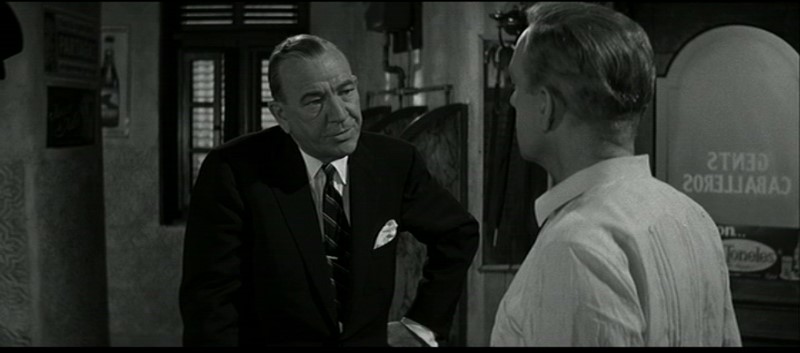
Our Man in Havana (Carol Reed, 1959) A fascinating serio-comic counter-point to author Graham Greene and Reed's post-war classic (made a decade previously) The Third Man. Reed's camera still swoops (courtesy of d.p. Oswald Morris), making sure that the Cinemascope frame is filled to the corners with detail, and the dark streets of Havana (filmed after the revolution and with the permission of Castro) at night, could be mistaken for post-war Vienna. The sun shines brighter, though, and so the internecine work of spies is done in the relative low-light of bars and brothels.
Greene's book was a cynical look at how Intelligence forces can show a distinct lack of intelligence when confronted with mis-information, but it is Reed's nifty idea to cast it with comedic actors, though not always playing for laughs. With such as Burl Ives, Noel Coward, Ralph Richardson, Ernie Kovacs (he plays a corrupt Cuban police official straight, but it is still funny) and Alec Guinness, it seems more a comedy of errors: British ex-pat Jim Wormold (Guinness) is scraping by a living selling vacuum cleaners in Havana, while his daughter (Jo Morrow) is developing a taste for the expensive horsey set—something that could be provided by Captain Segura (Kovacks), who has an eye for the blonde girl. Wormold has other plans for her, like an expensive Swiss boarding school. But where to get the money?
He is approached one day by Hawthorne (Coward, out of place in his dark suit and bowler hat in the mid-day sun of Havana) of the British secret service—or, as he is known, Agent 29500—to set up a bureau station for the service. For Wormold, it is extra cash, an all-expenses paid membership to the exclusive country club, and a more lavish life-style, all for keeping his daughter close. All the Service wants is results, which Wormold has trouble setting up—he is, after all, only a vaccuum cleaner salesman. Soon, he starts filing bogus reports, recruiting strangers as fellow agents (without their knowledge), building his station in importance to the delight of Hawthorne and his superior 'C' (Ralph Richardson).
However, becoming an important secret agent draws attention. He is soon assigned a secretary (Maureen O'Hara) by his superiors, wanting to build him up, and targeted for assassination by his enemies, wanting to shut him up. Doesn't matter if the information he's sending is all wrong; with so many resources at his command, he's sure to dig up something sooner or later. Scrutinized from both sides, the spy-game stops being so rewarding, and turns downright dangerous.
It's all played with a bit of a wink, with great comic actors under tight rein to let the material be funny without goosing it. Definitely worth seeing for the literate script, Reed's classic direction and the fine performances. John le Carré would later use the basic subject matter for his book (and subsequent John Boorman film) The Tailor of Panama.




Wednesday, January 26, 2011
The Lucky Ones

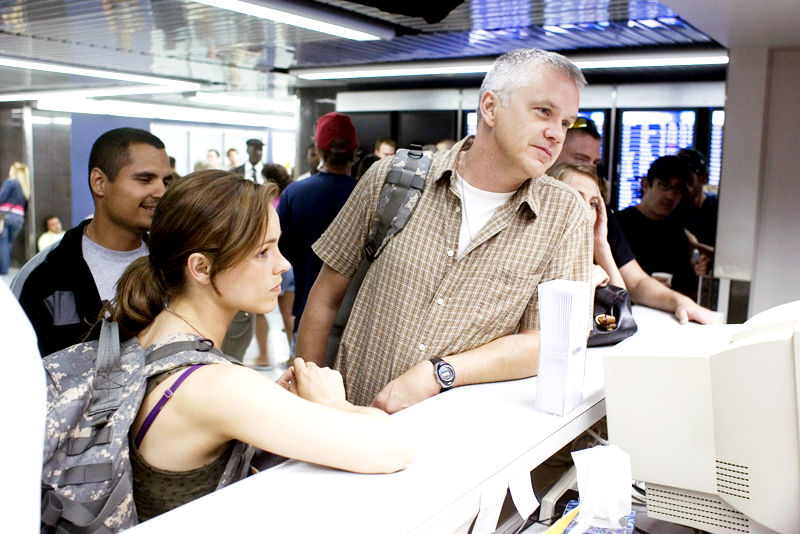
The Lucky Ones (Neil Burger, 2008) Every war, every "police action," seems to have its "re-patriation" film. World War 1 had The Razor's Edge, 2—The Best Years of Our Lives, VietNam—Coming Home. The Lucky Ones involves returning troops in the ongoing Iraq War, different from their cinematic (and real) fellow troops in that they're not coming home. They're on a 30 day leave before going back as part of the "stop-loss" program. So, this takes place as more of an interruption to their service. What happens when the environment is not so regimented, or as dangerous. The three come back from the war altered, and all have specific goals in mind, all of which change when they actually touch boots to ground in the States.
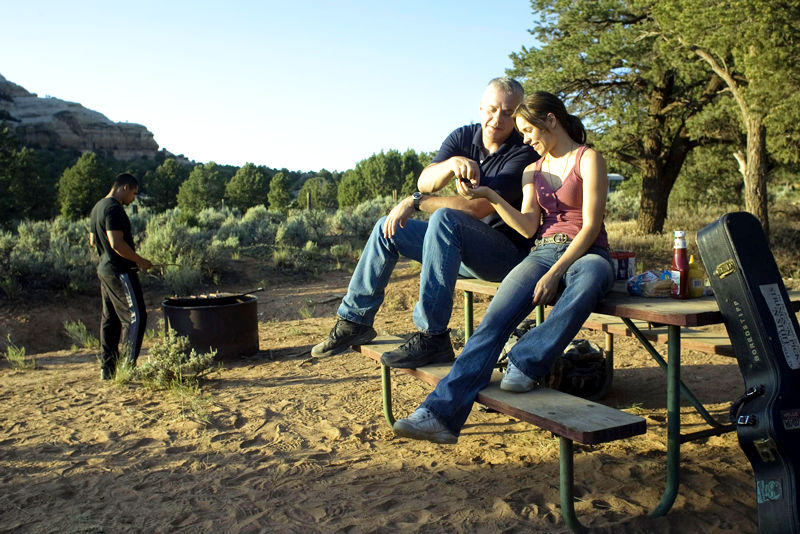
It follows three vets—Cheaver (Tim Robbins), an older sergeant just off his third and last tour, T.K. (Michael Peña), wounded, but gung-ho about going back, and Colee (Rachel McAdams), a neophyte coming back with a mission and a hole in her leg. They're all damaged: Cheaver is psychologically out-of-whack; T.K.'s purpose is to get back to his fiancee to see if "his equipment" still works after being wounded; Colee wants to find the family of the guy she hooked up with there and return his guitar to them. Meeting on the flight state-side, they decide to pool resources to get where they're heading. But, like any road-trip, there are detours, changes of plan, and the occasional loss of bearings. Stability is not to be found at home for any of them, and the trip only reinforces the perception that their fellow soldiers are the only ones who've "got their back."
Some of the episodes reach a bit, while some feel natural, and mostly the film avoids easy answers—less than it avoids mention of the war, except for a brief opening scene. The Lucky Ones is less concerned with Iraq, than it is with the soldier's plight, caught in the demilitarized zone of not fitting in either here or there. Putting them on the road—in transit—reflects that sense of rootlessness (as most road-movies do) that these perpetual soldiers must have that is unique to this era's soldiers. The film never really tackles that subject head-on, as it almost has a duty to do, instead relying on the various "missions" and destinations to define the characters. Ultimately, the film has nowhere to go once those stories are used up, and the film ends on a logical melancholy note.
Where it shines is in the performances. As with the war, Burger and his co-writer Dirk Wittenborn are quiet about the soldiers, presenting them as rather independent pawns in a much bigger game, their choices on the road sometimes unconventional, and not S.O.P. But McAdams, Pena, and especially Robbins (this is some of his subtlest work in the past decade and nice to see), breathe a likable humanity into their characters, buffering the moments of manipulation and contrivance. You like these guys and want them to succeed, even if they are a bit unreadable—enough so that some of their choices surprise, even deep into the movie. That The Lucky Ones manages to do that is no small accomplishment.



.jpg)





Tuesday, January 25, 2011
The Way Back

"Strangers in a Strange Land"
or
"Every Journey Begins with the First Steppe"
A new Peter Weir film is something of an event. The Aussie director of Picnic at Hanging Rock, The Year of Living Dangerously, Gallipoli, The Truman Show, Witness, and Master and Commander makes meticulous, thoughtful films of ambiguity and great beauty, throwing civilized men and women into clashes of culture (frequently more primitive) exploring the impact, with an eye towards the rough, otherworldly beauty of this world. Along the way, you learn a lot even if the movie does not draw to a dramatic or philosophical conclusion.
So, with little fanfare, here is The Way Back, Weir's latest film, one that has been optioned many times since its source book, Slavomir Rawicz's "The Long Walk: The True Story of a Trek to Freedom," was published in 1956. The veracity of the tale has been questioned a lot in that time, but the evidence is clear: four emaciated men walked into an Indian village, saying that they had walked from a Communist gulag in Siberia across the Gobi Desert and the Himalayas to freedom, a journey on-foot of 4,000 miles. One could speculate—for the length of such a journey—why it had never come to the screen before: too depressing—but think what it would do for soda and popcorn sales!; Elvis wasn't interested, indeed, what star would take on such a rugged movie, Burt Lancaster's brief interest notwithstanding; the movie has a lot of explaining to do about socio-political situations; the Russian market might not be too pleased with the film, and on and on. Weir made it (reportedly for less than $30 million, which seems incredible), but so few studios were interested in it that it almost went straight to video...which would have been a shame, as this is one of those movies demanding to be seen on a big screen.
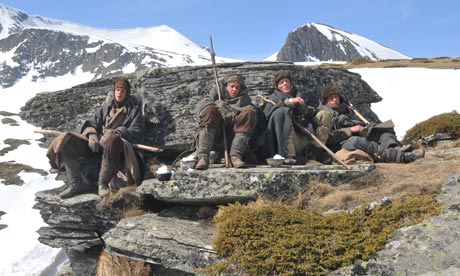
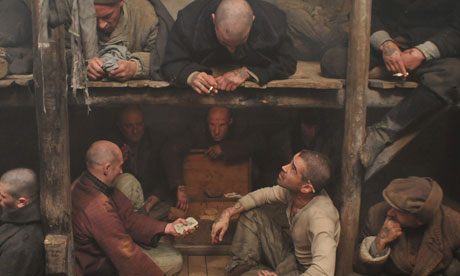
Janusz (Jim Sturgess) begins the film under interrogation in occupied Poland. The year is 1940. He has been turned in (reluctantly) by his wife under torture, and he is sent to a Soviet gulag in the mountainous regions of Siberia. After a period of learning the ropes (and the whips of the guards and the barbed wire of the camp), he becomes a part of a loose group of prisoners of differing skills and supplies to make a fast surgical escape from the gulag and make their way to Mongolia. Based on a loose plan of prisoner Khabarov (Mark Strong), they plan to make it to Lake Baikal, following it to the Sino-Russian railway. Their supplies will run out in mere days, but Janusz is convinced they can live off the land, walking the entire way. Among the group of escaping stragglers are "Mr. Smith" (Ed Harris)—"First name: Mister"—a particularly mysterious American (he tells Janusz, "you have a weakness I can use: kindness"), and, as it seems all movie escape attempts must have, a plays-by-his-own-rules maybe-criminal named Valka (Colin Farrell). The group begins suspicious of each other, but soon forms a close-knit, surprisingly democratic structure, sharing ideas and resources, voting when they're at a crossroads—despite the occasional individual insurrection.
Watching the movie is a slog. At 2 hours, 20 minutes, with the principal characters pushed to their endurance, the film feels longer than its running time, but one is never tempted to do a watch-check. The Way Back is one of those films that keeps you guessing, intrigued and involved every minute, like you were involved in the long walk, craning to see what is around every corner. Weir keeps the pace moving quickly, cutting scenes briskly from one episode to the next, so the film develops a natural rhythm.
But, it's the director's eye for detail—as always—that is striking, with scenes of stark, natural beauty that astonish: taking refuge in ancient caves, the camera pans up, following a bedraggled Mr. Smith's gaze, to two large holes in the ceiling, like the angry eyes of God; walking up a scrabble hill, Weir directs our view up and over the weary travelers to a screen-stretching shot of the expansive Gobi desert; at one point, they find a single solitary structure—a gate with no walls—absurdly marking their goal, while announcing another set-back.
It is a grueling adventure story with fine performances all around, interpreted through Weir's talent for keeping things real, even when they turn startlingly surreal. Go prepared for a tough movie, but a satisfying one, that, like all escapes, becomes a journey of the individual will and spirit, covering all manner of obstacles in physical space, mental discipline, and the longest journey...of time.
The Way Back is a Full-Price Ticket.




Sunday, January 23, 2011
Don't Make a Scene (Sing-Along Month Edition): Moulin Rouge!

The Story: Harmony (noun): 1. agreement; accord; harmonious relations. 2. the simultaneous combination of tones, esp. when blended into chords pleasing to the ear; chordal structure, as distinguished from melody and rhythm.
One of the things missing in most modern movies these days (possibly because audiences might find it "corny") is "the sing-along," where a group of characters participate in a collective musical performance that shows they can work together as a group to a common purpose. Corny? Maybe. But it's a great audio-visual short-hand for communicating a dramatic idea—the resolving of differences. Just as an orchestra can combine rhythm, brass, and strings to a unified whole, so, too, can disparate personalities and talents come together to create a sum greater than the parts. We see this work in music groups all the time, and there's no more obvious example in the movies than the Beatles documentary Let It Be, where the four writer-musicians bicker and back-bite, but manage to put it all together in their final concert on the Apple Studio roof-top, a meshing performance that shows just how good they could be.
This month, in our "Don't Make a Scene" section, we'll present four sing-alongs from movies that display dramatically, through music, the putting-aside of differences in the creation of a unified effort—harmony.
And as music is the important element here, and really doesn't work one note at a time, we will temporarily dispense with the usual frame-by-frame breakdowns, and present the scenes in their full 24 frames per second vitality.
The past two weeks (with -Only Angels Have Wings and Rio Bravo), we looked at how the director Howard Hawks used group sing-alongs as a dramatic to show the mending of differences to get everyone "on the same page"—ebven if it is sheet music.
It doesn't happen so often anymore. Audiences don't have the patience for it, or don't "buy" it, although Paul Bettany and Russell Crowe may perform string instruments together in Master and Commander, or it may show up, inevitably in musicals, like the Broadway adaptations or Disney.
Or Moulin Rouge!
A lot of people don't like this one (with that hysterical "hate, hate hate" kind of dislike), and it's semi-understandable: it's silly, and high-flung, operatic in tone with the lowliest of song-forms, the rock-song. It's edited much too fussily and extravagantly (with attention paid to rhythm more than continuity) and it borrows from so many plots ("La bohème," hello!) and eviscerates so many rock songs that purists of any stripe yank out hanks of hair at the glee with which Baz Luhrmann and company pay no respect in this giddy kaleidoscopic romp of a movie-musical.
Yeah..."whatever." The artists got paid...and the result sure is fun.
What I'm looking at this week is the very complicated sequence that is known as the "Elephant Love Medley," which features Ewan McGregor and Nicole Kidman singing full-bore into each other's faces bits and pieces of songs from sources diverse as The Beatles (and Paul McCartney), Phil Collins, Elton John, David Bowie, Kiss, Dolly Parton, U2, Joe Cocker and Jennifer Warnes, and Harold Melvin and the Blue Notes. It's the classic call-and-response of rock numbers where the romantic and the cynic parry back and forth, and the two only come together to sing a song unchanged and unexpurgated at Paul McCartney's "Silly Love Songs." I remember rolling my eyes when that one came up, but its usage is fairly brilliant because it has both the romantic and cynical arguments built into it, then the two come to a meeting of hearts and minds (with a burst of heart-shaped CGI sparkle at the down-beat) to sing together in harmony. It works, both in the foreground presentation and the background drama, and spectacularly well.
Saturday, January 22, 2011
The Dilemma

I put up a snarky comment on the LNTAM Facebook page that nothing strikes fear into my heart so much as the words "A Comedy by Ron Howard." A little facetious, perhaps. I like Splash a lot and Parenthood may be my favorite of Howard's films. But the director of so many thunderously ponderous dramas does not have the necessary light touch,* at least these days, when it comes to directing comedy. Instead, he's dependent on the flip style of his stars (like Tom Hanks and Steve Martin) to rise above his heavy hand, and The Dilemma** has no such talent in evidence.
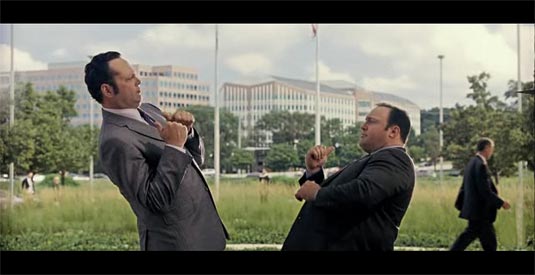
Not that Vince Vaughn and Kevin James don't try, but they're caught in a script so painful in its ramifications that you feel more sympathy for them than any mocking superiority, that might allow some amusement. It's a "Comedy-of-Errors" story, an "Incredible-Mess" scenario, and wants (wants, mind you) to say something about "the futility of good intentions" as well as "the value of honesty." But, then goes out of its way to show that one should just avert your eyes and walk away. The results, and the messages, are mixed.
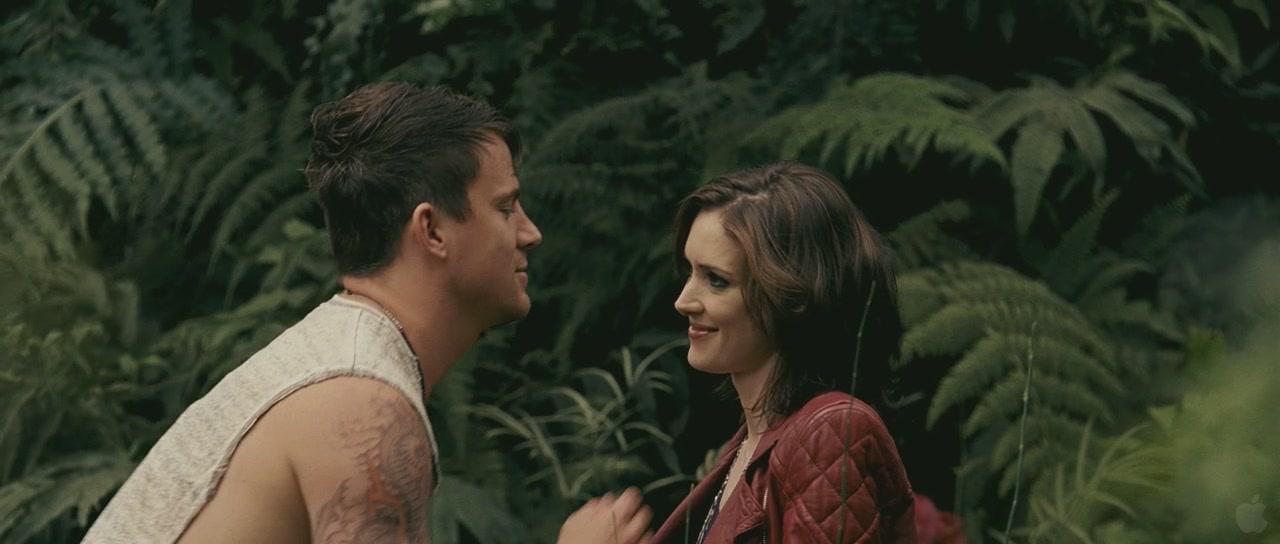
Ronny Valentine (Vaughn) is a gambling addict in denial. His struggles with the problem have previously derailed a relationship with Beth (Jennifer Connelly), and they're coping with honesty and trust issues, because its easier for Ronny to bull-shit over embarrassing situations with elaborate fictions rather than just stating the truth. Its a helpful business strategy for him in his business with Nick Brannen (James) in automobile development—their current scheme is to give electric cars the same vibrating muscle power as a gas-guzzler. But, lately, he's been thinking up elaborate ways to pop the question to Beth. During one of his scouting forays to an ultimate proposal sight, he is appalled to find Nick's wife, Geneva (Winona Ryder, welcome back), canoodling with a young dude (Channing Tatum), something that a) affects both his personal and business relationship with his college buddy and b) strikes at the core of his fear of entering into marriage with Beth. Not to add stress to Nick's life, he chooses to add stress to his own by NOT saying anything (except to the duplicitous Geneva, who is ready to make life VERY uncomfortable for Ronny). This leads to a series of mis-understandings and down-right lies that makes everyone in Ronny's life think that he's back to his old tricks of hiding the truth to cover his gambling habits...and, indeed, by taking the dilemma by the horns, he is gambling with his life and relationships and losing...badly.
Hilarity is supposed to ensue, but nothing approaching a smile cracked my face. Ronny's habit of lying, fudging and obfuscating makes him an easy mark for any sort of suspicion and the situation he finds himself in is somewhat Kafkaesque. The former gambler can't win for losing, and the thought that kept pin-balling through my mind was "since the creative Hail-Mary's of over-promising to his potential clients is so integral to his success, how can he effectively keep his salesmanship from entering osmotically his personal life?" (Honestly, that's what I was thinking). I found it tragic more than comic, and wondered how any person with an addiction can hope to live out a normal life...even after overcoming it.
Pretty depressing thoughts to arise from a comedy.
Maybe such thoughts wouldn't have popped up if I'd laughed more.
Or...at all.
The Dilemma is a Cable-Watcher.






* I'm omitting, of course, the bright spot of Ron Howard's recent comedy output, his shepherding of the TV-series "Arrested Development," whose crazed blunderbusting of the immaturity of the entitlement class was one of the better comedies of recent years.
** The most interesting aspect of The Dilemma is the spelling of its title. I'd always learned that it was spelled "D-I-L-E-M-N-A," and would frequently make a joke of too literally pronouncing it "dilem-na." But, these days spell-checks and my own (previously trusted) Random House Dictionary spells it with the double "m." However you spell it, it's a quandary.
Friday, January 21, 2011
The Fighter
 "Put Back What You Use"
or
"I-Yi-Yi-Yi-Yi'm Not Your Stepping-Stone"
The family that preys together, stays together. For the extended family of boxer Micky Ward (Mark Wahlberg), the preying is mostly internal although they have the illusion that they're getting the best of everybody else.
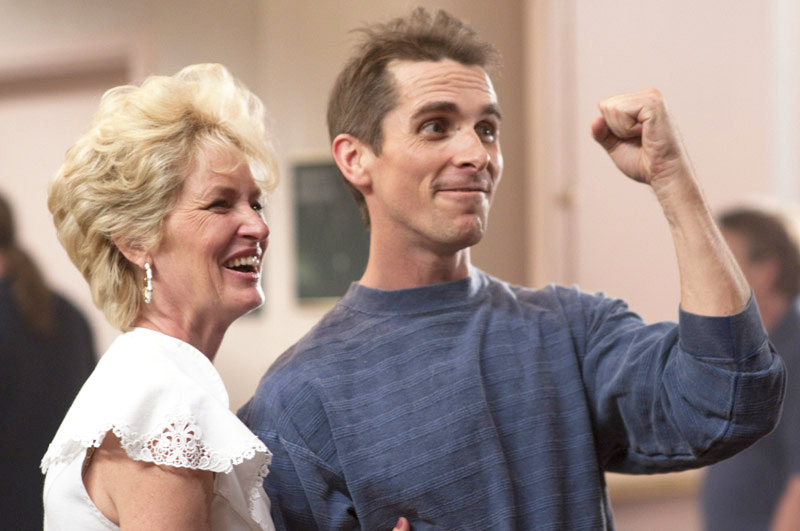
Micky is the younger brother (step-brother, actually) of Dickie Eklund (Christian Bale), former up-and-coming boxer, who had one glory moment: knocking down Sugar Ray Leonard in a match some years before. Now, he's a part-time trainer for his half-brother and a full-time crack addict. HBO is making a documentary about Dickie, who, despite his years and habits, still thinks he's on the comeback trail. But the pipe keeps him missing training sessions with Micky, leaving the heavy lifting to his trainer (Mickey O'Keefe playing himself). While the boys' lioness of a mother (Melissa Leo) manages Micky and enables Dickie, it leads to some bad decisions on matches for Ward, leaving him battered and disillusioned. The higher-ups at the sports networks have Ward pegged as a "stepping-stone," the fall-guy they use to advance other fighters in the winning circle to boost ratings, and that reputation follows him around his home-town of Lowell, Massachusettes. Ward's on a downward spiral, and any outside help is treated with suspicion. "You can't trust that guy. He ain't family." says Dickie, lounging in the limo his brother's money rented, sucking a beer.
Yeah. About that...
Perspective is all in The Fighter. And the boxing motif is the perfect setting. Micky is caged by his relations with his family, but every time he tries to strike out on his own, he gets attacked by Mom (playing the suffering card), step-brother hangs back and then takes his licks, and a coven of sisters and half-sisters are a unified greek-chorus of mom-ditto-speak. All you need to make this a match is a soft canvas to fall on, so Micky's a fighter always on the defensive. It's no reason he doesn't say much, but the eyes are far away, looking for a way out, looking for an opportunity to make a move, looking for anything.
"Your fahther looks at my ass, too, but at least he tawks ta me," says Charlene (Amy Adams, while not looking at him), the "bah-girl" Micky keeps staring at. Micky's so down for the count, he thinks even she's out of his league. And she might be, but she keeps showing up in his corner, alarmed at the punishment he's taking. When she questions it, Micky tells her everybody's not concerned. "Who's 'everybody?'" she asks. "My mother, my brother," he replies.
Yeah. About that...



The Fighter is a mostly true story. Ward is a better, tougher fighter than the movie wants to give credit for (the underdog status makes for a better story, I'm sure, but the dismissive commentary on the soundtrack during the fight sequences is the real thing...taken from the actual broadcasts...Ward was considered an underdog), and Dickie DID do all those things, but his timing was a bit better in real life. One wants to say that the best character arc in the movie is Dickie's, but that would be falling into the appreciation trap the movie sets up.

Because Micky's is the best character arc, although it seems a very simple Rocky-like success story on the surface. It's the approach that Micky takes with the forces in his life that are tearing each other apart which is the most interesting aspect of the story. Micky has been wronged by his family, but he won't discount their worth, or their place in his life, even over the objections of his new supporters—they have to find a way of dealing with each other and their conflicts, with or without him. For a fighter to take the stance that he does, reaching compromise with the warring factions in his life—to stand up and take control, risking everything from everybody—is a complete negation to what he does for a living and how he was raised.* The acting kudos are going to go to Bale (who is incredible, not to slight him) and Leo and Adams (who has two great scenes involving an intercom, and throws some nice punches in a chick-fight), but Wahlberg is the champ in this movie, with the tougher part (he trained for this through his last six roles), which he does almost purely physically. Micky is a man of few words, and not too many moods, but Wahlberg, restrained and less showy, does all of it with body language and does the difficult fight scenes, as well—in the latter taking a lot of body-blows that are not hidden with oblique camera angles or trickery. Wahlberg has worked with director David O. Russell before—in fact it was Russell's war pic Three Kings that first showed how good an actor Markey-Mark could be. Russell keeps the movie on edge with quick cutting and an improvised feel, even managing to make the final fight scenes nerve-rattling, despite the suspicion that one is going to see a typical boxing picture ending. But, his assurance with good material, performed by such a dedicated cast, manages to keep the movie on its feet, even at the final bell.


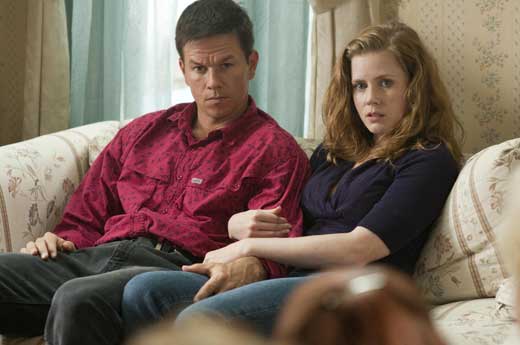


The Fighter is a Full-Price Ticket.
 |
| Micky and Dickie at the time of the events of the film |
Wednesday, January 19, 2011
The Day of the Jackal

The Day of the Jackal (Fred Zinnemann, 1973) Not to be confused with the lousy 1997 retread (rather than remake)The Jackal with Bruce Willis and a ludicrously accented Richard Gere "acting the maggot" that was dumbed down for its target audience (Assassinate General DeGaulle? Who's that? Make it the First Lady, instead).
This one actually is based on the Frederick Forsythe best-seller, and done in as nondescript a way as possible, almost a prettified documentary style lacking stars (although Michael Lonsdale and Edward Fox would emerge from it with solid character-actor careers), but adhering stoically to the plot and its amoral assassin (Fox), both as cold as they come.
The Jackal is teflon—never been photographed, only rumors to his existence, but, he is hired to take out France's President by a cadre of disgraced French Foreign Legion Generals. Their own clumsy attempt having, failed they turn to an outsider, anonymous, unknown but to have been involved with earlier assassinations. Because it is a once-in-a-lifetime "hit," he demands half a million dollars on which to retire.
The movie then runs along two parallel paths of suspense, as the Jackal arms, plans, and sneaks his way into France, while the authorities, led by the cool-as-a-cucumber-sandwich Lebel (Lonsdale), after hearing rumors about an attempt, try to find information within their own circle about a man that no one has seen.
They might as well be chasing a ghost. The Jackal assumes identities, habits and companions, then discards them like an unneeded skin as he moves inexorably to a point in time and place that only he knows, with murderous equipment well-hidden, to meet his target. He is one man. But, the police and government authorities are many, though at times it seems less an advantage. What is fascinating is the amoral methods of the two opponents, Jackal and Lebel. The former is a determined sociopath, leaving a trail of bodies that are found only days behind him, while Lebel, entrusted with the life of the most powerful man in France, has no qualms about disrupting those of others, refusing to let decorum, jurisdiction, or bureaucratic bumbledom stand in his way. He is, after all, fighting someone he doesn't know to prevent a crime he doesn't know where or when.
The script (by Kenneth Ross) is also morally ambiguous—not commenting either way on the actions of hunter and hunted. In one astounding scene (only in that it is not astounding at all), The Jackal discards a temporary lover in a manner that seems like an embrace, only her stillness informs that she is, in fact, deceased. Cerebrally chilly, and damned clever, the absence of stars might have made it less successful at the box-office (Michael Caine, Jack Nicholson, and Roger Moore were considered potential Jackals, but the producers went with the less-well-known Fox so he could "blend"), but The Day of the Jackal is still a film exercise in meticulous suspense, and becomes the novel well.


